Essays on Life

Greece
[[wysiwyg_imageupload:89:]]
THE RUINS OF VASSAE
The small car came bumping down the narrow cobblestone road. Suddenly it stopped, confronted by an imposing gray taxi advancing in its path. The irate cabbie's horn sounded savagely and he unleashed a series of oaths. Three more cabs lined up behind him and the passengers of the offending car tumbled out, laughing and chatting nervously in French. I watched in silence as the driver of their car, accompanied by a chorus of horns, backed up his small vehicle to a point narrow enough for the other cars to pass. They'did so, in great relief and evident disgust; they were in a hurry and had no time for misguided tourists.
The scene was not a street in New York during rush hour, but actually one in Plaka, the small, island-like section of Athens that is located under Greece's most famous site, the Acropolis. The traffic jam seemed incongruous in that classical setting; but the mixture is sadly not an uncommon one in Greece today.
"Progress" is slowly intruding on the land of Homer, and it is not unusual to see an old taverna existing side by side with the Grecian equivalent of an A & P. In Athens on a recent trip, such changes were very noticeable. Coca-Cola billboards littered the surrounding countryside. Down one street, a dough-brick house, which might have been a century old, was marred by a large sign over the 20th century storefront imposed on its main floor; "Union Chloride," said the English letters under the 17th century Venetian archway. And elsewhere, "Coke! It's the real thing." New skyscrapers, once a rare sight because of strict zoning ordinances, are now going up every day. And since the destruction of churches is forbidden in Greece, one such skyscraper has a small, decades-old church located in its lobby. Like the Venetian building with the Chloride sign and the blaring horns under the Acropolis, it, too, is a curious reminder of what was, amidst what will be. There is also talk of replacing the Parthenon's columns with plaster substitutes; the ever-increasing pollution is destroying the spiritual past as slowly and subtlely as Coke and high rises are destroying the physical one.
It's a sobering feeling that almost disappears as you drive through the Peloponnesus, the southern peninsula of Greece. There, you can find many small villages that recall another time when warmth, friendliness and simplicity were pervasive. Not, much happens, or, at least, not much that we'd think about. Mr. Kouriklas worries about his chickens and Mrs. Nikolopolous frets about her goats; Madame Taki wonders when it will rain, and Papou Nikos tells stories to his nephew's son. To them, strangers are a novelty, to be treated hospitably. In Marathea, my mother's village, many of the villagers remembered when I had been there last, as a small boy, 15 years before. They were pleased that I had come back.
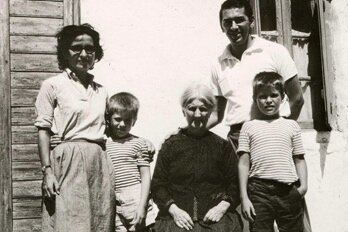 Tom (left) and family in Mani, 1962.
These people, in their small hamlets, are mostly old men and women caring for their grandchildren. The youth have left for Athens; they have forsaken the two-story castle-like homes that their great-great grandfathers built for them. Many of these structures have collapsed from neglect; others are inhabited by pigs and goats. For the young, excitement is in the city. And that city is now enroaching here as well. Television antennas and telephone poles dot the landscape almost as frequently as do the tall, thin cyprus trees that one writer compared to "exclamation points in a laconic landscape."
The Peloponnesus is laconic, but it is also striking for its contrasts and beauty. Lush mountains often give way to arid, rocky, uninhabitable land; smooth, sandy beaches alternate with rough, rocky ones; and blue skies fade into romantic mists. Here, it is not hard to see where Homer and even Haliburton received their inspiration. And the people. The villagers – especially the old men – are as striking as the countryside: they have a proud, rough beauty that is poised against gentle – almost humble – manners. They are in no hurry and are nothing if they are not kind. Lost on the road, I stopped and asked an old man on a donkey which way to go. His reply was apologetic, a bit angry at himself not me: "You made the wrong turn up there," he said, indicating the hilltop. "I saw you doing it. If only I had been there, I would have told you." Foolishly, touchingly, he felt responsible. This kindlness is a common trait here and contrasts noticeably with the unconcern and impatience of the residents in New York or Athens. The pace here is easy and friendly and the people can afford to look at themselves humorously, unruffled by the growing trickle of tourists that signals the beginning of the end to their their way of life. I thought of that later, when lost again, I asked a group of old villagers where the ruins of Vassae were. "We are they," was their straightfaced reply. And so they were, in a way more real than any temple could ever be. from COLUMBIA DAILY SPECTATOR, 1978; slightly revised in 2009
 A LOOK BACK This was the first published personal essay I wrote, a form I would not try my hand at again for over three decades. I remember at the time – I was only 21 – I was very nervous about the piece and I showed it to my father for his input. He was pleased with the article and made a number of useful suggestions, the only one that I remember being his saying I should insert the word "even" before the reference to Haliburton. Richard Haliburton was a long-forgotten writer of my father's youth (he had written a memoir of Greece called The Glorious Adventure), and my father thought that my original alliterative phrase, "Homer and Halliburton" was assuming the reader knew more than he probably did. I've made some minor stylistic edits, but the story is more or less as it first appeared (although I always hated the title my editor gave it, "Greece: The City Approacheth," as though the "city" were some comic book monster out of a bad Marvel comic).
Goodbye to All That

Sunday, March 9, 2003
So we finally split up today. To call it bizarre is an understatement -- but, then, the whole relationship was bizarre. The way she clung to her parents, was obsessed with their lives and they with hers. It gives me the creeps.
She made pancakes. It was so like her. Everything was neatly arranged: the plates, the silverware, the perfectly cut fruit, the phony flowers sitting in a waterless vase. Just once I’d like to see her embrace the chaos and disorder of life, instead of fleeing from it. So scared. I felt sorry for her -- and myself for clinging to her so hopefully for 11 sexless, middle-aged months. “Only people over 60 have artifcial flowers,” said CF later; I remembered what W's cousin had said to me on the train, “She never rebelled. She never fought her parents. At least I don’t remember it. She was always an adult.”
I sat there, eating the pancakes with the tasteless, sugar-free, low-fat syrup, and listened as she prattled on about God knows what. It was like we were two old drinking companions (except she never drinks), not two would-be, never-were lovers who, after 11 months of holding hands and one big argument, were now facing the end of the road.
Even my recent illness was treated as tea time chatter: polite concern with a sequeway to how great Robin Williams had been in AWAKENINGS. Why was I here? Would I have to do the breaking up?
Then, finally, like a quick summer shower, it was over. She escorted me into her living room, talked about where the chandelier would be hung, how the mirror would add depth to the room, and how I should search for someone who could say “I love you” to me. But she wasn’t the one. My talk of her family
[[wysiwyg_imageupload:16:]]
on Monday and of the need to have a real relationship, had made her “physically nauseous.” Not a word about what I had meant to her. Because I meant about as much to her as the pretty stuffed pillow I was sitting on. Maybe less.
I said goodbye -- after saying two things: that she couldn’t have a relationship with a man until she stopped having a love affair with her parents and that if she couldn’t say, “I love you” after 11 months, she never would.
We embraced, promised to keep in touch (I knew it was a lie), and as I walked out I thought two things simultaneously: I wished I had exited the relationship sooner – and the pancakes weren't half-bad.
Abandoned Love
 NO COOKIES FOR GERARD
"Do you want a cookie?" I said to the wide-eyed twentysomething young woman who looked back at me.
And with those five words began my frustrating, bittersweet one-sided love affair that never should have been with Carol. She was actually just six months past her 21st birthday; I was all of 20 and, like most 20-year-olds, felt I had just met "her," the woman of my dreams, the woman I was going to marry, the woman I would always love.
I had seen her around the campus, her compact yet buxom figure walking with determined strides to classes, to coffee, to wherever. She always flashed me a big, welcoming smile, encouraging me to think that she wanted to meet me, to talk with me, to be part of my life. I'd seen her everywhere, till soon, she was like the posse in Butch Cassidy and the Sundance Kid, pursuing me endlessly, in my dreams if not my waking life, as I wondered, "Who is that girl?"
But I eventually became the pursuer not the pursued, chasing her over the next decade, like some real-life Lieutenant Gerard, always thinking that, "This time, I'll get her, this time she'll be mine." It was a harmless obsession, I told myself. But did Ahab ever get much good from that whale?
Our meeting came about through a mistake. She tossed me that smile one day on campus, and I was determined to know who this will-of-the-wisp was. I ran after her, introducing myself. She told me her name and that she was an anthropology student here from Chicago. I walked with her, we talked; she laughed; I laughed. It was bliss.
Four days later, I saw her again at the library. She gave me that big Colgate smile, her round brown eyes as alluring as the flame to a fledgling pyromaniac. Encouraged, I offered her a homemade cookie my mother had given me.
"Do you want a cookie?" I said, not realizing that those were the first words I would say to her – for she was not the she I had met just days before but her twin sister ("They look alike, they sound alike, you can lose your mind when cousins are two of a kind"). It was a charming mistake; I was Fred and she was Ginger, and our romance, in my eyes, had just begun.
 Alas, it was never to be. I chased her through boyfriend after boyfriend – the sarcastic one who played tennis with her and dined well on her father's credit cards; the emotionally abusive one whom I suspected hit her occasionally; the smarmy intellectual one who was oh-so-superior to everyone and eventually faced sexual harassment charges at work.
Through it all, I was the "good friend," the Watson to her Holmes, "the one fixed point in a changing age," who would console her, comfort her, but never "date" her. The man who knew too much but was never good enough. We'd go out to dinner, I'd make her laugh, and she'd make me cry with a longing that was never to be fulfilled.
I once even called her my "foul-weather friend." It was my joke because she'd always be ready to advise me, psychoanalyze me, and sympathize with me when I had a problem with a girlfriend, or with my family, or with my life.
"You're so punishing to yourself," she said to me once. Not as punishing as she was to me.
Oh, how you broke my heart. "I'll never marry a non-Jew," she had said at 21 to me, the non-Jew. So definite, so sure of herself. And, of course, a decade or so later, she married a non-Jew, an agreeable fellow who never registered on my radar as anything beyond being a nice, sweet guy. She pleaded with me to go to the wedding, and like some sucker who lost a bet, I turned up, smiling, and danced with her for the first and only time.
It ended, as these things do, mundanely and unromantically. We had kept in touch over the years, but it was always me who did the work, calling her, setting up the meetings, insisting that we meet. She had another life now, apart from me, with two darling children. When we actually met, it was always the same connection, though my passion had long since cooled and hers –well, how can you cool something that was never hot?
I finally got tired of calling her, after she had canceled yet-another scheduled meeting. "You call me when you want to meet," I had said with frustration. Six months later, I still hadn't heard from her.
So, goodbye to all that. To the love, to the pursuit, to the fiction that she really ever gave a damn.
Yet to be human is to hope, and I still have that picture in my head, of the time she went away to Paris to get over another failed relationship. Of when she came back, and I was there waiting for her at Newark airport. She ran to me, embraced me, and kissed me, oh so tenderly. "I hoped you would be here," she had said so happily, so completely. "I knew you'd be here." Somewhere, in some other life, perhaps, we'll meet again, and this time, she'll take the cookie and see that I was the best man after all.
July 14, 2008
Memories of My Mother
NOT ME, KID
By TOM SOTER 
“I miss mom. Don’t you?” said my younger brother, Peter, one day soon after Christmas.
"I think about her a lot.”
“I try not to think about her at all,” I lied. I wanted to change the subject. “What’s the point?”
In fact, I was unconsciously repeating one of my mother’s favorite phrases: “What’s the point?” she would often say, though not in any existential fashion. She would say it as she would say any other number of peculiar catchphrases that were so uniquely hers: “Not me, kid,” “He looks dead,” “That’s stupid,” “I haven’t seen you in 10,000 years” (which she might say to a friend she hadn’t seen in a while, not caring how old that would make them both), and my father the grammarian’s particular bete noir: “She’s a prick.”
“You can’t say, ‘She’s a prick,’ Effie,” he would say to her.
“Why not?”
“Because a she can’t be a prick. A prick is male.”
“Well, she’s still a prick,” she would say, grammar be damned.
My father, George, who married my mother on Valentine’s Day, 1949, was continually exasperated by my mother’s stubbornness. When we were growing up in New York City, a blind man and his wife happened to live in our building. My mother would constantly refer to him as “the blind guy,” which bothered my father, probably because it defined the man by his ailment. “Don’t call him the blind guy,” my father would say. “He’s got a name. It’s John.” “Who’s John?” “The blind guy!” said my father, falling into her trap. “There, you see,” she said, triumphantly.
My mother hated pomposity and never let my father, a brilliant wordsmith and award-winning advertising copywriter, get too full of himself (the family jokingly referred to him as “The Puppet King”). Effie (her full name, Efftihia, means “happiness” in Greek) had herself come from humble beginnings. She was born in Greece in 1921, the first child of Thomas and Mary Hartocollis, but she spent the first five years of her life with her grandparents in the countryside outside of Athens. That was because her parents had gone to Brooklyn, New York, where Thomas managed real estate and Mary managed him. If Effie felt abandoned, she never said so directly, though she hinted at her feelings when she would retell the story of her youthful years with her maternal grandparents, and how her mother was shocked, on returning from America, to discover that Effie had adopted her grandparent’s surname in place of her own. “I had forgotten my parents,” she would explain.
My mother came to America in 1939, where her three siblings had all been born. “In the early ’30s,” George recalled in 2008, “her father had deposited his wife and four children in Greece (to preserve their Greekness of language and morals) while he worked away in Brooklyn, sending checks and showing up for short periodic visits at their outpost in Athens.”
 Effie and George Soter, with firstborn, c. 1955.
It was while attending Clark University in Worcester, Massachusetts, that she met my father, a Chicago-born Greek-American attending classes at the college as part of his army training. As he said to me years later, “I had heard there was a Greek girl at Clark, so I went up to her at a college dance and asked her to dance. She thought I was interested in her because her uncle [with whom she was living] owned a restaurant and was ‘wealthy,’ so she tuned me down. Again and again. And the cooler she got, the more interested I became.”
My mother’s resistance apparently didn’t last long. Soon after that, they were dating, for as my father said in a 2008 memoir: “To the Greek-American me (almost all Greek-Americans had village roots), a ‘girl from Athens’ had a bit of the aura that ‘a girl from Paris’ held for almost anyone else: sophisticated, worldly, soigné, wow! When I was shipped off to my relatively un-bellicose tour in Europe, our romance continued by mail.” Although they rarely talked about it, their’s seemed to have been a romantic, passionate love. Once, my mother showed me a shoebox full of letters from my father during the war. I looked at one: it was covered with handwriting on both sides, but the writing was only three words, a phrase repeated dozens of times: “I love you.”
I often think of that shoebox full of letters when I think of my mother. She was so fond of her memories, of recalling the happy moments from her past. She was a collector of keepsakes, her desk a rat’s nest of odds and ends – a program from a show I had been in, a grade-school notebook from my older brother now in San Francisco, a bookmark from my younger brother’s bookstore. But her greatest memory trove was the collection of photo albums. My mother would spend hours assembling photos of trips, dinner parties, birthdays, and other special events into albums. “Have you seen the latest album?” she would say with pride, and then present it: photos under plastic sheets, with captions and commentary by Effie.
She was an obsessive chronicler of memories. I always knew that, but it came home to me when I was recently helping my father clean up his apartment. In the process, we came across a thick, stiff-backed stenographer’s pad, with my mother’s distinct handwriting on the cover: “From 9.28.89 to 9.08.99.” I flipped open the book and saw two columns of writing. The first entry said: “9.28.89 (Audi) Beets. Salad. Cranberry Pie.” The next entry was “10.1.89 Chris’s birthday. Egg lemon soup. Leg of Lamb. Potatoes. Broccoli. Corn. Salad. Cake. Baklava.” The next: “10.12.89. Poker. Addie, John. Fish Soup. Guinea Hens. Broccoli. Rice. Salad. Apple Pie.” And on and on, an almost daily log, for pages and pages of what she had served and to whom she had served it – an amazing book of its kind, a memory book of memories no one should care about, so typical of its writer, so sad in retrospect.

Effie and Tom, c. 1957.
Sad because my mother, though she is still alive, is barely recognizable as the feisty woman who would say things like, “If I were you, I’d jump out the window” and “That’s stupid.” In the early ‘90s, she developed Alzheimer’s and the illness slowly and mercilessly erased the personality she had spent so many years perfecting. A scholarship student, a former social worker, a shopkeeper, a talented needlepoint “artist” (she made dozens of pillows out of old fabric, which she would give to family and friends), a wonderful cook, a great storyteller, a constant reader of fiction and non-fiction alike (her harshest charge against someone once was, “He doesn’t read, can you believe it?”), and a devoted mother and wife – all of that was eventually taken from her, as she became a ghost of herself. It took a long time – I always believed it was my mother’s stubborn willfulness that kept her cognizant for so long – and the last thing to go was her card playing.
My mother loved to play cards. It was ingrained in her from youth. She often told the story from her early teenage years, when her mother needed a fourth person to fill out a card game.
“Come down and play, Effie,” Mary called to her daughter.
“I can’t, mother. I’m studying.”
“You can study anytime. Come play cards, now.”
It was always a good time to play cards in Effie’s world – and she clung onto it for such a long time that even her doctors were amazed. When she couldn’t read or write anymore, and her cooking skills were gone, she could still whip you at cards. My poor father often would sit for hours on end, condemned to non-stop games of Onze, a kind of gin rummy game, until he would finally say “enough,” or be relieved at his post by a family member or friend.
But even that, too, finally was taken away. Her powerful will was broken, her ability to continue the battle, gone. The memories, so precious to her, were now only preserved in books or in the memories of others. When I see her these days, stooped and vacant, being led around by a nurse, I often want to cry or cry out, “Where did you go, mom? Why did you go like that?”
But then I’ll take her hand and lead her around the room myself. And she’ll smile a vacant but pleasant smile, and somewhere inside her I have to believe that a part of her still knows me, or at least knows my feelings. And sometimes, all too rarely, there is a glimmer of acknowledgment if not recognition. “You’re a nice boy,” she will say, suddenly. “I like you.”
I miss you, mom.
September 2008
Memories of My Mother (2)
[[wysiwyg_imageupload:468:]]BIG DEAL
My mother died today. But she had actually left us a long time ago, her identity erased by Alzheimer's Disease – bit by bit, drip by drip, in a painful process that would be heart-wrenching in any situation but was especially poignant with my mother. For my mother, Effie, treasured her memories: to her, the past was not something to be discarded like an old shoe but something to revisit again and again like an old friend.
Indeed, one of the activities that she enjoyed was making photo albums of people, places, and events. She had dozens of albums – at least 80 or 90 by my rough count – ranging from 11 x 14-inch mega-albums down to 4 x 6-inch mini-albums. They were invariably labeled on their spine in my mother’s distinctive handwriting with such practical titles as “Family A-H,” “Tom’s Graduation,” and, my particular favorite, “Friends and the Lemon” (which would often be referred to as “Friends of the Lemon”). There were two 4 x 6 volumes of the Lemon series, which was a bizarre collection that only my mother could concoct of people posing with the lemon tree that she was growing by her desk. “Would you like to see our lemon tree?” she would ask guests. People were amused and would pose awkwardly with the tree, and Effie got a kick out of their reaction.
My mother had a puckish sense of humor. During the 1976 presidential campaign, our family – life-long Democrats – accidentally received campaign literature from the Republican in the race, Gerald Ford. The packet included some phony snapshots of Ford with his dog and his family, with faux handwriting on the back saying, “This is a favorite shot of me and my dog” and “This is a favorite shot of my family.” Effie took the snapshots and placed them in her “Friends” album under the letter “F” for “Ford.”
Effie had catchphrases that she would use constantly, and anyone who knew her will remember her favorite sayings: “I haven’t seen you in 10,000 years,” “Not me, kid,” “That’s stupid,” “Who’s bright idea was this?” “Big deal,” “Who cares?” and my father the grammarian’s particular bete noir: “She’s a prick.”
“You can’t say, ‘She’s a prick,’ Effie,” he would say to her.
“Why not?”
“Because a she can’t be a prick. A prick is male.”
“Well, she’s still a prick,” she would say, grammar be damned.
My father, George, who married my mother on Valentine’s Day, 1949, was continually exasperated by my mother’s stubbornness. When we were growing up in New York City, a blind man and his wife happened to live in our building. My mother would constantly refer to him as “the blind guy,” which bothered my father, probably because it defined the man by his ailment.
“Don’t call him the blind guy,” my father would say. “He’s got a name. It’s John.”
“Who’s John?”
“The blind guy!” said my father, falling into her trap.
“There, you see,” she said, triumphantly.[[wysiwyg_imageupload:478:]]
My mother hated pomposity and never let my father, a brilliant wordsmith and award-winning advertising copywriter, get too full of himself (the family jokingly referred to him as “The Puppet King”). Effie (her full name, Efftihia, means “happiness” in Greek) had herself come from humble beginnings. She was born in Greece in 1921, the first child of Thomas and Mary Hartocollis, but she spent the first five years of her life with her grandparents in the countryside outside of Athens. That was because her parents had gone to Brooklyn, New York, where Thomas managed real estate and Mary managed him. If Effie felt abandoned, she never said so directly, though she hinted at her feelings when she would retell the story of her youthful years with her maternal grandparents, and how her mother was shocked, on returning from America, to discover that Effie had adopted her grandparent’s surname in place of her own. “I had forgotten my parents,” she would explain.
My mother came to America in 1939, where her three siblings had all been born. “In the early ’30s,” George recalled in 2008, “her father had deposited his wife and four children in Greece (to preserve their Greekness of language and morals) while he worked away in Brooklyn, sending checks and showing up for short periodic visits at their outpost in Athens.”
It was while attending Clark University in Worcester, Massachusetts, that she met my father, a Chicago-born Greek-American attending classes at the college as part of his army training. As he said to me years later, “I had heard there was a Greek girl at Clark, so I went up to her at a college dance and asked her to dance. She thought I was interested in her because her uncle [with whom she was living] owned a restaurant and was ‘wealthy,’ so she tuned me down. Again and again. And the cooler she got, the more interested I became.”
My mother’s resistance apparently didn’t last long. Soon after that, they were dating, for as my father said in a 2008 memoir: “To the Greek-American me (almost all Greek-Americans had village roots), a ‘girl from Athens’ had a bit of the aura that ‘a girl from Paris’ held for almost anyone else: sophisticated, worldly, soigné, wow! When I was shipped off to my relatively un-bellicose tour in Europe, our romance continued by mail.” Although they rarely talked about it, their’s seemed to have been a romantic, passionate love. Once, my mother showed me a shoebox full of letters from my father during the war. I looked at one: it was covered with handwriting on both sides, but the writing was only three words, a phrase repeated dozens of times: “I love you.”
[[wysiwyg_imageupload:472:]]They had an old-fashioned love, one that really lasted through good times and bad. For my father, gregarious and outgoing in his nature, was probably not the easiest man to live with. Flamboyant and larger than life, he seemed to dominate every situation he was in and my mother – though she never complained about it – probably had some regrets about giving up her career as a social worker. She was, in fact, quite proud of her advanced degree in social work (her colleague, Carol Gardiner, once told me that Effie was very effective in her job), but family came first, and she had three boys to raise.
I remember that childhood with fondness: though not known as a touchy-feely person, my mother would often say, “I love you,” to us and often say to me (or Nick or Peter), “You’re one of my favorites” – never mind that you could only have one favorite.
We learned English from my mom, too (she refused to teach us Greek because of an incident she repeatedly told about her cousin, Jimmy, running away from school in Worcester, Mass., because his classmates made fun of the fact that he could only speak Greek). Although she lived in this country since she was 17, she always spoke with a distinctive accent – something that we never noticed growing up. The point came home to me (and Peter) when we were corrected (at different times) by our school teachers over the pronunciation of the word, “didn’t.”
“The word is ‘didn’t,” they would say.
“That’s what I said,” would be the reply. “Dint.”
“No, not ‘dint.’ ‘Didn’t.’”
“Dint.”
“No, didn’t.”
We would go back to our mother and report the complaint and she would listen sympathetically, saying, “That’s stupid. Dint they listen to you?”
My mother spent her happiest years raising her family, but was almost as happy when she started working at the family store, Greek Island, a popular boutique of clothing, jewelry, and all things Greek that operated for most of its life (1963-1986) at 215 East 49th Street, in front of the historic Amster Yard. Effie loved socializing, and hob-knobbed with a number of celebrity customers, from Paul Newman (“his eyes are so blue”) to Katherine Hepburn. When Jacqueline Kennedy Onnasis, a famous Grecophile, came into the store in 1968, five years after the shop had opened, Effie was gracious but direct in her opening comment. “What kept you?” she said to Jackie O.[[wysiwyg_imageupload:473:]]
“The shop,” as she called it, soon came to dominate her life. She loved riding the subways to work (“They’re fast. They get you there 1-2-3”) and loved making special orders for customers (I often remember her working until 3 or 4 in the morning, altering a dress or more typically creating something new with imported fabric. She would show me the dress she had created with great pride, to which she would always add a label, “Made in Greece.”)
She was also fiercely protective of the store. When there were a number of after-hours break-ins at the shop, my mother got mad. She came up with a crazy plan to solve the problem: she went down to the store and sat in the dark by the front door with a baseball bat and a camera. As she matter-of-factly explained it: “When someone breaks in, I will take his picture with the camera and then hit him over the head with a baseball bat.” We couldn’t dissuade her from her mission – but my father and brother stood watch across the street to be sure nothing happened. Nothing did.
It was after the closing of the shop that my mother’s life began its downward spiral. She loved the activity of the store, loved to be around family, loved to be busy. But after 1986, the shop was no more, her boys had moved away (Nick to San Francisco, Peter and me to our own apartments in New York), and my father was at the office. She began drinking more, and perhaps it was then that the Alzheimer’s first started to break down this remarkable woman. She began forgetting things – first minor memories and then major ones. She denied there was a problem, however, and fought it with all the weapons at her command. When Peter took her in for a memory test, he reported this exchange between her and the doctor:
Doctor: “What year were you born?”
Effie: “1921.”
Doctor: “What year is this?”
Effie: “1991.”[[wysiwyg_imageupload:476:]]
Doctor: “So how old does that make you?”
Effie: “You figure it out.”
But the illness gave no quarter and slowly and mercilessly erased the personality she had spent so many years perfecting. The scholarship student, insightful social worker, hard-working shopkeeper, talented needlepoint “artist” (she made dozens of pillows out of old fabric, which she would give to family and friends), wonderful cook, great storyteller, constant reader of fiction and non-fiction alike (her harshest charge against someone once was, “He doesn’t read, can you believe it?”), and devoted mother and wife – all of that was eventually taken from her, as she became a ghost of herself. It took a long time – I always believed it was my mother’s stubborn willfulness that kept her cognizant for so long – and the last thing to go was her card playing.
My mother loved to play cards. It was ingrained in her from youth. She often told the story from her early teenage years, when her mother needed a fourth person to fill out a card game. “Come down and play, Effie,” Mary called to her daughter.
“I can’t, mother. I’m studying.”
“You can study anytime. Come play cards, now.”
It was always a good time to play cards in Effie’s world – and she clung onto it for such a long time that even her doctors were amazed. When she couldn’t read or write anymore, and her cooking skills were gone, she could still whip you at cards. My poor father often would sit for hours on end, condemned to non-stop games of Onze, a kind of gin rummy game, until he would finally say “enough,” or be relieved at his post by a family member or friend.
But even that, too, finally was taken away. Her powerful will was broken, her ability to continue the battle, gone. The memories, so precious to her, were now only preserved in books or in the memories of others. I remember visiting her in that friendly yet ghastly nursing home where she spent the last years of her life after my father died in 2009. The place was populated with a Fellini-esque gallery of old men and women, in various stages of pitiful dementia. There was the little birdlike woman who would come up to me conspiratorially and say, “Help me please, darling, help me.” Or the bald man with one side of his mouth turned down in a perpetual frown, who would talk to me like an old friend, but always repeating the same phrase, “Hiya, Mac, can I get a quarter for a cup of coffee?”
Although it was hard for me to take, the nurses seemed to handle them all with great care and affection. They were particularly fond of Effie, who was feisty almost to the end. When she didn’t like something she would stick out her tongue (or even spit out the offending food), speaking in a mixture of Greek, English, and gibberish. It didn’t phase the staff, but they were curious. At one point, a nurse asked me if the word “Scata” meant anything.
“Yes,” I replied, curious. “Why do you ask?”[[wysiwyg_imageupload:477:]]
“Your mother was using it the other day when we were feeding her. We thought it was a word of approval.”
“Oh,” I said, amused. “It's the Greek word for shit.”
As the months went by, my mother’s lucid moments became less and less. There were times when she would surprise you by looking at you intently, as though trying to place you in the jumbled world of her mind, and then would say, quite clearly, “You’re a good boy,” followed by, “I love you.” And, invariably, you would quickly reach out to her, asking for something she could no longer give – an observation, a thought, even one of those distinctive, ridiculous phrases that so defined her personality.
But she never said them again. Toothless (she refused to wear her dentures) and stooped, she spent much of her time wandering the halls of the nursing home, grabbing at the walls, endlessly searching for something she had lost – a memory, a moment, or, perhaps, a way home.
In the end, I think she found it. For, as I sat by her bedside for the last time, Effie still seemed to have a very strong presence, but now she was finally at peace. And then I thought of the albums, the meals, the laughter, and the tears. Of George and Effie, always together, even when they were apart. "Is George coming?" Effie used to say when I would visit her in the middle stages of her Alzheimer's. To each, the other was the most important. My father died in January 2009 -- but only after he had successfully seen that Effie was placed in a top-notch nursing home. And when my father was laid up in the hospital once, I brought my mother to visit him. "It should have been me in there, not George," was her comment when we left.
After she had died, I thought of the last time I saw her alive, tapping on the arm of her wheelchair, seemingly impatient to move on. The doctors later told us that, in the end, she passed quickly. Within minutes of a call from the nursing home warning of her imminent death, she was gone, almost as though she knew it was time to go.
I talked with Nick and Peter soon after that, and we imagined what Effie would have said about her condition of the last few years if she had been able to talk ("You should shoot me, boys"), and Peter told us that he always liked to imagine that Effie, when sleeping, had entered a happier world, where her family and friends were all recognizable and life was one big card game.
"She's probably sitting down to a card game with George right now," said Peter.
"And," I added, "she's probably sayIng to George, 'I haven't seen you in 10,000 years. Good to see you, fella.'"
I love you, mom.
July 20, 2011
Memories of My Father

NO MORE GEORGE
By Tom Soter
“My father died today.” I said it matter-of-factly and was surprised at how calm I was. Within moments, however, like some sort of delayed action tornado, the full force of those words hit me. “My father died today.” No more quick calls to check out a word or phrase that seemed odd or misused; no more last-minute invitations to have dinner and see a movie; no more jokes; no more twinkle in the eye; no more George.
I remember sitting opposite him, a few months ago, at a diner to which he liked to go after seeing me every week in my improv comedy show. It was a funny little place, and I always wondered why George liked it. The food was generally greasy and not very good, the place was loud and my dad’s hearing was bad, and it seemed so out-of-character for a man of such style, a man who loved and appreciated good food.
But he loved life more. Life to him was more than breathing or existing – it was about the people, about the vitality of the situation, about friendship. To be in a place like this was to be in the center of life, to be in a place “where everybody knows your name.” They didn’t know his name at that little coffee shop, but they certainly knew George: they greeted him heartily when he came in every week, he bantered with the waiters and flirted with the waitresses, and they always had his scotch ready for him. Ah, George and his scotch.
Everyone who met George found it hard to forget him. The outpouring of love and shock from those who hardly knew him both touched and overwhelmed me. Noel Katz, one of my piano players at Sunday Night Improv whom I always felt was aloof towards my dad, surprised and moved me with an anecdotal note revealing he had ridden the bus with George on many occasions and spent that time talking to him, “I don't think you're aware how much I learned from him, how much I enjoyed him, how much I'll miss him,” he wrote. Others talked about his ready smile, the twinkle in his eye, the joie-de-vivre that was so much a part of him. “Though I'd had word of George's impending death, it was nevertheless shocking to hear of its arrival,” wrote Stu Hample, a writer and long-time colleague of my father’s. “For George, as everyone whose path he crossed is well aware, gave off the dazzling essence of life in everything he did or said or thought or imagined. In a word, a look, a smile, a flick of his cigarette ashes.”
Carole Bugge, an improviser at my show who had seen George at performances and parties over the last 20 years, even wrote a poem about him, “On Hearing of the Death of George,” which said, in part: “No, that’s not right – death’s not for you…death seems to be for some people - sad, yes, but a natural passing
, but not for you
. You were not young, or well, but some people just aren't the dying kind.”
Indeed, that was a common refrain: how could a man who so loved life leave it behind? He didn’t go willingly, but he did go with style. From the beginning of his illness until the end, he kept his trademark wit. After he was diagnosed with lung cancer, he had news of two other people he knew being stricken with the same disease and quipped, “Everybody’s doing it.” Near the end, he pointed to a sign on the television set in his hospital room that said, “Inquire how you can rent this color television.” He turned to me and – intentionally placing the emphasis on the word color – said: “Why would anyone want a TV set that color?”
Indeed, his wit was part of his ever-present optimism. Although he knew he was going to die, he still talked hopefully of the future. When I visited him in the hospital one day, he was going a little loopy from being confined in bed. But he smiled defiantly and said, “They’re writing my obituary for tomorrow’s paper. Not yet. Not yet.” George in the 1950s.
Although no obituary ever appeared, my father’s life was certainly worth one. The only son of Greek immigrants, he grew up in poverty during the Great Depression, never graduated college, but rose to the top of the advertising world with humor, intelligence, and panache, as one of the original "Mad Men" (a show he hated, saying it only happened that way in a Hollywood screenwriter's mind). He started in the mailroom, and within a few years, was the man behind the "Le Car Hot" campaign for Renault, selling a French car at a time when foreign car sales were a rarity in the U.S. He used an unusually literate approach – until then, car ads were simply functional, bragging about horsepower, steering capabilities, etc. – and was a pioneer in "image advertising."
The award-winning campaign made George's name on Madison Avenue (and was even parodied in Mad magazine as "Der Kar Kraut" and the Yale Record as "Le Magazine Cool"). He went on to create other award-winning (and highly successful) campaigns for Helena Rubenstein, Donald Trump, Air France, the Central Park Conservancy ("You Gotta Have Park" was his invention), and many others.
He was always an optimist. At the height of his success, his boss thought he was getting too full of himself ("I thought I was hot stuff," George ruefully admitted years later), and he was summarily fired. Rather than look for work and confident in his future prospects, George took the opportunity to take the family on a boat trip to his parents' homeland, Greece, a country with which he had a life-long love affair. His confidence paid off; once he arrived (after a 14-day boat trip), he received a call from the U.S. Another agency wanted to hire him.
That kind-of-impetuousness was George’s hallmark. He liked living on the edge, always trusting that the cards would fall his way, and if they didn’t, he’d make the most of what he had. On talking with my cousin Anemona, who housed him in the basement apartment of her brownstone for the last three months of his life, we agreed on one point: George had no problem starting things; he had difficulty ending them. “The only thing he finished was his life,” I said sadly.
But what a life. He was also the co-founder and long-time owner of Greek Island, a fashionable and well-known boutique on East 49th Street, which catered to such celebrities as Katherine Hepburn, Paul Newman, Joanne Woodward, and Theoni V. Aldredge, among others, and which provided him with reason (if he needed it) to return to Greece time and again. It also provided him with a wealth of stories.
 George, 2006For above all else, George was a raconteur, a wonderful teller of tales. For instance, he loved to tell the story of my sick cat, Sally, and how my mother told me one night that animals don’t need to go to the doctor because they get better on their own. Sally died the next day. And – so the story goes – later that year, the Soter family was driving some winding roads in Greece, and I got nauseous. I vomited, and then asked my mother if I should see the doctor. “No, you’ll get better on your own.” My father would always pause at that moment, ready with the punch line: “And Tommy said, ‘That’s just what you said about Sally.’”
My father was just as particular about punctuation and grammar (he once sent a long letter to a book editor, cataloguing all the grammatical errors and typos in a book he had), and loved composing letters skewering pomposity and what he saw as the misuse of the language. When working at my brother’s first bookstore in Chelsea, for instance, a customer asked him if the bookstore had any gay books. “No, but we have some slightly amused ones,” he replied.
Not surprisingly, my father could also be the most frustrating of men. I remember telling him about a movie I had just seen and enjoyed, The Great Debaters. “I don’t want to see it,” he said. “I know what it’s about. I’ve read about it.”
“But you haven’t seen it,” I insisted. “I have.”
Undeterred, my father said, “It’s just like To Sir, With Love, except set in the 1930s.”
“It’s not like To Sir, With Love at all,” I argued. Pointlessly, for my father had the last word: “Well, I wouldn’t know. I’ve never seen To Sir, With Love.” The conversation ended.
In fact, he always wanted the last word. On an emergency room visit to the hospital, I overheard this exchange between a nurse and a groggy George: “Mr. Soter, you have a temperature.”
“No, I don’t think so.”
“You do. I just took your temperature.”
“Well, if you knew why did you ask me?”
He could be frustrating in another way, too. He was often impractical, always thinking of things in grandiose terms. When I suggested he visit a Greek art gallery in Chelsea to see if they’d be interested in buying some of his Greek paintings or artifacts, he went to the gallery and came back with a new idea: he would ask them to give over a room to exhibit “The Soter Collection.” Nothing ever came of it – except that he created a “Soter Collection” showcase of his own in his last apartment.  George's 10-room apartment at 404 Riverside Drive.
How he loved remaking that place! He called it his “last hurrah,” the opportunity to transform what had been a rundown basement unit in my cousin’s century-old brownstone into something special. When she and I discussed its use for him, my cousin and I envisioned a touch-up, not a major renovation; George saw it in grander terms. And, although he was dying, he crafted a space that most everyone who saw it thought was amazing. It was a reflection of the man.
George was a genius at interior design. Once, not long after he had moved in to that last apartment, Luanne, his nurse, found him sitting, staring into space, “What are you doing?” she asked. “I’m picturing the room,” he said. And one could imagine him crafting the place in his mind. He had lived in three different apartments over the last decade (and before that, had been in one magnificent ten-room unit for 33 years). Each bore his distinctive stamp of organized clutter.
As much as my father loved his activities, he loved his family more. In September 2004, George, who had recently passed his 80th birthday, focused his never-flagging energy on a new endeavor: helping generate interest in Morningside Books, the bookstore owned by his youngest son, Peter, and his daughter-in-law, Amelia. To that end, he came up with a publicity gimmick that employed his favorite device – words – about one of his favorite habits – reading. George was a voracious reader; he finished at least two books a week, as well as countless magazines, The New York Times, and, of course, The New Yorker (which he read cover to cover, even in the dark days of Tina Brown). He regularly passed books on to his sons with the comment, "I think you'll enjoy this," although no one enjoyed those books half as much as George.
The new publicity device would be called Booknotes and it would turn out to be a duty he loved. Although the newsletter was only four pages, he turned it into something special, a kind of "Talk of the Town" for Morningside Books. There were announcements, mini-reviews of quirky books, author birthdates (with quotations), political commentary, and even his memoirs. Every month, George designed it, brought it over personally to Village Copier on 118th Street ("They're terrific," he used to say, in his typically enthusiastic manner), and doted over it like a parent with a special child. It's no wonder that he was pleased to receive a letter and photograph from a Booknotes fan. The letter was one of praise, which he was happy to receive, but it was the photo that particularly tickled him: it was a picture the writer had taken of her assembled collection of Booknotes, George's last major writing project.
 Effie, with Nick
Through most of his life, he was accompanied on his journey by Effie, his one and only true love. He was a Chicago-born Greek-American attending classes at Clark University in Worcester, Massachusetts as part of his army training. As he said to me years later, “I had heard there was a Greek girl at Clark, so I went up to her at a college dance and asked her to dance. She thought I was interested in her because her uncle [with whom she was living] owned a restaurant and was ‘wealthy,’ so she tuned me down. Again and again. And the cooler she got, the more interested I became.”
My mother’s resistance apparently didn’t last long. Soon after that, they were dating. Although they rarely talked about it, theirs seemed to have been a romantic, passionate love. Once, my mother showed me a shoebox full of letters from my father during the war. I looked at one: it was covered with handwriting on both sides, but the writing was only three words, a phrase repeated dozens of times: “I love you.”
When Effie contracted Alzheimer’s in the early 1990s, no one was more protective of her – or more frustrated. Before the illness, they always had a wonderful bantering, affectionate relationship. As the disease slowly stripped away her personality, however, you could see him cling lovingly, desperately, furiously to what was left. One reason he continued to play cards with her was because, as he himself admitted, that was the time when her old personality still asserted itself.
For each of them, the other was primary. When George was in the hospital once, all he asked about was Effie’s care; for her part, all she wanted to do was see him. When they met, however, none of this concern was evident. My father, with tubes in his mouth and nose, couldn’t talk; my mother, ever the chronicler of our lives, said, “Oh look at you. Let me take a picture.” George, ever conscious of his image, frantically waved his hands, “No!!!” After Effie and I left, she was more expressive of her true feelings: “It should have been me in there instead of him.” George and Tom, December 2008.
I always believed that my father didn’t want to finish tasks because having new projects kept him young, kept him going. When – because his own failing health made him unable to give Effie the care she needed – he finally managed to place her in a top-notch rest home, his greatest responsibility was over. He then completed the new apartment and, not long after that, became bedridden. He lingered there for about a month, welcoming friends and family that came to say goodbye, the charming host until the last. Then, on the evening of January 8, 2009, he died. He was 84 years old, although he once noted, “I have always been 37 even when I eye that old man in my shaving mirror each morning.”
But I still cannot get one image out of my mind. It was not too long ago, in that coffee shop we sat in so many times after my show. He was sitting opposite me, eating the chicken soup he always recommended (and which I always declined). And I sat there, knowing he was going to die soon and trying my hardest to memorize every line of his face, to remember that smile and that twinkle that seemed to define his essence. He noticed me staring at him and smiled that unforgettable smile. “I love you,” he said quietly, as though he had read my thoughts. It’s going to be all right, he seemed to be saying. You’re all going to be all right.
I love you, dad.
January 2009
A Dog's Life
CHARLIE'S GIFT
By TOM SOTER
[[wysiwyg_imageupload:681:]]
Charlie was the family dog. But he was widely considered my dog. He joined our family in the spring of 1972,when I was still living at home. And long after I had moved out, I still came by and took him for walks in the park. He always was ecstatic to see me, jumping up and down, his tongue hanging out of his mouth, his eyes glowing with happiness.
Or so I always liked to think. If I looked at it objectively, Charlie got excited when most people came by to call, and he usually seemed excited, much in the same way. But logic was never part of my relationship with Charlie. How could it be? He was a sweet, neurotic kind of dog, a golden-haired, perfectly proportioned cocker spaniel, big enough to be manageable but not small enough to be crushed underfoot or regarded as a toy.
He was not our family's first dog – although he seemed a distant cousin to him. That honor went to Eustie (or Eustice, whom my father may have named after Eustice Tilley, the fop on the cover of The New Yorker, a magazine he loved). Eustie was a cocker spaniel, too, and he looked a lot like Charlie. He had joined the family in the late '50s in Chicago, and even though he moved to New York with us in 1956, I was too young to actually have any memory of him. But I do remember the family story, often told, about how Eustie came to an end. Apparently, my maternal grandmother never liked Eustie, and thought having a dog around the house was unsanitary for children. Coming from Greece, where dogs often roamed free and were not often kept as pets in the city, she decided one day to let Eustie go. She let him loose at the door of our apartment building, and a few minutes later was sitting with my older brother, Nick, by the window. Before her (presumably) horrified eyes, she and Nick, aged about three or four years old, watched as Eustie attempted to cross the street in the park and was run over by a car. "Look, Yaya," Nick reportedly said (using the Greek word for grandmother), "That looks like Eustie!" Our dogs – except for Charlie – were never very lucky.
Our next one, a dachshund named Gretchen, lived with us for three weeks before she swallowed something that literally stuck in her craw and choked her. Sybil, a Kerry Blue terrier, lasted a lot longer, four or five years, before she was stolen by someone in the park. (At least we thought she was stolen; the romantic in me still likes to think that the dog – who liked to wander far afield and out of sight from us on her walks, just decided to keep on going on an adventure of her own.) Charlie was a gift from my mother to my father, a purebred, as my mom liked to say, but one who was so pure that he was very highly strung. As a puppy, he liked to chew on our bare feet as we sat at the kitchen table over breakfast, and as an adult, he had a strange obsession with my father's feet, often licking them – for the salt, my father used to explain, although I think it was because Charlie knew who was the boss in our family and was simply trying to toady up to him.
[[wysiwyg_imageupload:683:]]
Charlie at the family dinner table, toadying up to the boss.
My father and I would often have disputes about Charlie. Not about his care and feeding but about more esoteric things. "He's having a bad dream," I would often say, when my father and I noticed him on his favorite couch in the kitchen, sleeping but growling at something going on in his dreamworld. "Dogs don't dream," my father would say, time and again. "Dogs don't think." It became a running gag with us, a kind of programmed mantra, in which I would argue for Charlie's thought process, and my father would take a Skinnerian position that dogs were just reactive. (It got to the point where I sent my dad a letter once, with a clipping for a book that postulated that cats had the ability to think. "Proof!" I wrote. "For cats maybe," was my father's reply, "but it doesn't say dogs.")
Certainly if Charlie could think, he would have thought twice about the present my father decided to give him one Christmas: all the food he could eat. Charlie loved to chow down, and he always ate his breakfast or dinner in the same way: fast. He could finish his half-a-can of horse meat in 30 seconds flat (we timed him once) and was usually still hungry after that (until we used a cast-iron bowl, he would kick his empty plastic supper dish around the kitchen with his nose to indicate that he was hungry – more proof to my mind that he could think). On Christmas day, sometime in the late '70s, my father said, "Charlie, we'll give you all you can eat." The dog eagerly downed his first half-can; then, with surprise and apparent joy, he went on to his second half-can, but by the time he had reached two-and-a-half cans, the formerly svelte dog was bloated and moving much slower. My mother said it was cruel, that he would eat until he exploded and even my dad had to concede that the gift had gone too far: that it had become too much of a good thing. We stopped the eating then. And Charlie was pretty miserable afterwards: because he was now so heavy, he could no longer jump onto couches the way he used to; he would try and then sit on the ground growling. We suffered, as well: usually taken for a walk three times a day, we probably had to take him out at least six or seven times because he had urgent business in the park.
Charlie loved the park. In those pre-leash law days, he liked to roam free – and would always wait to do his business until he had been out for a while since – no fool he – he must have recognized, through thought or instinct, that as soon as he finished what he was there to do, he would be taken home (this was especially true on shorter walks in the little park in front of our building, where we had to take him for quick pit stops before going to school). He loved the park because he loved the smells – and also the discarded food he would find. I would often rush up to him when I noticed he was hurriedly swallowing something, and I'd reach into his moth and pull a chicken bone from his mouth.
[[wysiwyg_imageupload:682:]]
Charlie was often the cause of argument in our house, especially between my cousin Niko and me. Niko was staying with us while going to college and he was usually home in the afternoons. The dog needed to be walked three times a day and with my brother Peter available, nothing could be simpler: I took the morning shift, Niko had the afternoon run, and Peter took Charlie at night. But it rarely worked out that way. Although Peter was reliable, Niko often blew off his responsibility, which ticked me off no end. That was mostly because of the cruelty to the dog, but also because of the unsavory problems it created for us. When Charlie wasn't walked, he didn't seem to mind: he would just go to the long hallway in my parents' ten-room apartment and pee on the built-in cabinetry. (My father once joked that we should build a replica of the hallway out in the park, just to make Charlie pee more quickly out there.)
My brother, Peter, and I sometimes had disputes about the dog as well. One night, I was coming home and I noticed Charlie tied up outside The West End, a bar. In a self-righteous mood that does me no credit but was typical of the cruelty of teen-aged older brothers, I unleashed the dog and took him home.
"That'll teach Peter a lesson," I thought smugly. It was a lesson in sadism, I think. For my brother, who had just stopped into the bar briefly looking for someone, was shocked to come out and find that Charlie had been dog-napped. He searched the neighborhood frantically, most of the time in tears, before coming home to discover the dog safe and sound.
"I hope this teaches you a lesson," I said, sounding a little like Miss Gulch, the spinster schoolteacher in The Wizard of Oz. Peter started yelling at me and we both were soon shouting loud enough to bring my father out of bed. "What's going on here?" he shouted. We explained and my dad, in true Solomon-like fashion, scolded us both. "Peter, you shouldn't have gone into the bar and left the dog tied up. That was irresponsible. And Tom, you shouldn't have taken the dog. That was cruel." Peter sat in silence, accepting the verdict. But I tried to have the last word, "In my heart, I know that I was right," I said. "Who are you, Barry Goldwater?" my father asked.
Charlie lived with us for ten years, from 1972 to 1982. He started to show signs of being unwell – not eating his food for one thing – and Peter took him to the vet, calling me up to say, "It doesn't look good for Charlie."'[[wysiwyg_imageupload:684:]] The dog stayed with the vet for a week and seemed to show positive signs from the treatment – his kidneys were malfunctioning and the vet had to insert a tube in the dog's paw to flush him out twice a day – but we were told that the dog was miserable sitting in a cage all day. Better to let him go home and die.
I went and fetched him, and the doctor warned me: "He should be alright for a while, just don't take him for long walks that might tire him out." I brought him home, and then left for work. Peter arrived soon after and he was so ecstatic to see the dog that he took him for the longest of long walks, running him up and down hills with joyous abandon. Until the dog collapsed. Peter thought he had killed him, but Charlie had just fainted. He would faint often after that – seemingly normal, and then passed out on his side.
The doctors had given him a week to live Charlie outlasted their predictions by six months. My mother would take to introducing him to our guests as "Charlie, our dog who is officially dead." The vet saw him frequently, my dad reporting, "Some days the dog feels good, other days not so good. Just like the rest of us." But the poor little dog – who it turned out also had a heart murmur – couldn't outrun his fate for long. One day he just stopped eating, and then didn't even want to go out. Listless and quite unlike himself, he sat curled up in a ball, unwilling to move or speak. Sadly, my father and I took him in a cab to the vet.
"What if we have to put him to sleep?" I asked my father. "He trusts us. And we're taking him to die."
"He trusts us to do what's right for him," said my father gently, no longer arguing about whether Charlie could think or not. "He trusts us not to let him suffer." 
Charlie, with TS
A few days after that, I talked with the vet who said that we should put the dog to death. "He is suffering, I think. But we can talk about it when you get here." I agonized about the decision on the way over, but ultimately I didn't have to make it. For Charlie, just moments before I arrived, had stood up straight and tall, let out one yelp, and then collapsed in a heap, dead. He apparently didn't suffer much – and I always think he didn't want me to suffer much, either. For after a lifetime of my taking care of him, Charlie had done his best to give me one final gift, and he took care of me.
July 12, 2009
Dear Mr. Inc.
FIGHTING THE LOST CAUSE

George, between battles.
By TOM SOTER
The envelope looked familiar yet unfamiliar. It was apparently something I had mailed that the post office was returning as undeliverable. Curious, I opened it to find that it was a letter with important information about my mother that I had sent to her nursing home – nearly a year ago. And it was being returned now?
Angry, I called the post office's customer service number. After wading through the various recorded keypad choices, I finally got a human. Human, yes, but not very humane. After I explained the situation, she said, in an impersonally sympathetic voice, "We're sorry for the inconvenience, sir." I exploded. "Inconvenience! It's outrageous!" Noting that the destination for my letter was only 50 blocks away, I exclaimed, in an attempt at wit, "I could have delivered my letter faster if I had crawled on my elbows."
My joke was as ridiculous as the whole situation – and I pursued it through two more equally frustrating phone calls with two more post office representatives. "Why do you waste your time?" a colleague at work asked me when I told her the story. Why indeed? Why take on these big, impersonal corporations and expect them to act any differently? Was it my inner Jimmy Stewart, challenging the powerful as his character, Jefferson Smith, did in Mr. Smith Goes to Washington (1939), where he famously said, "The lost causes are the only ones worth fighting for?"
Perhaps. But I think it had more to do with my father, George. He was a fabulous letter writer, and he was often at his most inspired when he took on chain stores, big corporations, and other faceless entities with which he was forced to deal.
A typical letter was one that he sent to the Eddie Bauer clothing store chain in 2002. "First off," he began, in his typically straightforward manner, "in my two conversations with your Eddie Bauer representatives (in my estimation, mistakenly labeled 'customer service') I made no inquiry regarding bank fees which your form letter suggests I did." He goes on to recount his tale of woe, as though he were Dickens writing about Pip in Great Expectations: "To trace the history of my having an account with your company ....[it] began when a business associate who was wearing a navy blue linen shirt that I admired directed me to your company where he had bought it. Alas, by the time in late August that I finally hit the Eddie Bauer store on Broadway and 68th, linen shirts were long gone. But, being a happy shopper, I looked around and found another handsome shirt – a sort of brushed denimy cotton, priced around $25. When I brought it to a salesperson, he asked if I had an Eddie Bauer charge [card] and then, when I said I would pay cash, suggested that, if I opened a charge [account] that day I would automatically receive a discount. I was hooked. The discount was relatively miniscule, but I liked the merchandise in the store and since I had three grown sons and any number of grown nephews for whom I purchased gifts, an Eddie Bauer Charge sounded like a good idea. Not so. I did the paperwork and went off with my lightly discounted denimy blue shirt."
He went on to explain that "shortly after the above, in mid-September, I moved – after forty years at one address and after a lucrative sale of a ten-room apartment on Riverside Drive – [and] as a result of that move experienced an unusual disruption of my mail delivery (I received no mail from September 6 through September 26 even though I had filed a change of address form in a timely manner).
".... among the many pieces of tardy mail I received was your first bill for that nice blue shirt and, that once I found it in the turmoil of the move, I immediately sent off a check even though the payment due date had passed by several days.... I was shocked to discover on my next bill from your company that my late payment for that slightly discounted handsome blue shirt was for more than the original cost of the shirt.
"It was then that I telephoned the customer service number with a request that my charge account be immediately canceled since I had no interest in being associated with a company engaged in such usurious fiscal practices. [The customer service representative], anxious to maintain a new (though albeit late-paying) charge customer suggested that the way to proceed was to immediately pay the minimum balance on the new bill and that she would, given the circumstances, convey my distress to the proper authorities and, though she made no concrete offer of reimbursement or even of review, she optimistically encouraged this line of action. So, I paid the $35, which, then, it turns out became a first installment on the purchase of my $25 shirt. And, I must admit, I half-expected that, soon, I would receive, at least, a form letter of apology from some Eddie Bauer representative. After all, Eddie Bauer was a Class Act not a Canal Street fly-by-nighter.
"After mailing a payment to you yesterday for my last bill from you ($54.93), I calculate that that nice blue denimy $25.00 shirt has now put me out for $115.55. If this is an example of your come-on discount, how would you identify a scalping operation?
"I hereby ask you to cancel my charge with your company and reqest that you send me no literature, catalogues, etc. Unfortunately, what you won’t be able to cancel is the word-of-mouth of this hapless former customer."
 George in his 80s.
George often threatened these impersonal corporations in the only way he knew how, with the loss of his business and with his powerful word of mouth. (He never minced words: once, after spending over two-and-a-half hours sitting through Apocalypse Now when it opened, he walked down the long ticket-buyers' line, saying to people, "It's terrible, don't waste your money!")
His letter to Rite-Aid in 2004 followed this same pattern: "I am an 80-year-old man, principal caregiver for my wife Effie Soter who has Alzheimer's," he wrote. "For the past decade, I had been ordering my prescription drugs via the AARP mail service but, about a year ago, I found that it was more convenient to use your pharmacy at the above location since I would then no longer need to depend on mail delivery. I have since used this pharmacy for all our household drug needs, finding the telephone refill service particularly helpful.
"On Friday, November 18, I tried to use the call-in service for a refill on my wife’s 10 mg Ambien pills; the bottle indicated that there were two refills available. I repeatedly called from 8:00 am until I left my office around 3:00 pm and was unable to complete the call (I later was told that the phone service had been inoperative that day). Since the medication was extremely important – my wife is subject to uneasy sleep and nocturnal wandering – I had the refill bottle hand-carried to the pharmacy at 6:00 pm and was told it would be ready in an hour. Although, when our son went to pick it up at 10:00 pm and was told with a disdainful and unaccommodating manner that he would have to wait another hour, that is not the main purpose of this complaint. That follows.
"At 11:00 pm, I received a call from the on-duty clerk who announced that our prescription was 'unfillable' despite the Rite Aid-typed 'two refills' on the label. He went on to offer a surly explanation that Dr. Braun who had provided the original prescription had erroneously (and illegally?) prescribed 60 tablets, which the pharmacy had filled with 30 tablets on the original pick-up and one subsequent one (and about which substitution neither I nor the doctor had been informed) and as a result there 'were no refills left.' (On whose authority did a part-time night duty clerk countermand Dr. Braun’s prescription instructions?)
"This surprising and unclear arithmetical explanation was of no use to me for my immediate problem – how do I get along on the Saturday/Sunday week-end without the necessary Ambien?
"It seems to me," said George, still searching for humanity among the inhumane, "that a responsible professional pharmacist would have done the following: if Dr. Braun had, indeed, made an error, either he or I should have been informed at the time of the original prescription order; failing that, the clerk, on Friday the 18th, should have telephoned me, early in the evening, to report that the prescription 'was unfillable' so that I was prepared and could make some rectification (such as a 'borrowing' of two pills from another Alzheimer patient’s caregiver – which was not possible at midnight on short notice).
"Because of this compounding of failures by your pharmacy staff, I was faced with the drama and painful mental anxiety of two nights without the necessary medication and this, after a 12-hour day of continuous frustration in trying to place the refill order. When I asked the manager of the Broadway store the name of the pharmacy manager there so that I could direct this complaint, she told me the name was 'Stacy' and that she didn’t know her surname but 'that it was Chinese.'
"As a result of this exceedingly unhappy long-day experience, I will no longer be using your pharmacy – nor any other of the services of your stores. And, despite my age, I have a big mouth and a large group of acquaintances, to whom this tale of Rite Aid professional non-service will be a much-repeated anecdote."
But the exchange my father had with The New Yorker (yes, The New Yorker) was his most personal and heartfelt. As a decades-long fan of the publication, he was particularly upset by his impersonal treatment at the hands of the magazine, which he had always equated with class and style. Alas, even the most classy can take a fall.
 "Dear, dear New Yorker," he began in a 2007 letter, as though he were writing to an old friend or wayward lover and not the subscription department, "I write this with mixed feelings – frustration, anger, disillusionment, annoyance, abandonment, shock.
"In early April, I ascribed the first absence of my New Yorker from my Monday mailbox to a probable postal error; then, for the second week's absence, to the possibility that the missed issue had been one of your periodic and periodically annoying 'double issues,' and that this accounted for no issue this week, again. By the third mailbox absence, I was having acute New Yorker-deprivation feelings – how would I know what was happening in the theater, at the movies, in Washington, in the world? (I bought a copy of the third absent issue at the local newsstand, having stolen the former week's copy from one of my sons – I have three, and for many years they each have been gifted by me with their own subscriptions.)
"So, I called the circulation department and spoke to a young woman about my missing copies. She coolly reported that my subscription had expired, citing an April date. When I complained that I had received no warning notice – card, letter, or e-mail–about the imminence of such expiration, she asked me to wait a moment while she consulted the record. Shortly after, she came back on the line to report that I was right, there had been no warning notice sent. She reported this failure coolly, without any explanation for such a lapse, nor even the suggestion of an apology. I asked her, testily, to renew my subscription
 A New Yorker-style cartoon, done by George in the 1950s.
"Don't you keep any sort of a file on your subscribers?" he asked, both irritated and plaintive, wanting some acknowledgment of his devotion and dedication to his much-beloved magazine. "[Isn't there] some kind of a data bank indicating the history of a multi-decade (such as my) subscribership? Nor some record of subscription gift-giving by subscribers? (My annual list has, for many years, included, in addition to my three sons, friends in such distant places as California, Greece, France, and England.) Is such data of no value to you?
"Of course, even if you had such records, they would hardly do more than imply my personal lifetime New Yorker relationship: being an enduring reader/fan starting in a 1930s Chicago high school English class; chasing after the armed forces mini-versions distributed to GIs in WW II; in the mid-40s, taking long weekly bus treks to Detroit's Book Cadillac Hotel newsstand, seemingly the only outlet in that culturally bereft city; once, at a flippant age, even toying with filling out some form, by writing 'New Yorker' in the space asking for 'religion'; still stubbornly continuing to subscribe during the odd Tina Brown years, though not as contentedly; and, in a four-decade career in the advertising business, using the New Yorker as the lead vehicle for advertisers, among them, Standard Oil, Renault, Air France, IBM, Tiffany, Shumacher, even, such unsophisticated ones, as Trump.
"A lifetime love affair doesn't have to be actively requited to last," he added, acknowledging the reality of his situation. "But it sure can piss you off when its tokens of adoration (continuous subscription, fervent gift giving) can seem irrelevant – even to the servants. There's not much you can say in answer to my rant; but perhaps it can prompt you to review your circulation department's standards and practices. (As you know, there's more to marketing than just blowing subscription-seeking cards into each issue.) And maybe you can thwart such dismaying similar occurrences in the future for other admirers and devotees some of whom may well be less loyal than I am."
I don't know if George expected a reply, but when he got one, it was hardly to his liking. "We do apologize for you not receiving any notice that your subscription was coming up on expiration," wrote someone named Mike, who impersonally referred to my dad as "Case id: 2609767," "but as there was no coding on your account to not receive renewal notices, we usually assume that the notices go out in the normal fashion. We currently show your subscription is restarting with the May 14, 2007 issue and is paid through May 18, 2009. Regarding your gift subscriptions, there are four of them that have expired as well, Jacques Decamps, Dr Savas Konstantoglou, Mr-Mrs Tom Menaugh, and Mr-Mrs T Theodorides. Did you wish to renew any of these subscriptions? All of your other gift subscriptions are good through at least the end of 2007." Not even acknowledging George's life-long devotion to the publication, Mike ended with the bland brush-off: "If you should need further assistance, please be sure to include all previous e-mail correspondence.'
Yes, The New Yorker.
My father's response was as chilly as a summer night in San Francisco: "Dear Sirs, Your annoying apology was not followed by a satisfactory, or even adequate, explanation. It was merely a description of what I was complaining about – your inexplicable failure to report in time that my subscription was about to expire. Your note further compounded my initial frustration and annoyance by, after the fact, informing me that a number of my gift subscriptions had also expired without my having received prior warning. Before I renew any of these relatively expensive, mostly foreign destination, subscriptions, I will, in this instance (normally I would have simply continued each of the subscriptions upon being notified of their imminent expiration), inquire of each of the recipients if they want to continue receiving your publication before I renew.
 Mr. Smith Goes to Washington
"As I suggested earlier your subscription control standards and practices seem to need some review and/or overhauling. Adding sea salt to my wounds, your boiler plate 'welcome back...' salutation in your e-mail was offensive, heralding a warm re-admittance to a party that you had peremptorily shut me out of. A computer-savvy friend suggests that the fault lies in the fact that there may be no human input involved in this contretemps, that it's all part of a pre-programmed computer faultily programmed to do its job. (That might have passed as an explanation.) Is it time to welcome back a human into your customer service and fulfillment affairs? Or at least to seriously review your template options?"
Alas, poor George. He never did get satisfaction from his old flame, who had all the warmth of the talking computer in Colossus: The Forbin Project, as it brushed him off as nothing, nobody, "Not now, George, I have a headache": "We have received your e-mail inquiry. Your message has been submitted to a customer service representative who will respond to you as soon as possible. Please do not reply to this message. Thank you for contacting The New Yorker."
But my father continued on, never giving up the fight, not until his dying day. In fact, I believe that part of his satisfaction came in the battle itself, in protesting his status in the world outside as a cabbage in a row of cabbages. For in an impersonal world, George constantly sought out the personal, fighting the lost causes because, to him, it was important to stand up and say, "I count. I'm a person. Give me a little respect." Because, in the end, the lost causes are only lost if you say they are.
May 15, 2010
A Big Joke
After each week's performance of Sunday Night Improv, my father and I would have a meal at the diner one block from the theater and then ride home in a cab. Although he was usually tired, my father was never too tired to make even a feeble joke. When the TV monitor in the back of the cab would spring to life with a commercial, he would hit the off button and a notice would come on: "To Resume, Press Here." Invariably, he would try to make some kind of quip by intentionally misunderstanding the word "resume" as a resume. It never quite worked, but he kept trying variations on it each week. (He was more successful with a crack about the color TV set in his hospital room: a sign said, "To rent this color TV, call the nurse," My father's remark: "Why would anyone want to rent that color [with the emphasis on color] television?")
In the cab, we would play other tricks. We would not tell the cab driver our exact address, just saying that we would get out at 120th Street (my father lived at 119th Street and Riverside Drive and I was on 122nd and Amsterdam Avenue). "That way," I explained to my dad, "no one can find out from the cabbie where we live." It was a spy game, of sorts, a ludicrous fantasy that allowed us to communicate in a playful way, looking at the world as if it were some big movie and we were characters in it. This happened frequently. Once, for instance, my father was rewiring some lighting in his apartment. I was listening to the soundtrack to Obsession, a particularly over-the-top Bernard Herrmann score, and my father said the music made him feel like he was defusing a bomb rather than undertaking a routine household task.
[[wysiwyg_imageupload:229:]]
With that in mind, I wondered what my father would make of a recent incident on the subway. I was on the No 1 local and it slowly pulled into the 96th Street station. There was an express train waiting across the platform. Our conductor made an announcement: "Ladies and gentlemen, we will be here for some time. The express across from us will be leaving immediately. If possible, take the express." Like lemmings or a rat in a Skinner Box, dozens of people crowded into the expess train (I stayed on the local). As soon as they had done that, the doors on our No. 1 local closed and we pulled out immediately – and the express sat and waited. Can you spell frustration? Can you also spell manipulation? Cattle? A conductor enjoying himself and his power?
With such antics, I think that having Walter Mitty-like fantasy life is important to survive. Everyone needs an escape, a laugh at the absurdities of life. As George Todisco, my first improv teacher said once, "Life's a big joke. It only hurts if you forget to laugh." That's a lesson my father knew well.
December 31, 2010
A Family Friend
I grew up in a 10-room apartment on Riverside Drive (often called the "Soters' palatial residence" by my friends). I lived there from 1966-1980, my brother Nick from 1966-1975, and my brother Peter from 1966-1988. My parents were there for 33 years, and it was heartbreaking when my dad, for financial reasons, was forced to sell.
I thought about that today when I received an e-mail from an old friend in Dubai, whom I hadn't seen in years. He was writing because he wanted to know the rules of a card game my mother loved to play, one which anyone who became close to my family was eventually lassoed into playing. It was called "Onze." And although he couldn't remember the name of the game – "your parents always played a certain card game with me and I was wondering if you could in your spare time write down the rules for me" – he remembered the experience.
Indeed, what an experience: in an earlier e-mail, he fondly recalled his days as a guest at the Soters' home, referring to the tribute film I had made about my father called The Whole Catastrophe: "I shall never forget the good times we had and the good times we shared. Your film of George really touched my heart and I am honored to having had the pleasure of knowing and living with him. I miss those nights we played cards, I miss the Sunday nights we came to see you at Sunday Night Improv. Your family taught me how to be a better husband and father and I hope the day will come when I visit New York City with my wife and three kids and pay my sincere respect to both George and Effie for being my friends, may their souls rest in everlasting peace."
In fact, many friends had stayed there over the years, some for a few days, others for many years. My parents were as generous in their hospitality, as they were in everything else. My two brothers and I often brought home friends, girlfriends, and various "stray cats" looking for peace, understanding, or just a place to hang their hat -- usually briefly but sometimes not -- as they passed through our lives and into their future. After my high school girlfriend had a sort-of-nervous breakdown at college, for instance, she stayed with us (not her nagging mother) for a month or two; another time, the daughter-in-law of a longtime French chum of my parents stopped by with a female friend of hers on their way from Paris to Brazil, the friend stayed on with us for months, as she worked out some personal issues.
Apartment 10-S was like a way station for the emotionally hurting, the lonely, or those slightly nutty. My parents didn't ask questions, just accepted without judgment or recompense – except for what these ever-present guests lost at Onze (at a quarter a round, with seven rounds, that didn’t amount to much).
But there was one person who talked a good talk but betrayed the hospitality of the Soters. I’ll call him Chris, and when I first met him he was a young man of great charm whom my younger brother had met at college. After he dropped out, he apparently had problems with his own family in Buffalo, N.Y., and soon became a “fourth son,” living rent free at my parents’ home, eating their food and drinking their hospitality like the special brew that it was.
My younger brother, Peter, gave Chris his first job at his bookstore. They also traveled together and shared good and bad times together. But then life intruded. Years after Chris had quit my parents' home – where he had stayed for some four years – my brother was in the book business and his shop was failing. He asked Chris – who now ran a more successful bookstore nearby – to help him out. “Partner with me,” he said. But Chris’s attitude seemed to be, Why throw good money after bad? Easier to let Peter go bankrupt and take over the space then.
Easier for him – but for my brother? What did Chris, who had been nurtured by my brother and my parents, do for his old friend – a knowledgable, hardworking manager of bookstores and books who was done in by bad breaks as much as by bad business decisions? Chris reluctantly hired him for a near-minimum wage spot, let him be supervised and ordered about by Chris’s managers, young kids who didn’t know half of what Peter knew. And if that wasn’t humiliating enough, after some time on the job, Chris took my brother aside and told him that, “for his own good,” he was letting him go, terminating him – okay, call it what it is: he was firing his old friend, his "brother," his pal. And he had the balls to say that it was for Peter’s benefit. Peter, with two young kids, a wife, and a bad jobs market, who rarely complained of the humiliations he had to endure, and kept on smiling.
At my father’s memorial service, Chris talked movingly about what George had meant to him. He loved George, he said. But apparently Chris's brand of love stops at the business’s door. Firing him for his own good. Right.
Bastard.
July 25, 2014
A Guy Named Joe
JOE, WE HARDLY KNEW YE
By TOM SOTER and TOM SINCLAIR[[wysiwyg_imageupload:11:]]
In the end, he was just a guy named Joe. During my high school years, I used to entertain myself by creating – with my pals Tom (“Siny”) Sinclair, Alan Saly, and Christian Doherty – tape-recorded audio shows. I’d call them radio programs, except that they weren’t broadcast on the radio. But they were radio in all but name: 15-minute dramas, comedies, spy thrillers, westerns – all preserved on reel-to-reel tapes. One of the programs for which I have a particular fondness, even to this day, is Joe, Agent of V.A.T. Joe wasn’t a tax revenue man in Britain (where VAT is commonly understood to be the Value Added Tax) but a spy for the top-secret organization Victor’s Action Team. Never mind that this was never explained in the actual series (nor was the shadowy figure of Victor ever heard or mentioned), V.A.T. was just, well, V.A.T., a cross between the 1940-50s propaganda-laden Captain America comics and the Boy Scouts of America, by way of The Man from U.N.C.L.E. TV series and the Nick Fury, Agent of S.H.I.E.L.D. comic book.
The V.A.T. agents, all played by Siny with practically the same vocal tones (no Mel Blanc he), included The Chief, Corporal Thaddeus Idiot, and Jasper Stanwell (the latter two being parodies of Dum-Dum Dugan and Jasper Sitwell in S.H.I.E.L.D.), and the villains included Speedman and, my personal favorite, The Mad German, who threatened V.A.T. agents with a pie that would brainwash them if they ate it.
All the V.A.T. men were true blue and didn’t curse, drink, or fool around with the ladies (when the Chief went on a date with a woman, Joe and Corporal Idiot knew he was under an evil influence), and the adventures were pure, tongue-in-cheek hokum.
Now, Siny played most of the roles except for the title character, Joe Ryan. For some reason, I was cast as Joe, even though the name (if not the part) was owned by another. There actually was a Joe Ryan, and he was in elementary school with Siny and me.
I didn’t have much cause to think of Joe, real or imagined, until over 30 years later, when Alan Saly and I put many of the old “radio” shows on the internet for their widest potential audience ever. We did it as a kick, but I was floored by an e-mail I received from – you guessed it – Joe Ryan. The real one.
Joe, who never knew that we had appropriated his name (but not his personality) for our audio series, was apparently amused and flattered by the show and left me a wry message. Siny, who knew Joe better than I did, was very excited about making contact with V.A.T.’s inspiration and actually called him. They talked, and, Siny told me, Joe had happy memories of our elementary school years together, remembering me as a very amusing third-grader.
It was flattering but also embarrassing. I didn’t remember being amusing in third grade and, apart from his picture in the yearbook, I had no memories of Joe Ryan himself. So, I asked Siny to tell me what the real Joe was like. His response:
[[wysiwyg_imageupload:299:]]
When we were in elementary school, I had a friend named Joe. We got chummy around third grade at St. Hilda’s and St. Hugh’s School. Over the summer of 1966, we went to Jamaica together for two weeks with our mothers; it was the summer I turned 10. We got our picture taken with Olympic legend Jesse Owens at a Sheraton Hotel there.
For the next few summers, Joe and I went to camp in the Parksville, N.Y., together. It was an idyllic time and place, filled with leisurely ping pong games, sporadic crab apple wars, and daily trips down the hill to “the Village,” where we would pick up comic books, Sugar Daddies, and the like with our 15-cent (sometimes 25-cent!) daily allowances. I remember Joe came up with a character called “Uncomfortable” (U.N. for short), who was a takeoff on Jasper Sitwell (get it?) from the Nick Fury, agent of S.H.I.E.L.D. feature in Strange Tales. Joe also had another character: Lala Bugosi, a sort-of-inverted version of Bela Lugosi of Dracula fame. I can still hear Joe delivering Lala’s catchphrase: “Bloo-gee, bloo-gah! I have come to suck your blood!”
When Joe moved to Teaneck, N.J., circa 1968, we remained friends, and would visit each other’s homes for sleepovers. I really enjoyed those trips to Teaneck. I still have fond memories of riding bikes all around the town; as a city kid, I found the suburbs exotic and kind of cool.
Around 1971-‘72, Joe and I drifted apart. In my case, adolescence brought with it a burgeoning alcohol problem, which would take almost a decade to overcome. I severed ties with many friends because of my drinking, but I wouldn’t speak with Joe for close to 40 years.
Over those years, I often thought of him but never reestablished contact. Then, Tom Soter got an e-mail from Joe, and that led to my phoning Joe and having a long-overdue catch-up conversation. It was great to reminisce. It seems to me now that nobody really knows you so well as your youthful friends, those who shared so many formative experiences with you.
It’s been over a year now since that talk, and, though we’ve e-mailed each other a few times, Joe and I have yet to get together in person. I’m not entirely sure why. But, I still hope it will happen. After all, who else in the entire blessed world remembers “Uncomfortable”?
FULL CAPTION FOR PHOTO (above): JOE AT LAST! Joe Ryan and Tom Sinclair were reunited in the fall of 2010 at the Columbus Circle branch of Borders, where Sinclair was on hand to read from his story on Quintano's School for Young Professionals in the just-published book SPIN GREATEST HITS: 25 YEARS OF HERETICS, HEROES, AND THE NEW ROCK 'N' ROLL. As this pic was snapped, Sinclair was heard to remark, "Joe at last, Joe at last! Thank God almighty, it's Joe at last!" (Photo by Bill Miller)
August 29, 2010
A Matter of Percentages
CARL KISSIN: IMPROVISER
[[wysiwyg_imageupload:1567:]]
(This essay, appears with over two-dozen others in DRIVING ME CRAZY.)
Carl doesn’t know I’m writing this.If he did, I’m sure he’d give me a lot of qualifiers, caveats, and other words expressing his not unsubtle desire to “keep the story accurate.” For as long as I have known him, Carl has always been concerned with accuracy, with being fair, and that’s where the qualifiers and caveats come in. “That’s not exactly correct,” he might say. The precision can drive you mad sometimes. But that’s Carl. He is obsessed with the truth and he worries…well, he worries about everything.
I first met Carl Kissin in classes at Chicago City Limits. It was about 1982 or 1983, and we hit it off immediately. Carl was a witty performer, and we shared a common background: we are roughly the same age and were both raised on the Upper West Side of Manhattan, home of lefties and other eccentrics (Carl’s dad moved his wife, daughter, and son to the East Side at some point; I don’t remember when).
Carl and I performed improvisation in class once or twice a week, but like most young improv enthusiasts – we were in our early to mid-twenties – we wanted more. So a group of us started doing improv exercises at home and then at a studio. Out of those rehearsals was born the New York Improv Squad, certainly not the most successful improv troupe around, but one that attracted huge crowds – and picked up quite a few bucks – when we performed on the New York City streets.
It was an exciting time. We rehearsed and rehearsed and performed and performed, seemingly for years and years (though it was actually only for about two years), and we formed a tight, solid bond. We played weekly gigs at Ye Olde Tripple Inn and the Original Improvisation, and turned up at the Duplex, Folk City, and Jason’s Park Royale, among others. We did an eight-show run at the Kraine Gallery, played at parties, and could even be seen at a clothing store (Unique was its name). We rehearsed constantly, we laughed, we cried, and we fought. But,most importantly, we made people laugh.
And through it all, we became like a family. No, we were a family – but a professional one, for Carl always insisted on professionalism. He was also insistent that we study pop culture, history, politics, current events, and old and new movies. If we were going to improvise, he argued, we should have a smattering of knowledge about everything. It wasn’t depth but breadth of knowledge that Carl was proposing. Improv is, after all, a shallow art form, which moves fast and gives off the illusion of depth. So to succeed, we had to seem deep, too.
That’s one reason he so forcefully argued against using the old Frank Sinatra song “High Hopes” as a template for an improvised song. “It moves too quickly,” he said with passion. “We’re setting ourselves up to fail.” We mocked him and sang improvised verses to that very tune, but we all knew he was right. It did move too quickly and we never used it. Such calculations were part of Carl’s theories of improv. As he once declared: “Improv is a matter of percentages,” i.e., the more you removed the unknown variables, the higher your percentage of success.
It was during those years that I learned that Carl is almost always late. It is not, as I angrily said to him once, a power trip (“We have to wait for you, Carl”), nor is it meant as a sign of disrespect. It is simply that Carl loves engaging with people, talking a blue streak with them – but listening as well. That, plus the fact that I believe Carl has no conception of how long it takes to get from one part of town to another (many a time, I’ve been traveling with him and I’m amazed at how many things he thinks he can do in just an hour). Of course, that means that he will be late.
The most notorious delayed arrival by Carl was at the memorial service for Doug Nervik, a close friend of Carl’s (and a pianist at my show, Sunday Night Improv). Joe Perce, the host of the event, introduced Carl as the next speaker.
No one came to the podium.
“Is Carl out there?” said Joe.
No answer.
“It figures,” said Joe, about to improvise something when Carl bustled in to laughs and applause.
“I don’t know whether Doug would be amused or pissed off,” he said to laughter from the audience. He had charmed everyone once again. It was just Carl being Carl.
[[wysiwyg_imageupload:1568:]]
Carl has other neurotically endearing qualities that I’ve learned to ignore. He can get obsessive about things: back in the 1980s, he heard about private auditions being held for the Chicago City Limits touring company. No one in our inner circle knew where they were. Carl was determined to audition for them.
“I’ll find them,” he said, sounding like an action hero. Well, he did, he got in, and eventually became a member of the main company (and head writer, too, penning many of the short sketches that came between the improvisations).
I remember a more recent incident, which could have come out of Seinfeld. I happened to mention to him that our mutual colleague, Tim, had proofread a book of mine and I added that Tim was an excellent proofreader.
“I’m a good proofreader,” Carl replied.
“I didn’t say you weren’t.”
I forgot about it until a week or so later when I received a phone call from Carl. He told me that he had found some significant errors in the book Tim had just proofed.
I looked, and what he said was true.
“So, do you think I’m a better proofreader than Tim?”
I was amused, feeling like Carl was channeling Seinfeld’s neurotic George Costanza. “Yes, you’re a better proofreader than Tim.”
“Will you tell him that?”
I didn’t know whether he was joking. “Yeah, sure.”
“You’ll tell him that Carl is a better proofreader.”
[[wysiwyg_imageupload:1569:]]
I agreed, I did, and Tim was amused. That was Carl being Carl.
Other times, he could be less manic. When we visited my father at the hospital during his last illness, my dad had trouble hearing me because I speak fairly softly. Carl speaks distinctly and clearly and he ended up acting as an interpreter between my father and me.
I left the New York Improv Squad in 1985, but the group went on without me for about another year. For me, it was like a divorce or a break-up; after spending so much time, so intensely with five other people, I was now alone.
But I kept in touch with Carl over the years, and we eventually performed together again at my improv jam, Sunday Night Improv, beginning in 1993. He has been there when I needed his support, and I have watched him in good times and bad. When his son, Django, was born, he and his partner, Julie, a former student of mine, asked me to be the godfather. I, of course, accepted, and have been impressed at his care and concern for his son as he faces a bitter break-up.
If he were just a charming (if neurotic) guy I don’t think I’d be writing this. Although he is a very witty man – something I have known about him since we studied in class all those years ago – he continues to surprise me with his integrity, honesty, and heartfelt concern for others. If I were Jewish I’d call him a mensch. But as I’m not I’ll just call him a great guy I’m happy to call my friend.
May 16, 2015
A Question of Perspective
[[wysiwyg_imageupload:1106:]]
MINNOWS AND WHALES
There’s a scene in Dr. No (1962) where secret agent James Bond notices a wall of glass in the villain’s lair through which the two men see what appear to be giant fish swimming about.
“A unique feat of engineering, if I may say so. I designed it myself,” says Dr. No, the bad guy. “The glass is convex, ten inches thick, which accounts for the magnifying effect.”
“Minnows pretending they're whales,” quips Bond. “Just like you on this island, Dr. No.”
Dr. No pauses and then replies: “It depends upon which side of the glass you are on, Mr. Bond.”
In many ways, this pithy exchange sums up the main problem with the board-management marriage. It’s all about on which side of the glass you are on.
Case in point: the management executive who talked with me about the board-management marriage as though it were a partnership made in hell. “I’ve has given up trying to reason with the boards,” the executive said to me. “Now, I just do what I’m told – only drawing the line at illegalities.”
The situations she said she encounters are mind-blowing: she’s repped a board where the president wanted to challenge the lease of a restaurant because he didn’t like the food; another where a woman complained about not getting a tax abatement for her apartment even though she no longer lived in the building (but still served on the board); and another where a board member threatened the manager with an AK47 because he didn’t like the answer the agent gave him.
“I honestly believe that most of these actions come out of the protections offered by the Business Judgment Rule and D&O [directors and officers liability coverage,” she said. “They’d be more responsible if they couldn’t hide behind them.”
Hard to say if that’s true. Still, this veteran manager is not alone in her complaints. One longtime management exec claimed to me that many board members feel they’re doing right by the building, and don’t see the difference between their interests and building interests.
“They should try to imagine what it would be like if they weren’t on the board. Are they truly looking out for the building or are they looking out for themselves.” If they could see it through the manager’s eyes, would that make a difference?
From the board members’ perspective, it’s a different picture, of course, sort of like the Japanese film Rashomon (1950), in which four people relate the same story – but radically change the details because their views – and interpretations – of the situation are different.
“Why do I need to explain to the managing agent various building codes issues? Why do I need to remind him the elevators need to be inspected?” asks a frustrated board member on Habitat’s “Board Talk” forum.
Another blogger adds: “I've been on the board in my building for over 15 years. We're on our fourth management company. After about twenty agents, three or four were worth the money. The rest had trouble writing a decent letter, doing a weekly walkthrough of the building, staying on top of the required inspections, filings, etc.”
When managers hear such complaints, they usually throw up their hands, claiming that they are the most misunderstood profession in the world. Pressures to perform make some managers ineffective: city, state, and federal rules have been increasing; competition from low-balling, fly-by-night firms has kept management fees lower than they should be; and it is hard to get (and train) good managers in an industry that offers relatively low pay for long hours. Between visiting buildings during the day and attending board meetings at night, managers often complain that they are stretched to the breaking point.
What’s the answer? More empathy and less bellyaching would be a good place to start. It would be wonderful if board members and managers could switch places – sort of like Queen for a Day – so each could see how the other half lives. But in lieu of that, both sides should try to remember: it always depends on which side of the glass you are on.
August 7, 2013
Always Leave 'Em Laughing
[[wysiwyg_imageupload:273:]]
Beth had asked me to come and see her in her one-woman show. "Please come, I want your opinion," she said, smiling sweetly. I have found that when most people say they want your opinion, they really don't want your opinion at all. They really just want you to say how wonderful they were. Knowing this, I should have run for the hills when Beth asked me, but, being a sucker for a pretty face, I said, "Of course, I'll be there."
It was a Halloween performance – that should have told me something – and I was going to a party after I saw Beth's show. For my party costume, I was wearing a tuxedo, and most of the casually dressed theatergoers must have thought me a tad eccentric – or excessively formal. Nonetheless, I took my seat and dutifully watched Beth's show. I'm sorry to say, that although the audience laughed a lot, I could only muster a smile or two. It wasn't very good (or, at least, it wasn't to my taste). Still, I dutifully went up to Beth after the show to congratulate her.
Her eyes blazed when she saw me. "You!" she said. "You didn't laugh once! You ruined my show! You and your damn tuxedo!"
Mortified, I apologized and slunk out of the theater, vowing never to be caught like that again.
A month later, Beth called me. "Hi," she chirped, pleasant as could be, my past transgressions apparently forgotten. "I've rewritten my one-woman show."
"Really?" I said suspiciously.
"I'd like you to come and see it." I was silent. "No, I really would. It's much better. I'd like your opinion."
Feeling like a man compelled to self-destruction, I found myself saying, "Sure, I'll be happy to come," this time vowing to see but not be seen.
Having learned my lesson, I dressed in the most nondescript outfit I could find, arrived at the theater early, and found a seat, high up in the shadowy rafters. During the show, whenever Beth would glance in my direction, I quickly ducked further into the shadows, hiding like some poor wannabe in a forgotten film noir. It was no use. When I went up to see Beth after the unfunny show, it was deja vu and j'acuse, with a little bit of "no good deed goes unpunished" tossed in for good measure.
"You didn't laugh!" she cried to me when I came to say goodbye.
"But how could you see me?" I asked.
She never explained, and that was almost the biggest mystery I ever encountered, perhaps dwarfed only by the question of why I even bother going to these things.
January 18. 2011
Barry. John Barry. 1933-2011. R.I.P.
[[wysiwyg_imageupload:1022:]]
I have vivid memories of lying in a dark room and listening to the music playing on my record player. It was the soundtrack to Diamonds Are Forever, and it was multi-layered, melodic, and complex. As I stretched out on the floor with my eyes closed, I would pick out the different musical lines and/or instruments and then form images in my head of actions to accompany the tunes. It was, as my college music professor would later explain to my class, "programmatic music," i.e. music meant to depict actions in a program or story. The man who composed the music to which I was listening, John Barry, called it something else again: "million-dollar Mickey Mouse music."
Barry, who died on January 31 at age 77, was most famously the composer of 11 James Bond movie soundtracks. In one of the great ironies of the film world, he never won an Oscar for his Bond scores – in fact, he was never even nominated for any of them, although other Bond composers, such as Paul McCartney and Marvin Hamlisch were (as though "Live and Let Die" or "Nobody Does It Better" could hold a candle to "Goldfinger" or "On Her Majesty's Secret Service"). Barry did win five Oscars in recognition of his more sentimental, melodic side, for Born Free (song and score), Out of Africa, Dances With Wolves, and the slightly more harsh The Lion in Winter (and he was nominated for two more, also on the lushly romantic side, Mary, Queen of Scots and Chaplin).
To me, Barry was a composer without peer – a man whose scores were ever-present in my youth. He was, as I observed in 1994, the year I interviewed him, "nothing if not eclectic. He is, after all, the man who could write a sweeping, sentimental theme for Out of Africa and then turn around and compose the pounding, action tunes for James Bond in The Living Daylights. He is also the man who could write the beautiful choral interludes of The Lion in Winter – and then later pen the synthesizer-based fright music of Jagged Edge...Perhaps no other movie compose has created so many catchy, wordless tunes that are so different from each other. Think of Elsa the Lioness and you think of Born Free.. Think of Tilly Masterson painted gold and you think of Goldfinger. Or think of John Dunbar on the plains, or Isak Dinensen in the air, and you think of Dances With Wolves and Out of Africa. And all the time, you are thinking of John Barry."
"His music is meant to be heard, not seen," wrote critic Harvey Siders, who pointed to Barry's "inventiveness for orchestral colors and infectious rhythms, his gift for melody, majestically sweeping or deceptively simple; his ability to paint indelible pictures, conjure up images that run a gamut from the hip to the hippie; and above all, his complete mastery of the orchestra."
R.I.P, music man. You were truly "the man with the Midas touch."
February 2, 2011
Birthdays
When I was a kid, birthdays were fun time because of all the gifts you'd get.
It was also a blast to get the homemade cakes, which my mother would design in the shape of something I was obsessing about that year (one birthday it was a Rat Fink cake, the next it was a cake shaped like a typewriter).
Later, birthdays served as a bizarre sort of test: who would remember my birthday? Who cared enough to send a card? (One friend of mine always calls me on September 23, while another, from England, sends me a card clearly marked on the envelope, "Not to be opened until October 23," as though it were some sort of secret document).
The reason I raise these points is because today is my 54th birthday. Birthdays have always been special to me because they are the one day in the year when you can, selfishly and without guilt, celebrate yourself.
My boss often makes fun of the fact that I never work on my birthday – "Is it some kind of national holiday?" she says – but I have stuck by my guns and taken the day off to do what I want to do. One year, I went to the movies in the middle of the day with my dad; another (and this) year, I flew to San Francisco to visit my older brother and his family. Some years, I just write and hang out.
It is my day.
[[wysiwyg_imageupload:215:]]
But I am touched this year by the extensive birthday salutations that I have received. I guess I must be doing something right to have so many people to wish me well. Thank you all – and happy Tom Day (or happy Your Day if this happens to be your birthday).
October 23, 2010
Bring Back Perry!
As a teenager aged 13 or 14, I started reading Perry Mason novels by Erle Stanley Gardner. He was a childhood favorite and I quickly went through about 60 or so Mason novels over a two-year period. A few months ago, I read a Mason novel I had never read before – the last one to be published in Gardner's lifetime, The Case of the Fabulous Fake (1969) – and found it to be a real page-turner. I then went back and re-read the first Mason mystery, The Case of the Velvet Claws (1933), and found that it was just as gripping, if not more so. I subsequently began a project that only an obsessive compulsive person like me would attempt: re-reading (or reading, since there were about 20 Masons I had never read) the entire series in chronological order (for the record, I just finished Mason No. 22, The Case of the Drowsy Mosquito, form the 1940s).
I remember being irritated when Erle Stanley Gardner died in 1970 and one of the obituary writers – I think it was a guy in Newsweek – sneerlingly said that "Gardner never learned to write worth beans." What the hell did that mean? He was certainly not a fancy stylist like Henry James or William Faulkner – but if writing is about fast pacing, clever plotting, and compelling characters then ESG was aces in my book, condescending critic be damned.
He was certainly embraced by the public. Gardner was a best-selling writer of his period (a long one, from 1933 to 1970) but is largely unknown by the general public today, thanks to the indifference of his life-long publisher, William Morrow & Co., which long ago let Gardner's 82 Mason books fall out of print. It's a crime almost as bad as any of the murders perpetrated by the characters Mason encounters. For the Perry Mason novels bear only a superficial resemblance to the long-running (nine years on CBS, starting in 1957) Mason TV show, in which Raymond Burr gave a stolid, effective performance as the ace criminal lawyer.
But the Mason TV show was more formulaic than the books (at least, the earlier ones) The first 10 minutes would set up the suspects and murder, the next 15 minutes would bring Mason into the case, and the final 25 minutes would involve a courtroom sequence in which Perry would invariably browbeat a confession out of someone, usually only with circumstantial evidence that a clever lawyer could beat on appeal. Few lawyers who knew of and/or watched Perry Mason took it seriously as law (in fact, a recording shown to jurors in New York City even presents a clip from the series, showing a witness saying, "I did it, I'm glad I killed him!" and warning viewers not to expect that to happen in court).
Most attorneys do not realize that Mason was created by a real-life attorney, Gardner, and that his character regularly used real points of law to win his cases. The books are fast-paced entertainments, usually opening in Mason's office with some client appearing with a bizarre case that appeals to Mason's sense of intrigue and they keep going at a crackerjack speed from then on, as Mason uses every legal trck in the book to stay ahead of disbarment or out of jail as he tries to clear an often-deceptive client from murder charges. They are great reads for the subway (you'll often miss your stop). But don't trust me. Go to Amazon and find a secondhand Mason novel for sale (priced anywhere from a penny to $140). And then write William Morrow & Co. and say, "We want Mason back!" What are they thinking?
October 9, 2010
Bus Stop
My ex-fiance Emily used to deride people who road busses: “Busses are for old people,” she said in that disdainful manner that she often used. “They go so slowly.” My mother, years before, had said something similar: “The bus takes forever,” she said once. “Give me the subway. One, two, three – and you’re there.”
My father, George, on the other hand, loved to ride the bus. He found it more civilized than the loud and in-your-face subway system, which he rarely visited (in fact, if you went with him on one of his infrequent excursions on the subway, he was usually lost, asking questions about it like a tourist, even though he had lived in New York for decades).
George liked the relative calm of the bus, and, because he got on the bus far uptown (usually on 112thStreet), he liked that he could get a seat and read. And woe to anyone who disturbed his reading. Once, he told me, when he was riding home, he couldn’t concentrate on his book because a woman was talking loudly on her cell phone about a relative who had some private problem. He was irritated, and when he was getting off the bus, he leaned over to her and said, very politely, “Excuse me, miss. Could you repeat that last phrase. I didn’t catch all of it?” And as she stared at him, probably thinking he was crazy, he would step out, probably pleased with his minor triumph.
Another time, he was riding home on a crowded bus. He noticed a woman preparing to get off. She was sitting on one of the single seats, that George felt were “more desirable” because you had more privacy. To his chagrin, he saw the woman lean over to another passenger on the bus and sat, “When I get off, you can have this seat.” My father said: “These seats aren’t co-op apartments, madame, for you to bequeath to your chosen heir.”
But sometimes bus rides are not so benign. Once, I was on line on Amsterdam Avenue waiting for the M60. Now, I like the M60. It takes you to the subway on Broadway and 116th Street – and also goes northeast to LaGuardia airport. All for $2.25. When you’re in a hurry, it sure beats walking.
Or so I thought. The line moved up, the woman in front of me stepped on the bus, and I had my hands in front of me, getting my Metrocard out of my wallet. Without warning, the driver closed the door on me, trapping my outstretched arms inside the bus – while leaving the rest of me on the outside. Oblivious to my situation, the bus driver started pulling the bus away from the curb.
Feeling not unlike a fish on the hook, I called out, “Hey! Hey!” – although I don’t know if the driver heard me over the roar of the motor. But all the other passengers saw me and started yelling at the bus driver to stop.
He stopped and opened the doors. And now it was his turn to yell. He berated me for “moving too slowly.” Not realizing that entries and exits were on a timer, I angrily said to the driver: “You’re blaming me? You’re saying it was my fault?” I was reminded of the child who killed his parents and then pleaded with the judge for mercy because he was an orphan.
The other passengers began shouting at him. “It’s your fault!” “We all saw it!” “Don’t try to blame him!” “Why don’t you apologize!” “Take responsibilty!”
The driver, not contrite in the least, defiantly said, “I did apologize” (I guess I didn’t hear it), adding, with an unfortunate turn of phrase, “It’s you folks that insist on dragging this out.”
Maybe there's something to be said for subways.
November 26, 2013
Chalmers Here
from the upcoming book DRIVING ME CRAZY...
CHALMERS HERE
I don’t even have a photo of him.
When I recently thought about Tom Chalmers, who left New York City nearly 20 years ago to return to his roots in Texas, I realized that I had never taken a photograph of him. That’s strange because I have hundreds – no, maybe thousands – of photos of family, friends, and acquaintances.
But no photos of Chalmers.
That’s odd and yet I certainly didn’t need a photo to remember him. Physically, Tom was nondescript: a short man with close-cropped hair, a small pot belly, and an impish grin, who spoke softly with the trace of a southern accent. He rarely talked much about himself – although he loved to listen to anything you cared to tell him; he called it gossip, but I now see that it was Tom’s way of connecting with life. He was a shy, private man, who loved to laugh and loved to help.
He would always answer the phone in the same way, “Chalmers here” – which always sounded to me like an affirmation: Chalmers was always there when you needed him.
If you asked him what he did, he would always give you a jokey response; although from Texas, he had none of the flamboyance normally associated with the Lone Star State. If pressed, he would tell you he practiced Alexander Technique “table work,” mixed in with Shiatsu. He was a healer, although he never called himself that. To everyone who knew him, he was just Chalmers.
I first met him in 1982, when an actress friend of mine, Kathy Fleig, suggested I see him because I was having stiffness in my shoulders and pain in my back, “See this guy,” she said, handing me his phone number scribbled on a page. “He’s wonderful.”
I went to the address on 14th Street and Fifth Avenue, a 1960s era building, bland on the outside, with an elegant lobby inside. I went up in the elevator, not knowing what to expect. He was waiting to greet me at the door of his apartment. The place itself was one of those low-ceilinged cookie-cutter apartments that was typical of a 1960s era building, so without character, so unlike Tom.
He offered me a quiet “Now what can I do for you, sir?” as he led me into what had been a bedroom but was now a “workroom.” The floors were carpeted here, as elsewhere, wall to wall, and the nearly empty room was dominated by a bed-like table sitting near the window. He had me sit on it, and as my legs dangled over one side, I told him about my pains. Then he stood behind me and pressed what I later learned were pressure points in my head. As he pressed them, I felt pains in my back (“Everything is connected,” he said when I asked him about it). He showed me then how to hold out my arm in a way that gave it support, told me how to sit properly (not to cross my legs because that would throw different points in my back out of alignment), and then, after massaging me on the table, he played his “Sherlock Holmes game,” telling me, “You had something sweet to eat earlier today.” After I expressed my amazement, he told me everyone has a “sugar line” in their leg and it was sensitive to the touch when the body had taken in too much sugar. “How elementary!” He also had me massage the bottom of my feet with a tennis ball.
It was a singular experience – and I did feel better – but that night one of my feet went into a painful spasm. I called Chalmers and he saw me the next morning, genuinely puzzled by my foot’s reaction. In fact, over the years that I saw him in that nondescript, empty room, he would often comment on the strange twitches and jerks that my body would make as he worked on me, complimenting me, in his own way, by saying, “You should leave your body to science. It’s reactions are so unusual. You’re just wired differently.”
That was the beginning of my friendship with Tom Chalmers, whom I would visit once a week for an hour-long session. For years, he only charged me $20 a week. I’m guessing his rates were as idiosyncratic as the man, who was more interested in a rich yarn (I would often do much of the talking during the session) than getting rich off you. I remember one session he asked me: “Have you heard the music to Out of Africa? It’s beautiful.” I told him it was composed by my favorite film composer, John Barry. “Could you give me a tape of it?” I did, and he gave me a free session. He asked me if I had any more John Barry recordings. I said yes. He said: “If you bring me a new John Barry tape each week, I’ll trade you sessions for them.” I told him that was unnecessary – I’d just give him the tapes. He wouldn’t hear of it. Consequently, I got about three months of free sessions – until I ran out of John Barry.
He would rarely talk much about himself, but I did learn that he grew up in a big house in Texas, that he was happy to get away, that he had even worked in an office for a time, I think as an office manager, and that he had once suffered through a mistaken identity case, in which he was misidentified as another Tom Chalmers, a deadbeat dad.
Like most of his stories, the “deadbeat dad” tale was told briefly – almost matter-of-factly – as though it had happened to someone else. He was always guarded about his past and his feelings, but his actions frequently betrayed him. Early on in our relationship, I told him about an improv show I was appearing in at the Duplex, a downtown club. He was non-committal, but near the end of the show, I saw him sitting at a table at the back. He smiled at me, but before I could speak to him, he was gone.
Chalmers was like that, the classic “enigma wrapped in a riddle” type of guy. Even when he sold his apartment some years ago and moved to Texas, he did it so casually, as though he were taking a walk with one of his many pets.
His pets! How can one talk about Tom without remembering his pets? When I first knew him, he had a dog and maybe a cat. By the time he left New York, his apartment had become a menagerie of variously crippled pets (most of whom had been given to Tom by friends and clients on a kind of “permanent loan”). There was one – I don’t remember if it was a cat or dog – with its mouth partially wired shut; there was also a three-legged dog, and cats, different breeds, different sizes, and different ages: cats, cats, and more cats. You’d find them everywhere, with bowls of dried food laid out for them all over the apartment. (Years later, I learned he had left instructions that, after his death, he was to be cremated and buried with any of his animals that had died.)
Besides the pets, his friend Rebecca Elmaleh, recently reminded me of his sweet tooth and unconditional love for Coke. And, then he had a habit of roaming the streets of New York while walking the dogs finding good furniture that had been discarded in the trash to bring home for him to use. “That's how he furnished his whole apartment,” she recalled. “And then he was always rearranging the furniture in his apartment. He just would move large pieces around all the time.”
What I didn’t know about him until recently – and which was so typical of the man – was that, during the time that the AIDS epidemic was in full force, he offered shelter to many young young men and a few women. But he never said a word about it.
After Chalmers moved to Texas (and later to Florida, then back to Texas), I would talk to him occasionally, usually on my birthday, which he rarely missed celebrating with a phone call to me. When that date rolled up, there would be Tom, usually opening with: “Chalmers here.”
One year, he called me a day late, and left this recording on my machine: “Oh God. Chalmers is a day late. I wonder if you’re at a rehearsal or a performance, out with that lovely looking girl. Well, at any rate, I hope you had a great one and maybe your parents gave you a lovely birthday party and maybe all your friends came. At any rate, I’m thinking about you. I’m just a day late because in Florida, things move at a slower pace. Lovely talking to your machine. Goodbye.”
So, when I didn’t receive the customary call from him in late 2014, I grew worried. In my recent conversations with him, he had related, in his matter-of-fact way, what must have been tremendous struggles for him to get around, at first dragging himself to the grocery store with a walker and later struggling with a wheelchair.
In an e-mail to Rebecca, he related one scary incident. He was having strange reactions to drugs that has been prescribed for him and he said: “I figured my body was rejecting it as it used to do with vitamins when I would try to take them. The big decision-maker with me is when I had a flood of a nosebleed which frightened me. I was in the grocery store with people surrounding me, offering advice such as “Call an ambulance,” “Put his knees up,” “Put his knees down,” and their excitement caused me to be more excited, which I knew wasn't good for me. Anyway, I [subsequently] stopped using [the drug] and though my breathing isn't much better it certainly isn't worse.”
He told me about bizarre hospital visits, strange-sounding advice from doctors, and comments that made him sound loopy (or, perhaps, more loopy than usual). By this point he was either 81 or 91, depending on which story you believed, and it seemed crazy that he was living alone. He – and the pets that he still cared for – were ultimately rescued by Chalmers’s nephew, who took him back to Texas and gave him the kind of attention he needed but for which he would never ask.
It was there, on May 5, that he died. I had spoken to him a couple of times briefly in April. During the first call he was raspy voiced and quite weak, apologizing for his condition. (Typically, as he confessed in an e-mail to Rebecca, he was mostly anxious about the concern his voice caused to others: “E-mail is going to be my salvation for communication with friends who must have shuddered whenever they heard me try to stammer out a sentence.”) Consistent to the end, he asked after me, my health, my writing, and I told him, “I’m fine, Tom. I’ll send you my latest book.”
Later, after I mailed him the volume, he left me a message thanking me for it, and after I played some phone tag with him, I received a last message on my answering machine, in which he again sounded raspy but still recognizably himself: “Tom – it’s Tom Chalmers returning your call, a day late. I went to the doctor to see about a pacemaker – but call me whenever you can.”
I spoke to him once more after that, and he was obviously in pain. I tried to find out more about his health, but he was as elusive as ever, saying the doctors were doing their best – but then I knew, Chalmers had never had much faith in traditional medicine. I remembered, then, what he had said to me a decade or so ago, when I had been diagnosed with Parkinson’s disease: “What really matters is the belief you put into something. I believe in the Aleve,” he said about the muscle relaxant which he had started taking every day, “so it works.” He told me not to label my illness, just to treat it. “Go for what works for you, be it Western, Eastern, or whatever,” he observed. “If you label it, you are lumped in with all the other people in that category and are expected to react in a certain way. Don’t put so much energy into believing you’re sick. Focus on healing yourself.” His words inspired me in a way I can’t explain. He was the first person to give me hope that I could survive.
That was Chalmers’s way. He was an odd man: a healer, a cynic, a true believer, and my friend.
Goodbye, Tom.
June 9, 2015
Charlie's Gift (Revised)
I recently revisited and revised my essay, "Charlie's Gift" for a public reading at the ROUGH AND READY show. Here is the essay I read.
[[wysiwyg_imageupload:678:]]
Charlie was the family dog. But he was widely considered to be my dog.
He joined our family in the spring of 1972,when I was still living at home. Long after I had moved out, however, I still came by and took him for long walks in the park. He was always ecstatic when he saw me, and he jumped up and down, with his tongue hanging out of his mouth, his eyes glowing with happiness.
If I looked at it objectively, however, Charlie got excited when most people came by to call, and he usually seemed excited in much the same way.
But logic was never part of my relationship with Charlie. How could it have been? He was a sweet, neurotic dog, a golden-haired, perfectly proportioned cocker spaniel, big enough to be manageable but not small enough to be crushed underfoot
Charlie was a gift from my mother to my father. He was a purebred, as my mother liked to say. But one so pure that he was very highly strung. He had some odd habits. As a puppy, he liked to chew on our toes as we sat at the kitchen table, and as an adult, he had a strange obsession with my father's feet: he would lick them. This was done for the salt, my father used to explain, although I think it was because Charlie knew who was the boss in our family, and it was his way of toadying up to him.
My father and I would often have disputes about Charlie. Not about his care but about more esoteric things. Like do animals think?
The debates would often start after the dog had, in my mind, demonstrated “thoughts.” For instance, there was the time when my father and I noticed Charlie on his favorite couch in the kitchen, sleeping but growling. "He's having a bad dream," I said.
“Dogs don't dream," my father replied in his best Mr. Know-It-All tones. "Dogs don't think."
This idea became a running gag with us, a kind of programmed mantra, in which I would argue for Charlie the thinking dog, and my father would take a Skinnerian position that dogs just reacted to external stimuli.
(It got to the point where I once sent my dad a clipping for a book that postulated that cats had the ability to think. "Proof!" I wrote in the margins of the clipping.
"For cats maybe," was my father's reply, "but it doesn't say dogs.")
Certainly, if Charlie could think, he would have thought twice about the present my father decided to give him one Christmas: all the food he could eat.
Charlie loved to chow down, and he always ate his breakfast or dinner in the same way: fast. He could finish his half-a-can of horse meat in 30 seconds flat (we timed him once) and was usually still hungry after that.
On Christmas day, sometime in the late 1970s, my father said, "Charlie, we'll give you all you can eat."
The dog eagerly downed his first half-can; then, with surprise and apparent joy, he went on to his second half-can.
By the time he had reached two-and-a-half cans, however, the formerly skinny dog was bloated and moving much slower.
“It’s cruel,” said my mother. “The poor dog will eat until he explodes.” And even my dad had to concede that the gift had become too much of a good thing.
We stopped the eating then. And Charlie was pretty miserable for the rest of the day: because he was now so heavy, he could no longer jump onto couches the way he used to; he would try and then, frustrated, sit on the ground growling.
We suffered, as well: Charlie was usually taken for a walk three times a day. But that Christmas, we had many additional “emergency” walks. When you gotta go, you gotta go.
My brother, Peter, and I sometimes had disputes about the dog. One night, I was coming home and I noticed Charlie tied up outside The West End, a neighborhood bar.
In a self-righteous mood that does me no credit but was typical of the cruelty of teen-aged older brothers, I unleashed the dog and took him home.
“That'll teach Peter a lesson," I thought smugly.
[[wysiwyg_imageupload:679:]]
It was a lesson in sadism, I think. For my brother, who had just stopped into the bar briefly to look for someone, was shocked to come out and find that Charlie had apparently been dog-napped. He searched the neighborhood frantically, most of the time in tears, before coming home to discover the dog safe and sound.
“I hope this teaches you a lesson," I said, sounding a little like Miss Gulch, the spinster schoolteacher in The Wizard of Oz.
Peter started yelling at me and we both were soon shouting loud enough to bring my father out of bed.
"What's going on here?" he shouted.
We explained. My father, in true Solomon-like fashion, scolded us both.
"Peter, you shouldn't have gone into the bar and left the dog tied up. That was irresponsible.
“And Tom, you shouldn't have taken the dog. That was cruel."
Peter sat in silence, accepting the verdict.
But I tried to have the last word, "In my heart, I know that I was right," I said.
"Who are you, Barry Goldwater?" my father asked, referring to the conservative Senator’s campaign slogan, “In your heart, you know he’s right.” (To which someone once added: “In your head, you know he’s nuts.”)
Charlie lived with us for ten years. As he approached his tenth birthday, he started to show signs of being unwell – not eating his food for one thing. So, Peter took him to the vet, calling me up afterwards to say, "It doesn't look good for Charlie."
After an examination, it turned out that the dog’s kidneys were malfunctioning and the vet had to insert a tube in the dog's paw to flush him out twice a day. For the treatment, the dog stayed with the vet for one week. Although he was apparently responding well, the dog was apparently miserable sitting in a cage all day. The doctor told us that it would be better to let him go home and die.
I went and fetched him, and the doctor warned me: "He should be alright for a while, just don't take him for long walks that might tire him out."
I brought him home, and then left without seeing anyone. Peter arrived soon after and he was so ecstatic to see the dog that he took him for the longest of long walks, running him up and down hills with joyous abandon. Up one hill. Down another. Faster and faster, with the dog running breathlessly after my brother. Until finally, the dog collapsed. Peter thought he had killed him, but Charlie had simply fainted.
He would faint often after that, passing out for a few moments and then getting up again as though he were normal.
When we had brought him home, the doctors had given the dog a week to live. Charlie outlasted their predictions by six months. My mother, taking pride in Charlie’s confounding of the experts, would introduce him to our guests as "Charlie, our dog who is officially dead."
The vet saw him frequently, puzzled at the dog’s ability to keep going, and my dad once reported to the doctor on the dog’s condition: "Some days the dog feels good, other days not so good. Just like the rest of us."
But the poor little dog – who it turned out also had a heart murmur – couldn't outrun his fate for long. One day, he just stopped eating, and then didn't even want to go for a walk. Listless and, quite unlike himself, he sat curled up in a ball, unwilling to move or speak.
Sadly, my father and I took him in a cab to the vet.
"What if we have to put him down?" I asked my father. "He trusts us. And we would be killing him."
"He trusts us to do what's right for him," said my father gently, no longer arguing about whether Charlie could think or not. "He trusts us not to let him suffer."
He stayed at the vet’s, then, and the next day I talked by telephone with the vet who said that we should end the dog’s life. "I think he is suffering,” said the doctor. “But, of course the final decision of what to do is up to you. We can talk about it when you get here.”
On the bus ride to the veterinarian, I agonized about the decision: should I or shouldn’t I? How could I order the trusting little dog’s death?
Ultimately, however, it was a decision I didn't have to make.
For Charlie, just moments before I arrived, stood up straight and tall, let out one yelp, and then collapsed in a heap. Dead. He apparently didn't suffer much – and I always think that he didn't want me to suffer much, either. For after a lifetime of my taking care of him, Charlie had done his best to give me one final gift, and he took care of me.
Revised May 22, 2012
Crazy People
Like many other people, I sell used books, CDs, and DVDs on Amazon. It's an odd business: you have to price your item -- usually by looking at what other people were charging – and then, if it sold, you have to package it and get it out within two days (otherwise you get a warning notice in red on your item saying, "This item is late." Then your customers rate you, on a scale from 1 to 5, usually with brief comments (typical ones I have received: "Quick Delivery; item was as described," or "Fast, efficient service. Pleased with item. Thank you.") I always try to satisfy the customer, of course, and generally I pride myself on being successful. I get the occasional complaint; once or twice I've sent the wrong order; sometimes items were lost in the mail. One customer didn't know how to read the tracking notice and insisted to me in multiple e-mails that her order was lost. I patiently explained to her that, according to the tracking information, it was still in transit; she eventually got it, though she never thanked me for the extra efforts I took on her behalf.
I don't make a lot of money off the sales and with all the hassles I sometimes I wonder why I do it.
I wondered that the other day when I got a bizarre e-mail from one of my customers. I had sent him a used CD of DIRTY HARRY ANTHOLOGY, a CD that had been in my private collection and was in excellent condition. I described it as "Like new" in my listing, and since there were many copies available on-line, I priced it at $5. It was packed with bubble wrap and sent First Class mail. Even though the customer had only paid for Media Mail; the difference between First Class and Media was maybe 25 cents, so I paid more so my customer would get it faster.
If I expected gratitude, I was to be sorely disappointed.
"If you can describe this CD as 'like new' then you need a new pair of glasses," he wrote with no preamble. "A visit to my local DVD rental store to have the disc repolished and a new replacement case restored the disc to "as new". But to add insult to injury you had the item shrink wrapped. It plays fine and i will keep it but if you went to a local car dealership and found a 5 year old Lexus in saran-wrap described 'as new' you would be straight out of the showroom. I give 5 star reviews to 99.9% of my many Amazon purchases but this was a bad joke. Do yourself a favour in future and be honest. It will benefit you in the long run. I wanted to give you a 1 star rating but it wouldn't let me. I have my CD, you have your money. Sleep well. Sincerely. Alan Haycock."
Were we on the same planet? I knew the case and disc were fine, and I certainly hadn't shrink-wrapped it. I was irritated -- more by his tone than his complaint -- and responded with the following e-mail:
"Dear Mr. Haycock,
I'm sorry you're dissatisfied with your purchase, but frankly, I don't know what you're talking about. The disc was from my private collection and played perfectly, which even you admit. It was NOT shrink-wrapped. There was bubble wrap used to protect it, but it was not shrink-wrapped. The case was fine when I packed it. The disc was unscratched and played without a skip. I stand by my statement, it was "like new."
I have consistently gotten top ratings for my service and products. You apparently received your disc within three-four business days, as I sent it – at no extra charge to you – "expedited" i.e. first class. As you are so dissatisfied, however, I am refunding you your $5.
What a silly brouhaha. In the future, I suggest you avoid what is obviously a stressful experience for you and buy only new products. And, thank you for the unsolicited advice about being honest. I've never had a problem with it.
Best wishes,
Tom Soter
Perhaps I shouldn't have added the sarcastic remarks, because they seemed to set him off in his next e-mail:
"You really are a prize #### merchant. The fellow in the video store held it up to the light and said 'Someone been playing frisbee with it? I'll polish it up for you.' Old Chinese proverb, "When caught with trousers round ankles, best to fess up" You obviously subscribe to the 'Try and #### your way out of it' school. Like new, my arse. Alan Haycock."
I shot off a quick reply: "You really are nuts. Get a life." He sent me one more nasty e-mail where he compared me to a Ponzi schemer, with vitriol everywhere, and I thought to myself. For five dollars? He gets so lunatic over five bucks. And even if what he says were true, the CD couldn't have been that bad or else why would he keep it? But who knows what goes on in the mind of a crazy man?
For five dollars. Sometimes you've got to know when to let go.
February 16, 2013
DISAPPEARING ACT
“Why do you want to reprint these old stories?” my colleague said to me when my last book, Overheard On a Bus, was publlshed. “They’re over. They’re done.” Another time, my critical co-worker said, “Why do you have a website dedicated to yourself?” – the implication being that it was somehow narcissistic, or worse, in bad taste, to reveal so much about my life to the general public. This friend would often speak cynically about my website, as though a writer promoting himself through his website is any different from a shoemaker advertising his wares.
Another old friend of mine, after reading Overheard On a Bus, complained that I was essentially wasting my talents on trite stories about people and incidents from my life. “What I am bitching about in your book is this dwelling on emotional attachments and ‘moments,’” he wrote me in an e-mail. “You seem afflicted with sentimentality, mawkishness…”
Well, get ready for more sentimental "old" stories, afflicted with mawkishness...
[[wysiwyg_imageupload:1510:]]
[[wysiwyg_imageupload:1508:]]I have two new books coming out in the next month. One is called A Doctor and a Plumber in a Rowboat, which Carol Schindler and I are finishing up now. That's the long-promised book about improvisation that I've been threatening to write for years. It should be out by November, and more about that later.
More immediate, available now from Amazon, is Disappearing Act. This book is partially for the large handful of friends, family, acquaintances, students, and strangers who picked up my last collection of memories, Overheard On a Bus (I was tempted to call this one More Things Overheard On a Bus but refrained). In this new volume, as many of you requested, I present more stories from the Soter family vaults, and also answer my critics who asked, “Why are you stuck in the past?” and “Why don’t you write something profound?” and “I’ve read most of these stories on the internet, why should I buy the book?” and “Why didn’t you have a proofreader? There were a lot of typos.” For an answer to the first two questions, take a look at the piece, “Why I Write.” As for the third question, you should enjoy this book because I wrote 16 new stories exclusively for inclusion here, and have added some previously unpublished material from as far back as 1970. And, as for the issue of proofing, I was suitably embarrassed by the typos in Overheard On a Bus, so not only did I read through the book twice, but I also had two proofreaders look it over.
It's available now on Amazon. Buy a million copies!
October 7, 2014
Dept. of Similarity
THE SINCEREST FORM
OF FLATTERY
 Fess Parker and Patricia Blair as Mr. & Mrs. Boone
By TOM SOTER
They say imitation is the sincerest form of flattery, but some people can get carried away.
This came to mind the other day when I was watching an old Anthony Mann western. Now, non-film buffs may not have heard of Mann, but he was a director who became well known and successful in the 1950s for directing a series of psychologically complex "noir westerns," most of them starring Jimmy Stewart. Stewart had made his name for himself in the 1930s and early 1940s by playing, shy, "aw shucks" boy-next-door types, as charming as they were earnest: the classic example being the idealistic young senator, Jefferson Smith, who takes on Washington in Mr. Smith Goes to Washington (1939). By the 1950s, however, Stewart was at sea: he was no longer young enough to play earnest young men and audiences in the post-World War Ii era were looking for something tougher and less sentimental in their heroes.
Enter Anthony Mann. Mann, a director who had gotten his start in film noir B-flicks in the '40s (Desperate, Raided, Raw Deal), usually depicting neurotic women and psychologically scarred men, had recently transitioned to B plus westerns with a difference: unlike the Gene Autry-Tom Mix-Hopalong Cassidy-Lone Ranger school of westerns popularized in film and on television, Mann's oaters were about neurotic women and psychologically scarred men– the "noir western." Stewart made his first film with Mann, Winchester '73 – about a man obsessed with catching the man who stole his Winchester '73 rifle – in 1950, and it changed his persona slightly but enough to revive his career. Still earnest, Ste wart's characters now had a dark, obsessive side that made them more psychologically complex (and which carried on into other films, the prime example being Hitchcock's Vertigo).
And that brings us to the flattery part. As I was watching Bend of the River (1952), the aforementioned Mann western, I suddenly had a profound sense of deja vu: I could predict what was going to happen. It wasn't just a case of a predictable, redundant plot line – no, the story was quite unusual and quite original. But I felt I knew this story; almost as though I had seen it before. But I knew I never had (I keep meticulous records of movies I have seen). What was it?
The mystery was partially resolved when I suddenly remembered the two-part 1966 episode of the 1964-1970 TV series, Daniel Boone, "The High Cumberland" (released theatrically abroad as Daniel Boone, Frontier Trail Rider). Here is an outline of the plots of both movies: the hero (Jimmy Stewart in Bend of the River; Fess Parker in Daniel Boone) is leading a wagon train of settlers to a new land, across the mountains; he rescues a man who is about to be hanged/killed and the man – a rougish character – joins the hero on the trail. The rogue meets the pretty woman in the wagon train who has a playful love/hate relationship with the hero and is obviously attracted to her. The wagon train is attacked by Indians and the woman is injured. The wagon train reaches a settlement where they buy supplies for the winter, which the storekeeper promises to send on in a month. The wagon train leaves; the woman stays behind to recover; the rogue stays behind, too.
A month or more goes by, and the settlers have reached their spot and settled in, but no supplies have arrived. The hero goes back with a friend to inquire. They find that their supplies are still there but have been sold to someone else for a higher price. The hero also finds the rogue is engaged to the pretty woman. The hero takes his supplies by force, aided by the rogue. 
A chase follows. They get away (killing the trader in the process). On their journey back, they encounter other settlers who offer to buy their supplies for double the price. The hero turns them down. Along the way, one of the wagons breaks a wheel. While changing it, the men running the wagons – who had been hired in town – let the wagon drop on the hero's friend, injuring him. The hero punches them out, and is backed up by the rogue. The next day, however, the rogue backs up the men when they grab the hero and start beating him. The rogue stops them from killing the hero. The hero says that was a mistake and that he'll get even. In the wagon, the friend and the beautiful woman have an exchange about what one man can do to salvage the situation, on foot and unarmed. The hero eventually wins out, beating the odds – and killing the rogue in the process. He also wins the hand of the pretty woman.
Coincidence? Perhaps. The screenwriters are different. Still, it’s curious. Especially when you consider that the producer of both the movie and the TV show was Aaron Rosenberg.
April 27, 2010
Distinguished Gentleman
What does it mean when someone says you look "very distinguished"? Take this recent photo of a man
[[wysiwyg_imageupload:356:]]
who will remain nameless. A friend wrote him that he looked like a "distinguished banker." Now is that different from an ordinary banker? I looked up the word and it means "marked, different" and was further defined as "Separated from others by distinct difference."
[[wysiwyg_imageupload:357:]]
Now how is this man different from this man? The second man is more casually dressed, is perhaps thinner, looks less stern. Yet he is the same man, isn't he? Is distinguished just a superficial observation? Do people mean he looks older, has gravitas, is tight-fisted with his money?
And what about this man? He looks robust, well-fed, smiling?
[[wysiwyg_imageupload:358:]]
Isn't he distinguished? But it's the same man, isn't it? Life is strange. So are people. But I guess it's better to say distinguished than fat. Yes, I guess he does look distinguished. Very distinguished.
May 23, 2011
Dora
It’s hard to believe there was a time when Dora wasn’t part of our family. She has been, at different periods, the organizer, the analyst, the true-blue friend, and the earth mother of all of us, but especially of Nick, who was the eldest son but also, by 1978, when Dora came into our lives, the black sheep of the family. Against my father’s wishes, Nick had traveled to India, staying there for months, forsaking school and family ties for the life of a hippie abroad.[[wysiwyg_imageupload:81:height=225,width=300]]When Nick returned, he wandered out to San Francisco, and somewhere along the way met Dora, who eventually gave birth to their first daughter, Evita. That was a turning point for Nick, who returned to school and settled down – more or less – to the sometimes unorthodox life of a California husband and lawyer for the poor and indigent.
Becoming a lawyer was credited to Dora, at least by my mother, who, after an unpleasantly hostile period that lasted many years, came around to see that Dora was good for Nick and good for all of us. In the end, we’ve all come to count on her for wisdom, wit, and a wry sense of humor. To survive the Soters, I think, you need to have all three.
August 14, 2010
Effie Remembering
[[wysiwyg_imageupload:951:]]
Today is my mom's birthday. Since she loved telling (and listening to) stories about her family, here's one she told at a family gathering in 1985:
My mother-in-law was staying with us at the time and so we had the dinner and my father is there and he says, “Who cooked the meal?” I said, “I did.” “You can’t cook a meal, you lie.” I said, “I cooked the meal.” He said, “You can’t, you’ve gone to college, you can’t cook a meal. Your mother-in-law cooked it, you’re lying to me.” And I said, “Father, I cooked the meal.” He says, “No, it’s impossible. People who have gone to college cannot cook.”
I have to tell you one more thing about my father. George and I got married, we lived in Chicago and we got married in Brooklyn. We had a big, formal wedding in Brooklyn. We got all these presents from the relatives here and friends and millions of presents. And we lived in Chicago so we couldn’t take them with us and we left them for the basement, you know, they had a private home in Brooklyn, my mother and father. We left them there and I get a letter from Stella and Stella says, “Effie, take your wedding presents real fast because they’re disappearing. They’re going away. Whenever there was a wedding, father will go down in the basement, pick up one of the presents and we’ll give it away." So I called him up and said, "Father, what are you doing?" He said, "I paid for the wedding, so I can do what I want with the presents."
Here's a Q & A I did with her in 1997:
Q: Tell me about your mother, how you got along with her.
ES: Not so well, really. I mean, we were not friends.
Q: Why? Is that because you didn’t grow up with her, do you think?
ES: That may be one reason and the other reason was that she was not really interested in the family; she was more interested in running my father’s business, you know, having dates with lawyers and so forth. She was never home. We never saw her. And she spent her afternoons, early evenings, having beer with lawyers. And the thing to me, now that I think of it, was amazing, she hardly finished grammar school and yet she was able to do legal work—because my father had property, houses-that was the income that we grew up with, rentals and my mother was in charge because my father was gone all of the time. She was in charge of dealing with the houses; renting them, repairing them, all those things. With no education, which was amazing—she hardly finished grammar school, you know?
Q: How did she get along with your father? How did she meet your father?
ES: In Maine. He wanted to finally take a wife and they told him there was a Greek family in Maine, that’s where Xanthe was born. But I don’t think she was ever in love with him and besides, he never stayed long enough in the house in Greece. But then after they got married they came to Greece and they stayed with my grandmother, grandfather and my father decided to go back to the States. He never liked to stay in Greece. He came back and a year or so later my mother went to the States where Peter, Billy, and Stella were born. And they left me with my grandmother, grandfather. I didn’t see them for six, seven, eight years. And as a matter of fact, when I went to grammar school to enroll, my grandfather took me and they asked me my name and I gave my grandfather’s last name as my name. And my grandfather thought it was funny and interestingly, he let it go, Mandripelis instead of Hartocollis. And this went on for a year or two and then my father came and when he saw the papers (laughs)…
Happy birthday Ef. I miss you. I love you.
January 7, 2013
Encountering Tarzan
[[wysiwyg_imageupload:1114:]]
It was in the summer of 1968 that I first encountered Tarzan.
Oh, I don't mean I met him. I was with my father in Taylor's Bookstore (on the corner of 114th Street and Broadway), when my dad took a book off one of the shelves. "Have you ever read Tarzan?" he asked. I hadn't. But what I had read was Daniel Boone: The Opening of the Wilderness, by John Mason Brown. As part of my obsession with all things Boone (starting with the Fess Parker TV series), I had checked out the book regularly from my high school library (my name was the only one on the library card -- and the school gave the card to me as a memento when it was done).
My dad was trying to wean me off of Boone, but he only succeeded in replacing one obsession with another. In place of Daniel Boone, I now became obsessed with Tarzan. I read the first book of the Tarzan series – a vivid, heart-pounding page-turner about a man raised by the Great Apes of Africa – and became hooked on the ape-man and, subsequently, all the books written by Tarzan's creator, Edgar Rice Burroughs.
My fascination with Tarzan (who first appeared in a 1912 pulp magazine) is based not so much on the ape-man's primitive, back-to-nature quality as on his unusual combination of savagery and civilization. Unlike the popular Johnny Weissmuller Tarzan films, ERB’s Tarzan had a dual nature: in the civilized world, he is Lord Greystoke, erudite, well-mannered, and well-read, the master of many languages, including ape talk. As Tarzan, however, he is a wild and deadly adversary, just as much at home fighting lions as other men would be fighting their wives. Countless times, he risks his life for others, leaping on the back of a lion, encircling it with one arm, and using his other arm to plunge a knife repeatedly in its side. When the lion dies, the victorious ape-man puts one foot on the carcass and lets out a blood-curdling yell – the victory cry of the bull ape – which unsettles anyone who hears it.
Burroughs wisely combines this unusual character with fast-moving, unbelievably fun plots that relied a great deal on coincidence, romance, and nasty baddies.
I read all 25 of ERB’s Tarzan books (and even read the authorized sequel to the series, Tarzan and the Valley of Gold, by Fritz Leiber) and then went on to the rest of the Burroughs canon, mostly sci-fi and fantasy books (heck, all ERB’s books were fantasies, even the melodramas like The Girl from Hollywood): the 11 Mars books, the 5 Venus books, the 7 “inner-world” novels (about Pellucidar, the primitive world within our world), and the numerous non-series novels that the prolific author turned out.
With Tom Sinclair and Christian Doherty, I even created a bizarre homage to him with The Edgar Rice Burroughs Discussion Hour. Burroughs's books are terrific page-turners, boyhood daydreams of the best sort, where the bad guys can be bested by a true blue hero and true love can succeed despite the odds. As Burroughs's John Carter of Mars often said, "While there is life, there is hope!”
Now, many years later, I have been re-reading all the Tarzan books. I am just finishing the 20th one, Tarzan and the Forbidden City, and even though it is the weakest one yet – short on ideas, Burroughs adapted a radio script for the plot – it still keeps you going, with one fast-paced coincidence after another. The books also showcased ERB's sly sense of humor: Tarzan and the City of Gold features an amusing exchange between a potential antagonist and the ape-man, while Tarzan and the Lion Man features a wonderful send-up of Hollywood's view of Tarzan (in his lifetime, the studios never captured the essence of Tarzan, making him a monosyllabic brute; the closest they came to ERB's hero was in the 1959 film, aptly named Tarzan's Greatest Adventure).
I was at the gym the other day, and a heavyset, middle-aged man with a white beard addressed me.
"Good stuff," he said, indicating the Tarzan book that was sitting in my bag. "Oh, you've read Tarzan?"
"I read it as a kid," he said. "My father introduced me to it." It was a Burroughs-like coincidence. "I'm trying to get my son to read it," he added.
"Really?" I replied, smiling to myself. I guess passing on Tarzan is something that fathers just do.
August 17, 2013
Escalating in Oblivion
[[wysiwyg_imageupload:272:]]
WARNING, WILL ROBINSON!
I guess the moral is you can never trust a salesperson.
It all started when I decided to upgrade some software on my computer. Roxio Toast, to be specific. I was checking out the prices and features, and talked on the phone to a saleswoman at Roxio who, after explaining the attractions of Roxio Toast 10 (I only had Roxio Toast 7!), added the clincher to the argument: “If you buy it from us, you can take advantage of the free technical support we offer.”
Sold. Cut to two weeks later, after I have received the software. One feature doesn’t seem to work, so I e-mail Roxio’s technical support team, leave a message, and get a repair “ticket number,” along with the assurance that someone will get back to me shortly. Shortly is apparently a relative term, because it was two weeks before someone named “Todd” got back to me, via e-mail. He re-stated my problem to assure me we were on the same page – and then promptly gave me useless advice (he told me to download a software update that my software told me was unnecessary).
Slightly confused and thinking I may have done something wrong, I telephoned Roxio and got a pleasant-sounding woman on the phone. After she took my ticket number, she asked me if I had Roxio 11. I said, “No, I just bought 10.”
There was silence at the other end of the line. “Well, I can’t help you then.”
“Excuse me?”
“I can’t help you. Roxio 11 was just released and we are only allowed to give free support for Roxio 11.”
“But I just bought Roxio 10 a month ago!”
Silence.
“What happened to the free technical support I was promised?”
“I don’t know, sir. I am not allowed to help you.”
“But why didn’t the saleswoman tell me that Roxio 11 was about to be released? I could have waited.” Silence. “What about my free technical support.”
“I don’t know. I can’t break the rules.”
Then I played what I thought would be a trump card. “But I asked for the technical support before Roxio 11 was released. It’s not my fault that your guy took two weeks to get back to me.”
“I don’t know what to tell you.”
“Let me talk to your supervisor, please.”
“Hold on one minute, sir.” I was put on hold, punished for my insolence in requesting help I was promised by eight minutes of mind-numbing elevator music.
She finally came back. “Because of an escalation, a Tier 1 or Tier 2 will respond to you within 48 hours,” she said.
“What?” I said. “What is an escalation?”
“It has escalated beyond my level of knowledge,” she said, suddenly sounding a lot like the Robot on Lost in Space. And faster than you could say, “Warning, Will Robinson!” I knew I had had it. Hopelessly, I asked what a Tier 1 was. It’s the next step up, I was told, thinking, oh, it’s a fancy name for a supervisor, a title probably given in lieu of a pay raise or, more likely, to obscure the functionary’s responsibilities. As the Catholic Chuch learned long ago, in mystery, there is strength.
“Can I help you with anything else, sir?”
“You haven’t helped me with anything,” I said, hanging up with a sigh.
March 10, 2011
Fess Parker
KING OF THE CHILDHOOD FRONTIER
By TOM SOTER
 Fess Parker as Daniel Boone.
When I was 10 or 11, I complained to my father about our family’s annual summer trips to Greece. Oblivious to the beautiful sun and sand, I longed for a different kind of setting, one which existed (although I didn’t know it at the time) only on a Hollywood soundstage. “Greece again?” I would sigh, jaded world traveler that I was. “Why do we always have to go to Greece? Why can’t we go to Kentucky?”
Kentucky, of course, was the home of Daniel Boone, intrepid frontiersman of the 18th century, about whom I had an obsession. I had a hat reportedly made from a raccoon (a coonskin cap), I had a buckskin jacket with fringes, and I even owned an imitation musket (the single-shot rifle used by men like Boone). I also kept checking out my high school library’s copy of the biography Daniel Boone: The Opening of the Wilderness every week (when they retired the library card they gave it to me). And I would often go to sleep listening to audio tapes I had made of the theme song to the Daniel Boone TV series (“Daniel Boone was a man, yes a big man....”)
I thought of all this the other day when I heard the news that Fess Parker, 85, had died. When I mentioned Parker’s death to a thirty-something friend of mine, he looked blankly at me and asked, “Fess who?"
To older generations, that would never have been a question. Baby-boomers of the 1950s knew him as Davy Crockett, another American frontiersman, who famously died defending Texas at the Alamo and who was immortalized in the song, “Davy Crockett, King of the Wild Frontier.” That tune was sung in the Walt Disney mini-series (there were only five episodes), Davy Crockett. And baby-boomers of the 1960s, like me, knew him as Daniel Boone, who may not have been king of the wild frontier but was pretty remarkable nonetheless (as his theme song explained, he had “an eye like an eagle” and he was "as tall as a mountain”).
I never took to Davy as much as I did to Dan’l. (On the show, everyone called him that, except for his wife, Becky – she called him Dan – and his two friends, the Oxford-educated, part-Cherokee Indian Mingo, and the runaway slave Gabe Cooper, who both called him Daniel.) Davy was a bit too wild and immature, for my sophisticated 10-year-old tastes, and his adventures were a little too simple. Give me Dan’l, the family man, who had a quaint log cabin, two children (at least for the first three years of the series), and who was more mature and wiser than Davy in the ways of the world (though he still packed a mean punch in his frequent fist fights with bad-guys).
Tom Soter meets Fess Parker, 1998.
Although Davy Crockett was the international phenomenon (as most of the media told us in the days following Parker’s death), it was Daniel Boone that was the dependable choice. Crockett took off like a rocket in 1955 – as the New York Times reported, “American children had their choice of more than 3,000 different Davy Crockett toys, lunch boxes, thermoses and coloring books”– but it had fizzled out a little over a year later, leaving behind five TV programs that were reedited into two movies (Davy Crockett, King of the Wild Frontier and Davy Crockett and the River Pirates), and also a lot of unsold coonskin caps. Daniel Boone, however, generated much less heat but was a solid breadwinner over 165 episodes broadcast between 1964 and 1970 (it appeared in the 20 most-watched TV programs in 1968 and regularly beat its competition).
Never mind that both series were riddled with historical inaccuracies (starting with the fact that neither man wore a coonskin cap). Boone, for instance, was not a “big man” in a physical sense: unlike the 6-foot, 4-inch Parker, the real Daniel was an ”average man,” coming in at 5-9 or so. And he was no slavery-hating liberal; like any good southern landowner, he had his share of slaves. He was also apparently more sexually active than his television counterpart: compared to TV Dan’s two kids, Israel and Jemima, real Dan had at least a dozen children Of course, he had no Oxford-educated Indian friend named Mingo, but one aspect of that relationship carried some truth: he frequently befriended native Americans, lived for nearly a year with the Shawnee Indians as the chief’s adopted son, and learned much of his backwoods skill from his dealings with native Americans.
None of that mattered. The series was a rich fantasy, shot in beautiful Northern California exteriors and effective (though fairly obvious these days) sets, about a man who fought for what was right in a dangerous world but who kept his wits and his wit about him at all times. Surely, Kentucky – “old Kentuck” to some, the “dark and bloody ground” to others – was a place worth visiting, a place more wonderful than New York, more beautiful than Greece, more special than anywhere else a ten-year-old could imagine. It was, in fact, my own never-never land, a place I could not enter but would always know was there.
Adios, Dan’l.
March 20, 2010
HOW NOT TO SELL A BOOK
I've been silent on this page for the last six months. Has anyone noticed?
In December, I started a major effort to market my books: this included hiring Ellen Green, a publicist at Author Marketing Ideas, to get some attention for the pile of books I've produced in the last two years. They produced a slick "video press release," and also an e-mail press release, and suggested that I take part in Goodreads (that's a web site) promotion in which I gave away ten copies of my book, DISAPPEARING ACT. On January 20, one of Ellen' s associates wrote to me:
"I’m glad to inform you that your giveaway for the book DISAPPEARING ACT has successfully ended last Sunday. We are very happy of the result of this giveaway, since it attracted 748 people and generated much interest around your book. It means that we did a good job with our promotion activity on social media and also that your book has a good potential. Remember that all the participants to the giveaway added DISAPPEARING ACT to their bookshelves, so it is possible that some of them will decide to buy a copy of your book."
I dutifully packed the ten copies up – signing the books and adding a personal request: "If you enjoyed the book, can you please write a review on Amazon?"
I guess no one liked the book.
I wrote Ellen and asked her what I should do. Her reply: "Have any of the Goodreads winners posted on Goodreads? Did you ask them for reviews when you sent them the books? Usually people are pretty good about it. Have you continued on Goodreads? It is a great place to continue your marketing… you can join review groups and ask for reviews, you can join groups related to your genre (genres) and join in on discussions, getting exposure that way."
"I'll try more on Good Reads," I responded, "but I have to admit that I haven't gotten much response from the site. Over 700 people requested a free copy, but apparently not one of them is willing to shell out $10 for one. What is the next step you think I should take?"
"I would try Goodreads," Ellen wrote back, "because it’s free and you can do easily. Just use the links I sent and join some review groups and some genre groups. In the latter, join in on the discussions as appropriate… don’t appear to just be there to sell your book Jbut certainly bring it up as appropriate. Pick one book to start and really work it, both trying to get reviews and potential reads and give it a few weeks – say a month – and then let’s see what if any results – reviews and/or sales."
Kim Subra, a colleague of Ellen's, wrote me in February, saying: "We are pleased to inform you that your Press Release was sent out on January 25, 2016. We are happy to see that your book has gained some massive exposure with our PRWeb service. Below is a report based on PRWeb figures which describes your PR exposure under Headline Impressions, Full release reads and Media Sources & Online Pick-ups. As we will explain, these numbers are stats of exposure through PRWeb’s own site that they can therefore track. When the PR is picked up and reposted, those subsequent stats cannot be tracked by PRWeb and so are NOT included in the numbers shown.
(1) Headline Impressions, PRWeb is showing 174,199 Headline Impressions, which is the number of times your press release headline has appeared on PRWeb and within news aggregators, like RSS feeds and web crawlers. These are great figures and, better still, aren’t even close to the overall total as there are many more impressions which PRWeb can’t track once the release is reposted-which certainly has been, hundreds of times.
(2) Full release reads. We are also seeing 1,454 full page reads, which is the number of times a full version of the PR was loaded. These numbers are also great and please bear in mind that they do NOT include the reads on sites beyond PRWeb as again, those they cannot track. So the true number of reads is far greater!
(3) Media Sources & Online Pick-ups.The PR also went directly to close to 4,280 media sources and was picked up by 98 sites and again, potentially picked up and reposted from there.
(4) Overview. Basically, the PR is picked up from PRWeb and reposted from there to a host of other websites whose exposure cannot be tracked, just extrapolated as exponentially more exposure! We are happy to say that you have gained great amount of exposure with the number of headline impressions and full release reads. Having full page reads of 1,400 and impressions of 174,000 are considered great figures. Also, the best thing is that your PR was picked up by 98 sites, which means even more exposure! We hope you are satisfied with our work."
"The analysis is very impressive," I wrote back. "But I haven't sold a single copy of DISAPPEARING ACT since I signed up." I wrote Ellen in March: "I’m frustrated by the lack of any response — reviews, sales, even an acknowledgment from the book contest winners that they got the book. It’s as though we did nothing…"
June 12, 2016
His Brother's Keeper
[[wysiwyg_imageupload:102:height=267,width=200]]REFLECTIONS NO. 5
HIS BROTHER'S KEEPER
When we were growing up together, I often thought my older brother Nick was trying to kill me. It wasn’t anything big – well, I suppose shooting an arrow in my head was sort of big. I must have been about four or five, which meant Nick was about five or six (his birthday is March 11, 1955 and mine is October 23, 1956). I was walking down the corridor at our home when I felt a thud in the back of my head. I ran crying to my mother. She found a toy arrow dangling from the back, not having penetrated very deeply. Nick, ingeniously, had removed the rubber suction-cup tip from a toy arrow and had sharpened it in a pencil sharpener. That was remarkable by itself. The fact that he could hit the back of my head using a bow and arrow and get the arrow to penetrate was even more remarkable still.
He made up for such murderous attempts years later, in 1987, when we were in Mexico together and he saved me from drowning. Less dramatically, but more pointedly, was the “fan incident.” I can’t stand the heat. So of course, I went to Mexico with Nick and his family and stayed in a cinder block house that seemed to bake at night. Nick and I slept in the same room on two small cots, side by side, with an oscillating fan alternating between the two of us. One night, as I lay there in bed, sweltering, I selfishly thought, “I would be cooler if the fan were just pointed at me the whole time.” Following that reasoning, I then thought, “If I were in bed with Nick, I could put the fan on both of us for the whole time.” Thinking myself very clever, I stopped the fan’s oscillations and aimed it at the sleeping Nick. I began to climb into his tiny cot with him, when he suddenly awoke. “What are you doing?” he said. I explained my theory to him. Nick made a face. “It won’t cool us down! We’ll get even warmer because of our shared body heat! Now, go back to your cot and go to sleep!’
I sighed, and eventually fell asleep. When I woke up, I found out why. To my surprise, the fan was not oscillating, anymore. It was pointed directly at me. Nick always insisted he did this to keep me from trying any more crazy ideas, but to me, it was just part of the older brother paradox: sometimes he’s trying to kill you, but the rest of the time, he’s there to save your life.
July 31, 2010
How to be a Great Writer
[[wysiwyg_imageupload:969:]]
My mother’s cousin, “Baby” Jim Davis, was a character. He gave me my first job, as his assistant at Firehouse magazine. Founded by ex-firefighter-turned writer Dennis Smith (Report from Engine Company 82), the magazine was aimed at firefighters and, despite its staff, it was very successful.
I say “despite its staff” because no one who worked on it knew a thing about the fire service. Dennis was supposedly the guiding light, but in my first year there, I saw him maybe twice (one time I came across him sitting in a darkened office with the lights off).
Baby Jim – he was called that because he had three cousins, all named Jim; so they were differentiated as Baby Jim, Big Jim, Little Jim, and Doctor Him – was eccentric, to say the least. He was the master of the big bluff. When we had our weekly editorial meetings, Jim would describe stories we were “working” on which I had never heard of. I remember him once describing a feature underway that he called “Anatomy of an Ambulance.”
“It will go in depth into the life and death experiences of an ambulance crew,” Jim told Bartle Bull, the money man who ran Firehouse but who liked to spend his days at the gym, at lunches, and at Democratic Party fund-raising events (Bartle had worked on Bobby Kennedy’s ill-fated 1968 presidential campaign and had a framed campaign poster in his office). When I asked Jim about the story, he admitted to me: "Tom, the best lies are those which you yourself believe."
Baby Jim liked to visit vintage magazine stores (do they even exist anymore?) in search of vintage magazine movie ads (he collected them). Knowing of my interest in Tarzan of the Apes, he once returned from an excursion and gave me some articles he had literally ripped out of old magazines he had bought there. They were about Edgar Rice Burroughs, the creator of Tarzan. One of the pieces, by Alva Johnston from the Saturday Evening Post, is called “How to be a Great Writer,” and is quite amusing. Here’s an excerpt:
No other literary creation of this century has a following like Tarzan. Another character with a world-wide public is Mickey Mouse, but he belongs to a different art. The only other recent works of imagination in this class are Charlie McCarthy and The Lone Ranger, but their vogue is confined to the English-speaking peoples and they are still novelties rather than assured immortals.
Twenty-five million copies of the Tarzan books have been sold. Tarzan has established his durability; the first book on the ape boy came out a quarter of a century ago, and he is today more popular than ever. A writer's foreign following has been described as a contemporary posterity; Tarzan books have been translated into fifty-six languages and dialects. Hundreds of baseball players, football players, wrestlers, fighters, and other athletes are nicknamed Tarzan. Extra-large schoolboys are called Tarzan in admiration. and undersized ones are called Tarzan in derision.Tarzan is a household word on every continent.
Burroughs is clearly the man to tell [would-be] American writers how to write. His life story ought to be the supreme textbook. The main rules for literary training that can be gathered the experiences of Burroughs are:
(1) Be a disappointed man. (2) Achieve no success at anything you touch. (3) Lead an unbearably drab and uninteresting life. (4) Hate civilization. (5) Learn no grammar. (6) Read little. (7) Write nothing. (8) Have an ordinary mind and commonplace tastes, approximating those of the great reading public. (9) Avoid subjects that you know about.
Burroughs had been an ill-paid employee and an unsuccessful small businessman for fifteen years before he wrote a word of fiction. The great difficulty in basing a college training on his rules is t of compressing into four years all the dullness, wretchedness and futility which it took Burroughs fifteen years to assimilate.
February 24, 2013
I WON'T BE FOOLED AGAIN
It all started with Orwell.
As anyone who knows me can tell you, I am a collector. Comics, CDs, DVDs, mugs, t-shirts, but especially books. I have sets of works by Edgar Rice Burroughs, Anthony Trollope, Graham Greene, Erle Stanley Gardner, Anne Tyler, Ian Fleming – all favorites most with uniform (and also unusual) editions of their works. Some years ago, I began picking up editions from the out-of-print, 20-volume Complete Works of George Orwell. This was purportedly the definitive collection of the writer whose real name was Eric Blair. Published between 1987 and 1997, the uniform editions were attractive – and generally hard to come by.
I didn’t know how difficult it would be to complete the set when I started. Indeed, I was deceived by my early successes: I picked up five or six (or more) volumes almost immediately remaindered at the Strand Book Store for $6.95 apiece. Then it got more difficult, as I found more pricey editions on the internet.
My girlfriend didn’t understand my collector’s obsession with completeness. I would tell her a complete set was more valuable for resale (which is true) but I didn’t add that a collector rarely sells unless forced to, and that part of the joy of collecting was the hunt.
But even this hunt got frustrating – by the time I had snagged 18 volumes, I despaired of obtaining the final two: Animal Farm and 1984. And then, suddenly, Animal Farm surfaced on a British web site. I snagged it, just barely missing 1984 as well. Well, they say everything comes to he who waits…
Then in 2010, a seller on Amazon offered the book for a reasonable price (considering its scarcity). I ordered it. When it arrived, it was the Harcourt Brace edition, perhaps the most commonly available volume. Disgusted and disappointed, I wrote the dealer – an outfit called EliteDigital UK that was based in London but had shipped the book from New York – an angry letter, accusing them of incompetence.
Someone named Gloria wrote me an apologetic e-mail, saying, “I'm sorry again for the mixup with the item. It is obvious that one of our staff made a mistake. No need to return the incorrect item. We will ship you a replacement if we can get one, if we are unable to then we will issue you a full refund. Thank you for your understanding and again our sincere apologies for this mistake.”
Fast-forward: two years later, a seller on Amazon offered the book for a reasonable price. I ordered it. When it arrived, it was the Harcourt Brace edition. Déjà vu all over again. I complained to the seller, who had included a note saying he hoped I was satisfied because he always strived for a “five-star” rating. Someone named Gloria wrote me an apologetic e-mail, saying, “I'm sorry again for the mixup with the item. It is obvious that one of our staff made a mistake. No need to return the incorrect item. We will ship you a replacement if we can get one, if we are unable to then we will issue you a full refund. Thank you for your understanding and again our sincere apologies for this mistake.”
I smelled a rat. Checking my e-mails, I found that the 2010 seller and the 2012 seller were one and the same. EliteDigital UK. Remembering the old George W. Bush adage, “Fool me once shame on you; fool me twice, ah, I won’t be fooled again,” I wrote “Gloria” back: “You'd better issue me a full refund. I have little confidence that you can find the book I want, nor do I believe this was a simple mistake (the existence of this careless staff-member, who appears as the scapegoat in both [identical] e-mails makes me think this happens often enough for you to have a form letter blaming him). I even wonder if Claudia exists.”
The search continues.
July 11, 2012
I Was a Criminal
I don’t know what I expected, but I was surprised by what the cop was saying. “Now, this is serious," he said, handing me a summons. "If you don’t show up at the hearing on December 10, the court will issue a warrant for your arrest.”
A warrant? For me? I had noirish images of a man on the run, accused of a crime he didn’t commit, searching for the evidence that would clear his name.
“Oh, I’ll be there,” I said, snapping out of my reverie.
It actually didn’t seem like such a big deal; just a pain in the butt. My crime was doing what I had done countless times over the last 40 years: I rode my bike on the upper level of Riverside Park. As I prepared to exit the park at 72nd Street, a police car stopped me and one of the cops in it accused me of riding on the sidewalk. Sidewalk? What sidewalk? This is the park, isn’t it? He disagreed, and as he wrote me a summons, a little old lady rode by on the “sidewalk,” and was quietly ignored.
My girlfriend posted the summons on the refrigerator door, like some Bizarro World trophy. (Actually, I knew it was there so I wouldn’t lose it or forget about it.) As the dreaded date drew closer, she circled the date and attached a piece of paper saying, “DEC. 10” next to it. I didn’t forget.
When I got to the Community Court House on West 54th Street, it was five minutes to 9 and a dozen people were standing in a long line outside, as though we were waiting to see a movie.
I really didn’t have a clue. I had imagined myself standing up in court, delivering a passionate speech about the injustice of the charge, offering evidence of the upper level being park land and not sidewalk (I had actually tried – in vain -- to find such a distinction). I fantasized about cross-examining the officer who had ticketed me, accusing him of trying to fill a quota, and the judge apologizing to me.
What I really thought was going to happen was I show up, plead guilty, and pay a $30 fine.
Neither scenario happened.
I found myself in a tiny courtroom; my fellow criminals were a motley crew: well-dressed women who agreed to community service instead of jail time for shoplifting; yuppies and professorial types, who pled guilty to drug use in return for community service; and black, white, Spanish, and Asian folks who had solicited on the subway, sold cigarettes to a minor, smoked pot, and perpetrated all sorts of what I would call minor crimes. All of them agreed not to fight the charges, opting for a case dismissal and a cleaned up record if they would just agree to community service (I was beginning to understand why it was called Community Court).
My name was finally called, and a chubby young man told me to follow him upstairs. We were in a small room with lots of chairs and a long, rectangular table. People were everywhere, talking constantly. My companion, reviewed the facts of my case with me – I later discovered he was a court-appointed attorney, though he never told me that (nor did he give me his name). He said that I could probably get off if I promised to (what else?) do some community service. He didn’t seem to think the charges were that serious.
Confident that I was home free, I was shocked when, about a half hour later as my lawyer and I were standing before the judge, she cut him off in mid-sentence.
“Your argument has no merit,” she said. Certain that this was all a formality, I hadn’t been listening. “Tell me what happened,” the judge said, turning to me.
I told my story, finishing, rather lamely, with “I thought I was in the park.”
She looked at the summons the police officer had filled out, and then said, not unsympathetically, “Well, even though what you say may be true, this is still a misdemeanor. But the officer hasn’t indicated whether you were a hazard to any pedestrians. He hasn’t written it up correctly. Case dismissed.”
I was relieved. The judge had some final words for me: “This was serious. If he had written it up correctly, you could have been facing 60 days in jail. Do you understand?”
Images of my girlfriend delivering a pie with a hammer and chisel in it flashed through my mind.
“Yes, your honor. Now I know. I won’t do it again.” I shook my nameless lawyer's hand and walked out, passed the shoplifters, pot-smokers, and jaywalkers, holding my head high. I was free. Ah, I breathed the free air of midtiown and walked quietly to my job.
Jail for biking? And if I had a permit I could have carried a concealed handgun. That's America. Isn't it bizarre?
December 10, 2013
IT'S A DRAG
April Fool’s Day came a day early for me this year.
March 31 began darkly. It was a rainy Thursday morning, and I was standing at the end of a line of people boarding a southbound M60 bus on Amsterdam Avenue and 122nd Street. Now, I like the M60. It takes you to the subway on Broadway and 116th Street – and also goes northeast to LaGuardia airport. All for $2.25. When you’re in a hurry, it sure beats walking.
Or so I thought. The line moved up, the woman in front of me stepped on the bus, and I had my hands in front of me, getting my Metrocard out of my wallet. Without warning, the driver closed the door on me, trapping my outstretched arms inside the bus – while leaving the rest of me on the outside. Oblivious to my situation, the bus driver started pulling the bus away from the curb.
Feeling not unlike a fish on the hook, I called out, “Hey! Hey!” – although I don’t know if the driver heard me over the roar of the motor. But all the other passengers saw me and started yelling at the bus driver to stop.
He stopped and opened the doors. And now it was his turn to yell. He berated me for “moving too slowly.” Not realizing that entries and exits were on a timer, I angrily said to the driver: “You’re blaming me? You’re saying it was my fault?” I was reminded of the child who killed his parents and then pleaded with the judge for mercy because he was an orphan.
The other passengers began shouting at him. “It’s your fault!” “We all saw it!” “Don’t try to blame him!” “Why don’t you apologize!” “Take responsibilty!”
The driver, not contrite in the least, defiantly said, “I did apologize” (I guess I didn’t hear it), adding, with an unfortunate turn of phrase, “It’s you folks that insist on dragging this out.”
Let’s not go there. Sigh. Just another day at the MTA.
April 4, 2011
James Bonding
[[wysiwyg_imageupload:999:]]
About three months ago, my brother told me he had taken his daughters, Xanthe, age 12, and Helena, age 8, to see Skyfall (2012), the latest James Bond movie.
“They had never seen a Bond movie before,” he told me, “and they were blown away by it.”
Never seen a Bond, I thought, what could that be like? It just so happened that on Christmas I had gotten a nice present: the 50th Anniversary Blu-Ray collection of all the "official" 007 epics, excluding the final Sean Connery installment, Never Say Never Again (1983) and the comic caper Casino Royale (1967).
It seemed to be fate. Regretfully, I had not spent a lot of time with my nieces over the years, so I thought, "This is a good way to bond with them" (if you'll pardon the appropriate pun) – and also give me an excuse to revisit the movies in their new Blu-Ray incarnations (they look terrific, as my father might have said).
A few people offered me unsolicited advice, all well-intentioned. “You should have popcorn for them,” said my sister-in-law. “There are certain expectations with a movie.” My boss, who disapproves of Bond, was thrilled that I was spending time with them and suggested I listen to them and let them share their movies with me. “You can learn something from them.” My long-time friend, Alan, who had raised two girls of his own, warned me about showing them Doctor No (1962) and Thunderball (1965). “Those movies are too cold and violent for kids. You should show them the Roger Moore films, like Live and Let Die (1973). Those are aimed at kids.”
I didn’t realize that showing a movie could be so complicated. Nonetheless, I proceeded full steam ahead to the first screening. I figured I’d start with what I consider to be the best Bond, Goldfinger (1964) and see what happened. They might not like it. After all, Skyfall’s somber tone and gritty action were light years away from Connery’s tough but slightly tongue-in-cheek sexist spy.
I needn’t have worried. The kids were delighted to be visiting their (probably to them) aloof and slightly eccentric uncle, who would give them videos of obscure comedies, bring them on stage at his improv comedy show, and see them occasionally at family gatherings.
But now we were one on one. I provided them with dinner from The Kitchenette (the next two visits brought us Chinese food from Ollie’s; the fourth visit saw me making spaghetti for them – the least popular meal of the bunch).
They came to the first evening with great excitement, fascinated by my Bond memorabilia (a vintage Thunderball poster framed above my desk; a Sean Connery as Bond sculpture), and at evening’s end, I gave them a signed copy of my book, Bond and Beyond: 007 and Other Special Agents (1993).
Since then, we've watched four Connery 007s, with the common consensus among us being that Goldfinger has been the best so far (it was educational, too: Helena learned not to paint her body gold – unless she left a small bare patch at the base of the spine to allow the body to breathe), with You Only Live Twice (1967) a close second (they loved the volcano headquarters of the bald villain – whom they thought resembled Dr. Evil in the Austin Powers series). We all agreed that Doctor No looked the cheapest, though Connery was lean and mean (and Xanthe wouldn't agree that there was anything wrong with Bond shooting a bad guy in cold blood), and that the best moment in Thunderball was when Bond leaves the dance floor with a newly minted corpse, deposits her at a table of guests, and explains: "Do you mind if my partner sits this one out? She's just dead."
March 17, 2013
Just the Fact Pattern, Ma'am
I'm constantly depressed by the degradation of our language. People talk about "fact patterns," "impacting on it," and "pre-planning our trip" until you no longer know what they're talking about. Is a "fact pattern" the same thing as "the facts" (would Sgt. Friday on Dragnet have to say, "Just the fact pattern, ma'am"?) How do you impact on something? (Have we suddenly become guided missiles?) Isn't that the same as "having an affect on it"? And don't get me started about pre-planning. Is that the plan before the plan? What's the plan, then?
This came to mind when I recently received some online comments about an article I wrote that appeared on the Habitat magazine website. The article was about a co-op that ordered a woman to get rid of a dog, but the details are less important at the moment than the poor use of language. "Soter's tone is heavily biased," writes one reader. " I personally believe the directors overstepped their authority." Leaving aside the question of this person's credentials to make such a judgment, what does he mean when he says he "personally" believes? Is there any other belief but a personal one? Can you have an impersonal belief?
Another reader writes, "I was shocked to see this article published in the possible guise of sound advice. The tone was too bubbly and chirpy.The Editors of Habitat would do well to re-review this piece with legal counsel for his/her '2nd opinion] and consider a possible ancillary note cataloging the potential difficulties, or else consider a retraction. I'd personally vote for retraction."
"Shocked" seems a little strong, but that's just my "personal belief." I don't quite understand the phrase "the possible guise of sound advice." Since a guise, according to my dictionary, is a concealment of "the true nature" of something, then of what is the reader accusing me? Of writing a story that possibly conceals sound advice? And is it a guise or not? (That word "possible" confuses me.) Or does he mean "it is presented as sound advice but is actually not?" I think that's what he means, but why doesn't he say so? Instead of asking us to "re-review" the piece (one review would have been sufficient), he'd do well to review basic style and grammar in The Elements of Style, by William Strunk and E.B. White. Or read George Orwell's essay, "Politics and the English Language." (And let's not get into his "personal vote" for retraction.") Finally, I wonder about the phrase "the tone was too bubbly and chirpy." What degree of bubbliness and chirpyness would be acceptable to him?
[[wysiwyg_imageupload:825:]]
But enough. The debasement of our language is everywhere, yet no more so than in the current election cycle. Politicians talk about what they believe the facts to be – as though facts are not by definition immutable – and about "not completely factual statements" – what we used to call lies, and the world rolls on, apparently unaware or uncaring that when we debase our language, we debase ourselves and our ability to communicate. And without clear communication, everyone loses.
September 2, 2012
Lucky George (1)
[[wysiwyg_imageupload:934:]]
It was the first Christmas I could recall without the presence of my father, George. Only days before, my dad – at the time, just 59 years old, which seemed so old back then but which now, at age 56, has me saying, “How young!” – had undergone the first of many medical traumas in his life. He suffered a heart attack.
It was rough but my father must have been born under a lucky star. It was the holiday season and George was helping my mother out by cleaning potatoes for a meal. My mother noticed he was acting a bit oddly. She found him sitting at the kitchen table, a potato in his hand, staring into space.
“What’s wrong with you?” she asked.
“I’ve run out of potatoes,” he said in an odd monotone.
“Well, then get some more.”
He looked up, shook himself, and said, “I’m going to the hospital.”
My mother made light of it, but my dad knew best. He had a keen instinct for self-preservation. Who else, in such circumstances, would have insisted on calling his son to take him to the emergency room? (I remember one of our neighbors once complained to his wife of chest pains. They were in bed and she pooh-poohed him, saying it was probably gas; when she woke up the next morning, he was dead.) My brother, Peter, came by in a cab and took my father the two blocks to the hospital.
Again, that was lucky. As we later discovered, if he had walked up the hill from his home and then the two blocks to the emergency room, that exercise probably would have induced a heart attack on the street (much like the one that killed his idol, Adlai Stevenson, who collapsed from heart failure on a busy New York thoroughfare). As it was, he got to the emergency room, the doctors examined him, and while they were discussing the results, he had a massive heart attack. His heart actually stopped for 20 seconds – but he was saved because the doctors were right there. If you’re going to have a heart attack, Geore later noted wrly, have the good sense to have one near doctors who have equipment that can save your life.
My brother was there through it all, and he went back alone to my mother. He told her what had happened, and her reaction was a kind of surprised matter-of-factness that was typical of her. “He wasn’t fooling then,” she said.
We were thankful that he had survived, but it was a body blow to the family, which had never been without George. When I arrived at the house that night, it was too late to go visiting, and I remember the three of us, sitting around the kitchen table, weeping.
(George later told us of his own thoughts that night. The 10-room apartment he called home had just been repainted for the first time in years, and all his paintings, posters, artifacts, and framed photographs sat on the floor waiting to be hung up. “It’s lucky I survived,” he said on many occasions. “I had visions of people coming by the apartment after I died and saying, ‘Look at this. He had all these things and he never hung them up. What a slob!’”)
My great-Aunt Xanthe, my grandmother’s youthful sister who was close to George, insisted on going over to the hospital on the night of the heart attack. Despite the fact that visiting hours were over, she apparently bullied her way in. When we arrived in the morning to see him, an orderly told us, “He’s over there; his wife has been with him all night.”
The next day, my grandmother arrived from Greece. Because my mother wanted to tell her face to face, she had not been told about the heart attack. So, as the fates would have it, Xanthe and I were on our way to the hospital to visit George when we ran into my uncle and grandmother getting out of a cab in front of my parents’ building.
“Hello!” said my yia-yia (Greek for grandmother).
“Hello!” said Xanthe, hustling me out with her.
“Where are you two going?”
“We’re going for a walk!” Xanthe said hurriedly.
That must have seemed odd to yia-yia, as the temperature was below freezing. But she said nothing.
My father stayed in the hospital for a week or so, and we celebrated Christmas when he came back. He felt guilty because he hadn’t been able to shop for presents, and thus had nothing to give us. But he was wrong about that, for – as I realize more and more since his death on January 8, 2009 – he gave us something that nothing can replace. I miss you, dad.
December 30, 2012
Lucky George (2)
[[wysiwyg_imageupload:1015:]]
My father, George, was a lucky man. I don’t mean in terms of the lottery. He played it regularly – often I would come home to find that my dad was “out buying his lottery ticket,” as my mother reported – and he occasionally won amounts ranging from $20 to $200.
No, his luck showed itself in other ways. When he had a heart attack in 1983, he knew enough to get to the hospital and collapse among a collection of doctors who had the equipment needed to save his life.
In 1999, his luck continued, although it was hard to tell at the time. It was Monday, at about 4 A.M. when I was roused from sleep by a phone call. It was George, complaining about back pains. “I’ve been trying to sleep since 2:30,” he said. “Can you take me to the emergency room?”
I hopped in a cab and picked up George, who was standing in front of his apartment building looking somewhat dazed. At the hospital, the attendant asked us to sit down and wait. Noticing George’s gray demeanor, I got insistent. “Look, this is an emergency. We need to see a doctor now.”
“You should have told me it was urgent,” said the attendant.
We’re in an emergency room, for God’s sake, I thought, but I only said, “I’ve never done this before.”
A heavyset Jamaican doctor examined George. “Did you know that your aorta is very large?” she asked him.
“Is that good?” he replied.
“…and your blood circulation is very slow,” she added, without answering him. She left. When she returned she said: “I think we’ll do a CAT scan.”
Her manner was professional, impersonal, and it had a calming effect. Maybe we were too hasty, I thought. The doctor left.
“I’m feeling nauseous,” George said suddenly. I got the attention of a nurse, who gave George a once-over. She got another doctor to examine him. They talked in subdued but anxious tones, the professional calm gone. Without saying a word to me, they wheeled him off in a hurry, looking concerned. Soon after, the Jamaican doctor returned. “This is very serious,” she said, explaining that George had just had an aneurysm and had been taken into emergency surgery. She handed me a bag containing George’s ring, watch, and other belongings. Seeing those objects divorced from my father seemed so final. I choked up.
But George’s time hadn’t come yet. (to be contInued)
March 3, 2013
MINI-MOVIE REVIEWS
[[wysiwyg_imageupload:978:]]
AMERICA, AMERICA (1963) An autobiographical film about the immigration of writer-director Elia Kazan's father from Greece to America in the early 1900s. There are some striking angles and impessive photography, but the movie suffers from an unappealing lead (who scowls through much of the nearly three-hour film), and from terrible post-sync sound. Everyone was obviously redubbed (by other actors) and it's quite distracting. Tedious.
[[wysiwyg_imageupload:979:]]
TINY FURNITURE (2012) A frustrating examination of a collection of 20-something teenagers, who complain, insult, and get wrapped up in the petty concerns of youth. It tells the story of a recent college grad who has come home to live with her short-tempered mother and argumentative sisters. She wants to be a video artist. She is socially awkward. She makes the mistakes of youth. Such an irritating group of kids: can you spell self-involved? Can you also spell, "Who cares?"
Lucky George (2) Pt. II
[[wysiwyg_imageupload:1016:]]
I left the hospital and called Peter, my younger brother who lived nearby, and Nick, my older brother, who was in San Francisco. “It’s not good,” I told them. "George was feeling bad and I took him to the hospital. It's something to do with his heart. He's in surgery."
I then went home and tried to rest, but all I could think about was George and what had happened. Finally, the morning came and Peter and I met and went to the hospital. George was still in surgery. We were told he could be there for hours.
After four-and-a-half hours in surgery, George was out. The surgeon talked to us on the phone and confirmed the general consensus about George: he was a very lucky man. “Two out of three patients don’t survive surgery of this type,” the doctor said. “Half don’t even make it to the hospital.” What happened? we asked. “His aorta ruptured in the rear but was supported by his back. If it had ruptured any other way, he would have bled to death. As it was," repeated the doctor, "he was very lucky to survive.”
The events of the next few days are a blur in my memory, but are recalled in a journal I kept at the time:
Monday, January 18. Evening.I have been to the hospital and seen an unconscious George. The doctors say his prognosis is good.
Tuesday, January 19. George is hooked up to tubes in the intensive care unit (ICU). Peter and Phillipe Cheng [a friend] go to see him. Both are concerned. Peter calls Nick and suggests he fly in.
Wednesday, January 20.George is up and alert, and aware. Effie and I come by. Effie jokes, “Where’s my camera? We should take a picture.” George vigorously shakes his head and rolls his eyes. He cannot talk because feeding tubes are in his throat. He writes a message. “Get her address,” he says about the nurse. “Maybe he wants a date!” smiles the nurse. Nick says he will be coming in on Sunday morning.
Thursday, January 21.The doctors had hoped to have George out of the ICU by today, but because of [his history of heavy] smoking, he is having trouble with his breathing. “His lung capacity is not great,” explains Dr. Chu. Jimmy Davis, Effie's cousin, arrives today. He and Effie go see George. He writes a cryptic message to Peter about the president of Iraq, Nick, and “Zeon.”
Friday, January 22. George seems much better and is able to talk, at last. He seems very tired. He is still in the ICU. The Soter family holds a quiet birthday party for Peter. Effie and Jimmy play cards constantly.
Saturday, January 23. There are plans to move George out of the ICU today. He is very animated, almost agitated, talking to nephew Tom Hart and his wife Regina and me about the clocks, which he claims were all made in Turkey or Iraq. In the evening, he is moved out of the ICU.
Sunday, January 24. Jimmy leaves early in the morning. Nick arrives. George is back in the ICU. He was having problems breathing and also became violently delusional so they brought him back. A number of doctors say he is exhibiting normal signs of “ICU Psychosis” after being cooped up for too long in the windowless space. Nick thinks that George is also having an adverse reaction to the drugs (this theory is also offered by another doctor). George says odd things: “Get me some fruitcake when the fruitcake tray comes around” and when he wants the straps holding him down removed: “Take these off! I order you. This is your commanding officer speaking!” He is also very suspicious of the doctors. Nick stays with him most of the day.
Wednesday, January 27. George is moved to a private room, at Nick’s instigation. It is much more relaxed; like a hotel. George plays cards with Effie and Nick.
Friday, January 29. Dora [Nick’s wife] arrives. George gets a little testy. But his doctors say this is a good sign. It means he is getting better.
Saturday, January 30.The doctors say George may leave on Sunday. Nick and Dora get George a new mattress. Effie and I stay with George, playing cards and watching home movies.
Sunday, January 31.Nick, Dora, Peter, and I replace the old mattress in George and Effie’s bed. It crumbles in their hands because it is nearly 50 years old. George comes home. “Good to see you, fella,” says Effie.
March 6, 2013
Make My Day
[[wysiwyg_imageupload:1017:]]
In James Bond or Dirty Harry movies, the hero always comes up with a quip to defuse or punctuate a tense situation. In films, that's easy. Your hero has a battery of scriptwriters (or at least one) to come up with the bon mots that show the hero has a (dark) sense of humor. Classic examples include Dirty Harry's comment to "Make my day" (in Sudden Impact, when a hostage-taker threatens to kill a hostage at which point Harry will have a chance to blow away the hostage-taker, thereby making his day), or Bond's comment, "He got the point" (in Thunderball, after harpooning a would-be-assassin).
(A side note: I always thought that in his younger years, Clint Eastwood would have made a good cinematic Jesus Christ. Think about it: Jesus is always coming up with clever quips that thwart his enemies and make Jesus seem like the cooler dude. Take the time his enemies tried to trick him into admitting that his disciples had broken Jewish law by helping a man get his donkey out of a ditch on the Sabbath. "Master," they reportedly said. "Have not your disciples broken the law by working on the Sabbath, a day of rest?" I always pictured Eastwood whispering Jesus's response: "The Sabbath was made for man. Man was not made for the Sabbath." Punk!)
Invariably in real life, however, when faced with a situation calling for a clever quip, I often fumble around, coming up with not-so-clever remarks like, "Oh yeah?" or "What's your problem, pal?" (An ex-girlfriend of mine used to say that I always added the word "pal" or "buddy" to address strangers with whom I was arguing. Another attempt at subtle irony, I guess.) Recently, when I was desperately relieving myself in the park, a Parks Department employee drove up and started yelling at me. "Why didn't you use the bathroom in the playground?" he yelled. "I didn't know it was there!" I replied truthfully but lamely. "Well, it is," he said. Then, in an attempt at sharp wit, I called out: "I don't see why dogs can urinate in the park and humans can't!" That's zinging it to him!
There are those who are good at impromptu quips. My dad used to be able to come up with funny pronouncements on the spur of the moment. When riding a bus one day, he was trying to read but kept being distracted by a woman talking loudly on a cell phone. He vented his frustration as he got off the bus by politely leaning towards the talkative lady and saying, "Excuse me, madame, but I couldn't quite catch that last comment. Could you repeat it?"
But my favorite comes from my mother. At a memory test she took some years ago, the doctor asked her, "What year were you born?" Her reply: "1921." Doctor: "And what year is this?" Mother: "1991." Doctor: "And how old does that make you?" Mother: "You figure it out."
Make my day, pal.
May 30, 2011
Master of the Absurd
"Me Tarzan, You Jane," was a rallying cry of which Edgar Rice Burroughs never approved. Although it netted him millions of dollars as the creator of a Jungle Lord who appeared in comics, movies, radio programs, and books, the Chicago-born ex-pencil-sharpener salesman always felt that his creation was misrepresented by Johnny Weismuller and friends.
[[wysiwyg_imageupload:1019:]]
He was right, too. The nearly hundred-year-old fascination that' the world has had with Tarzan (who first appeared in a 1912 pulp magazine) is based not so much on the apeman's primitive, back-to-nature quality (although that has something to do with it) as on the unusual combination of savagery and civilization that is Tarzan. As Lord Greystoke, the apeman is erudite, well-mannered, and well-read, the master of many languages, including apetalk. As Tarzan, however, he is a wild and deadly adversary, just as much at home fighting lions as other men would be fighting their wives.
Burroughs wisely combines this unusual character with fast"moving, unbelievably fun plots that relied a great deal on coincidence, romance, and nasty baddies. The reader had little time to think about flaws because everything moved so effortlessly. E.R.B. was rightly called the Master of Adventure, but he could have been called the Master of the Absurd as well.
Burroughs was born on September 1, 1875 – so today is his birthday – and I can trace my own fascination with him to 1967, when my father, attempting to cure my obsession with TV's Daniel Boone, started a new one to take its place. Burroughs wrote 25 Tarzan books, and countless other sci-fi and fantasy works (pretty much everything E.R.B. wrote was a fantasy, including such "realistic" novels as The Girl from Hollywood), and I even created a bizarre homage to him with The Edgar Rice Burroughs Discussion Hour. Burroughs's books are terrific page-turners, boyhood daydreams of the best sort, where the bad guys can be bested by a true blue hero and true love can succeed despite the odds. As Burroughs's John Carter of Mars often said, "While there is life, there is hope!" Happy birthday, Masterful One.
September 1, 2010
My Dinner With Siny 1975
Tom Sinclair, better known to some of his compatriots as Siny, is my oldest friend. Not in age, of course, but in longevity. We had similar interests – Marvel comics, Edgar Rice Burroughs, Combat! (the TV series not the activity), and book collecting. With Alan Saly and Christian Doherty – whom we joined up with in 1968-69 – we were the creative quartet behind Guardian publishing and Apar Films.
Siny was acknowledged by Saly, Doherty, and myself, as the best writer of the three of us, and at 14 he wrote his entertaining stories of a talking but nameless Warthog, who was born in Africa but traveled (with his two human companions, Frank and Joe) to the moons of Mars and back in a series of Burroughs-like adventures that were eventually published as Tales of a Wandering Warthog.[[wysiwyg_imageupload:359:]]
In 1974, the quartet split up to go to college. It was a rough period for all of us. Siny and Doherty had been drifting apart from the group in 1973, as they began drinking more heavily and as Saly and I got more involved with women and school activities.
By the time college began, I hadn’t seen much of my old friend. But then, in January 1975, he resurfaced, asking if I had kept his old Warthog stories (which I had published in our homegrown publication, The Warthog Reader.) I had, and he took copies of them, wrote a few new stories, and got a publisher toput them out as an entertaining book.
At that time, I recorded an interview with Siny, to use with what turned out to be the last of the fanzines I published in 1975. I recently discovered the transcript among some old papers and re-reading it was like visiting another world. Could that be me making those (sometimes inane) statements? How cocky and (yet) confused the two of us were!
“I’ve been degenerating,” Siny admitted. “Basically, I got into liquor and other things as a result of being a neurotic and crazy person. so I haven't had much time for writing, although I have written poetry. The world out there is obviously a shit world and the only thing to do is to escape into art or humor or whatever you feel you can escape into that's viable.”
“I can see that in a way,” I replied. “I enjoy music and things like that. And I'm loaded with problems, too. I think everyone at this age is.
“It's a rough age to live in.”
“Well, I meant more age 18. It's even more - because this is the big change period, with college and all.
“That's true. The change I had to go through was trying to get off of wanting to die and back into wanting to live.”
“And music and things like that help you?”
“Well, yeah, y'know, but not always positively, and in some cases neither positively or negatively, just as, y'know, a muse.”
“I've gone through a lot of phases, too, and I'm in one right now.”
[[wysiwyg_imageupload:422:]]
“Seems like a lot of people are,” Siny said. “That's the weird thing to try and adjust to: the fact that you're just one more person.”
“Right. Whether you live or die doesn't affect the world that greatly. I can see changes in you in the way you speak and act but that's good, I think. I think change is essential to survival, really. Because to a large extent living is a painful process until you find the right place for you. It's easy to fall into being something you're not. Actually, it's not that easy to make the physical changes and to say the right things at the right places, but the toll that that takes on your soul is really hard. I remember having a very bad experience meeting some people whom I didn't want to meet. Y'know, just being polite was a great strain' because it's a very emotional thing. I don't know if that's what you mean exactly. But I think you have to mean what you say.”
“Yeah, that's true. And then again, there are the type of people who you just can't open up to because they are not in tune with themselves. On the other side, you could say street people – hippies – people who are very into drugs whom I have had a bit of experience are into change. And the changes that I went through in order to get on their level weren't always that good. Tthere were a lot of people up at Wyndom [college] who were into getting stoned all time. I mean, in high school that's all I was in to. But, like, it's time for a change now.”
“You can' t go through that for the rest of your life.”
“You can, but ypu might end up destroying yourself, I think.”
June 24, 2011
NICE WORK
[[wysiwyg_imageupload:309:]]In the 1980s, I got the job that would define my career as an editor at Habitat.
The job started with a handshake. In March 1982, I was all of 25 and I had been without a full-time job for a year or so. My first gig out of college had been at Firehouse magazine (1978-1981), where I learned all I ever wanted to know about the fire service industry.
After two-and-a-half years on that job, first as assistant editor and then as associate editor, I had had enough. I left for a gig at Americana magazine – which started as a promising partnership and ended up a disaster. I moved on after six months – writing about firefighters was more my thing apparently than making rocking chairs seem interesting – and I took off for a year to write my first book, produce cable TV's Videosyncracies, and discover improvisation.
And then I got my job at Habitat. While there, I wrote a great deal of freelance stories for various publications, and in the process, met a number of my childhood idols: Patrick McGoohan, Raymond Burr, the cast of Monty Python. And I got paid for it too! Nice work if you can get it and for a while, I did.
May 1, 2011
Never Wave Goodbye
I was never good at goodbyes.
That's why I prefer, "Be seeing you," or "Ciao!," or even, "It's been real." My father was never good at saying so long, either, even though when he was dying he spent a month graciously accepting farewell visits from friends who wanted to see him one last time. His death itself was not easy: as he died, he seemed to be grasping out at us, trying to hold on to the life he so loved. But when he was gone, that was it. Goodbye.
I thought of this because of an old college obsession. It was an unrequited love affair (the love being mostly on my part, the affair, well that took two), which is described elsewhere on this site. I thought I had said farewell to her two years ago when I wrote that piece. But some months after it appeared, she contacted me, We met, we talked, and we were apparently friends again.
[[wysiwyg_imageupload:206:]]
But then, the same old pattern emerged. Unreturned phone calls, broken engagements. Five or six months after our "reunion," I had seen her not at all. I ran into her on the street. She was obviously uncomfortable seeing me. So, I said goodbye, leaving it up to her to call me. Which I knew she never would.
Almost a year later, I came across some lovely pictures of her from college. I e-mailed them to her, with a friendly note, saying I was sorry our friendship had waned and wishing her well in the future. I didn't expect a response (or maybe part of me did, otherwise why send the note? Surprisingly (or maybe not), she contacted me, with wistful comments about how she thought of me often, and if I ever wanted to talk, I should call her. Like Charlie Brown, Lucy, and the football (she is always offering to hold it for him so he can kick it, he agrees, always knowing that she is going to pull it out at the last minute), I called her up, thinking things might be different.
Alas, plus ca change, as the French say. Or more to the point, those who forget the past are destined to repeat it. So, farewell, college chum, and lover-that-never-was. I'll be seeing you. I mean, "Goodbye."
Until the next time, that is.
September 24, 2010
One of My Favorites
Although not known as a touchy-feely person, my mother, who died on July 18, would often say, “I love you,” to her three sons and just as often say to me (or Nick or Peter), “You’re one of my favorites” – never mind that you could only have one favorite. Contradiction was something my mother was very good at. As the film you have just seen makes clear my mother offered people a mixture of contradictory impressions. She was tough but she was loving. She was direct but she was shy. She loved to socialize. She loved staying at home.
In the months leading up to her death, my two brothers, Nick and Peter, and I often speculated on how many people would come to a memorial service/party for our mom. Although our father's memorial two years ago was well-attended, he had been very active in the world, almost up till the moment he died. He was a charming, sociable man with lots of friends. Although my mom could be charming and sociable, she was, as many people told me in my documentary, Remembering Effie, she was also more "forbidding," "formidable," and hard to get to know. It had also been almost a decade since she had been active in the world, since her struggle with Alzheimer's disease had taken her out of the picture.
We were pleasantly surprised, therefore, when more than 50 people showed up. And why? I think it all comes back to that phrase, “You’re one of my favorites.” It is telling -- and it's misleading to try and decipher who really was Effie’s “favorite.” It wasn't Nick, Peter, George, or Me. As I prepared for the service, I suddenly realized the answer that had eluded me for so many years – that anyone Effie loved was her favorite.
[[wysiwyg_imageupload:534:]]
[[wysiwyg_imageupload:531:]]
I love you, mom. You’re my favorite.
September 14, 2011
[[wysiwyg_imageupload:535:]]
Open Channel Donald
 The man from U.N.C.L.E. died this past week, and what could be a better symbol for the new, dark era of Donald Trump? The Man from U.N.C.L.E. (1964-68) was primarily a tongue-in-cheek TV action series about two intrepid spies working for a mysterious organization known as U.N.C.L.E. (the United Network Command for Law Enforcement) who, every week, sought to save the world from diabolical masterminds. Yes, it was about 1960s spy stuff in an age of spy stuff (The Avengers, Danger Man, I Spy) but above all it was about style and sophistication. Superspy Napoleon Solo (played to perfection by Robert Vaughn) looked smashing in a vested tuxedo, and – like his big screen cousin James Bond – was always cool in a crisis, ready with a quip if not a gun when faced with a grim situation.
The Man from U.N.C.L.E. was a top-rated program – actually, a brief phenomenon in the 1965-66 TV season – that reflected the style and sophistication of the John F. Kennedy years. When U.N.C.L.E. began Kennedy had only been assassinated a few months before and the wounds to the American psyche were still fresh. And the mythic status of JFK was already taking hold. Kennedy was seen as a class act (and today, Trump only pales in comparison).
“With an effortless look that betrayed a privileged New England upbringing and a Harvard education,” writer George Hahn observed once, “Kennedy’s iconic Ivy League style came to represent a distinctly American sophistication and masculine glamour that was rooted in Brooks Brothers and has continued to influence the likes of Ralph Lauren, Tommy Hilfiger, Thom Browne and others. His style, both dress and casual, has influenced all of us, really, whether we’re aware of it or not.”
Along with style, Kennedy brought a subtle, dry wit to the White House, which Trump, with his crude jokes (remember the Al Smith dinner fiasco?) could never dream of matching. After JFK appointed his brother to be attorney general, for instance, there were charges of nepotism, to which the president responded: “I see nothing wrong with giving Robert some legal experience as attorney general before he goes out to practice law.”And when queried at a press conferences about how he became a war hero, he said: “It was absolutely involuntary; they sunk my boat.”
Vaughn, who died last week at age 83, perfectly captured these qualities as he played Solo (a name donated to the series by 007 author Ian Fleming), a gentleman of panache and breeding. Although he was a lady’s man, Solo would be appalled at the crassness of Trump, at his unrelenting boorishness. He was adept at using a gun, but Solo would never brag about it, never asserting, “I’m the best.” Knowing he was good was enough. And although he ran into many wicked women (in To Trap a Spy, the big-screen version of the pilot episode, he is double-crossed by luscious Luciana Paluzzi, who would later betray Sean Connery in Thunderball), he is always courteous to them, never once labeling them “nasty women.” (And if he ever found a sexual predator like Trump at work, well...it would be short work.)
Finally, Solo believed in working together to resolve problems, rather than brooding and blaming others for difficulties he might encounter. In every episode, the secret agent would persuade an “ordinary person” to assist him. And what about U.N.C.L.E. itself? It was clearly an organization ahead of its time in that it transcended cold war norms by pairing Solo, an American, with Illya Kuryakin (David McCallum), a Russian. No walls here, only bridges.
The series was an absurd fantasy, of course, starting with its top secret headquarters, which the agents would enter through a dressing room in a Manhattan tailor’s shop in the East 40s. And they communicated with each other by saying, “Open Channel D” into their pens, for God’s sake! But it was a self-aware fantasy by actors, writers, and directors who knew they were making a fantasy, and who never confused reality with their own narcissism, or traded real-life concerns for cheap, selfish dreams of grandeur. They knew that the world is a dangerous place and that the only way a tongue-in-cheek fantasy wouldn’t become a real-life nightmare was to know when to draw the line. At some point, you have to turn the TV off and get on with the concerns of living, of looking out for your family, your friends, and your neighbors.
In U.N.C.L.E.’s world, Donald Trump would be the villain – clearly, the man has no class – and Solo would dispatch him by ironically turning his own plan against him (condemned, perhaps, to work for years building a great wall along with Mexican murderers and rapists). But in our jaded reality, Vaughn, the real man from U.N.C.L.E., is dead and Donald Trump will be the next president.
It’s scary. But we don’t have to give up. The “man” may be gone, but hope lives on. At one point in "The Alexander the Greater Affair," Solo, Kuryakin, and a beautiful woman are trapped and facing certain death. She cries out: “What are we going to do?” Solo’s reply? “The best that we can.” That’s all anyone can do. And pray it will be enough.
November 16, 2016
Overheard on a Bus
I had just gotten off the subway at Broadway and 116th Street when I noticed an M104 bus getting ready to depart. Now it's only a few blocks to my home from there, but it was a cold night and I was tired, so I put on a burst of speed and rushed to get on the bus. The driver opened the doors for me, and as I got on, I heard him mumble something about unusual traffic. I looked out the front window and sure enough, the traffic was inching along slowly, bumper to bumper. Well, I thought, it's cold outside and warm in here.
As I settled down, I looked around at my fellow passengers. They were the usual idiosnbcratic collection of Upper West Siders you usually find on a bus near Columbia University. But one man caught my eye. He was an elderly, well-dressed black man sitting near the driver, wearing a brown beret, nondescript coat, and glasses. He had a Clark Gable moustache and seemed like about a hundred other senior citizens you might or might not notice on any bus or subway. He was speaking in clear, firm tones to another man – this one younger, balding, wearing what seemed to be a Ralph Lauren top coat and Tsubo shoes.
"You have style," the elderly man was saying. "I imagine you were born with style."
[[wysiwyg_imageupload:1285:]]
The younger man seemed embarassed but pleased. "Well, thank you," he said.
"I tend to notice things like that because I'm an intelligent man." The senior paused and looked his fellow rider up and down. "My, but you have style."
"Thank you, thank you."
"If other people don’t comment on it, it’s because they envy you. I’m well-educated, so I know."
Neither man spoke for a few moments as the bus inched along in the congested traffic.
"I’ll probably see you again," said the older man. "I ride this bus often." He held out his hand for a handshake. "I’m Leon."
"I’m David." They shook.
"Well, I’ll be." He paused and looked the man up and down. "That’s my son’s name. David."
"Uh-huh."
"My son committed suicide three weeks ago."
"I’m sorry."
"That’s OK." He paused, as though in thought. "I saw you, and for some reason I talked with you. And your name is David. He’s still with us. His spirit is still with us." The younger man didn't speak, and the older man continued: "I’m 72 years old." He paused, and then said, in the same matter-of-fact way: "You see, I spent ten years in a federal penitentiary. They put me in there because they wanted to put away people like me."
"Really?"
"Sure." He seemed to have come to a decision and reached into his pocket. "I want to give you something." He pulled out a newspaper clipping and pointed to a person in what seemed to be a photograph. "That’s me. I was 22. I was his bodyguard." He was silent for a moment and then said, again matter-of-factly: "You know, I was visited by the FBI. They wanted me to work with them. They said to me, 'Do you like your family?' I didn’t know what they meant. But I was 33 when I got out of prison." He looked up. "Oh, here’s my stop. Nice talking with you, David." He got off the bus, exiting through the front door. David was going out the back door when I stopped him.
"Who was that?" I asked. "The person in the clipping? Who was it?"
[[wysiwyg_imageupload:1283:]]
"It was Malcolm X," he said quickly, rushing off the bus, as though he were afraid that I, too, would start speaking to him. There's a reason New Yorkers don't talk to each other, I thought, as I walked from the bus stop to my home. When I got there, I told the story to my girlfriend, Christine, as she was preparing dinner. At first, she was only half-listening, but by the end she was all ears and said, "Why don't you Google him?"
"Who?"
"Leon."
"I don't know his last name," I said.
Nontheless, later, as I sat at the computer, I typed in the words, "Malcolm X" and "Leon," and saw a number of entries appear. I picked a selection and started reading, feeling not unlike a character in a predictable thriller. But this was real, I thought, and I read on with curiosity. There was a lot about the shooting of Malcolm X, about an accused bodyguard named Talmadge Hayer who gave testimony about the death of the civil rights advocate nearly 50 years ago. The oft-told story that was repeated here was that Malcolm was betrayed by his bodyguards, who shot and killed him, and one conspiracy theory after another posits that the FBI was behind it. According to the entry I was reading, Hayer asserted that he and "a man named 'Lee' or 'Leon,' later identified as Leon Davis, both armed with pistols, fired on Malcolm X immediately after the shotgun blast [into Malcolm]. Hayer also said that a man named 'Ben,' later identified as Benjamin Thomas, was involved in the conspiracy... As of 1989, Leon Davis was reported to be living in Paterson, New Jersey." No mention was made of a son named David.
December 17, 2013
Rent a Child
OUR LITTLE JOKE
My brother, Pete, phoned me the other day to tell me about an article he had just read in The New Yorker.
"Hey, check it out," he said with excitement. "It's all about rent-a-family."
I knew exactly why he was excited. "Dad's favorite story," I thought to myself. "I'll take a look," I said. This morning, I did, And there it was, in the January 31 issue of The New Yorker (which I still receive on a long-term subscription that my father got for me – and a dozen other people – before he died two years ago – but that's another story). Titled, "The Borrowers," the story talks about a new trend: renting instead of buying. You can rent wedding guests, clothing, even children.
Sorry, folks, my brother had the idea long ago.
In 1980, my father wanted to take my mother, my brother, and me on a post-New Year's trip (he must have come into some money, though with my father you never knew – he may just have been feeling lucky). He gave us a choice: we could go to London, Paris, or Chicago. Now, I don't know about you, but Chicago in January is not my idea of fun city (it's COLD). But we all knew it was my father's home town (more or less, or really the place he considered his home town, since he had also grown up in Detroit), and he hadn't been back there in years. We knew he wanted to show it off to us, and that he wanted to see his one-time mentor and long-time friend Tom Menaugh, whom he rarely saw anymore since we lived in New York.
[[wysiwyg_imageupload:267:]]
So, with all that in mind, the choice of where to go was a no-brainer. "Chicago," we all said in unison. "Of course."
In Chicago, we stayed with Tom and his wife, Lynn, in a rambling townhouse that the two of them owned. My father was very excited to be there, and every day, he'd take us on a tour of places that meant something to him (his first apartment with my mother, his high school) and after the trip, he'd show us on a map where we'd been.
Lynn's mother was visiting the Menaughs at the same time as us and she was quite a talkative old bird. One thing that she liked to talk about was how impressed she was with our family. "Imagine, having two grown boys" – Pete was about to turn 19 at the time and I was 23 – "traveling around with their parents! And enjoying it! Your parents must have raised you right. What good boys you are!"
Now, one compliment like this is nice. But when the old lady kept on it, every morning at breakfast and every evening at dinner, it got to be a bit much. We smiled politely, and mumbled something about it was no problem, really. No, really. No, not al all.
One day – perhaps it was our last – Pete had had enough. We came down to breakfast and there was Lynn's mom, smiling and excited to see us. "Well, going out with your parents again?"
"Yes," we both mumbled, knowing what was coming.
"Well, did I ever tell you what a wonderful thing I think it is, that two grown boys travel around with their parents. And enjoy it! What good boys you are!"
Pete coughed and spoke, quite seriously, to the bubbly woman. "Uh hum, I'm sorry to have to tell you this," he began. "But I can't let you go on this way."
She gave him a puzzled look.
"The fact is, Mrs. Trevor, this gentleman here," he said indicating me, "and myself are actors. We are paid to travel with the Soters as their sons. Their real children are in prison."
"Yes," I said quickly, chiming in with: "We have another couple we'll be traveling with next week in St. Louis ."
The old woman's mouth dropped. She went to my parents and asked them if there was any truth to this wild story. My father assured her it was all a fanciful joke. But from that point on, I think she was never quite sure of us, glancing our way every time we passed with a suspicious eye.
My father loved that story and delighted telling it on any occasion. (I always remember him talking about Peter coming up with the idea and then, "This one," he would say, referring to me, "would chime in, without missing a beat, 'Yes, we have another job next week.' I don't know if I actually said that or if it was just my father's way of including me in the story; he did things like that.)
Rent a child! What a concept. And we had it first.
February 6. 2011
SALY BALKS, APAR WALKS IN TALKS FOR NEW 'SORELLI' PICTURE
Apar Films has walked out of talks to make a new "Henry Sorelli" film with Alan Saly, saying that the star was asking for too much to return to the screen. Mr. Saly, who shot to superstardom as superspy Henry Sorelli in six films made between 1971-73, has made no secret of his distaste for the Sorelli pictures and Apar Films in general, saying at one point that he "wished the films would go away."
Mr. Saly reportedly wanted $10 million just to talk about returning to the role, and a guarantee that if he made the movie, tentatively titled Flowers Are for Funerals and scheduled to begin shooting in April, the studio would only allow it to be seen by five people. "The demands were too great," said director Christian Doherty, a long-time friend of the former actor who recently returned to filmmaking with a series of comedies including the hit, Hugh & I. "I pleaded with him to just do a cameo, for old times' sake, but he refused."
Mr. Saly was apparently miffed that the old Sorelli movies – as well as other films he made for Apar, including The Sandman and Visual Horror – were sold to YouTube without his permission or any compensation. He is also reportedly angry about the unauthorized use of his likeness in Mr. Doherty's recent remake of the 1972 film The Place, called House of Horror.
"Why do they even want me to appear?" he said with some bitterness. "They took old footage of my head, cut it up, and inserted me in the movie. I think it's the cheapest kind of exploitation. Why don't they do that with the Henry movie? They probably will."
Tom Soter, producer of the new Sorelli picture, said that he regretted Mr. Saly's decision but added that Apar was going ahead with the movie, and that Chris Griggs, the star of Hugh & I and A Girl Like You, has agreed to step in as the new Henry Sorelli. Mr. Soter noted that former Apar stars Tom Sinclair, Evan Jones, and Mr. Soter himself, would all appear in the movie, possibly co-starring with new Apar stars Laurel Sturrock and Krissy Garber.
March 8, 2011
SOMETIMES THE GOOD GUYS LOSE
 As I stood there, staring into the cold, rainy night of November 9, I was overcome by feelings of devastation and loss, feelings that were impossible to shake. The night before when I went to bed at 10 PM, things had looked bad for the Democrats and they seemed worse an hour or so later when I had stopped tossing and turning and got up to check the returns. Only a miracle could save Hillary, who – only month before was, according to the pundits, would be riding a blue wave of electoral college votes, picking up Republican-friendly states that were so appalled by their standard-bearer that they would do the unthinkable and vote for a Democrats. A month ago, many declared the election over and all that was left was to see how big a victory Hil got, how things would be different with the Democrats in control of the Senate (maybe they'd even take the House). It was a giddy ride that turned into a pipe dream. The happy dreams of hollow men. President Trump not Clinton. Or as one of my friends put it: "Four years of grab my pussy."
My father, George, had worked with Donald Trump in the 1990s. George was usually a genial man who tried to like everyone, but he hated the Donald. After months of working as a copywriter for Trump at a boutique advertising agency called Great Scott, my father started referring to his orange-haired client as “the turd.” Well, Trump had the last word: he walked away from millions of dollars in bills owed to the agency, refusing to pay and ultimately putting Great Scott out of business.
Now Trump – typically, in defiance of all logic, common sense, and decency – has been elected president of the United States. A supreme narcissist, a bully, a misogynist, a serial liar, a sexual predator, a bigot, a man who never apologizes, who admires thugs and dictators, and encourages hate and violence, this is one sick cookie who lives in a fantasy world where he is always right. And he has been chosen to lead our country.
Barak Obama, Michele Obama, Bernie Sanders, and many others have all spoken eloquently on why Trump is dangerous and should not be give the power he will be given. To no avail. He won. What happened to the "rigged election"? If only it had been!
I blame the media, which led us down a garden path with talk of a “solid four-point lead” in the polls and an 81 percent chance of Hilary Clinton winning the presidency and their over-the-top coverage of Trump, making him into a mega-super star whose every utterance was parsed for meaning. I blame the Democratic Party, which was obsessed with the Clintons, and didn’t see the importance of Bernie Sanders, a phenomenon who, as the nominee with an enthusiastic following, could have taken down Trump. I blame the FBI for getting involved in politics. I blame Hillary, who, while supremely qualified to be president, took too much for granted, watching the polls not the people.
But most of all, I blame the American public. Angry and ill-informed, by electing Trump, they showed that all the talk of “American Greatness” is bullshit. The majority that voted for Trump is mean-spirited and short-sighted, seeking scapegoats not solutions, uninterested in progressive ideas, Russian duplicity, or the state of our planet. We are told they feel left behind. If we live that long, let’s see how much further left behind they will be in four years – and who they scapegoat then.
As for me, I haven’t looked at a newspaper or watched the TV news in two days. If I don’t see it, maybe I can believe it didn’t happen. But then, like Mia Farrow in the classic horror film Rosemary’s Baby, I find myself waking up in the middle of the night, screaming in an overpowering terror, “This is not a nightmare! This is real!”
I fear for the planet.
November 10, 2016
Sense and Nonsense
[[wysiwyg_imageupload:1089:]]
I came upon improv by accident. It was February 1981, and my ex-girlfriend and writing partner Sari Bodi and I were starting a cable TV show on public access. (We had written some pretty bad sketches for the appropriately titled Public Abcess.) We wanted to improve our writing so we went to some stand-up comedy classes. They were okay, but I never took to the "me-ism" and hackneyed comic material that was common in these classes. (I encountered one guy who was attempting to write the perfect routine; he had been working on it for years, but had never tried it out on an audience. He wanted to get it perfect, he said. He's probably still working on it somewhere.)
[[wysiwyg_imageupload:1087:]]
Things changed – big-time – when we went to see Chicago City Limits performing at their little theater near 11th Avenue (or was it 10th?) It was a Saturday night and we walked from 7th Avenue in a blinding blizzard. God only knows why we went out on that night. But I'm glad we did. The show we saw was marvelous; a revelation to me. How did they come up with such witty and outrageous things so fast? I was intrigued.
Sari and I went to class soon after that. It was taught by the late, great George Todisco (who died in 1982 at age 30). George was cynical, sarcastic, insightful – and oh so supportive. He would always find the good in a scene, even if it was something as negligible as "You had good energy" (his comment to me after my first terrible scene; I survived the scene, thinking I had "good energy," thinking, "I can do this stuff" -- although if he had been more critical I may have shut down and never returned).
I later learned that support is what improv is all about, the kind of support that says, "I make you look good and you make me look good," and "Yes and" and all the other improv standards ("The Codes of the Improviser" is what one of my teachers, Carol Schindler, calls them). It has been a support, a joy, a passion, and an obsession of mine, as I went through seven years of classes at CCL, one-and-a-half years with the N.Y. Improv Squad, a brief turn winning an award with Improv Da-Da, 25 years or so as a teacher (which I love doing), and 20 years as the host of Sunday Night Improv (and before that a guest with Ian Prior's All-Star Improv Jam).
[[wysiwyg_imageupload:1088:]]
That obsession led to the documentary I recently completed. It's called SENSE AND NONSENSE, is about (what else?) improv, and has a return engagement Wednesday, August 7, and Thursday, August 15, at 7 P.M. at the Soter-Lee Theater, 236 W. 78th St. I talked to about a dozen improvisers, who were generous with their time and insights, and I'm thankful that they shared their thoughts with me. It was also fun going through 30 years of clips (mostly from Sunday Night Improv) that best exemplified what people were discussing. Some outtakes are on YouTube, but I don't expect to put the full documentary on YouTube any time soon (if at all), so catch it at these screenings, if you're interested. (Since its debut earlier this month, I cut about 20 minutes out of it, based on audience suggestions and response.)
I enjoyed making it. I hope you'll enjoy watching it. Whether you're an aspiring or veteran improviser, or you're just someone who wonders how it's done, come on by. I think you'll laugh -- and maybe learn something, too.
July 17, 2013
Stupid Uncle Tricks
[[wysiwyg_imageupload:270:]]
My first major experience as an uncle was when my older brother let me take his three-year-old daughter, Eva, to the Bronx Zoo. Not having been to the zoo in years, I got off at the wrong stop and found myself carrying the little girl on my shoulders as we wandered around the Bronx. “Are we lost, Uncle Tommy?” she asked. “Yes,” I admitted. “Why?” she asked, as little girls do. “Because your Uncle Tommy was stupid,” I replied. That gave her a big laugh, and she delighted in telling others – non-maliciously but matter-of-factly, even proudly – that her uncle “got us lost because he was stupid.”
I had encounters with my other nieces as years went by: I surprised Xanthe and Helena one year with a DVD of TV’s old Adventures of Superman, which their father, Peter said they’d never enjoy. He admitted his error, however, when the two of them couldn’t get enough of the Man of Steel (Xanthe pumped me with unanswerable questions like, “Why doesn’t anyone recognize that Clark Kent is Superman?” I was tempted to say, “Because they’re stupid,” but refrained).
My niece, Zoe, took pleasure in my reading her Curious George. In doing that, I relieved my boredom with the tedious tale of that dopey monkey by giving the Man With the Yellow Hat a supercilious English accent and adding the phrase, “my little furry friend” to the end of his many speeches to Curious George. For me, though, the big unanswered question was why Curious George, so inquisitive about so many things, never wondered why the Man With the Yellow Hat had no name.
August 2, 2010
THE BUCK STOPS WHERE?
[[wysiwyg_imageupload:809:]]
We had talked several times on the phone, but when the board secretary arrived at my office at Habitat magazine on a warm March day, he wasn’t what I had expected. On the phone, complaining about his manager, he had seemed a little lost, a little naive, a little crazy even.
I know crazy, too, having dealt with my share of nutjobs over the years. There was the woman in the trenchcoat, delivering the damning evidence against the board, but who acted like a femme fatale out of a spy thriller. Then there was the woman who was going to send me all the evidence she had amassed against a well-known and reputable attorney that would prove he was a crook. “E-mail it or fax it to me,” I had said to her, intrigued by what she could possibly have on this man. Since I had known the lawyer for years – he seemed to be the soul of integrity – I was curious about what she had. Anti-climactically, nothing ever arrived.
So appearances can be deceiving – or not. I thought of this as I met the board secretary, whom we will call Jack. Tall and slightly stopped, with a ready grin, he apologized for arriving early, but didn’t apologize for what he was there about. To talk about alleged corruption by his former manager. Our first conversation had occurred when I was conducting a survey for our 30th anniversary issue. Jack was one of many board members who talked with me about the economic policies in their buildings. At that time, he was blunt, saying his property’s situation was dire: the managing agent had allegedly stolen money, had not paid bills, and had even forged a signature on a check. More specifically, he and another board member had found the manager hadn’t paid back water bills, and the property – with many non-English-speaking Asian residents – had amassed a ton of debt. The board had even assessed the residents to pay back some of the bill, but that money had apparently never gotten into the hands of the city, whIch supplied the water and was now (not unreasonably) expecting to get paid for it.
Something about this scenario gave me a sense of deja vu. The water bills not being paid, non-English-speaking Asian residents, a manager accused of taking money. “What’s the name of the management company?” I asked him.
He told me. It was the same company that had been involved in a similar situation I had reported on a few years before. Coincidence? I called one of the partners in the firm. He was affable and charming. I told him I was looking into complaints lodged against his company by a former client. “Oh yes,” he gushed. “We handled that building for ten years. What seems to be the problem?” I asked him why his firm was no longer managing the property? “They wanted to go self-management,” he said, noting that there had never been any problems with the building to his knowledge. I told him about their complaints; he replied: “Well, if they’ve got evidence of criminality, why don’t they get a lawyer and sue?” I told him they said they didn’t have the money. “There you go,” he said. “They’ve mismanaged the property and they’re looking for a scapegoat.”
Was that the case? In the end, it comes down to a “he said/they said” situation. What is the moral of the story? Hard to say, but one fact was clear: the building was out of money, and the buck stops with the board.
June 21, 2012
Tarzan and the Imposter
[[wysiwyg_imageupload:1203:]]
It's my birthday and I want to write about Edgar Rice Burroughs and Tarzan -- again. I wrote about the subject one or two months ago, but I want to revisit it because I recently stopped reading a dreadful book called Tarzan: The Lost Adventure. This is a big deal for me because I always try to finish reading books, no matter how bad. This story was reportedly co-written by Burroughs and some guy named Joe Lansdale, but ERB's contribution was so heavily rewritten by Lansdale that it was unrecognizable.
The novel was built out of an 83-page manuscript left unfinished at the time of Burroughs's death in 1950, locked in a safe and discovered with a whole pile of unpublished ERB manuscripts in 1963. Fans have been waiting to see it ever since. Instead of printing it as is, warts and all, as a final Tarzan story from the Master of Adventure, the Burroughs estate, for some reason, chose Lansdale to complete it. Lansdale has apparently never read any of the 25 previous Tarzan books, for if he had, it would be impossible for him to have depicted a Tarzan like the one in this tedious tale. ERB's Tarzan was a stoic individual who rarely smiled (he often had the ghost of a smile), spoke English (and a dozen other languages) perfectly, took no delight in killing, rarely sought revenge (rare cases: the murder of his ape foster mother, Kala, in Tarzan of the Apes, and the supposed death of Jane in Tarzan the Untamed). What can you make of a Tarzan who is constantly grinning, says he will take pleasure in the death of another, promises to revenge himself against someone, and speaks Englsh in a stilted, awkward fashion?
The book also has none of the gripping pace of a true Burroughs novel, which at its best. will sweep you along at a rapid clip. When re-reading the 25 Tarzan books recently, I often missed my stop on the subway because I was so engrossed in the story. Lansdale's plodding style -- and unpleasant use of graphic violence -- is a turnoff, and I often found myself not wanting to continue with the book, more a chore than a delight to read. Supposedly, there is a privately printed version of the unfinished novel floating around out there; I'd love to see it. From what I can tell -- looking at an online summary of the story -- Lansdale made a lot of unnecessary changes in the plot and style, making it more Lansdale than Burroughs. If he had really been serious about this, the author would have taken a leaf from the late Fritz Leiber's book. When he was commissioned to write a Tarzan sequel in 1965, he imitated ERB's style as closely as he could, even referring to past adventures (citing them in footnotes), and making Tarzan and the Valley of Gold (long out of print) one of the best Tarzan pastiches around.
On a related note: if you're a collector of ERB items, you'll want to check out three websites: Facsimile Dustjackets, Recoverings, and erbgraphics. All of them offer something special – and I was totally unaware of that something until about a year ago: facsimiles of original Burroughs dustjackets. Either as art pieces or covers for your faded hardcover editions of ERB's works, they are well worth
[[wysiwyg_imageupload:1204:]]
purchasing. Recoverings and erbgraphics offer facsimiles and also "variant editions," which are dustjackets that use contemporary art to improve on the originals (Recoverings' DJs for John Carter of Mars and Savage Pellucidar are vast improvements over the poorly designedl Canaveral Press versions of 1963). erbgraphics has the best prices and has also presented some excellent variant editions (and with every three DJs you buy, you get a bonus surprise DJ for free).
Over the last year, I've acquired a number of ERB DJs, primarily from Mark Terry at Facsimile, and I had the pleasure of meeting Mark during my current trip to San Francisco. He does wonderful work -- he painstakingly restores the dustjackets so they look as good as new -- and he has thousands of covers he has created in the last 16 years (naturally not all being Burroughs). It's an esoteric item to collect, but most of the DJs are eye-poppingly great. You could become addicted to them. They're that good.
October 23, 2013
The Ghost in the Darkness
[[wysiwyg_imageupload:1082:]]
When I moved in to my apartment in 1987, I learned very quickly that there was no insulation in the walls. On many nights, my life was like a 1930s radio drama – or farce. You could hear people talking in my next-door neighbor's bedroom – and although most of the time it would be a low murmur of indistinct voices, like something out of The Haunting – other times, it would be quite clear.
“I don’t know if I want to do that,” said a disembodied voice from the other side one evening. As I lay there in bed, trying to sleep, my mind would race with questions. What is it that he doesn’t want to do? Will he finally give in? And what was she saying? I sometimes felt like I was in a strange hybrid mystery, blending Wait Until Dark withRear Window, with yours truly as the man who heard too much but didn’t know what it meant.
Only sometimes, however. Other times – when I heard the squeaks of bed springs, and moaning and groaning – I was suddenly transported to a different sort of movie, one which I wouldn’t want my nieces to see.
On yet another night, I was startled when the disembodied voice actually spoke to me, albeit briefly. I sneezed loudly, and to my surprise (and consternation) a male voice on the other side said, “Bless you!” How much more did they hear of my conversations? Should I care?
One night, my girlfriend woke me about a different problem. She said that there was someone in the alley outside our window.
“There are two guys on the roof of that building,” she said, indicating the small, two-story structure that abutted our six-story co-op and the building next door. “They’re doing some kind of work.”
I got out of bed, looked out the window, and saw two shadowy figures, one bending over an air duct, the other holding some kind of torch.
“Hey!” I called out to them. “What are you doing out there?”
They both looked startled, as they wheeled around and stared into space, their heads turning every which way as they attempted to locate from where my voice was coming.
“We’re working,” said one of them, with the trace of an accent.
“At 2:30 in the morning?” I yelled back at them.
“Two minutes, boss, two minutes, and we’ll be finished,” pleaded one.
I wasn’t feeling particularly merciful. If this were the TV series 24, these would be terrorists from Fox News, planning to destroy my liberal Upper West Side neighborhood while we Upper West Side progressives slept the sleep of the just. As I put on my clothes to go downstairs and investigate, I dialed 911. I was no fool. I wasn’t going to be the guy who goes to investigate a noise and becomes the why-didn’t-he-summon-backup-guy-who-disappears? “It seems fishy to me,” I said, feeling very much like 24’s take-no-prisoners hero Jack Bauer, as I went down to the lobby to meet the police,. “Who does work at 2:30 in the morning?”
It turns out some people do: the officers found a man sitting in a truck out by the street corner, who claimed he and two colleagues were doing regular duct work required by law. Who knew whether he was telling the truth? When I repeated my new found mantra to him, “You do work at 2:30 in the morning?” one of the two police officers said, “Thank you, sir, we’ll handle it from here.”
I went back to bed. Jack would have found out; he would somehow gotten the back of their van, which would take him to the terrorists' lair. There, he would have one hair-raising escape after another, as he discovered that the police were not really the police, that his girlfriend had betrayed him, and that desert that he had just had was not low-fat. Wait a minute -- "Jack didn't eat deserts, did he?" I said out loud. "That's right," said a voice on the other side of the wall.
I woke up. I looked around. Everything was quiet. Was it just a dream. I lay on the bed. "I've got to watch what I eat," I said as I drifted off to sleeps, contemplating cakes, bagels, pasta, and bulging stomachs.
"Yes you do," said a voice in the darkness, "Yes you do."
July 2, 2013
The Grandmother Joke
MEMORIES OF MY GREAT-UNCLE
[[wysiwyg_imageupload:665:]]
I recently came across this piece among my papers. I have not updated it.
My great uncle Costa died last year. He had been sick for a while, and every year, my father would return from visiting him in his native Greece and say, "This is probably the last time I'll see him." But then, Costa would go on, charming people with whatever energy he could muster, telling the grandmother joke to whoever would listen.
The grandmother joke was legend, even 26 or 27 years ago when I visited Athens for the first time. Costa would tell it to anyone from the States, usually beginning with, "You are from America? You, of course, have heard about the grandmother who died?" When they would say no, he would go into an elaborate recital of what seemed a simple gag: a grandmother in California dies, a telegram is sent to her grandson in Greece, and he immediately takes a plane to America. When he arrives for the funeral, however, he finds that his grandmother is still alive, because of the time difference between Greece and the United States.
Costa, with his formal, accented-English, would go into meticulous detail as he told the joke, and he invariably got a laugh. Although he charmed most newcomers with the story, his friends and relatives quickly became tired of it: all made mock attempts to jump out the window or run from the room when they heard the joke coming. In fact, the joke about Costa's joke soon became the biggest gag of all.
His full name was Constantine Damascus, and he was a successful lawyer in Greece, and also something of a rogue. I first met my great-uncle when he came to America in the early 1960s, when I was about 4 or 5. He was here for a serious operation and stayed with my family until his hospital room was ready. To me, he was the man who never got dressed: when my brother and I left for school in the morning, he would be having breakfast in his pajamas. After we left, he must have gone out, but he also followed Greek custom and took a siesta at lunchtime. When we returned from school, he would just be rising again -- and still be in his pajamas. After a few days of this, my brother and I took my mother aside and said, "We really like Costa. Don't you think you could buy him some clothes?"
I always liked Costa, because he always had a dry joke and a smile. I remember the first time I went to Greece on my own, in 1974. It was probably the worst choice for a date: I arrived in Athens the day the dictatorship fell. Chaos was everywhere as Greece prepared for war with the Turkey following the Turks' invasion of Cyprus. Since I spoke no Greek and was incommunicado on a plane when it happened, I didn't know any of that -- all I knew was that my mother had given me two things to deliver: a chocolate cake for my father’s cousin, Elias, and a cherry pie for Costa, who had always joked, "When·you come from America, bring me an apple pie” (a reference to the saying, “As American as apple pie.”)
No one greeted me because no one knew I had arrived (they were told all flights had been canceled). No cabs were to be found and the airport seemed even more chaotic than usual. Nonetheless, I managed to get standing room on a bus into Athens, carrying two bags and two cakes (which my mother had told me, as mothers do in such situations, to "keep them upright" so they wouldn't drip, impractical as that was).
The bus left me in Constitution Square, from which I knew the way to Costa's. He lived on a hill, a 20-minute walk, but with my bags and the cake, it took me at least two hours, a strenuous, sweaty journey, not made easier with the two cakes. When I arrived, Costa wasn't there. The doorman phoned him for me, and Costa seemed surprised:
"Tom! What are you doing here?"
"I just arrived. No one was at the airport."
"I am at Elias's home," he said, referring to my father’s cousin, his nephew. "He has just been invited to the army."
"That's nice," I said, thinking that Elias, a doctor, was giving a lecture, and not realizing that he had been drafted.
Costa explained that "The Turks have invaded Cyprus," and then added with what might or might not have been mock pride: "It is war. We will eat the Turks!"
A few days later, I saw Elias and asked him how he had liked the chocolate cake, which I had carried thousands of miles and up a hill to deposit at Costa's home, with instructions to give it to Elias. "Cake? What cake?" he said. I asked Costa about it. He couldn't have been more serious as he explained. "Tom," he said with the gravity of a seasoned diplomat, "the cake was so badly damaged, I am afraid that I was forced to eat it myself."
I will miss Costa. It is hard to believe he's gone, that I can't just get on a fast plane somehow and arrive somewhere to find him, in an earlier time zone, still alive and still threatening his friends with another telling of the grandmother joke.
Adio, Costa.
1989
The Great Dog Debate
You've heard of "Big Brother Syndrome," haven't you? Not Big Brother in the Orwellian sense, more in the "I am older than you and have been around longer than you and know more than you" sense.
[[wysiwyg_imageupload:1221:]]
It can be irritating and infuriating, but also, at times can be helpful. In some things, my older brother does know more than me. Whenever I have a computer or technical problem, for instance, I'm on the phone to my brother Nick in San Francisco, and he will patiently talk me through a problem, making it seem simple (well, simpler). He's also great at explaining money issues, and he's a good guy to have in a pinch (he once rescued me from drowning and helped hold the family together when our father was dying).
That said, it's still infuriating when he – as my mother used to put it – gets on his "high horse," i.e., asserts himself forcefully and with finality, brooking no dissent. I experienced him in full "Big Brother" mode at a recent dinner I had with my in-laws and friends when I was visiting family in San Francisco.
For some reason, we were talking about dogs our family had owned over the years. Nick was describing each one and it’s fate: Eustice was the first pooch, and he got run over; Gretchen was the second,and she choked to death; Sybil was third and ran away (with Nick forcefully asserting that Sybil was his dog); and Charlie was last and, in my brother’s view, the least of the dogs because (a) Nick was not living at home during most of Charlie’s time there; and (b) Charlie had the unfortunate habit of pissing in the apartment’s long hallway, stinking it up.
Nick said that he and my mother bought Charlie in 1971. “Um, 1972,” I corrected him.
“It was 1971,” my brother said with finality. “I was still living at home when we got him.”
“No, it was 1972,” I said. “I’m sure of it.”
“You’re just wrong,” said Nick, dismissively. The subject was closed. And I was branded with the scarlet W for “Wrong."
It rankled me. I was sure I was right – and I knew we had a photo album back in New York that had a photo of the dog and me on my dad’s birthday, clearly labeled, “Charlie arrives – May 1972.” That book was my ticket to the truth.
When I got back to the Big Apple, I immediately sought out the album. It wasn’t where I thought it would be. Then began the great search – and not since Ahab chased that great white wale has someone searched more obsessively for that book. I looked in cabinets and under beds, in closets and behind shelves, in the storage room and beyond – to my younger brother’s house – to no avail. The book – my great evidence – was missing.
I was about to give up when my younger brother Peter reminded me that Charlie had appeared as a puppy in the Greek Island Ltd. catalogue that my father used to assemble each year to promote his shop of all things Greek. I found that catalogue. The date: 1972. This could clinch it, I thought, but if I only had something more…
My younger brother stepped in again. “Why don’t you ask Tim about it?” he said. Tim! Of course, I said, feeling like Holmes being prodded by the ever-faithful Watson. Tim and Maggie, a young couple we knew in the 1970s, had taken care of the apartment – and puppy Charlie – when we went abroad. If Tim could just remember the date.
I texted Tim, got his reply, and then sent my “brief” to Nick via e-mail:
“We got Charlie on May 16, 1972,” I began, supporting that contention with thr statement from Tim, who recalled that he and Maggie took care of Charlie and the house in “1972. It was the summer of Bobby Fisher v. Boris Spassky chess match."
So there could be no mistake, I included the Wikipedia entry on it: “The World Chess Championship 1972 was a match between challenger Bobby Fischer of the United States and defending champion Boris Spassky of the Soviet Union for the World Chess Championship…The first game started on July 11, 1972. The last game began on August.”
[[wysiwyg_imageupload:1219:]]
Although that could clinch it, I offered other evidence: Charlie, as a puppy, appearing in the Greek Island Christmas catalogue of 1972, and a photo album I had prepared for my father in 1984 that referred to our “cocker spaniel, Charlie (1972-1982)." I offered anecdotal evidence as well: Charlie died, at age 10. in 1982, right before I got my job at Habitat in 1982.
I felt I had a strong case, which I had pursued doggedly (one might say nuttily).
Would my Big Brother admit his error? Or would simply disgard the subject the way my mother often did, with a dismissive, “Who cares?” as she walked out of the room?
The e-mail arrived the next day. It contained one word: uncle.
That was, I thought, the end of the story, with truth winning out. As it was a question between my brother, Nick, and me, I felt I wouldn’t turn it into an essay here. But then another e-mail arrived from Nick, addressed to me and all the guests at the first dinner where this brouhaha started.
“When we were last together with my brother we had a dinner table discussion about our various pets, specifically the dogs,” he wrote. “When it came to Charlie, my brother and I disagreed about when we got Charlie. I said it had to have been 1971, when I was in 11th grade, and he was pretty sure it was 1972, in May, for my father’s birthday. We went back and forth, and I was pretty insistent that it was 1971 because I remember him being around when I was still at home.
“Well, I was wrong.
“Tom has done the research and conclusively determined that it was in May of 1972 when we got Charlie. We had him for ten years until his untimely death in 1982. Tom’s memory for dates is really good, as he knows all the dates for movies, TV shows, actors vital statistics, etc. My memory, of course, is not so good anymore, having been clouded by years of this and that.
“So I apologize for having led anyone astray as to when we got Charlie, who was truly Tom’s dog. Tom was correct. Sorry for doubting you, Tom, particularly on this topic.”
It was a classy way to set the record straight, and impressed me no end. Big Brother may have been wrong on the facts, but he was right-on about how to handle the truth – with grace, style, and just enough humility to keep his Big Brother status intact.
November 2, 2013
The James Joyce Message Center
[[wysiwyg_imageupload:1399:]]
James Joyce lives! The Irish author, known for his weirdly experimental novels Ulysses and Finnegans Wake, which are noteworthy for their stream-of-consciousness, unpunctuated paragraphs, is lucky that cell phones didn't exist at the time in which he was writing. If they had, his seminal achievements might not have seemed so impressive.
Take this bit from Finnegans Wake, for instance: "past Eve and Adam’s, from swerve of shore to bend of bay, brings us by a commodius vicus of recirculation back to Howth Castle and Environs. Sir Tristram, violer d’amores, fr’over the short sea, had passencore rearrived from North Armorica on this side the scraggy isthmus of Europe Minor to wielderfight his penisolate war: nor had topsawyer’s rocks by the stream Oconee exaggerated themselse to Laurens County’s gorgios while they went doublin their mumper all the time: nor avoice from afire bellowsed mishe mishe totauftauf thuartpeatrick: not yet, though venissoon after, had a kidscad buttended a bland old isaac: not yet, though all’s fair in vanessy, were sosie sesthers wroth with twone nathandjoe. Rot a peck of pa’s malt had Jhem or Shen"
Scholars can debate the meaning of that passage, but my cell phone, with its special feature that transcribes voice mail messages as it hears them, can create its own obscure texts, offering a kind of Joyce pastiche, which scholars might also debate for years and years and still not arrive at the true meaning.
Take this message from "Peggy" on January 24:
"Hey tom it's peggy I just wanted to give you a callback just call from my mother and apparently lance props thinking a turn for the better thanks thankfully and sushi 2 dozen it's for now so which is which they release some very good news but then so I don't know if you've already found somebody for sunday but if you wanna yeah if you haven't heard don't worry about making phone calls or anything I can I can definitely be there on sunday I still won't make tomorrow but but if you can today that's fine but a great as said a if you didn't you haven't got in touch with you buddy I haven't heard from anybody in kempee sunday so any clay sorry for that the phone calls and yet but but anyway take care I will talk to you soon bye bye thanks.'
What does it all mean? What is a "lance props" and why is it "thinking a turn for the better"? And what is the cryptic "sushi 2 dozen" and what is it that Peggy is asking when she remarks "if you can today that's fine but a great as said a if you didn't you haven't got in touch with you buddy I haven't heard from anybody in kempee sunday"? And what is a "kempee sunday"?
"Alan" is equally cryptic on January 28:
"Hey sundar I'm calling you back I'm heading back up 37 at to go down to Laura and for dennis appointment but everything is working along fine with with jordie stuff I'll give you an update call me later tonight."
Some meaning here: could a "dennis apointment" be a dentist appointment? But what does "heading back up 37 at to go down" mean?
Don't despair! The seemingly dense remarks from "Carolyn" are rich with hidden meaning and even include key – but still mysterious – plot points in this Joycean tale, which clever scholars can unlock without much trouble:
"Hi if you can guess what happen I'm sorry but I thought it was the the park right now but 5 then I saw you called I'm got I just got out there somewhere in I know you think with my phone I wanna look at this time I was looking at the clocks in my outbox and my husband seen but I thought I was on I wasn't on time the months they gone by now I'm so sorry it's I'm arriving a new are probably have already last goodbye hans it's about trying to night I think and I told this moment I thought it was and 8 I'm very sorry link I left for you see you okay maybe you will be there if I got it all right."
The meaning of the passage is clear: it seems that Carolyn is expressing her fears of getting older as she confronts an unexpected pregnancy. "Looking at the clocks" obviously indicates the passing of time, while the outbox symbolizes death. We quickly learn that her husband is upset that she has gotten pregnant (she apologizes for not being "on time" and something – presumably a baby – is "arriving a new"), although she suspects that the child is not her husband's but actually the love child of Hans, with whom she broke up months ago ("last goodbye"). But there is still her current lover, Link, who may be the missing link who will support her, if her husband abandons her, and make it all right.
I bet you never thought your cell phone was so deep.
May 18, 2014
The True Believer
[[wysiwyg_imageupload:1187:]]
I remember when I first met Rob. It was – as he never tired of reminding me – at the last class I taught at the Homegrown Theater on November 25, 2001. I don’t remember much about that first meeting, but Rob did. He had a memory for details that would have been impressive if it hadn’t been so irritating. Weeks – or even months – after he had done a scene in my improv class, he would recall a character or a moment that I had long since forgotten and eagerly reincorporate that character into the storyline, even though it may have been forced or inappropriate. That didn’t matter to Rob. Nothing succeeded like success, and if it had worked before it would work again.
Rob was fascinated by improvisation, and he brought his highly technical mind (I understood he worked as a computer programmer) to the free-flowing, spontaneous world of improv. He diligently learned everything I taught in my class, and then, like a scientist testing a theorem, he would go about methodically applying my “theories” (or rules) into a scene. Sometimes he created very funny characters or scenes; other times, he would fall flat. On occasion, he would create brilliance.
He was maddening. He had a lot of talent, a lot of skill, but he also had a crying need for attention. He was a good-looking man, whose face was often a stoic mask of seeming indifference; yet beneath it was the constant neediness of a puppy craving attention. I would give notes on an improvised, 30-minute story we had just done, reviewing and commenting on everyone’s scenes. Invariably, Rob would ask me for more: more notes on his scene or character or even praise for a line of dialogue he had uttered (“Wasn’t that funny?” he would ask), like a small child seeking approval from a parent.
He sucked up all the notes and information I gave him, and would frequently repeated parts of them to class newcomers, either while they were waiting for class to begin, after class, or – sometimes annoyingly – during a workshop, adding a pointer or two after I had given some basic advice (if he got too carried away, I would say, “I’ll give the notes, Rob”).
It was an irritating habit – but how could you remain irritated at a guy who was so loyal, and so devoted to the beliefs of improv? I had to smile when a fellow improv teacher came up to me one day and said, “Who is this guy, Rob?”
“Why?” I asked.
“He keeps quoting you to me in class. When I give notes, he’ll offer comments like: ‘Tom always says…’”
Yet Rob, although methodical and almost plodding at times, frequently surprised me with his spontaneity. When I was teaching classes on a studio on 21st Street some years ago, Rob excused himself and stepped out of the room. I assumed he was going to the bathroom, but when he didn’t return for 45 minutes, I got concerned. Finally, he came back. After class, I asked him where he had been. He said he had seen a sign on a door outside our studio announcing an audition for some play. He had gone in and auditioned.
He was charmingly, irritatingly eccentric. One day, years ago, he saw me spontaneously give a free-class to a long-time student who was celebrating his birthday that night. A month later, when class was over and I was collecting money, he said to me, “It’s my birthday.”
“Happy birthday,” I said, slightly preoccupied with the counting of money.
He waited.
I looked up. “Is there something else?” I asked.
“Don’t I get a free class for my birthday?”
“Of course,” I said, and it later became unofficial policy because Rob would tell people, “On your birthday, you get a free class.” (I later tried to explain to him that it was not a policy per se, just a spontaneous moment, but I don’t think Rob got it).
Although he seemed to be quite smart, he never tired of playing dumb characters with funny-sounding names or strange accents. He frequently played a dumb-as-dirt Southern boy named Cletus; or a friendly Pakistani man who was eager to please; or a tough Liverpool rocker. They all seemed to be different, but they were all various aspects of Rob, funny without knowing it, insecure, frustrating, talented.
He was often high (dominant) status in scenes, and I would tell him (and others), “One way to lower your status is to cry in the scene.” After he had learned that, he was soon weeping at the midpoint of every scene. “I wanted to change my status,” he would explain afterwards, even though he was one of the few people I knew who could cry in a high status way.
Rob was not always easy to work with. Frequently, I’d call for volunteers and he would be the first to leap up. No one else would join him. It wasn’t that he was a bad guy; he could just be very controlling in scenes. But the class rallied around him when one new student, a retired lawyer who was irritated by Rob’s quirks, threatened to “take him out” (and not on a date) after the two had done one too many scenes. Afterwards, I told the lawyer not to come back. Call me old-fashioned, but I don’t think it’s acceptable to threaten students in my class.
The one time I felt as though I had let him down was when I had invited him to perform in my comedy jam, Sunday Night Improv. He worked with a veteran improviser, who was known for breaking rules and getting a laugh at the expense of his partner (for that reason, he no longer does the show). Rob did a scene with him and methodically applied everything he had learned over the years. The vet, however, was merciless, breaking reality for a laugh at Rob’s expense, making jokes about Rob’s Pakistani and Southern accents, his use of funny names, and generally using Rob as a soccer ball, kicking him all over the field.
[[wysiwyg_imageupload:1191:]]
Rob was devastated, a true believer who had seen his belief system rocked. After the show, I could see that he was upset, and I congratulated him on his work. The praise did little for him and he left in a funk. The next time I saw him, he wanted to talk with me. We spoke after class, and he was quite blunt. “I feel like you let me down,” he said. “When that guy was bouncing me around like a basketball, I thought you would stop it. I thought you would save me.”
I was embarrassed and also a little touched. For Rob, in his own simple, by-the-numbers way, understood and believed in one of the basic principles of improv: I make you look good and you make me look good. It explained a lot to me about him, about his eccentricities, about his passion for improv. He loved it for the creativity, but he also loved it for its support. It is the only art form that is communal, where you actually have somebody watching over you.
All these thoughts came to me suddenly, like a powerful wave, when I received an e-mail from another student who told me that Rob Frail had died on the morning of September 10. Rob had apparently had a heart attack about two weeks before, had surgery, and was recovering slowly. “One of Rob's concerns that he mentioned when I was with him,” wrote the student in the e-mail, “was when he could get back to improv class, because climbing stairs [to the second-floor studio where class was held] after heart surgery would have taken him a while to build up to.”
Although I knew little about his personal life, as an improv teacher, I felt like I knew him as a wayward son, or a frequent parishioner in the church of comedy.
Last winter, after over a decade of regular attendance, he disappeared from class, which I assumed was because he had finally grown tired of my approach and had left to seek something fresh. Then, a few months ago, he returned. He seemed a changed man; the neediness seemed to be gone; he was more accepting of criticism; he didn’t push as hard. It was as though he had come to terms with his limitations and just wanted to have a good time. I joked to a colleague who had known him from previous classes, “Maybe it’s not Rob, maybe it’s an alien from outer space who has assumed his identity.”
But, in the end, it was simply Rob being Rob: surprising, loyal, irritating, funny, dedicated, and a helluva improviser.
So long, Cletus.
September 11, 2013
The Weekend Wife
LOVE ON THE RUN
By TOM SOTER
My friend, Sebastian, has a Weekend Wife. It wasn’t always so. When he was married for the first time, he had a traditional marriage. Like most of us, when Sebastian and his wife-to-be first met, things were romantic, lovey-dovey, passionate. Then came the family: two children, neatly spaced apart by a few years. Sebastian doted on them but you could tell things had changed between Sebastian and his spouse. Things were no longer very lovey-dovey. I remember calling Sebastian and he would whisper things to me on the phone like, “I can’t talk now, I’m busy cleaning the kitchen floor.” Then I would hear a voice in the background: “Who are you talking to? Don’t you know you have work to do?” Our conversation would be cut short.
Well, Sebastian struggled on for years and finally the two of them split up. He moved on to become the partner of a wealthy woman who liked to pay for his meals and buy him clothes. To an outsider like me, that seemed like heaven. But my friend Sebastian was looking for more than the leisurely life of a Kept Man. And he found it, when he met his Weekend Wife-to-Be. This was the real thing, he said, even though she was married (separated) and had two teenage children. (I vaguely remembered he had been really in love with both of his previous women before things went south – but, then, how is that any different from the rest of us?) Sebastian liked a challenge, too: the new love interest lived in another state. Oh, it wasn’t a New York-New Jersey kind of thing. No, no. It was a New York-D.C. commute. Four hours or so. But that didn’t matter to Sebastian: he was in bliss, taking the bus to see her every weekend. “Long-distance relationships are a bitch,” I’d say to him. “Yeah,” Sebastian would admit. But secretly, I think he loved it.
I soon realized that Sebastian had hit upon the secret of success in a relationship, a way to maintain the romance and avoid the pitfalls. The Weekend Wife. Remember all those movies where the hero and heroine part for months at a time, swearing undying love until they meet again? Most notably, Cary Grant and Deborah Kerr in An Affair to Remember, the classic romantic tearjerker. I’m sure that once Cary and Deborah settled down forever, their lives together would become one humdrum Affair to Forget as Cary, the henpecked husband ran errands for Deborah, the get-things-done wife. No romance is forever. But Sebastian, who soon married his long-distance sweetheart, seemed to have found the secret of success: spend five days to yourself, working relaxing, living your own life, talking romantically to your weekend wife every night for 30 minutes or so (interlacing your comments with words like “darling” and “dearest” and “baby doll” – words that leave your lexicon after a about the first year of a long-term relationship). Then on the weekends, you’d take a trip up to see her and bang: every weekend is a honeymoon – you’d talk about how much you missed her, how gorgeous she looked, and it was Weekend at the Waldorf and Honeymoon Suite each time. And then when Monday rolls around, you’d go back to your life, leaving behind your Weekend Wife where she would miss you (and you her). As they say, absence makes the heart grow fonder.
Sebastian had certainly hit on a successful solution… Was there some way, I wondered, that we could apply this solution to our jobs, or our families, or our other relationships? Weekend Work, I thought to myself. Now there’s a concept. Oh, wait a minute – in this hold-onto-your-jobs at any cost recession, we have that already, don’t we? That’s no fun. Back to the drawing board.
July 5, 2010
Ticket to Ride
[[wysiwyg_imageupload:1192:]]
I had exited the park and was waiting for a red light to change on Riverside Drive and 72nd Street when the police car pulled up beside me. It flashed its light and a police officer, sitting inside, said something unintelligible to me.
“Are you talking to me?” I asked, realizing that I might be coming off as a sarcastic Robert De Niro wannabe from Taxi Driver – not a good stance to take.
“Yes,” the cop said, as he got out of the car. He was young, polite, and soft-spoken; his partner was a heavy-set woman who didn’t smile.
“What seems to be the problem?”
“You were riding on the sidewalk.”
I was surprised. “No, I wasn’t. I was riding in the park.”
He smiled. “That’s the sidewalk,” he said, pointing to the promenade behind us.
“I’ve been riding my bike through the park for 30 years and no one told me that that’s the sidewalk.”
“Ever gotten a summons before?” he asked.
“No,” I said.
“Let me see your license.”
I handed it to him and he stepped into the car and got on the radio. I stood there with my bike, and noticed the doorman and some people across the street staring at me and talking. I began to feel twitchy, sort of like Richard Kimble in The Fugitive, nervous about the authorities but accused of a crime he didn’t commit.
I thought back. Well, sure I had gotten a summons once before – in the ‘80s, for running a red light – but I had never paid it. Was this karma? A payback? And I had driver my bike on the sidewalks at one point or another to avoid an oncoming truck or bus (and, hell, as teenagers, we shot a chase sequence with two bikes riding on a crowed West 70s sidewalk, avoiding pedestrians and shooting at each other, for God’s sake, and no cops intervened). But, clearly, this time, I was in the right.
As if to bolster my point, a little old lady on a bike rode past us onto the “sidewalk” from which I had just come.
“What about her?” I asked the female cop.
“We only do one person at a time,” she said, sort of lamely, I thought. If they really wanted to make a point, they could have pulled her over and had her wait, as I was doing.
The male cop came back, brandishing a newly written summons. What happened to the “first offense we’re letting you off with a warning” school of policing? Gone with the “end of the month need to fill my quota” approach.
“How much is it for?” I asked.
“It’s not much,” he said. “Thirty dollars.”
“An expensive lesson,” I said.
“Expensive!” exclaimed the cop. “Double-parked cars get tickets for $110!” He paused and then told me where the court hearing was. “Don’t miss it, because it will be kind of a big deal if you do.” I looked at the ticket later, and it said, “Failure to appear will result in the issuance of a warrant for your arrest.”
A quick series of images – of me as an interstate fugitive pursued by this young cop, who was obsessed with my capture – flashed through my brain. “I’ll be there,” I said. Another series of images – of me as fighting for the truth at my hearing, pleading “Not guilty” as I tore open the “ticket quota” scandal – danced before my eyes. Then I shook my head, sighed, and thought, “That’s another $30 wasted,” as I rode through a red light.
[[wysiwyg_imageupload:1193:]]
October 1, 2013
Violence in the Cinema
While cleaning out some old papers, I came across this curious essay that I wrote for some class – possibly social studies – when I was in my junior year in high school. It’s a little naïve but I thought it might give someone a little chuckle – and it does show some youthful insight into its subject (and, for the record, I got a B+ on it).
[[wysiwyg_imageupload:566:]]
"I don' t mind saying that I myself was sickened by my own film." It is one thing for an audience to be disgusted by images on a screen, but quite another for the director to admit he's disgusted as well. Why continue, in that case? Because, in case you haven't heard, violence is the "in" thing around Hollywood. Movies, such as The Godfather, Dirty Harry, and A Clockwork Orange – all use violence as their prime staples and all have been incredibly successful.
The violence, scoff some to critics, is all in fun. However, where does the fun end and the reality begin? Are our movie theaters breeding grounds for would-be-assassins who, without the help of the psychopathic killer in Dirty Harry, might never have picked up a rifle or even thought of killing someone?
Alfred Hitchcock (whose 1960 film, Psycho, might be called the first of the violent films because it included a gruesome scene in which a woman is stabbed to death while taking a shower) says no, movies are not harmful. (When asked what he thought of the man who confessed that he had committed an especially sticky murder after seeing Psycho, Hitchcock replied, "That man murdered three women. When the local paper called up to ask for my comment, I replied by putting another question to them. 'What film did the man see before he murdered the second woman? And am I to assume that he murdered the first woman after drinking a glass of milk?’” Then, according to Hitchcock, if you’re the sort of fellow to go about stabbing people in the shower, you're not going to wait for psycho Tony Perkins to show you how it's done.) Yet, it's only natural for a director of violent movies to feel that way; perhaps he is trying to clear guilty conscience, or, perhaps he is right.
If so, then why did there seem to be a great increase in crime and the many assassinations in the sixties? Was it caused by the movies? Or are the violent films – as some claim – actually betterfor society? According to this theory, viewing filmed violence allows one’s pent-up emotions to be released vicariously – and harmlessly.
The Surgeon General's Office conducted a study last year on the effects of media violence. The results partially agreed with Hitchcock, and totally disagreed with the catharsis theory. The study reported that the most direct effects of media violence may occur among children predisposed to violence. This group is “a small portion on a substantial portion of the total population of viewers. The present entertainment offerings may be contributing, in some measure, to the aggressive behavior of many normal children. Such an effect has not been shown in a wide variety of situations.”
If this is true, and motion picture theaters might indeed be the birthplaces of next year's killers, why do the powers that be treat violent films with such excessive permissiveness? What has happened to the censorship that existed in the thirties, forties, and fifties? In the pre-1960s fi1m era, the Motion Picture Association of America (MPAA) had been much more powerful than it is today when it merely classifies the suitability of movies for children: in the past, it was able, if it found objectionable content, to keep that picture out of many theaters, causing its producers to lose money. To prevent this blacklisting, the producers would be very careful in how much sex and violence they included.
However, times change and in the late fifties and early sixties, the MPAA became increasingly less powerful and viewers were much less stringent, leaving the road clear for the crop that lives in the seventies. Censorship now, besides cutting scenes to get a better “children admission” rating, is non-existent in the flicks.
And in a way, that is good. When the censors were going full steam they went to extremes in their requirements. The problem now is that without censorship, many films run wild with violence, going to the opposite extreme in their newfound freedom. Pauline Kael, movie critic for The New Yorker feels that there is such a thing as "objectionable violence”: when there is really nothing in the movie but the excitement of violence, so that you wait for it… “You should view every violent action as pure horror…whereas the tendency of thoughtless movies is to make you want the brutality. This brutality is disassociated from suffering, because those maimed or killed appear to be subhuman.”
And if that's true, and the audience no longer looks at the death as the death of a person, but as the death of a thing, the result can be very bad. It would tend to dehumanize an audience, so that it is longer shocked by attrocities that go on, by murders, crimes, or wars. It is a world where the hero has himself has been partly dehumanized, a world where the the animal instincts are brought to the surface and one finds oneself, as in Dirty Harry, sitting among a cheering audience – cheering for the hero as he tortures the villain…or laughing uproariously as people as a head is sliced off in Macbeth and goes bouncing down the stairs like a basketball. What is becoming of society's values?
Some say that the violence kick, that, like a child with a new toy, audiences are fascinated with the novelty of violence and will soon lose interest. But the other argument is that man was born in violence; his whole life on earth has been partially a violent one (wars, crime, the fight for survival - all basic, though sometimes not pleasant, parts of existence. The violent films show the ugly, brutal side of humanity, a side that we must sometimes see in order to understand ourselves. We need our savage instincts, for without them, we would no longer be human.
What makes the difference is the ability to control your violent nature - to submerge and rechannel it into useful activities. At least, that’s one theory.
c. 1973
Waiting, Crying, Hoping
[[wysiwyg_imageupload:1021:]]
The subway poster stared back at me, mockingly. “Improving service all the time,” it read, referring to improvements on the MTA. It was written without irony – except that right now, at this moment, everything about it was ironic. I had boarded the “D” train at one hundred and twenty-fifth street, hoping to get into work early. It’s a straight shot on the express down to fifty-ninth street and then four stops to my final destination, thirty-fourth street.
The train was crowded on this Wednesday morning, and I wormed my way past the people crowding around the door to a pocket of empty space in the center of the train. It was packed, but the advantage of the D over the C or the No. 1 is that it makes fewer stops and the discomfort is minimal. And, if I find a seat, I can usually get in a few pages of a Perry Mason mystery.
The doors closed and we zoomed off. I swayed back and forth with the train and let my mind wander. We had passed eighty-first street and were in our last leg before fifty-ninth Street when the train began slowing down. Slower. Slower. Slower.
Then we came to a full stop in the tunnel. It was dark out there. People in the train shifted uncomfortably. “Ladies and gentlemen,” came a faint, garbled voice over the train’s loudspeaker. “We are…” the voice faded away into a crackling collection of static.
We waited. And waited. Some people a few feet away from me talked loudly, and laughed, as though at a party. Everyone else stood glumly in place, trying to avoid staring at the other passengers, with whom they shared that strange intimacy of the subway rider. I put my bag on the floor. My legs were hurting. I tried to stretch them a bit.
Fifteen minutes went by and many other trains had rumbled slowly by us: the A, the B, the C, and the D, going both uptown and downtown. A young woman standing at the door said, “Why don’t they tell us what’s going on?” No one responded. She worked her way past me and others until she was deep into the car. An announcement came on, once again too garbled to understand. But, apparently, it was more audible at the point where the woman was standing because she repeated it for the benefit of those who could not hear it: “There’s a police investigation,” she said. “We will be moving shortly. Thank you for your patience and cooperation.”
I always wonder why conductors feel it is necessary to thank you for your patience and cooperation. What else can you do but be patient and cooperate? Yell and riot? It’s sort of like thanking the rat in a Skinner Box for being patient and understanding as he frantically tries to avoid getting an electric shock.
Anyway, it was reassuring to know that it was the police holding us up, not a mechanical failure of the train. That relief was short-lived, however, when the engineer came on the loudspeaker, crisp and clear, apparently trying to communicate with the conductor but also sharing his thoughts with us. “We have an air problem,” he said cryptically (and, I thought, somewhat frantically). I later figured he was referring to the brakes, but at the time, I thought he might mean the air in the train. And sure enough, it seemed to be getting hotter in there. We had been waiting 25 minutes. Were we running low on oxygen?
Just as I was beginning to have dark forbodings of all of us being escorted off the train and through the tunnel (like the scene in the good version of The Taking of Pelham 1-2-3), the train made a wooshing sound, there was a lurch, and we rumbled into fifty-ninth street.
Many of us tumbled out of the train, but many more intrepid souls stayed, happy to get a seat. No explanations and no apologies were offered. Just another day with the MTA.
March 3, 2011
War Is Peace
[[wysiwyg_imageupload:817:]]
It all started with Orwell.
As anyone who knows me can tell you, I am a collector. Comics, CDs, DVDs, mugs, t-shirts, but especially books. I have sets of works by Edgar Rice Burroughs, Anthony Trollope, Graham Greene, Erle Stanley Gardner, Anne Tyler, Ian Fleming – all favorites most with uniform (and also unusual) editions of their works. Some years ago, I began picking up editions from the out-of-print, 20-volume Complete Works of George Orwell. This was purportedly the definitive collection of the writer whose real name was Eric Blair. Published between 1987 and 1997, the uniform editions were attractive – and generally hard to come by.
I didn’t know how difficult it would be to complete the set when I started. Indeed, I was deceived by my early successes: I picked up five or six (or more) volumes remaindered at the Strand Book Store for $6.95 apiece. Then it got more difficult, as I found more pricey editions on the internet.
My girlfriend didn’t understand my collector’s obsession with completeness. I would tell her a complete set was more valuable for resale (which is true) but I didn’t add that a collector rarely sells unless forced to, and that part of the joy of collecting was the hunt.
But even this hunt got frustrating – by the time I had acquired 18 volumes, I despaired of obtaining the final two: Animal Farm and 1984. And then, suddenly,Animal Farm surfaced on a British web site. I snagged it, just barely missing 1984 as well. Well, they say everything comes to he who waits…
Then in 2010, a seller on Amazon offered the book for a reasonable price (considering its scarcity). I ordered it. When it arrived, it was the Harcourt Brace edition, perhaps the most commonly available edition. Disgusted, I wrote the dealer – an outfit called EliteDigital UK that was based in London but had shipped the book from New York) – an angry letter, accusing them of incompetence.
Someone named Gloria wrote me an apologetic e-mail, saying, “I'm sorry again for the mixup with the item. It is obvious that one of our staff made a mistake. No need to return the incorrect item. We will ship you a replacement if we can get one, if we are unable to then we will issue you a full refund. Thank you for your understanding and again our sincere apologies for this mistake.”
Fast-forward: two years later, a seller on Amazon offered the book for a reasonable price. I ordered it. When it arrived, it was the Harcourt Brace edition. Déjà vu all over again. I complained to the seller, who had included a note saying he hoped I was satisfied because he always strived for a “five-star” rating. Someone named Gloria wrote me an apologetic e-mail, saying: “I'm sorry again for the mixup with the item. It is obvious that one of our staff made a mistake. No need to return the incorrect item. We will ship you a replacement if we can get one, if we are unable to then we will issue you a full refund. Thank you for your understanding and again our sincere apologies for this mistake.”
I smelled a rat. Checking my e-mails, I found that the 2010 seller and the 2012 seller were one and the same: EliteDigital UK. Remembering the old George W. Bush adage, “Fool me once shame on you; fool me twice, ah, I won’t be fooled again,” I wrote “Gloria” back: “You'd better issue me a full refund. I have little confidence that you can find the book I want, nor do I believe this was a simple mistake (the existence of this careless staff-member, who appears as the scapegoat in both [identical] e-mails makes me think this happens often enough for you to have a form letter blaming him). I even wonder if Claudia exists.”
THE CLAUDIA-TOM CORRESPONDENCE
DOES CLAUDIA EXIST? OR IS IT ONE GUY CREATING THE ILLUSION OF A MEGA-EMPIRE? DOES HE REALLY HAVE A "RETURNS DEPT" -- IS HE REALLY IN ENGLAND -- OR IS HE JUST SOME GUY IN YONKERS MAKING ALL THIS STUFF UP? YOU BE THE JUDGE.
CLAUDIA TO TOM
Dear Tom Soter,
RE: The Complete Works of George Orwell: Volume 9: Nineteen Eighty-Four 1984 by Orwell. Thank you for your recent purchase from us, we greatly appreciate the opportunity to provide you with great media products. Domestic items are shipped by Media Mail, which generally takes 4-14 business days. (Occasionally can take up to 21 days). If you item fails to arrive within our delivery estimate, please feel free to re-contact us.
[[wysiwyg_imageupload:814:]]Thanks again!
Best Regards,
Claudia - EliteDigital UK
FORM LETTER INCLUDED WITH COPY OF THE BOOK FROM RICK STERLING
Dear Tom Soter,
Thank you very much for your purchase and I do sincerely hope you enjoy your item.
If there is a problem with your order, please email me before returning an item.
I work very hard to preserve my good reputation as an Amazon UK seller. I strive for 100% customer satisfaction and a 5 Star Feedback rating. I would be very honored (and appreciative) if you took the time to leave me a positive rating on AmazonUK.
If for any reason you were dissatisfied with our product or our service and you do not feel that I deserve a good rating, then I politely request that you contact me before leaving any rating. This will give me the opportunity to remedy any issue you encountered. Your total satisfaction with each transaction is my absolute goal.
Thank you again for giving me this opportunity to service your media needs.
Best wishes and kind regards,
Rick Sterling: CEO, EIiteDigital
"EliteDigital your best source for hard to find items"
TOM TO CLAUDIA
This not the edition that was advertised. I am returning it and expect a full refund, including postage.
Tom Soter
TOM TO RICK STERLING
Dear Rick Sterling,
If, as you state in your letter to me, that you "strive for 100% customer satisfaction," you are going about it in an odd way.
You advertised that you had a copy of the hard-to-find Vol. 9 of the Complete Works of George Orwell: 1984. I ordered it, for what is a not-inexpensive sum. What did you send me? A beat-up copy of the easy-to-find Harcourt Brace edition, without a dustjacket and with someone's bookplate in it. As I already own this edition – and as it is not even what you advertised – I see this as tantamount to fraud. When I wrote your company (twice) through Amazon, I received no reply.
In addition, I was charged $10.72 air mail for what was essentially a local delivery. The cost was $2.89 from Plattsburgh, N.Y.
This is not what I would term "five-star" behavior.
As you requested in your letter, I am writing you before I return the book, before I rate you, and before I file a complaint with Amazon for unethical behavior.
Sincerely,
Tom Soter
CLAUDIA TO TOM
Dear Tom Soter,
I'm sorry again for the mixup with the item. It is obvious that one of our staff made a mistake.No need to return the incorrect item. We will ship you a replacement if we can get one, if we are unable to then we will issue you a full refund. Thank you for your understanding and again our sincere apologies for this mistake. Amazon UK automatically charges overseas delivery charges for any order with a delivery address in the US. They do not take into account that we are located in New York, as well, nor is there the possiblity to change the setting on the website. We have just refunded you GBP 5,00, which should make up the difference between the shipping cost you were charged by Amazon and the actual postage charges.
Best Regards,
Claudia - EliteDigital UK
[[wysiwyg_imageupload:818:]]
TOM TO CLAUDIA
I had a feeling of deja vu about this experience, and realized that I had ordered 1984 from you once before. At that time, when I complained that it was the wrong 1984, you sent me this e-mail:
Dear Tom Soter,
I'm sorry again for the mixup with the items. It is obvious that one of our staff made a mistake.
No need to return the incorrect item. We will ship you a replacement if we can get one, if we are unable to then we will issue you a full refund.
You'd better issue me a full refund. I have little confidence that you can find the book I want, nor do I believe this was simple mistake (the existence of this careless staff-member, who appears as the scapegoat in both [identical] e-mails makes me think this happens often enough for you to have a form letter blaming him). I even wonder if Claudia exists. I'll expect a full refund within 24 hours. Thanks for the postal refund.
Tom Soter
CLAUDIA TO TOM
Dear Amazon Customer,
We regret that you had the same happen to you before. I tried to find the order for "1984" in our system, however, I could not find anything. The only order we show for you is the one for the George Orwell. We can assure you that indeed it was a mistake that you received the wrong edition, as it happens often times that the person processing order only looks at the title and author and not at the edition. Unfortunately, if you wish to receive a full refund, we will have to ask you to return the book that you received to us. Please return the item to:EliteDigital UK/Returns Department “P”/P.O. Box 1908/Plattsburgh, NY 12901/USA
Please include a copy of this email with your return as your return authorization, as it is required in order for us to process a refund. Your full refund plus return shipping costs (up to GBP 8.00) will be processed once we receive your return. Please include a receipt for the return shipping charges with your return. We apologize for the inconvenience this has caused you.
PS: I can assure you that I am a real person. I must be answering too many emails each day if I am starting to sound automated.
TOM TO CLAUDIA
My only remaining question is why you continue to list your 1984 editions under The Complete Works of George Orwell, Vol. 9 -- when you apparently do not have that particular edition. This seems like a bait-and-switch game (or a supremely slipshod way of doing business). I am going to register a complaint with Amazon about your false listing. Unless you can produce that exact edition, stop listing it for sale. And, by the way, that's a little tacky to now request the book back (forcing me to go to the P.O.) after you had told me to keep it. Is that my "punishment" for being a pain in the neck-- or do you just want to hold onto my money for as long as possible?
Tom Soter
CLAUDIA TO TOM
[[wysiwyg_imageupload:812:]]
We do have that edition in stock, but as I said earlier, the person processing the order grabbed the wrong one. We regret that it is company policy not to give any full refunds unless the item has been returned.
Thanks,
Claudia, EliteDigital UK
TOM TO CLAUDIA
If you do have that edition in stock -- your previous e-mail said you would "ship me a replacement if you could get one" -- by all means send it to me when you get this edition back. And this company policy concerning refunds must be new – at least put in place since your e-mail yesterday when you wrote, "No need to return the incorrect item. We will ship you a replacement if we can get one, if we are unable to then we will issue you a full refund." I don't believe you have the book.
Tom Soter
CLAUDIA TO TOM
Dear Amazon Customer,
You have over the last few days said several times that you would like a refund. We request that you kindly return the book to us so we can process the refund and we request that you not order from us in the future.
Thanks,
Claudia
EliteDigital UK
TOM TO CLAUDIA
Dear "Claudia,"
The book is on the way. I have indeed said several times that I want a refund. And you have said on different occasions (1) I can keep the book; (2) I must return the book; (3) You will try to find the correct book; (4) You have the correct book; it was just a staffer who apparently can't read very well that stopped you from sending it. You have now said several times that you have the correct edition. Either put up (show me the book) or shut up (i.e. remove your false advertising). I don't believe you have the edition.
And don't worry. I won't order from you again.
RICK TO TOM
[[wysiwyg_imageupload:815:]]
Dear Tom Soter,
Due to previous problems with selling to you, we will not be shipping any more items to you. All additional orders will be cancelled. If you file any future AtoZ claims or leave negative feedback we will be reporting you to Amazon. Please purchase your items from other sellers.
Thank you.
Best Regards,
Rick, CEO - EliteDigital UK
TOM TO RICK
Don’t make this about me. You’re the one who advertised the book. Either put up (produce the book) or shut up (remove the ad). And what will you be “reporting” to Amazon? I don’t believe you have the book.
Best regards,
Tom
AMAZON TO TOM
Greetings from Amazon.co.uk. We are writing to follow-up with your Amazon.co.uk A-to-z Guarantee claim that was filed for order 202-4915148-1052318. The seller of this listing notified us that they have agreed that they would issue a refund or send a replacement upon receiving the return of the item. The seller sent the following return information:
EliteDigital UK
Returns Department “P”
P.O. Box 1908
Plattsburgh, NY 12901
USA
Please include a copy of this email with your return as your retur authorization, as it is required in order for us to process a refund. Your full refund plus return shipping costs (up to GBP 8.00) will be processed once we receive your return. Please include a receipt for the return shipping charges with your return. We apologize for the inconvenience this has caused you.
For your protection, we recommend that you use a recorded-delivery service to return the item. To track your recorded item, please use your carrier's online tracking service. Please make sure to include your name and order number in the package so that your seller can easily locate your account. Also, we would ask you to include a brief description of the problem with the item for easy reference. Please confirm that the order has been returned by replying to this message and provide us with the tracking information for this return in your reply. We will require this information to resolve your claim.
Thank you for your cooperation with this matter and thank you for your interest in Amazon.co.uk.
-Britney
Account Specialist
A-to-z Guarantee Program
[[wysiwyg_imageupload:816:]]
TOM TO AMAZON
Dear Britney,
I will send the book back first thing in the morning and forward you the return information.
I would just like to make it clear that this dispute is about a larger issue: the fraudulent ad that EliteDigital UK is posting on your site, advertising a book that they apparently do not have. If you review the correspondence I have had with them, you will see a pattern of inconsistencies: they at first insist that the mix-up was a clerical error, then say they'll try to find the proper edition for me (and advise me to hold onto the book they sent me), then they say they cannot refund the money unless I return the faulty book (which they had previously told me to hold onto), then they go ahead and refund me part of the postage (without my returning the book) -- but only after I point out that they charged me air mail rates for what was a local delivery. After that, they say of course they have the book. When I write back, and say that, as soon as they received my return, they should send the correct edition to me, I get a threatening e-mail from the company's CEO, who implies that I am a trouble-maker and that if I continue with my claim and/or rate him poorly, he will "report" me to Amazon (see below). It's truly an Orwellian situation: all I'm trying to do is get a book or stop a lie -- but now EliteDigital is trying to paint me as the bad guy. Peace is war. Love is hate.
Is this the behavior of an honest man? Is he the kind of person with whom you want to have your customers do business? If honesty and integrity weren't so important, this would all be a big joke. But I'm not laughing.
Best,
Tom Soter
July 12, 2012
Where Monsters Dwell
It is probably the jauntiest tune ever heard on something described in the opening credits as a "new terror show." But it came out of necessity. When Tom ("Siny") Sinclair and I recorded the audio program WHERE MONSTERS DWELL in 1970, we needed the sound effect of falling rain, and this Paul Mauriat record I had, THE MANY MOODS OF PAUL MAURIAT, included a thunderstorm as part of its many moods, and the storm led into the jaunty theme, so history was made through happenstance.
The dichotomy between terror and jauntiness was appropriate, however, since WHERE MONSTERS DWELL could not be taken seriously. It was one of our adaptations of Marvel comic books ("adapting" as in reading them pretty much straight off the page). We had done the same with JOE AGENT OF V.A.T., which utilized some 1950s anti-Communist Captain America stories that were so bad they were camp. That was also the case with WHERE MONSTERS DWELL, which took its title and stories from a comic book of that name that reprinted terror/fantasy stories from Marvel Comics's early 1960s editions of TALES OF SUSPENSE, TALES TO ASTONISH, and JOURNEY INTO MYSTERY.
In any event, WHERE MONSTERS DWELL's first (and perhaps only) episode is a minor classic of inanity. Featuring Siny as Hans Grubnick (using his shiftless low-life "Ron Neilsen" voice, though, curiously, the credited actor has the name of the character he plays), the tale involves a water demon that attacks a small town. Like a bad TWILIGHT ZONE episode, the story has a twist ending full of heavy-handed irony, but the performances – arch and over-the-top – are what make this WMD a classic. Enjoy it – and also the bizarre collection of commercials that ran with it when we "broadcast" it on a BEC day.
You're Alright, Jack
JACK MONTALVO, THE APAR FAN
By Tom Soter
I first met Jack Montalvo the way a lot of people met him – on the internet.
[[wysiwyg_imageupload:1559:]]
He wrote me a cheerful e-mail about ten years ago, in which he introduced himself in an easy-going manner that I later learned disguised an obsessive intensity about things that interested him. He told me that he had attended St. Hilda’s & St. Hugh’s high school in the early 1970s at the time I was there, adding that I wouldn’t know him because he was four years younger than me. Then he got to the point: he said he was a big fan of Apar Films.
I read that part again.
Now being “a big fan” of Apar Films would give anyone pause. Outside of my immediate family and a few friends, who would remember Apar, let alone be a “big fan”? Apar was the name of the “company” that produced 25 Super-8 movies in which I appeared with Tom Sinclair, Alan Saly, and Evan Jones, and which were directed by Christian Doherty. We had made them between 1970 and 1974, and they were primarily screened for family and friends. They were action films, each featuring a chase, a fight, and sometimes a girl.
But how could this guy Montalvo know about Apar?
He explained that he had seen them when we screened some of them at the school bazaar (admission: 25 cents). They apparently made a big impression on him. “I was blown away,” he said once. “They were so cool.” He watched them whenever we had screenings, and as the years went by, he never forgot them. In 2005, he took a shot in the dark and e-mailed me, asking if the films were still around and if he could see them. We had transferred most of them to DVD by this point (and they are now on YouTube), so he was in luck.
[[wysiwyg_imageupload:1562:]]
Jack’s obsessive love of those films was mind-boggling. He remembered details that most anyone else would have long since forgotten. In one of the many enthusiastic e-mails he sent me before we actually met, he asked me if we had ever made Flowers Are for Funerals. Now this shows the obsession of a true fan. At the end of Don’t Live for Tomorrow, our James Bond-influenced spy film (featuring our James Bond-like spy Henry Sorelli), a title card appeared announcing our next Sorelli movie, called Flowers Are for Funerals. The card appeared for maybe 15 seconds at the very end of the film. Fifteen seconds. And yet nearly 40 years later, Jack remembered it.
Jack was a detail man. He once wrote me about a continuity error he noticed in Don’t Live for Tomorrow. “Henry Sorrelli chases after the No. 4 bus which has a billboard on the side of it; advertising one of New York City's AM radio news stations,” he recalled. “The bus gets away from him, so he appropriates someone's bicycle to continue the chase with. When he catches up to the bus, the billboard is gone. In fact, there is no billboard on that side of the bus, at all!” (I’m surprised he found only one error!)
When we finally met, Jack was full of praise for us, gushing about what a thrill it was to meet the stars of Apar. I felt a little embarrassed by Jack’s hero worship of us. I certainly didn’t feel we merited it. But Jack was always e-mailing or calling us, asking us to share memories of the movies with him. When I put a documentary together about the films, called A Chase, a Gun, and Sometimes a Girl, I interviewed Jack for a segment. In the outtakes from that interview (seen in the short film, Fan), there is a moment when, off-camera, I am about to photograph Jack and I ask, “Ready?” “Born ready,” he says with the cocky self-assurance that I often felt masked a deep insecurity.
But that’s just an impression. I have to admit, I didn’t really know Jack, except through the Apar connection. I didn’t know much about his family or friends (though, if Facebook is any indicator, he seemed to have a lot of the latter). He once confessed to me in an e-mail: “During my party-animal days (mid-1980s) I used to sit in with bands and sing lead vocals on R&B and rock & roll songs and the people in the club used to like it.” I know he had a job working with a disabled man, that he had dreams of one day buying into the apartment building in which he grew up, that his political beliefs were naive and objectionable, and that he was a terrible driver.
On that last point, I remember riding with him and Christian Doherty when we were driving out to a location in New Jersey in 2010 to film a new version of Christian’s 1972 movie, The Place. Jack said he was “nervous” about driving in New Jersey, saying he’d gotten lost there in the past. But, really, the only ones who should have been nervous were the other drivers – and Christian and me. I never felt as close to death as I did in that harrowing car ride, which Christian later referred to as “playing bumper cars with Jack Montalvo.” Going out was a trip that could have been part of The Road Warrior, with Jack weaving in and out of traffic with reckless abandon, at one point jumping across two lanes, amid blaring horns and swerving cars, to make an exit. Coming back at night, Jack complained about his back hurting and suggested I drive; then he jumped a curb and landed us on a lane divider. As high-speed traffic whizzed by us on the right and left, I wondered if we would ever get home in one piece. We escaped with our lives – and what got us through that experience was primarily Jack’s “gee whiz” excitement about everything he encountered (and, of course, a little luck).
[[wysiwyg_imageupload:1561:]]
Jack was like that: passionate about so much, so earnest – almost naive – in his enthusiasm. He admitted to us that he had always wanted to be a filmmaker. “I wanted to be the next Alfred Hitchcock. I was always reading about making movies and while I've never really made a film, myself, I did work behind the scenes and as an actor, years later for student films made by a guy I knew who majored in film. But during my St. Hilda’s days, my life seemed to revolve around doo-wop music, George Carlin, Star Trek, Cheech and Chong, the Marx Brothers, James Bond, and horror movies. I was forever using an open microphone to tape record entire soundtracks of horror movies that were shown on Channels 5, 7, 9 and 11. One of my favorites was the 1958 version of The Blob. While Steve McQueen (one of my favorite actors) always hated this film, I liked it so much that I can still recite all of the dialog in it from start to finish if I watch it today! And I plan to eventually produce my own feature-length movie version of The Blob but with a Pulp Fiction approach to it! Maybe my version of The Blob can become an upcoming Apar Production!”
Jack always wanted to make a film. He once told us an idea for a movie revolving around a pop song he loved. We told him to write an outline. I don’t know if he ever did. The one time he submitted ideas was when Tom Sinclair and I were preparing a script for the Apar Film Quandary in 2012. Jack gave Doherty, Sinclair, Saly, and me audiocassettes of Jack describing his ideas for the movie. None of us could take it seriously – who records notes for a movie? Otto Preminger maybe. And who still has a cassette player? We didn’t treat Jack too well then – Alan was the only one who listened to the one-hour tape (and then just part of it). We weren’t trying to be cruel – though Jack must have been hurt by our behavior – it was simply that we couldn’t take ourselves as seriously as Jack did. And if we couldn’t take his love of Apar Films seriously, it became harder to take him seriously.
After Quandary, in which Jack had a small role, I didn’t see him for a long time. Just recently, however, I had a brief conversation with him, and he asked me (as he always did) when were we going to make another film? I joked that Alan Saly wanted a million dollars to do another one, but then added, more seriously, “Christian and I were talking about shooting a short film soon.” I could sense his excitement over the phone, as he blurted out, “Let me know! I’ll be there!”
Alas, it was never to be. On Wednesday, September 30, I got a call from Saly, who offered me the grim news that Montalvo was dead. Once again, it was hard to take seriously – but this time for a different reason. It was hard to picture that vivacious, enthusiastic “big kid” of a guy dead, only in his mid-fifties, felled by a heart attack.
I’d rather remember Jack as he was in 2009, when he wrote me a long e-mail offering his thoughts about Apar, fandom, and why he was an actor “almost as good as Marlon Brando.” “You guys have dubbed me your number-one fan and I like wearing that hat but I'd prefer to trade it in for a different one,” he said. “I'd like to be the first official member of the Apar Productions team for the new century (I gather that no one else has beat me to it yet). And rather than make cameo appearances in the films, I'd like to try out for ‘meatier’ parts. I think I'd make a good villain in a Henry Sorrelli film. I'm a good actor; almost as good as Marlon Brando and, when I want to, I can be funnier than W.C. Fields. I am good at facial expressions, body language, and voice work! I've got a voice like a rubberband! I can twist it around so many different ways and I can do various accents, as well. So, if you guys are still interested in making films where actors' voices are dubbed in with those belonging to others, you want me on your team!”
You’re on the team, big guy. You’re alright, Jack.
October 3, 2015
The Wisdom of Pete
REFLECTIONS NO. 3
THE WISDOM OF PETE
By Tom Soter
[[wysiwyg_imageupload:98:]]
“Hey, Tom,” my brother Pete said to me softly. “Look over there. Isn’t that Barbara Feldom?” He pointed across the crowded theater lobby at a tall woman chatting with a couple of people. Sure enough, it was “Agent 99” from a favorite TV comedy, Get Smart.
“Yes, it is,” I replied, always amazed at Peter’s ability to spot a celebrity.
“Would you like to meet her?”
“Sure, but how – ?“
Before I could finish speaking, he was waving and calling out loudly, “Barbara! Barbara! Over here!” She made her way over to us, smiling, and said, “How are you?”
“My brother, Tom, here, just wanted to make your acquaintance,” he said breezily. After that, the three of us chatted smoothly for a few minutes until Feldon, obviously consumed by curiosity, asked Peter, “Say, I can’t remember. When did we first meet?”
“Just a few minutes ago,” said my brother without missing a beat. And as he explained to me later: “These celebrities meet so many people that they forget who they know. If you act like you’re somebody who might know them, they respond rather than being embarrassed.”
Now, how did he know that?
July 24, 2010
REFLECTIONS NO. 4
FRIENDS LIKE FAMILY
Carol Gardiner is one of those people who always seem to have been in one’s life. I have known Carol since before I seemed to know anybody (I was three when we met) and she has been a stalwart friend in both good times and bad. She was a fellow social worker when my mother met her in 1959, having recently arrived in the U.S. from her native England. Daughter of a lord, she never put on airs and was usually present at every Soter Christmas, bringing a cabload of gifts to the three Soter children (and parents), undeserving as we were. When she moved back to England in 1980, my mother jokingly called her a traitor. We missed her, but she was never that.
His name was Tom Sinclair but everyone called him Siny. It was third grade but I was still old enough to think the spelling was odd (shouldn’t that be Sinny?). Still, spelling aside we both liked the Combat! TV series, Marvel Comics, and Edgar Rice Burroughs (creator of Tarzan) and we were soon hanging out together. Siny was later joined by Alan Saly, a brainy type, and Christian Doherty, a wild kid who was highly creative. We recorded such audio dramas as Planet of the Nuns and The West that Wasn’t, filmed such movies as Visual Horror and You Made Me Hate Myself with a Super-8 camera, and stayed buddies for 40 years. They were the lifelong friends of my youth – and are the youthful friends of my middle age.
July 29, 2010
And Then There Were Nuns
SISTER MARY SHERIFF RIDES AGAIN
By TOM SOTER
[[wysiwyg_imageupload:61:]]
She was insistent on the point. “I was talking with someone at a party last night and she told me that there is no such thing as an Episcopalian nun,” my friend said in her forceful, know-it-all manner. “You must have been mistaken. They must have been Catholic.”
I was equally insistent. “Look,” I said to her. “I don’t care what your party pal said. I went to that school for 14 years. I think I’d know if they were Episcopalian or not."
Of course, I was right (I showed my friend the Episcopalian nuns' website), but something else in our exchange rocked me.
Fourteen years!
Was it that long? That was a significant portion of my life. Some times it seems like only yesterday, other times it feels like – as my mother used to say – “ten thousand years ago.” The teachers, both nuns and laypeople are a who’s who of forgotten figures who once loomed large in my life: The Reverend Mother Ruth, Sister Hedwig, Sister Mary Sharon, Sister Marguerite, Mr. Baker, Mr. Ptucha, Mr. Riordan, Father Jones, Miss Turnipseed. Ah, memories. The way we were.
Where do I start? There was Sister Mary Sharon. She was a kindergarten or nursery school teacher of mine, about whom all I can remember is that I called her “Sister Mary Sheriff,” probably because of my love of cowboys. Then there was the nun who was an ex-model, and the quiet novice (a nun in training) with whom a friend of mine liked to play mind games (every day at lunch, when she would serve him his meal, he would give her little notes that would say things like, “You must be hammer or anvil. I will break you”; she finally sternly told him to stop giving her notes – I don’t think he obeyed).
I have more memories of Sister Hedwig: she had been a lay teacher named Hedwig Zorb (her picture was in an old yearbook, one of the few times we had actually seen a nun – or in this case, a nun-to-be – in lay clothes). She was a small compact, German woman, who spoke with a thick accent and would say things like, “Zero for the day” if we misbehaved or, in some cases, make us sit on our hands if we got out of line (I used to do a killer impersonation of her, employing her pet phrases – “Sit on your hands!” – in comic monologues that would delight of my family and friends; I also used my impression in an audio show made with my friends called Planet of the Nuns).
The nuns taught all sorts of classes: Sister Marguerite (a former student at the high school who had joined the order months after she graduated) was our laid back, amusing chemistry teacher; Sister Lavinia was the jolly, heavyset nurse; Sister Mary Elizabeth was the Walter Matthau-like geography teacher. They all taught with no salary, lived in a convent one block away, and all were enigmas to me. As my mother put it, “Who, in this day and age, becomes a nun?”
The lay teachers, who supplemented the nuns, were equally odd. Mr. Ptucha, a gym teacher who came to class in double-breasted sports jackets and neckties, used to encourage us to faster speeds by throwing a volley ball at us as we crawled across the gym floor on our elbows. Mr. Baker, another gym teacher, used to bark out orders like the ex-marine he said he was.
Certainly he talked tough. When we would go down to the park for gym class on hot spring or fall days, we would often run around kicking up dust clouds. “Stop that!” Mr. Baker would cry out harshly. And then he would tell us the story he never tired of telling: about how we could develop pink eye from all that dust. And how the only treatment was to “put you in a dark room for a day” until someone came to treat you. And the treatment was pretty horrible: a suction cup would be placed over your eye and they’d suction out the dust and, he always said at the finish, they could "hear you screaming a mile away."
[[wysiwyg_imageupload:62:]]High schoolmates Noelle Ghnassia and Paul Lourd, 1974 (right) and (below) Tom Soter with Noelle Ghnassia, 2010.
Miss Turnipseed certainly had the oddest name of all the teachers. I remember her only vaguely, as the woman with the cornpone southern accent and the Jackie Kennedy bouffant hairdo, who was my fifth-grade homeroom teacher, and also my math teacher. She was one of the many lay teachers (i.e. non-nun) who[[wysiwyg_imageupload:198:]] taught at the school and my father always had trouble remembering her name (he called her Miss Peppercorn). But he eventually had reason to recall her: near the end of fifth grade, she told my dad that I was doing so poorly in math class that there was little hope that I could remedy it by semester’s end. Failing math would mean I’d have to redo fifth grade – something we hoped to avoid. All was not lost, however. If I were to take summer remedial math courses, she was sure I could be promoted into the sixth grade.
And naturally, Miss Turnipseed, out of the goodness of her heart, offered to tutor me – for $30 a session (a lot of money in 1967 dollars). For a month, I went to morning sessions at her tiny apartment (located somewhere in Manhattan’s West 50s), and, I have to say, Miss Turnipseed certainly didn’t knock herself out. As I worked on assignments that she tore out of a math workbook, she sat in the other room drinking coffee and watching game shows or soap operas. She would come in every so often to refresh her coffee and ask me, “How’re y’all doin’?” It was sheer torture.
It was therefore with some delight that I came to my penultimate “class.” At its end, Miss Turnipseed talked about what we would be covering in the next month until I foolishly interrupted her.
[[wysiwyg_imageupload:64:]]Classmate Lisa Volpe in 1974, and at a reunion with Paul Lourd in 2010[[wysiwyg_imageupload:65:]].
“Miss Turnipseed,” I said. “My father told you when we started that we could only do this for six weeks because we were going to Greece in July.”
Her eyes narrowed. “Oh, yes,” she said. “I do recall. Well, in that case, we will have a double-length session next week, and tell your father, it’ll be $50 for that.”
My father was none too pleased at this increase in my ransom, but like any good blackmail victim, he paid up rather than go to the cops. He didn’t get his money’s worth, either. I came to that special, extra-long session dreading it but left a happy child.
“Thomas, do y’all have the check?” Miss Turnipseed said as I arrived. I handed it to her. A big smile broke out on her face. The “special” class was certainly special. It didn’t exist. “Y’all can go home now,” she said as she pocketed the money. I was delighted, but my father was not thrilled. "Can you spell shakedown?" he must have been thinking. But as he always did when facing the absurdities of life, he smiled and carried on. And, after all, I did make it into the sixth grade.
That was over 40 years ago. Other memories rush by: of friendships made that last to this day, of girlfriends and Christmas pageants, of chapels and track meets, of hopes and dreams, and of one of the happiest, safest times of my life, when the best was still ahead of me. And even though my skeptical friend thinks that Episcopalian nuns do not exist, I can state that they – and their equally memorable lay colleagues – certainly, most definitely did. Once upon a time, and to this day, in life and in my memories. And if you still don’t believe it, “Zero for the day!”
July 16, 2010
Mr. K's Bookshop
REFLECTIONS No. 1[[wysiwyg_imageupload:197:]]
For three years, I have been looking for 1984. Not just any 1984, but the ninth volume of The Collected Works of George Orwell, the definitive collection of Orwell's work, published in 1997 and out of print for many years. I hunted down the other nineteen editions, but 1984, perhaps the author's most popular and widely read book (next to Animal Farm) eluded me. Until I saw a listing for it two weeks ago on AmazonUK. There it was: "Vol. 9: The Collected Works of George Orwell, 1984." It was selling for a hefty price, which proved to me thatit must be the real McCoy.
It wasn't. When it arrived, I found it not to be Vol. 9 at all, but simply the American edition – and not even a first, either. There was a cheerful letter enclosed from a man who thanked me for my purchase and said that should I need to contact the company, called EliteDigital, about a problem, I should do so before I gave them an Amazon rating. I e-mailed him about the problem.
Two days later, I got an e-mail back addressed to "Amazon Buyer" (making me sound like a slave trader). A person named Claudia was now writing, explaining that “someone” had sent the wrong book. Would I like the correct one?
What a question! Why would I spend a pile of money to get this book if I didn't want it? I wrote her back and said that and then we had an exchange of two more letters, in which she offered instructions that were either contradictory ("Please keep the book...and send it back") or simply nonsensical (requesting I return the unwanted book to Address A in one case and to Address B in another, even though Addresses A and B were exactly the same.)
The moral of the story? People are strange. It makes me think, if Mr. Kafka had run a bookstore, this is how it would have been. Simply bizarre.
July 10, 2010
Genre Gems
REFLECTIONS. NO. 2
THE PERRY MASON NOVELS
[[wysiwyg_imageupload:79:]]
"No one's heard of Perry Mason, at least among the young people," said my friend definitively. Even though I wanted to disagree with her, I feared that she was right. If anyone below 30 knew of the intrepid fictional lawyer at all now, it was through the 25 or so bloated Perry Mason TV movies that were tired exercises in nostalgia, useful mainly for giving Raymond Burr a last hurrah in his most famous role.
Burr was no one's first choice for Mason in the 1957-66 TV series (everyone thought he'd be better as the bad guy, D.A. Hamilton Burger, since Burr had been playing heavies in the movies since the late '40s), but once he was cast the part became his. Urbane, suave, yet thunderous in his cross-examination, he could force a confession out of the most unlikely suspect – and on the witness stand to boot. To this day, those who grew up watching Mason, are still somewhat disappointed on jury duty when witnesses don't confess in open court.
While the television series remains alive on DVD, the 82 source novels by ex-lawyer Erle Stanley Gardner (1889-1970) have more or less disappeared from view. Huge bestsellers in their day, these out-of-print gems will prove a revelation to those unfamiliar with them. I originally read them 40 years ago, and just recently finished re-reading my tenth one. They are brilliant, hard-boiled detective stories and, in the first ten, written between 1933 and 1937, Mason is a hard-driving tough guy in the best noir tradition: "I've already smashed one nose," Mason says to one bad guy in The Case of the Stuttering Bishop (1936), "I'd just as soon smash another." The plots are complex and often turn on some real legal point, and very rarely have the hokey witness stand confessions that climax the TV shows. If you've never read a Mason novel, go to Amazon and pick up one,preferably from the 1930s. There's a reason Gardner was the best-selling author of his day – but no reason why these genre gems should be out of print. July 18, 2010
The Novels 1933–50
The Case of the Velvet Claws (1933) – A spoiled woman is keen to keep news of her affairs from her powerful husband, even if it costs Perry his freedom when she swears he was on the murder scene.
The Case of the Sulky Girl (1933) – A bratty heiress wants to keep the news of her marriage a secret from the guardian who controls her purse strings, but when he's murdered, her groom is accused.
The Case of the Lucky Legs (1934) – A mistake at a murder scene dogs Perry while he tries to represent a woman taken in by a con man.
The Case of the Howling Dog (1934) – "When a potential client wants to see Perry Mason about a howling dog and a will, the attorney is not interested. He does not enjoy drawing wills, and wonders if the man shouldn't see a veterinarian. However, when the man asks whether a will is legal if the person who made it had been executed for murder, immediately Mason becomes interested. He finds, in addition to the will and the dog, a man who had run away with the wife of another, and a sexy housekeeper."[3]
[[wysiwyg_imageupload:255:]]The Case of the Curious Bride (1935) – A woman claiming not to be a bride consults Mason about her 'friend' whose husband, long thought to have died in a plane crash, turns up alive.
The Case of the Counterfeit Eye (1935) – "Peter Brunold has a bloodshot glass eye to use the "morning after". It is distinctive, closely identified with him, and thus quite a handicap when a corpse is found clutching a bloodshot glass eye. Later, another corpse is found, with another bloodshot glass eye in hand. Perry Mason is in almost as much jeopardy as his client: the lawyer's fingerprints have been found on one of the alleged murder weapons." This is the first novel in which DA Hamilton Burger appears.
The Case of the Caretaker's Cat (1935) – After his employer dies in a fire, a caretaker hires Mason to allow him to keep his cat against the wishes of the men who inherit. When the caretaker is killed, Mason defends the woman accused of his murder.
The Case of the Sleepwalker's Niece (1936) – When two men change bedrooms at a house-party, everyone thinks that the sleepwalker with the carving knife killed the wrong man.
The Case of the Stuttering Bishop (1936) – Mason gets a telephone call from a man who identifies himself as Anglican Bishop William Mallory, recently returned from many years in Australia, and tells Mason that he will testify on the behalf of Mason's client, if Mason can find him. But Mason observes that a bishop who's delivered many sermons is unlikely to stutter.
The Case of the Dangerous Dowager (1937) – Mason is hired to retrieve a spoiled granddaughter's gambling IOUs by a wealthy cigar-smoking dowager. A murder aboard a gambling ship is beyond the three-mile limit.
The Case of the Lame Canary (1937) – A snoopy neighbour and a canary whose claws have been cut too short provide the clues to an illicit affair and a murder.
The Case of the Substitute Face (1938) – During a dark and stormy night aboard ship, a man goes missing. A portrait photograph is mysteriously changed out of a frame. Mason must solve the mystery to save a life.[[wysiwyg_imageupload:256:]]
The Case of the Shoplifter's Shoe (1938) – Mason defends an elderly woman who claims to have no memory of shooting a man, but he needs to know why she would go shoplifting when she has plenty of money in her purse.
The Case of the Perjured Parrot (1939) – "One of Perry Mason's trademarks is his ability, in court, to switch the physical evidence in a case. This is generally done with guns or bullets and confuses the jury, to his client's advantage. In this case, Perry offers a coroner's inquest two parrots, one of which swore like a muleskinner and was found near the body of a millionaire hermit who had been murdered.[3] "This early Perry Mason is uncommonly full of detection, and the games played in it with parrots do not detract from plausibility. Denouement not huddled -- all in all, a model in his special genre."[4] In the television production of "The Case of the Perjured Parrot", the parrot was voiced by Mel Blanc.
The Case of the Rolling Bones (1939) – A murder during the California Gold Rush has ramifications that lead to murder in the present day. This novel is the first one for Mason's switchboard operator, Gertie.
The Case of the Baited Hook (1940) – Mason is given a third of a $10,000 bill to represent a masked woman in the future. It takes him almost until the murder trial to find out which cheating woman is his client.
The Case of the Silent Partner (1940) – A dynamic young businesswoman is in danger of losing control of her flower shop, and someone sends poisoned bonbons to a nightclub hostess. Mason must reacquire some stock and defend the businesswoman. This novel is the first to feature Lt. Arthur Tragg.
The Case of the Haunted Husband (1941) – A cigarette girl in San Francisco leaves her job and the city abruptly, and hitchhikes to LA, but gets in a car wreck with a would-be Romeo, waking up in the hospital to find herself charged with his death. [[wysiwyg_imageupload:257:]]
The Case of the Empty Tin (1941) – A snoopy spinster discovers the passing of coded messages sealed into empty tins, but it's someone else who gets killed in the basement.
The Case of the Drowning Duck (1942) – Perry Mason and Della Street are on a vacation in Palm Springs when a wealthy businessman asks for advice regarding his daughter's boyfriend, a chemist who drowns ducks and becomes a murder suspect.
The Case of the Careless Kitten (1942) – Mason defends Della Street, who is accused of helping a material witness or possible murder suspect vanish from a crime scene. Key clues in the murder case are the behaviour of a greedy kitten and the impersonation of an elderly crippled woman.
The Case of the Buried Clock (1943) – A returning war veteran stumbles across a buried clock that's apparently keeping sidereal time. A murder victim is found in a rural area where it seems all the neighbors go out for walks at night.
The Case of the Drowsy Mosquito (1943) – A wealthy prospector is camping in his own back yard, someone tries to poison Perry and Della, Paul Drake poses as a drunken prospector, and the clue to the murder is the sound of a mosquito flying in lazy circles.
The Case of the Crooked Candle (1944) – A key element in a complicated story of a body found on a beached boat is a candle that's standing at a steep angle. "The details of the boat grounded at low tide with a corpse in the cabin are superbly handled, and the rest of the story – motives and characters – is both believable and reasonably straightforward. ... (It) is an absolutely first-rate job."[4]
The Case of the Black-Eyed Blonde (1944) – A beautiful blonde gets a fist in the eye from her employer's son, and Mason must defend her when her roommate is murdered.
The Case of the Golddigger's Purse (1945) – Mason is surprised to hear that someone wants to consult him about a sick goldfish, and the case also concerns a crooked partner, a secret formula and a golddigging ingenue accused of murder.
The Case of the Half-Wakened Wife (1945) – A shady promoter is blocking the sale of a valuable island when he comes up with an oil lease, but when he's murdered on a pleasure cruise, it's his wife who stands trial for murder.
The Case of the Borrowed Brunette (1946) – A young woman is hired to impersonate someone because her measurements and coloring match a very specific list. It's a tricky ploy in a divorce and soon leads to a murder charge against her chaperone.
The Case of the Fan Dancer's Horse (1947) – There are two gorgeous fan dancers with the same name, two blood-soaked ostrich fans, a samurai sword and a horse with a very unusual addition to its saddle.[[wysiwyg_imageupload:258:]]
The Case of the Lazy Lover (1947) – A man tells everyone that his wife has run away with his best friend, who seems to have a strange lack of enthusiasm about the affair. The case leads to murder and a trial that hinges on multiple sets of footprints.
The Case of the Lonely Heiress (1948) – Mason is hired to find the identify of an "heiress" who ran ads in a lonely hearts magazine. Later, he defends the heiress against a murder charge.
The Case of the Vagabond Virgin (1948) – A man picks up an innocent young hitchhiker and gets into even more trouble when his partner is found murdered.
The Case of the Dubious Bridegroom (1949) – First Mason gets his face slapped by a beautiful burglar in his office building, then a Tijuana wedding trip leads to a murder.
The Case of the Cautious Coquette (1949) – At the behest of Mason, who is representing a young man hit by a car, Paul Drake places an ad in the paper asking for witnesses to the hit and run. To Mason's astonishment, two different drivers are identified, one by a mysterious letter enclosing a key. The 1949 hard cover edition included two Mason short stories: The Case of the Crying Swallow and The Case of the Crimson Kiss.
The Case of the Negligent Nymph (1950) – A young woman swims to Mason's canoe to escape a vicious watchdog, then is accused of jewel theft and murder. But it's the dog who provides the key to the murder.
The Case of the One-Eyed Witness (1950) – When a mysterious woman hires Mason over the telephone, he must defend her in a case that involves an adoption racket and her husband's murder. A woman in an eyepatch is a key witness.
The Novels 1951-73
[[wysiwyg_imageupload:259:]]The Case of the Fiery Fingers (1951) – Mason defends a woman twice – once on theft charges, and then on murder charges.
The Case of the Angry Mourner (1951) – A playboy is murdered in his lakeside cabin and a mother and daughter, who had both been there, start to suspect each other so call on Perry Mason for help.
The Case of the Moth-Eaten Mink (1952) – A waitress in a favorite restaurant of Mason's runs out in the middle of the lunch rush, leaving behind her moth-eaten mink, and is hit by a car. Later, a message in lipstick helps Mason disprove the murder case against her framed boss.
The Case of the Grinning Gorilla (1952) – Mason buys the diary of a drowned woman at an auction, and after a murder he finds himself confronted by a hypnotized gorilla.
The Case of the Hesitant Hostess (1953) – A hostess at a nightclub seems determined to convince a jury that Mason's client committed armed robbery, so he goes over her story in painstaking detail on the stand.
The Case of the Green-Eyed Sister (1953) – Mason, hired to protect a family from illegitimate blackmail, ends up defending a woman who the police claim murdered the blackmailer. "One of the tightest knit and richest in gimmicks and characters. (Mason's) fiddling with tape recorders is excellent, and the dialogues in and out of court show what can be done with backchat to create drama."
The Case of the Fugitive Nurse (1954) – When young Steffanie Malden, recently widowed by the death of her husband, the very successful surgeon Summerfield Malden, consults Mason, she wants the $100,000 her husband and nurse hid from his wife and the IRS in a love nest, but changes priorities when the authorities prosecute her for murder.
The Case of the Runaway Corpse (1954) – Mason defends a woman accused of poisoning her husband—even though witnesses saw the corpse climb out the motel window.
The Case of the Restless Redhead (1954) – Mason helps a young defense attorney get an innocent verdict from a woman accused of theft. Later, he defends her in a murder case with a large number of twists. Served as the first episode of the television series.
The Case of the Sun Bather's Diary (1955) – Mason defends the daughter of a man convicted of armed robbery who first loses her trailer, all her clothes and her diary.
The Case of the Glamorous Ghost (1955) – A scantily-clad woman claims she's got amnesia, and can't remember a thing about the jewel smuggling or the murder.
The Case of the Nervous Accomplice (1955) – Mason is hired by a woman whose husband is having an affair to wreck it, then defends her on a murder charge.
The Case of the Terrified Typist (1956) – After a temporary typist who enjoys trick photography has left Mason's office in a tearing hurry, he and Della find some diamonds stuck in chewing gum on the bottom of her desk. Her murder trial features an ending unique in the Mason series.
The Case of the Gilded Lily (1956) – Mason defends a man thought to have killed his blackmailer.
The Case of the Demure Defendant (1956) – A woman confesses to murder during a therapy session, and her doctor consults Mason as to the legal ramifications. Later Mason defends the woman in court.
The Case of the Screaming Woman (1957) – Mason defends a woman accused of murdering a doctor running an illegal adoption agency.
The Case of the Lucky Loser (1957) – Mason defends a man previously convicted of killing a man with an automobile while intoxicated. When the body is found to have been killed with a gun, Mason argues double jeopardy as a plea, but eventually clears his client of all crimes.
The Case of the Daring Decoy (1957) – Mason defends a man embroiled in a stock battle who is accused of killing a business rival's secretary. Was the woman in the nightie and the mudpack trying to keep the gun herself, or palm it off?
The Case of the Foot-Loose Doll (1958) – Mason defends a woman against charges of two murders - she has already stolen $4,000, stabbed a man with an ice pick and fled a fatal accident but he is convinced she is innocent of murder.
The Case of the Long-legged Models (1958) – Mason defends a woman accused of murdering the man who murdered her father, and does so by juggling identical guns until no one knows what's what and involving the car dealer and his newlywed son.
The Case of the Calendar Girl (1958) – Mason masterfully defends a man accused of murdering a corrupt politician by shoving the blame onto a model. When the model is accused of murder using the evidence Mason uncovered, Perry defends her.
The Case of the Singing Skirt (1959) – Mason's client is framed for theft and fired because she wouldn't help cheat a casino patron. Then she's accused of murder, and the gun juggling begins. "The court scene is excellent; the characters, though thin as usual, are amply credible; and the pace never flags."
The Case of the Mythical Monkeys (1959) – Gladys Doyle, secretary of underworld moll turned bestselling novelist Mauvis Meade, keeps an appointment in her employer's stead at mountaintop Summit Inn, but gets stuck in the mud on her way back and spends the night with a man who vanishes. A crucial clue is a scarf printed with the three mythical monkeys -- "Hear no evil, see no evil, speak no evil."
The Case of the Deadly Toy (1959) – A boy with a toy printing press and a .22 leads Perry Mason to a murder trial where his mother is on trial for the murder of his father, and his wealthy grandfather will do anything to get her convicted.
The Case of the Waylaid Wolf (1960) – A woman defends herself from date rape by stealing his car. When her would-be rapist is found dead, Mason defends her on the murder charge and does some spectacular misdirection with the evidence.
The Case of the Duplicate Daughter (1960) – Perry's not sure which woman was running away from the murder garage wearing only a nightie and as a retainer he asks for title to all the money found in the garage.
The Case of the Shapely Shadow (1960) – A secretary, convinced her boss is being blackmailed, hire Mason to secure evidence, but when her boss is found murdered, she needs him to defend her on murder charges.
The Case of the Spurious Spinster (1961) – A shoebox full of cash and an elderly mine owner who disappears, wheelchair and all, leave a secretary charged with murder.
The Case of the Bigamous Spouse (1961) – Gwynn Elston, door-to-door saleswoman, finds herself implicated in the murder of her best friend's new husband.
[[wysiwyg_imageupload:260:]]The Case of the Reluctant Model (1962) – Mason gets involved in a case of slander when an art dealer says a painting by Phellipe Feteet is a fake. When Mason goes to the apartment of the main witness all he finds is a very dead body.
The Case of the Blonde Bonanza (1962) – Mason thinks it's crazy that someone is paying a beautiful girl $100 a week to put on weight, but she might be a missing heir—or a murderer. "A diabolically clever variation on the confidence game of the "lost heir" is the foundation of this delightful caper, in which Perry Mason once again sees through the machinations of people generally quite as able as himself. ... Again, the court scene is thrilling and brilliant."[4]
The Case of the Ice-Cold Hands (1962) – An interesting legal point arises about an embezzler who gambles on the ponies and wins, and an interesting murder trial centres on some trout packed in dry ice.
The Case of the Amorous Aunt (1963) – Mason defends a young woman accused of murdering her aunt's fiancé.
The Case of the Stepdaughter's Secret (1963) – Blackmail leads to murder on a yacht and a cash-filled purse on the bottom of the ocean weighted down with a gun.
The Case of the Mischievous Doll (1963) – Mason is hired to identify a woman based on an appendix scar, as she fears being a look-alike to an heiress might be a setup for her arrest. Mason later defends the heiress on murder charges.
The Case of the Phantom Fortune (1964) – Mason is hired to protect a man's wife from an unknown blackmailer. However, while Mason's ingenious plan to ruin the blackmailer works, he ends up having to defend the man after he is prosecuted for murder.
The Case of the Horrified Heirs (1964) – Mason defends a woman twice; once on drug smuggling charges, and once on murder charges.
The Case of the Daring Divorcee (1964) – A purse containing thousands of dollars and a twice-fired gun is left in Mason's office, but his potential client has disappeared.
The Case of the Troubled Trustee (1965) – Why would a talented investment advisor embezzle a quarter of a million dollars from his client 'for her own good?' Mason first advises him, then defends him as the case becomes murder.
The Case of the Beautiful Beggar (1965) – When her wealthy uncle disappears, his niece hasn't got a cent, except his cheque for $150,000. Did she poison his Chinese food after she kidnapped him from the asylum?
The Case of the Worried Waitress (1966) – A pretty waitress is accused of stealing $100 from her wealthy aunt's hatbox, and a blind pencil-seller earns enough to come to work in a taxicab.
The Case of the Queenly Contestant (1967) – Mason is hired to stop a news story about an old beauty pageant. Later, he ends up defending the former contestant on murder charges.[[wysiwyg_imageupload:261:]]
The Case of the Careless Cupid (1968) – Mason defends a wealthy widow who is accused of murdering her husband.
The Case of the Fabulous Fake (1969) – Trying to protect her brother, a woman tries to handle the person blackmailing him - only to be implicated in his murder.
The Case of the Fenced-In Woman (1972) – Mason becomes involved in the bizarre case of a house split right through the living room with a barbed-wire fence—and a body in the pool.
The Case of the Postponed Murder (1973) – A young woman asks Mason to find her sister—but what does she really want? And did the corpse sail the yacht away after he was shot?
Short Stories 1947-53
The Case of the Crying Swallow (1947)--published with The Case of Cautious Coquette (1949) and then in a short story collection The Case of the Crying Swallow published in 1970.
The Case of the Crimson Kiss (1948)--published with The Case of the Cautious Coquette (1949) and then in a short story collection The Case of the Crimson Kiss published in 1971.
The Case of the Irate Witness (1953)--first book publication Fiction Goes to Court : Favorite Stories of Lawyers and the Law Selected by Famous Lawyers