Habitat 1982-
My first gig out of college had been at Firehouse magazine (1978-1981), where I learned all I ever wanted to know about the fire service industry. After two-and-a-half years on that job, first as assistant editor and then as associate editor, I had had enough. I left for a gig at Americana magazine – which started as a promising partnership and ended up a disaster. I left after six months – writing about firefighters was more my thing apparently than making rocking chairs seem interesting – and I took off for a year to write my first book, produce cable TV's Videosyncracies, and discover improvisation. And then I got my job at Habitat. Carol Ott, the
[[wysiwyg_imageupload:802:]]
red-headed publisher of a new magazine about cooperative housing corporations, asked me point blank: "Do you know much about co-ops?" "No," I replied. "But I didn't know much about firefighters when I started at Firehouse, and I knew a lot by the time I left." Apparently, it was a good answer. The next day, Carol hired me. We shook hands on the deal and I've been there every since. And I actually do know more about co-ops now.
\
[[wysiwyg_imageupload:805:]]
[[wysiwyg_imageupload:806:]]
[[wysiwyg_imageupload:306:]]

From the Editor 1: Rats

THINGS THAT GO BUMP IN THE NIGHT
By Tom Soter
"The building is overrun by rats," Ellen Kornfeld, vice president of the Lovett Company, said to me at a recent meeting, and as she spoke, I had a fleeting image of a scene out of Willard or Ben, the rats-are-out-to-get-you horror flicks of the 1970s. "It''s not over yet," she said, citing an 80-unit Upper West Side building she had recently begun managing. "I'm in the throes of dealing with it."
Her words reminded me of my own, much smaller cooperative in Manhattan, and its battle with rodents last year. The ground-floor residents had first reported the rats, and the five of us on the board – I am the president – asked the manager to look into it immediately. Kornfeld’s board also responded quickly but simply told her to hire an exterminator. She suggested that before they do that, they should get an analysis done of the 102-year-old building. "Very often, the attitude is: 'Rats, schmatz, what can you do? Everybody has rats.' One board member even said to me, 'I'm not going to spend the money on a building analysis; just get the exterminator.' I wish it were that simple." from HABITAT, September 2008
Her reasoning was clear: the exterminator can kill the rats, but unless you get to the heart of the problem – their entry and exit points into the property – you might win the battle but lose the war. “An exterminator can do the job from the outside, but you can’t blame the exterminator [for failing] if the building doesn’t so what it has to do to get things under control on a preventive measure.”
I remembered our building’s problem: we had simply hired an exterminator who came by multiple times a week, placing traps with poison. But like the multi-headed Hydra of myth, they never seemed to stay dead for long. As one died, two more seemed to take its place, a situation that was, in part, caused by a poor tenant education program on my board’s part. Residents would leave the garbage can lids ajar and the rats would climb in, only to leap out of the cans when you went to deposit the trash. (Once, our super actually trapped one in a can and – well, I won’t describe the gory details beyond saying that it was an epic battle.) We also had restaurants on either side of our building that were supplying attractive lures – ill-packaged waste products – to the creatures.
Kornfeld’s property had different woes, however: the rear courtyard was crumbling, a drain had collapsed, and a retaining wall was in disrepair. All three offered hiding places and/or entry spots for our modern-day Bens. “I’m also dealing with a property that owns a neighboring lot. You’ve got that vacant lot contributing to your condition, you’ve got Central Park across the street, and with all the construction going on – every time you rip up the street, or you knock down a building you contribute to the problem.”
The situation was becoming intolerable, she noted with dismay. “We’ve just planted beautiful flowers at the entrance of the building. And we’re talking a gorgeous building – it looks like the Dakota. You’re talking 12-room apartments, in some instances, quite lovely. We have a circular planter when you come into the building, and the rats, brazen as they are, went into the circular planters and dug out the plants.”
The planter assault proved too much for the board’s resistance to spending money – “Once the people are afraid of rats getting into their apartments, they will do whatever they have to do,” Kornfeld explained to me – and the manager got her way. A building-wide inspection was conducted and a number of suggested steps were undertaken: new concrete was poured in the courtyard, new sealed steel sheds were put out for garbage – “I think every building at the very least should keep garbage in a sealed container. I’m shocked they didn’t have this already” – and there are plans to rip out the sidewalk and plug all the holes. The total cost? Between $300,000 and $400,000.
My much smaller building had a much smaller bill – $5,000 – but that was still too high by our standards. Unlike Kornfeld’s property, we had just hired a man to come by and bait traps. At $75 a visit, that was an awful lot of baiting. We told our manager each month that we wanted to terminate the exterminator as too pricey, but, like the rats themselves, he wouldn’t go away. Either because our agent didn’t tell him or because of an Ahab-like obsession with our rodents, the man kept returning every few days. Unnoticed by anyone, he would silently bait the traps, and then just as silently depart, leaving little Kilroyesque notes for us that he had been there. Besides our concern over security – how did he keep getting in? – we were frustrated by our inability to fire him. Some $2,000 later, however, he finally got the message: he was history. We didn’t pay the extra money and we never saw the little man again. We also got rid of the rats eventually, thanks to our super’s diligent efforts.
As for Kornfeld? Her approach seems as methodical as it is practical and has a good chance of success. “Every board tries to get their building so buttoned up and tight that the rats go somewhere else,” she said. “That’s what’s happened at the building next door – they redid their backyard, they redid everything in their building so the rats can’t go there. If they can’t go in, they go elsewhere. We’ve got to do the same thing.” She added: “You know, we have this notion that rats only go into slums. That’s not true. They go everywhere.”
From the Editor 2: Dogs
SNOOPY, TOTO...OR CUJO?
THE BOW-WOW AFFAIR
By TOM SOTER
Growing up in New York City, my best friend was always my dog. No surprise there: dogs are traditionally seen as faithful, friendly, and obedient. After all, what other animal would be happy to go fetch a dirty stick and return it to you, over and over again? Certainly not a cat (“Fetch a stick? Moi?”)
But popular image notwithstanding, dogs can also be dumb, dangerous, and disobedient – and the source of headaches for co-op boards. In fact, if you knock on any co-op.condo attorney or manager’s door, he or she is sure to have a canine caper to share with you.
This thought came to mind when I was talking with Don Levy the other day. A vice president and account executive at Brown Harris Stevens, Don told me about one of his employees who had faced his own dog day afternoon: “One of our shareholders has two dogs that don’t look all that terrifying, but when our handyman went to make a repair in the bathroom, the two dogs attacked him and did some serious damage around his knees requiring tetanus shots and hospitalization.” Under current policy, the pets were allowed, so the board was trying to find some polite way of asking them to leave.
How does one ask a deadly dog to go? How do you determine that the canine is actually a menace and not just experiencing a one-time fit of pique caused by, perhaps, indigestion? (I recall my own dog-owning days, when Charlie, our family dog, revealed his apparently racist tendencies by growling at African-Americans who came to call. I always felt I had failed in his upbringing. Should I have banned him from the premises? Sent him to remedial racism school? Monitored his friends?)
It’s a thorny situation, from both ends of the street. I had a girlfriend once who had one of those tiny little dogs that look more like a toy than a living creature. The beast was completely innocuous but still widely noticed and admired by the staff in her Manhattan building, an East Side co-op. For some reason, the board president got bent out of shape over the animal, and like Miss Gulch in The Wizard of Oz, ordered the dog removed. Unlike Dorothy and Toto, however, my girlfriend didn’t run away but instead fought the board, claiming that the mutt had been “hiding” in plain site of the staff and that the board’s “agents” therefore knew and tacitly approved of the dog. Unfortunately, the staff – so friendly with the tiny dog in the past – now claimed it had never seen it. Facing the collapse of her case – and after she and the board had spent thousands of dollars litigating over this tiny canine – my girlfriend threw in the towel and moved out. She wouldn’t give up the dog. She sold the apartment instead.
Was the board right to shell out the co-op’s hard-earned money over a harmless little dog that could easily have been allowed in without setting a precedent? Who knows? “Boards get crazy,” attorney Jim Samson, a partner in Samson Fink and Dubow once said to me when we were talking about pet policy. “Things get out of proportion.”
Then, again, there are times when the pet most definitely has to go. Ask Lynn Whiting, director of management at Argo. A self-proclaimed animal advocate who finds homes for feral cats, Lynn told me about a situation she had once faced in a Manhattan co-op.
“There was an elderly resident who had a dog that was emitting a very foul odor. So, the board sent a letter to the man demanding that the dog be removed from the premises by a certain date. I was surprised that the board took such extreme action, and I even called up the co-op’s lawyer and said, ‘Come on, this is an old man, you’re asking him to get rid of his 14-year-old dog. How bad can the smell be?’
“He told me that the dog had some kind of condition and that it was under medical care because its skin was decaying.’ I said, ‘That’s too bad,’ but still thought they were overreacting. So, I went to the building myself, got into the elevator, and stepped off onto the floor where the guy lives – and my gag reflex started. I thought I was going to throw up because it smelled like a dead body. Maybe worse.” The smell was so powerful that it spread throughout the hallway. Lynn Whiting, animal advocate, was convinced. “So, we got the dog to go,” she recalled. But he didn’t go alone. He took his owner with him. “There was no way that the shareholder was going to give up that dog. He moved out.” He was, in fact, this dog's best friend. Arf.
From the Editor 3: Staff
FAMILY AFFAIR
By Tom Soter
“We love our super,” the long-time board member said to me when we were talking about problems in his building. So what was he to do when the love affair went sour? One of the porters had apparently gotten angry with the superintendent – his boss – and an angry exchange soon got ugly as each side refused to back down – until the super threatened his porter with a lead pipe.
It was no lead pipe cinch what the board should do next. Sure, the board could discipline both men, but could they really retain a Captain Bligh as the one in charge of their employees? What if he had hit the porter with the pipe and the porter had sued – or, worse yet, died?
I don’t know how that co-op resolved the problem – they were probably going to have to dismiss him – but the incident got me thinking about the supers and staff of my youth, and the Upstairs Downstairs kind of world they inhabited: employees, true, yet still a kind of remote family, inhabiting a world of their own, which would occasionally intersect with ours.
Some of the moments I recalled are bizarre: there was a super named Mr. Brown, a big bear of a man, who once asked my dad to hold him by the legs as he hung from a window to help him make a repair (my father, naturally enough, refused); I also remembered the personable doorman named Fastino who was fired for having prostitutes visit him on the night shift.
Then there were two other doormen, both named Eddie. One was twinkly, the other dour. Twinkly Eddie, who worked the morning shift, looked a little like Jimmy Durante and would engage in endless chatter, repeating the same bad jokes over and over (he’d feed our family dog, Charlie, candies in the morning, while quipping, “Charlie Chan,” cackle, cackle, "Charlie Chan has a sweet tooth”). Dour Eddie was hardly as animated – which was not surprising since he worked from midnight until eight – and when I’d occasionally see him, he would be half-asleep in his chair. When twinkly Eddie died (he was buried in his doorman’s uniform, or so the story went), dour Eddie used his seniority and union clout to get the morning shift, a spot the board had wanted to give to a more talkative man. Needless to say, he never made Charlie Chan jokes.
That world of supers and doormen is quite different from the reality of most co-op or condo owners who often have very little contact with the staff, outside of hellos and goodbyes and the can-you-send-someone-up-to-fix-my-door-it-squeaks type questions. It is a world that some managers look on with amazement. “No matter how charming they may appear, smart they’re not,” a veteran agent told me. “They can’t remember things. You talk to them, you tell them stuff, they go, ‘Okay, okay, yeah, okay, I, got that.’ You go up in the elevator, and then come back down and ask them again [what you told them to do] and it’s nothing like what you told them. The co-op owners don’t get it. I say to them, ‘You’re all just lucky the elevator only goes up and down. Because if it went sideways as well, nobody would ever get home at night. They would never be able to figure it out.”
This manager wasn’t surprised by the pipe battle between the super and the staff member. “There’s the whole issue about pride and machismo. You don’t know what it’s like dealing with them at times. They can be like children. These guys fight sometimes in the employee lockers over who ripped off a newspaper. ‘He took my newspaper!’ I go crazy. And you’re thinking to yourself, ‘It costs what? Fifty cents or a quarter.’ If it were me, I’d say, ‘Let him take the Goddamn paper.’ But it’s not about that. It’s at some other level that you don’t even want to know about.”
Maybe so, but there are some great supers and staff members out there, none better than Nick Orozco, a superintendent at the Manhattan co-op where my family lived for 33 years. Diligent and hard-working, he seemed like he could do almost anything, always with a smile and a “Don’t worry about it” when you’d try to thank him for completing some seemingly impossible task. I’ve kept in touch with Nick over the years, and when my father recently had an emergency at his new home, he called me – and asked me to call Nick. I did, explained the problem, and help was there within minutes. When I tried to thank Nick, he waved me aside. It’s understood, he seemed to be saying. It’s family.
October 2008
From the Editor 4: Crime
ALL FOR NONE (AND NONE FOR ALL)
By Tom Soter
I was home early, and had settled down to watch a little Hardball with Chris Matthews when someone decided to play hardball with me. The intercom buzzed and a man said, "I have a check for you." Knowing that my 22-unit co-op’s commercial tenant (who subleases the ground-floor space) was late with his rent, I thought, “That’s probably him, wanting to make nice over the check.”
When I went downstairs, there was a slightly built bald man standing by the outside door. I opened it and said, "Yes, can I help you?
He looked at me, his eyes blazing with anger. "Is this you?" he said loudly, waving the certified envelope in which I had sent him a letter advising him that he was late. "Is this you?" he shouted.
"Yes," I said, taken aback by the intensity of his emotion.
He took a half step towards me and threw the paper in my face, brandishing a fist. "If you ever send me one of these motherf---ing notes again I will kill you!" he screamed, lunging at me. I quickly slammed the door, forcing it shut as he pushed on it. "I'll kill you!" he cried, banging on the door.
After a moment, he started walking down the steps; I opened the door and yelled after him: "If you ever come around here again, I'll call the police."
Wrong move.
He pivoted suddenly and ran towards me; I shut the door, and he banged on it again. "If you send one again, I'll kill you!"
I am the board president of my small co-op, and I’ve heard from angry shareholders, pissed-off staff members, and even an irate manager or two – but my life has never been threatened because of a late notice. I suppose stranger things have happened – but not to me.
I made a report to the police, and although they were sympathetic, they weren’t very helpful (apparently, I would have had a stronger case if he had actually hit me). The next day, a detective phoned, who was Inspector Clouseau-like in his manner: he seemed to have all the facts wrong and capped the conversation by asking if I knew where to find the commercial tenant’s offices. “You only have a P.O. box,” he complained. A simple trip to Google produced the address and also several newspaper articles about the commercial tenant, who was a slumlord apparently prone to verbally abusing tenants when they complained about their apartments. I passed this information on to the investigating sleuth, but he didn’t seem particularly grateful or interested in my dilemma.
Somewhat shaken by this cavalier attitude towards (my) life and death, I mentioned the incident to Jim Samson, an attorney and partner at Samson Fink & Dubow. Jim was more sympathetic, but equally blasé: “I've been threatened before," he said to me, adding: "Guys who make threats like that rarely carry them out. He's too smart. He doesn't want to end up in jail." The lawyer then launched into a pair of anecdotes about how he had survived death threats, one by a managing agent whom he had ticked off.
I was almost reassured until Jim added: “You should probably get an order of protection, so he doesn’t come near you.” In other words, I needn’t worry because the threats were empty but I’d better get a protective order just in case they weren’t.
Only slightly comforted, I talked with Andrea Bunis, principal at Andrea Bunis Management. Protection orders? Sure, her board members got them all the time, she said, as though we were discussing what sort of bagels to order for breakfast. To get one, I would apparently have to go to my local precinct and then to the courthouses downtown, where a judge would sign off on it. This notice would be sent to the tenant, who would, of course, abide by it peacefully, as any reasonable person would.
Ha! I grunted bitterly to myself, feeling like the abandoned Gary Cooper in High Noon. That emotion was intensified when one member of my board, for some reason, tried to separate me, Tom the Individual, from me, Tom the Board President, seeming to indicate that Individual Tom had to take care of himself because he was the one who got the threat – not the board. (I tried to explain that I was being threatened because I was doing the board’s work but was about as successful as Kevin McCarthy had been at getting people to believe him in Invasion of the Body Snatchers).
A bit down about it all, I mentioned the incident (in the abstract) to co-op attorney Bruce Cholst, a partner at Rosen & Livingston. “A board member attacked!” he said, with sincere shock in his voice. “I’ve never heard of such a thing!”
Ah, thank goodness for innocent, conscientious Bruce Cholst! The last of the true believers. Serving on the board may be a thankless job – but you occasionally do want some sympathy. And, of course, a bulletproof vest.
October 25, 2008
From the Editor 5: Self-Management
IF YOU WANT SOMETHING DONE
By TOM SOTER
from January 2009
It was a routine question. The answer was what floored me. The managing agent of our 22-unit building was responding to a question from a board member, who had asked why a repair had not been made as directed. "Well," the manager said, with some exasperation, "I didn't get to it. If you were so concerned, you could have called the contractor yourself."
I was flabbergasted. "If you want us to do that," I asked, "then what are we paying you for?"
What indeed? This incident flashed through my mind as I stood at the Council of New York Cooperatives & Condominiums (CNYC) housing conference, listening to a frustrated board member tell me about the troubles she had seen. She lived in a 16-unit, two-building condominium association and the board was having a whale of a time getting the manager to return phone calls and complete what seemed to her the simplest of tasks.
"You're probably too small for him and get lost between the cracks," I said. "You live in a small building. Why don't you manage it yourself."
She laughed, as though I had suggested she perform brain surgery on herself. "Not with these people," she sighed, referring to her board.
I knew how she felt. Back in 1988, my board had been frustrated with its first managing agent — a holdover from the sponsor — but didn't know where to turn: other managers were too expensive, and everyone felt self-management was daunting. Who had the time to run down to the courthouse and contest the sanitation violation? Or keep track of the payroll taxes for our small staff? Or do the myriad of other mysterious things a manager does?
Finally, we got a volunteer. We had been so fed up with our agent — and she with us — that we had increasingly turned to an aggressive board member to complete tasks left unfinished by the manager. His job allowed him to work out of his home, so, eventually, we fired her and hired him. He resigned from the board, and we put him on a salary much less than what we had been paying the former agent. We were set.
He became increasingly more arrogant,
lecturing us as though we were errant
schoolchildren who needed scolding.
Things went swimmingly for a number of years. But as time went by, Our Neighbor the Manager (ONM) became increasingly more erratic: he would attend to the things that interested him and leave the rest to fall between the cracks. You've heard the expression, "Absolute power corrupting absolutely"? Well, our situation was something like that, if a tad less grandiose. (More like, "Too much power going to his head.") We tried to give him instruction, but he became increasingly more arrogant, lecturing us as though we were errant schoolchildren who needed scolding. Our treasurer, a mousy but knowledgeable man, got into frequent fights with ONM, who tended to bully and bluster when his authority was questioned. After one circuitous conversation about some innocuous matter, which took twice as long as it had to, I sighed, remarking, "That's 15 minutes of my life I'll never have again."
The problem, we found, with having our neighbor as manager was that we couldn't properly discipline him — it was awkward, since he lived next door to me — and he was a peer but also an employee. And he knew it. He was pretty much doing what he wanted, the board be damned.
We eventually got up the nerve to fire him — with a generous, guilt-induced severance package included — and, thankfully, turned to an outside manager for two years. When that didn't work out, we decided to try it ourselves. "How hard can it be?" asked our secretary, a detail-oriented fellow who was so organized he'd write memos about his memos. We were bolstered in our plans by a visit the secretary and I had taken to a CNYC seminar, entitled something like, "Self-Management? Is It for You?" We told the seminar leader that we were considering self-management.
"How large is your co-op?" he asked.
"Twenty-two units."
"A piece of cake," he said. "There's no reason why you should be paying someone. It's a question of organization. You get it organized properly, and after a few months, it'll run itself."
He was right, too. At first, it seemed overwhelming, but our anal-retentive secretary (who later became treasurer-secretary) was so wonderfully organized — and the rest of the board so committed (the members attended weekly 7 a.m. board meetings!) — that, within six months, deficits had turned to surpluses and the place was humming along.
It got to the point, where one of the directors, proud of our accomplishment, said, "Hey, why don't we offer ourselves as managers to another building?"
I think he was joking. At least, I hope so.
From the Editor 6: Security
DANGER, WILL ROBINSON!
By Tom Soter
from February 2009
It was about 1 a.m. and my girlfriend and I were just returning from a New Year's Eve Party. I slipped my key in the door and we stepped in, when out of nowhere, a well-built young man in an open-necked shirt and jeans appeared right behind us. Even though we live in a co-op and I'm on the board, there are some people I don't immediately recognize: girlfriends, guests, and odd hangers-on. This fellow could have fallen in that last category. Since he was not wearing a coat on a night when the temperature was well below freezing, I assumed he was a New Year's partygoer at my building who had stepped out for a smoke.
Nonetheless, I was wary of him, having had personal experience with security breaches. When I was much younger and living in a brownstone in Manhattan's West 80s, I was standing in my vestibule getting the mail after a long day at work. A stranger came up the steps with a piece of paper in his hand, apparently a messenger.
"Do you know if this person lives here?" he asked me.
I examined the scrap but didn't recognize the name, so I turned away from him to look at the mailboxes. "Did you check...?" I started to ask.
My words were cut off as I felt the man's hands around my throat. "Give me your money," he said.
Without thinking — if I had thought, I would probably have surrendered my wallet — I rammed him back into the wall of the narrow space; he released me and a furious fight ensued, after which my attacker fled.
I thought of this as the strange young man followed my girlfriend up the steps of our six-story walk-up in Manhattan's Morningside Heights neighborhood; I came up behind him with the intention of seeing if he actually was a partygoer. But when we reached our landing, the man stopped, indicating our apartment. "I have to get behind that door, for ten minutes," he said mysteriously.
"You don't live here, do you?" I asked him. He was unsteady on his feet, apparently drunk or high. He shook his head. "You'll have to leave then," I said as matter-of-factly as I could. I escorted him down the stairs. He went quietly — until we got downstairs, when he ran into the street and was nearly hit by a cab.
I don't know what happened to our young visitor — I called the police to report him as a danger to himself — but I do know that security is a big issue in most non-doorman co-ops. When I first moved to my Upper West Side apartment 20 odd years ago, the word on the street was that the street was something to worry about. The man in the hardware store next door to us did a booming business in accordion gates — the kind that slide open and shut, keeping the would-be burglar (and most of the available light) out. One of my neighbors, who lived on the top floor and had been burglarized in his last home in Boston, bought sets for his six windows. One week after he had purchased them, however, he had been robbed. A burglar had climbed the fire escape and kicked in the gates.
Although there's little a board could have done in a situation like that, recounting such stories puts everyone on his or her guard. At every admissions interview, we stress to potential owners the need to know who you're admitting, whether in person or via a buzzer. Still, people are careless, leaving the front door propped open or a basement door without its double-lock secured (the latter has led to thefts from our bike room). You can remind people till you're out of breath, but sometimes they never learn. I sometimes wish we could supply everyone with a variation of the robot from the 1960s TV series Lost in Space, who could sense a threat before it happened and would invariably cry out to his young friend, "Danger, Will Robinson!"
Some years ago, in an effort to remind people about their role in security, our building had the then-manager prepare a sign that was to be posted in the vestibule. Unfortunately, we left its wording up to him, and the warning came off as strangely one-sided: "Please do not allow strangers to enter the building as you are leaving." While the intention seemed to be clear, my ever-particular grammarian father was quick to point out a flaw, a loophole that might confuse any overly literate owner: "Do not let them enter as you are leaving. What about as you are entering? Is it okay to let them in then?"
As wordsmith E.B. White might have put it, security be damned. When crafting security warnings, you can't be too careful. Or precise.
Reprinted from Habitat February 2009.
From the Editor 7: Communication
An Impactful Essay Is About to Commence
By TOM SOTER
It was Saturday morning at about 8 and there was a lot of commotion in the halls. I opened my apartment door to find the board treasurer looking ticked off as two burly men carried Sheetrock up the stairs.
"He's putting in a pressurized wall," he said, referring to the shareholder in the apartment above me in our six-story walk-up. I could see why he was angry: Although the shareholder had mentioned to the board that he had wanted to add a new wall to his apartment, he had received no official permission; we had not received insurance forms from the contractor, nor had he signed a "hold harmless" agreement in case of injury; and the work was being done early morning on a weekend, which was forbidden by the house rules.
Apparently, we had not done a good job in communicating with this shareholder. When confronted, the errant resident was apologetic but also thought he had been given the board's blessing. Our treasurer recalled later that he had made some vague remarks in a hallway conversation with the shareholder about thinking the proposed work would be okay and the eager-to-proceed resident had obviously taken that as approval. (And this was apparently a pattern: only the week before, we had dealt with a former board member who had thought we had endorsed some construction in his unit because of a casual conversation with one of the directors.)
Hadn't we told him at the admissions interview that he should read the house rules? Or had we been unclear in our e-mails about when we would get back to him? Or that we would have to get back to him? Or that talking with a board member informally was not the same as getting a green light? Was our communication faulty – or was his?
Was our communication faulty — or was his? I looked back through our e-mails; they seemed straightforward enough. Curious, I also looked at other letters sent and received by professionals we had employed over the years. Some of them were appalling in their lack of clarity (which may indicate why we had problems with some of those professionals). In fact, although managing agents and attorneys often emphasize clarity in communication when talking with board members about smooth operations of buildings, plain speaking is often a lost art. I recalled William Strunk and E.B. White's admonitions in The Elements of Style: Don't be "tempted by a twenty-dollar word when there is a ten-center handy, ready, and able." Strunk and White's view on such words as "finalize," "impactful," and "accessorized" is equally blunt: "portentous nouns and verbs invest ordinary events with high adventure... [However,] a good many of the special words of business... [do not] express [a] precise meaning."
I often think of those comments when I listen to lawyers talk or write. With most attorneys, you never "begin" something, it is always (passive voice) "commenced." It is never "according to" it is always "pursuant." Attorneys say that their legal language has to be precise: to me it is often dry and imprecise, created that way, years ago, perhaps by someone who had never heard the phrase, "Less is more." I've had letters from many well-meaning lawyers who often use ten words when six would do (for instance: "One point of clarification, as per our conversation, ... I had been, and remain, glad to liaise with him directly." Is "liaise" even a word? Is that the same as talking with him).
I also remember a mini-controversy my father had some years ago at his Upper West Side co-op with his neighbor, who had written to the board complaining about a gas fireplace in our family's apartment that he claimed was a fire hazard. My father skewered his fellow shareholder and the managing agent (who had also written us about the supposed dangers of the fireplace). My dad, a great stylist, letter-writer and grammarian, was direct in his letter of reply, using his language to define his logic and position for the historical record. "If you are saying that a burning gas flame requires some sort of a chimney or vent then this must be a new insight into the dynamics and properties of burning gas," he wrote at one point. "Certainly our kitchen stove, when a large meal is being prepared ... creates more 'undissipated gases' — whatever they may be — than our ... living room log. If you conclude our log is unsafe because of the absence of an air vent, our kitchen range is downright cinematic in its potential for destruction."
Clearly, a board needs to be clear — for the record, for the well-being of the building, and for the sake of harmony among the tenancy. For, as George Orwell once observed, clarity of word leads to clarity of thought. The more imprecise you are in your writing and talking the more often misunderstandings will arise. And you've got enough headaches operating a co-op or condo without adding communication to the list of challenges.
Now, is that clear? Or do I need to finalize my theoretical fulminations further?
From the Editor 8: Boards
SHIP OF FOOLS
By Tom Soter
from April 2009
Serving on a co-op board can be fun. People stopping you in the hall to tell you why they feel you’re not doing your job correctly. People explaining to you at annual shareholders’ meetings why they have a better plan for handling that flip tax proposal that you spent hours creating. (But do you want to serve on the flip tax committee? “No I’m sorry, who has the time?”) Other people writing you a letter addressed to “That bunch of Nazis who run the building.”
Yeah, serving on the board is a barrel of laughs.
Nonetheless, someone’s got to do it, and with my experience at Habitat, I was not only a natural but, as my boss told me, I was born to run (but how fast and in which direction would eventually be the questions of the day).
It’s become a cliché of the co-op and condo world that serving on the board is a thankless task. It’s also become standard to poke fun at service (see, I’ve done it here to open this tale of woe – there! I did it again). You can’t help it. Sure, they say comedy helps you keep your sanity – that life is a big joke and it only hurts if you don’t laugh – but come on, the very idea of a co-op/condo board is fertile ground for satire. Where else would you find the patients running the asylum? Or, to be kinder and more truthful: who in his right mind would entrust million-dollar-plus corporations to a bunch of amateurs – and volunteers to boot – who are learning about flip taxes, boilers, and arcane real estate law as they go along? Wasn’t the lesson of George W. Bush enough?
Of course, I’m not alone in my ruminations. Countless managing agents have complained to me – albeit off the record – about the idiocy of boards. “These people are morons,” said one agent with exasperation, as he went off on a diatribe detailing the ridiculous antics of one property he handled. Another said almost the same thing and added: “I don’t know why I don’t resign the account.”
Or why I don’t leave the board. I tried. Really I did. After 12 years of service, I thought I had done my time and stepped down. I was free! Free at last! Things went smoothly for a while, until I heard rumblings from the treasurer, who had worked with me to build up our reserves into a mighty fund, about his continuing adventures on the board. The new president – who was an investor and didn’t live there – apparently said at one meeting, “We’re sitting on a lot of money in the reserve account. We should spend some of it.” And spend they did. The exterior entrance to the basement had a perfectly acceptable steel fence surrounding it. That was replaced with two majestic brick walls on either side (unfortunately, they were installed crookedly). The front door steps to the building itself were getting a little worn. So they were replaced with beautiful green tiles that were easier for the super to clean because of their glossy sheen (but which also made them easier to slip on when wet).
The last straw, however, was the storage space. Years before, we had a carpenter construct 22 storage bins in three empty rooms in the basement. They were fairly standard: an inexpensive wood frame with a wire-mesh door so you could see inside. Well, the manager and non-resident president convinced a majority of the board that these bins were sub-par. What replaced them was, if anything, over-par. Beautifully built, laminated, completely enclosed wooden bins that were pretty enough to live in (if you didn’t mind the cramped quarters). Naturally, as our next super later pointed out when he saw them, the lamination (and extensive amount of wood) made them a fire hazard; and it was dangerous not being able to see inside (we later found people were storing paint in them). That’s not even mentioning the one bin that was built over a drain, which caused extensive flooding when it rained. (Oh, and did I mention the price tag: with unforeseen extras, it came to a cool grand for each bin. Ouch!)
That got me back on the board. Pronto. I’d like to say that I rode to the rescue and saved the building tons of money. But I didn’t. I made my share of well-meaning blunders, too, and for all my Habitat-gained knowledge, I could be as naïve and inept in my decision-making as the next fellow.
But what has kept me on the board for all these years – and I guess what really made me want to return – is the sense of responsibility, dedication, and concern for their neighbors’ well being that seems to motivate each of those unsung heroes who serve. It may be that board service is a big joke but the cliché is true; it is a thankless job. So, let me say a big “thank you” to all the amateurs and know-nothings, who endure the jokes and the insults and the time lost as they spend countless hours trying to (and usually succeeding in) making their brick-and-mortar enclaves into something very special: a bona fide community. Thanks, all – and don’t forget to dodge that brickbat!
From the Editor 9: Procedure
SMILING JACK
By Tom Soter
from May 2009
Although the apartment was supposed to be empty, the treasurer of our small, Upper West Side co-op – who lived across the hallway – was sure he had heard noises coming from inside. Not believing in ghosts – at least, not the supernatural kind – but still feeling that there is safety in numbers, he asked me to join him in his investigation.
We knocked on the door. It was answered not by a poltergeist but by a balding, slightly nervous, middle-aged man.
“Yes?” he said, opening the door slightly and peering out, like a character from a Dickens novel.
“We thought we heard a dog barking in your apartment,” I said.
“Dog – there’s no dog here. I’m, ah, watching TV. Perhaps you heard that."
Before we got too far, I decided to level with him. “Look,” I said, “we’re from the board. Where are the owners of this apartment?”
The man laughed and then smiled weakly. “He’s away. I’m staying here.” He paused. “Can’t I?”
I felt like the landlord heavy in a Lillian Gish silent weepie, evicting the penniless tenant who had pleaded with me for clemency. “It’s not a question of can you,” explained the treasurer, “it’s just about proper procedure. We have to know who’s living in the building for the protection of the building.”
We finally worked it all out with the owner and allowed the sublet, but why is the concept of procedure so hard to grasp? Many residents seem to think the board is made up of nosy busybodies who have nothing better to do than pry into the affairs of the residents (believe me, I could care less what goes on in most apartments). Yet the belief persists that the directors are National Inquirer wannabes, searching out scandal and dirt.
For instance, there’s the young man who lives upstairs (we’ll call him Jack, though of course that’s not his real name). Now Jack is not the original owner of the apartment. His parents bought it some years ago when Jack was just a tyke. Jack Senior, his dad, was always a friendly guy, but – as my mother used to say about questionable characters – he smiled too much. You always got the feeling that he was hiding something from you. And he usually was – like the time we found he had constructed an illegal wall in his unit (he had to take it down), or the other time when he did some rewiring that our super said was improperly done. When confronted with these sorts of things, he always gave a Peter Lorre kind of smile – and it usually took repeated calls and letters to get him to fix them.
One day, I met Jack Senior and his wife (also a smiler) with all their furniture in the lobby. Although we had procedures for moving in and out – a fee had to be deposited with us to cover damages to the wall, for instance, and the super had to be given notice to inspect those walls both before and after – Jack S. had not notified anyone.
“Moving out, Jack?” I asked.
“No, no. We’re just moving our furniture to another place,” he said, which I guess he figured was not, technically, moving out.
I didn’t push it, but we didn’t see much more of Jack S. after that. (In an odd coincidence, he and his wife were later sighted as happy residents at a large hi-rise about ten blocks from us by a former board member who had moved into that building, too – although she gave us fair warning.) We saw a lot more of Jack Jr., however, who also smiled often but who also freely told us that he had taken over the family homestead. Although we were a bit ruffled by this end-run around our carefully constructed rules, he wasn’t actually a sublessee or even a new owner, so we didn’t need to be told. He was just a family member who had grown up there and moved back in after college. So much for procedure.
I still think he smiles too much.
32 Years of Co-op Truisms
This month is the 32nd year of Habitat’s existence, and my 10,000th year on the board of my co-op (actually, it’s more like the 20th). In that time, I’ve learned that managers like to refer to the magazine that I work for as The Habitat; that the majority of people I’ve met over the past three decades think Jimmy Carter builds houses for us (or else that we can broker your next big sale); and that eating a bagel for breakfast every day for 30 years can make you unrecognizable to people who haven’t seen you in a few years.
Besides that, I’ve discovered at least ten definite things about the real estate business in general and about co-ops and condos, in particular:
1. Managing agents never return a board member’s phone calls because they are too busy answering the 987 texts and tweets that their clients send them every day.
2. Shareholders and unit-owners are apathetic, which is a good thing because it shows the board is doing something right - or a bad thing because the board can’t get a quorum for its annual meeting.
3. Lobby redesign is the most controversial action a board can take, unless it consults with everyone in the building to get a “consensus lobby” that everyone agrees on and no one likes, and which now must be redesigned.
4. Increasing the maintenance is responsible but foolhardy and hurts sales by raising the cost of living, except when it helps sales because it shows the board is responsible.
5. Proxies are essential for annual meetings, which can be boring affairs, except if everyone is talking about lobby redesign or maintenance increases, in which case the board members would probably wish they could send in their proxies instead of attending
6. Board members are too hands-on, interfering with the smooth operation of the building, except when they are not involved enough, interfering with the smooth operation of the building.
7. The superintendent is “the captain of the ship,” except when you have to create a 32BJ-sanctioned paper trail to sack him.
8. Night meetings go on forever but are better than morning meetings, which are too high-pressured, which are better than no meetings at all, which happens when you can’t get enough board members to agree on a meeting date.
9. Sublets are bad for co-ops but good for condos, except when a condo wants to be more like a co-op and control who’s living there.
10. Board presidents always spend decades on the board, saying they hate serving and insisting they would step down, except that no one a) will let them or b) knows enough or c) wants to serve or d) will serve unless they can redesign the lobby and cut maintenance.
April 16, 2014
A Cautionary Tale
 This is a story with which I am especially pleased. In my job as an editor at Habitat, A lawyer, Scott Greenspun, told me about a story he had written about the dangers of e-mail. I envisioned a story told entirely in e-mails. It was not that. As I noted to my co-workers at Habitat in a note: "This needs to be completely reformatted so it's all e-mail exchanges, showing the problem rather than paraphrasing it. That's what's going to make it work."
Uncredited, I completely rewrote it, having some fun with the in-jokes of the characters' names (see how many you can place). The original piece follows the rewrite.
A cautionary e-mail tale. The e-mails you are about to read are works of fiction drawn from my experiences as an attorney specializing in co-op and condo law. The story they tell is a dramatization – but I have seen real-life versions of similar exchanges. And if you’re not careful, it could happen to you.
SHAREHOLDER TO BOARD
From: Bob Green<[email protected]>
Date: Saturday, January 16, 2016
To: John Drake<[email protected]>
Cc: 88 River Road House Board
Subject: My apartment renovations
Hi, John. I’d like to confirm with you and the board that we’re good to go on my apartment alteration. I’ve completed my alteration agreement and am sending it back to you as an attachment to this e-mail. Don’t forget: I want to move the gas line and I’ll need the board’s approval to do so. My contractor’s ready to go. If the board would just give me the green light, I could get the job done! Tick-tock!
BOARD CHATTER
From: John Drake<[email protected]>
Date: Wednesday, January 27, 2016
To: 88 River Road House Board
Subject: A Jackass Brays
Bob Green is a braying jackass. That guy makes my blood boil. He has lived in the building for 30 years and has not lifted a finger to help the co-op and does nothing but complain about the board’s decision-making. We do not work for Bob and we should not be bullied by him.
From: Jack Baur<[email protected]>
Date: Thursday, January 28, 2016
To: 88 River Road House Board
Subject: To Hell With Him
I think we should agree, as a board, that hell will freeze over before we allow Bob Green to move his gas line.
From: Becky Boone<[email protected]>
Date: Friday, January 29, 2016
To: 88 River Road House Board
Subject: To Hell With Him
Dealing with the arrogant Mr. Green is as much fun as a trip to the dentist. Let’s not forget that he sued us. This is our chance to repay the favor, fellow board members!
PREZ TO SHAREHOLDER AND BACK AGAIN
From: John Drake<[email protected]>
Date: Saturday, January 30, 2016
To: Bob Green<[email protected]>
Cc: 88 River Road House Board,
Jim Bowie<[email protected]>
Subject: My apartment renovations
Hi, Bob: I’m sorry to have to say this, but Mr. Bowie, our managing agent, and Mr. Kennedy, our consulting engineer, have both recommended that the board deny your request to move your gas line due to the risk of a gas leak and a related shutdown of the gas service to an entire line of apartments in the building. My apologies for the delay in getting back to you. If you have any additional questions, please feel free to contact me.
From: Bob Green<[email protected]>
Date: Saturday, January 30, 2016
To: John Drake<[email protected]>
Cc: 88 River Road House Board,
Jim Bowie<[email protected]>
Subject: My apartment renovations
You don’t give a rat’s ass about the dangers of moving the pipe. I haven’t forgotten Mrs. Gale’s repairs of a few years ago, when the board gave her permission to move a gas line in a similar situation. So, let’s have a reality check, shall we? The board denied my request to move the gas line because of the lawsuit I commenced against the co-op four years ago over the water damage you refused to repair in my apartment. Your latest action is vindictive, pure and simple. See you in court. Again.
PREZ TO BOARD
From: John Drake<[email protected]>
Date: Tuesday, February 9, 2016
To: 88 River Road House Board,
Jim Bowie<[email protected]>
Subject: Piece of Sh*t
That piece of sh*t Green has sued the co-op AGAIN, this time over the gas-line issue! I just got served! We should counter sue him for harassment! I’ll contact our attorney tomorrow morning as soon as I get to work.
PREZ TO ATTORNEY
From: John Drake<[email protected]>
Date: Wednesday, February 10, 2016
To: Clinton Judd
<[email protected]>
Subject: Let’s sue the bastard
I learned late yesterday afternoon that that prick Bob Green is suing us. I wanted to shoot you an e-mail ASAP, so I’m writing to you from the office. Green has been a pain in the ass for as long as I can remember. Becky’s right, dealing with him is worse than a trip to the dentist. I want to stick it to him. Can we counter sue?
ATTORNEY TO BOARD
From: Clinton Judd
<[email protected]>
Date: Tuesday, February 16, 2016
To: 88 River House Board,
John Drake<[email protected]>
Subject: The State of the Green Lawsuit
As I expressed to John on the phone last week, I strongly suggest that all board members refrain from further communications with Mr. Green, and that you permit us, as your attorneys, to handle matters. Here’s what you can expect as a defendant in the action. You will be served with a discovery request that will require you to produce any documents that you may have concerning the following: Mr. Green’s request to move his gas line; other shareholder requests to perform similar renovations; and the prior water-damage dispute with Mr. Green.
As I told John, not all communications with this office are privileged. The attorney-client privilege attaches only to communications that are seeking or giving legal advice. The attorney-client privilege can be waived if you voluntarily disclose a confidential communication to a third-party.
From: Clinton Judd
<[email protected]>
Date: Tuesday, March 1, 2016
To: John Drake<[email protected]>,
88 River Road House Board
Subject: Feb. 10 e-mail
A new concern has arisen, John. Your Feb. 10 e-mail to this office – which was sent from your work account – would typically be privileged, but because of an agreement you signed with your employer, World Travel, you seem to have waived privilege. Your agreement with World Travel provided that: (i) any personal use of the company’s e-mail system is prohibited, (ii) the company’s e-mail system is the property of the company, and (iii) the company’s e-mail system is monitored by the company. As a result, any e-mails exchanged between you and the co-op’s general counsel sent from your job at World Travel will have to be shown to Mr. Green. The fact that your work-generated e-mails are the company’s property and can be monitored by the company means you have waived attorney-client privilege.
From: Clinton Judd
<[email protected]>
Date: Thursday, March 3, 2016
To: John Drake<[email protected]>,
88 River Road House Board
Subject: Bad News
I’m bound to tell you that matters do not look promising for avoiding a costly full-blown trial. Mr. Green was not favorably inclined to a settlement to begin with, and your unfortunate Feb. 10 e-mail, which he unearthed in discovery, inflamed the situation even further.
Shareholder litigations against cooperative boards tend to be emotional confrontations. Until that Feb. 10 e-mail was revealed, my office was hoping to arrive at a possible settlement with opposing counsel. And the co-op’s Directors and Officers liability carrier, The Thrush Group, which is providing a defense against Mr. Green’s claims, had indicated a willingness to offer some money to Mr. Green to get the case settled. Your proprietary lease includes a typical provision requiring a shareholder to obtain board consent before performing any renovations, but such consent may not be “unreasonably withheld.” A common misconception is that the board’s decision to deny a renovation request is protected by the Business Judgment Rule. It is not. Rather, a denial of an alteration request is reviewed under a “reasonableness” standard, i.e., “legitimately related to the welfare of the cooperative.” No one will consider it reasonable when you’ve called a fellow shareholder “a prick” and stated that you want to “stick it to him.” Because of this e-mail, we doubt that any pre-trial settlement can be reached. This e-mail has emboldened Mr. Green to vigorously prosecute his claims because it seems to confirm his opinion that the board was acting out of personal animus.
MANAGER TO BOARD
From: Jim Bowie
<[email protected]>
Date: Monday, May 16, 2016
To: John Drake<[email protected]>,
Ron Grainer<[email protected]>,
Paul Mason<[email protected]>, Jack Baur<[email protected]>, Becky Boone<[email protected]>
Subject: Re-election
As you all know, board elections are coming up in a month, and Bob Green is part of a very vocal group of shareholders running for office. Mr. Green has placed a solicitation under the door of every shareholder, which includes a copy of John’s rather blunt e-mail that he obtained in discovery. In light of the recent lawsuit, I’d like to offer some advice that might help you in the future:
• Do not use e-mails between your fellow board members as a vehicle to express your frustrations about other shareholders.
• If you need to vent about a fellow shareholder, make a telephone call. Think twice before you hit the send button on an e-mail expressing personal views. Keep in mind that text messages are also discoverable.
• Boards should consider creating dedicated e-mails and group e-mails (such as Google Groups). Using those e-mail tools will ensure that all e-mails involving board business will be in one location and it will be much easier to find documents. Using a group e-mail will ensure that e-mails involving board business will be sent to all members.
• Please keep in mind that not every communication with the building’s attorney is privileged. The attorney-client privilege extends only to communications seeking or giving legal advice.
• Also be careful about who is “cc’d” on e-mails to counsel. Copying other board members and the managing agent will not affect the privilege, but adding former board members, other shareholders, the superintendent, or your spouse could raise issues as to whether the privilege has been waived.
• NEVER send a sensitive e-mail from your workplace.
NEW PREZ TO EX-BOARD
From: Bob Green<[email protected]>
Date: Thursday, June 16, 2016
To: John Drake<[email protected]>,
Ron Grainer<[email protected]>,
Paul Mason<[email protected]>, Jack Baur<[email protected]>, Becky Boone<[email protected]>
Subject: Board transitions
Still calling me a “braying jackass,” Johnny boy? Well, who’s got the last laugh now, mighty ex-board members? Don’t think I – or any other members of the new board – will ever make the same mistakes you whiz kids made. And guess who’s getting ready to move a gas line!

THE ORIGINAL STORY
By Scott Greenspun
It is January 10th, 2016, you wake up at 5:15 in the morning, run to the gym, get home in time to get your kids ready for school, put in a full day of work, and rush home to have dinner with the family. Now at 9:15 at night, you begin your second job as a member of your Co-op’s Board of Directors. Tonight, your inbox contains another nasty missive from Bob Green, a tenant-shareholder, regarding the Board’s refusal to approve his request to relocate the gas line in his kitchen in order to accommodate a gut renovation of his apartment.
The Board’s managing agent and consulting engineer have recommended that the Board deny Mr. Green’s request to move his gas line due to the risk of a gas leak and a related shutdown of the gas service to an entire line of apartments in the building. Mr. Green has accused the Board of acting improperly in refusing to allow him to do the gas work, believing the Board withheld its consent due to a lawsuit he commenced against the Co-op four years ago over a dispute involving water damage in his apartment. Mr. Green also maintained he was being treated differently by the Board, particularly since several years ago the prior managing agent allowed a shareholder to move his gas line without incident. Outraged at Mr. Green, and exhausted from your long day, you fire off the following email to your fellow Board members and the managing agent:
Bob Green is a jack-ass. That guy makes my blood boil. He has lived in the building for 30 years and has not lifted a finger to help the Co-op and does nothing but complain about the Board’s decision-making. We do not work for Bob and we should not be bullied by him.
One of your fellow Board members responds to your email with the following comment: “Hell will freeze over before we allow him to move his gas line.” Another Board member chimes in writing: “Dealing with Mr. Green is a living hell.” “LOLs” and “hahas” are circulated all around.
One month later, a process server is at your door-step and hands you a complaint in an action started by Mr. Green in which he seeks an injunction permitting him to move his gas line, as well as claims for money damages against the Co-op for breach of contract and against all of the individual Board members for breach of fiduciary duty.
Your blood is now boiling when you send the following missive to your fellow Board members and general counsel on February 10, 2016:
That piece of sh*t Green sued the Co-op AGAIN, this time over the gas-line issue. I just got served. We should counter-sue him for harassment. We need to have a meeting to respond as soon as possible.
As a defendant in the action, you will be served with a discovery request that will require that you produce any document that you may have concerning Mr. Green’s request to move his gas line, other shareholder requests to perform similar renovations, and the prior water damage dispute with Mr. Green. Like most Board members, you have sent and received Board communications using your work and personal email accounts. In addition to gathering together any pertinent documents that you had in your office or apartment, you are obligated to review all of your email accounts to cull together any relevant emails that you may have sent or received over the four year period that you have been a Board member. The scope of documents that Mr. Green can demand that you produce in the litigation is particularly broad, i.e., any document that could lead to the discovery of admissible evidence. See CPLR § 3101; Polygram Holding, Inc. v. Cafaro, 42 A.D.3d 339, 839 N.Y.S.2d 493 (1st Dept. 2007) [disclosure extends not only to admissible proof but also to testimony or documents which may lead to the disclosure of admissible proof].
Email communications amongst Board members and the Co-op’s managing agent are typically not privileged, and pertinent communications (including the Board’s January 10th emails) will have to be produced. Communications between the Board members and their counsel about the dispute with Mr. Green are typically privileged and will not have to be disclosed in discovery. However, you will need to give your attorney a copy of emails exchanged between the Board and its counsel that are in your possession, as the attorney must review each document to determine whether (i) the document falls within the scope of Mr. Green’s document request, (ii) Mr. Green is entitled to request the document and (iii) the document contains a privileged communication. Not all communications with your attorney are privileged. The attorney-client privilege attaches only to communications that are seeking or giving legal advice. See Rossi v. Blue Cross & Blue Shield of Greater N.Y., 73 N.Y.2d 588, 542 N.Y.S.2d 508 (1989). The attorney-client privilege can be waived if you voluntarily disclose a confidential communication to a third-party.
Your February 10th email to your counsel – which was sent from your work account – would typically be privileged. However, when you started your job at a financial services company, amongst the mound of documents you signed was an acknowledgement of the company’s email policy, which provided that (i) any personal use of the company’s email system is prohibited, (ii) the company’s email system is the property of the company, and thus any communications stored and/or transmitted over the company’s system are deemed company records, and (iii) the company’s email system is monitored by the company. Under New York law, any emails exchanged between you and the Co-op’s general counsel might have to be produced to Mr. Green because you could be deemed to have waived the privilege. See Scott v. Beth Israel Medical Center, Inc., 17 Misc. 3d 934, 874 N.Y.S.2d 436 (Sup. Ct., N.Y. Co. 2007) (noting that “the effect of an employer e-mail policy…is to have the employer looking over your shoulder each time you send an e-mail.”); Long v. Marubeni America Corp., 2006 WL 2998671 (S.D.N.Y.) (held no attorney-client privilege for emails exchanged over employer’s e-mail system where employer had formal no personal use policy); In re Asia Global Crossing, Ltd., 322 B.R. 247 (Bankr. S.D.N.Y. 2005) (developed a test to “measure the employee’s expectation of privacy in his computer files and e-mail” in order to consider whether trustee could force the production of emails sent by company employees to their personal attorneys on the company’s email system).
Your counsel’s production of the Board’s email exchanges regarding the alteration dispute with Mr. Green could result in a number of troubling consequences that were certainly not contemplated or intended at the time those communications were sent.
First, the production of the emails might derail Defendants’ motion for summary judgment. Your proprietary lease includes a typical provision requiring a shareholder to obtain board consent before performing any renovations, but such consent may not be “unreasonably withheld.” A common misconception is that the Board’s decision to deny a renovation request is protected by the business judgment rule. Where a proprietary lease sets forth a specific standard of review (such as “unreasonably withheld”), the business judgment rules does not apply to the Board’s determination. Rather, a challenge to a denial of an alteration request is reviewed under a “reasonableness” standard, i.e., “legitimately related to the welfare of the cooperative.” Rosenthal v. One Hudson Park, Inc., 269 A.D.2d 144, 701 N.Y.S.2d 899 (1st Dept. 2000).
While your attorneys have moved for summary judgment with seemingly unassailable affidavits from the managing agent and the Co-op’s consulting architect detailing all of the numerous problems and risks associated with moving a gas line, Mr. Green’s opposition to the motion emphasizes that the Board’s emails are supposed evidence that the Board denied his renovation request based on personal animus, particularly when combined with evidence that several years ago the prior managing agent permitted another shareholder to move her gas line and three years ago Mr. Green sued the Co-op regarding a water leak in his apartment (that resulted in the Co-op’s insurer paying a nominal sum to Mr. Green).
When reviewing a motion for summary judgment, the Court’s job is not to weigh or evaluate evidence. The Court’s function is to analyze the parties’ submissions to determine whether there are any issues of material fact that require a trial and, if there are no such issues, to apply the undisputed material facts to the law. See CPLR § 3212(b); Winegrad v. New York University Medical Center, 64 N.Y.2d 851, 487 N.Y.S.2d 316 (1985); Zuckerman v. City of New York, 49 N.Y.2d 557, 427 N.Y.S.2d 595 (1980). Even if ninety-nine percent of the evidence submitted on a motion for summary judgment favors dismissal of Mr. Green’s bogus complaint, the Board’s emails might create that one percent of evidence supporting Mr. Green’s complaint that will mandate denial of the motion and require the Board to defend Mr. Green’s claims at a full-blown trial.
Second, shareholder litigations against cooperative boards tend to be emotional confrontations. However, before documents were exchanged, counsel for Defendants and Mr. Green had a brief discussion about trying to settle the matter; and the Co-op’s directors and officers liability carrier, which is providing a defense to Mr. Green’s claims, has indicated a willingness to offer some money to Mr. Green to get the case settled. The Board’s hopes that the matter can be quickly settled are dashed when Mr. Green reads the Board’s emails, as Mr. Green finds them inflammatory and emboldens him to continue to vigorously prosecute his claims – rather than compromise -- because those emails only confirm his perspective that the Board was acting out of personal animus rather than out of a concern over a gas leak and shut-down.
Third, the Board elections are coming up in a month, and Mr. Green is part of a small, but very vocal, group of minority shareholders. In an effort to gather proxies, Mr. Green has placed a solicitation under the door of every shareholder, which includes a copy of the Board’s email exchanges that he obtained in discovery.
In order to avoid being on the defense against shareholders such as Mr. Green, Boards should consider the following “Do’s and Do not’s” for email communications involving Board business:
1. Do not use emails between your fellow Board members and managing agent as a vehicle to express your frustrations about other apartment owners who make the work of serving on the Board more difficult. If you need to vent about a fellow shareholder, make a telephone call. Think twice before you hit the send button on an email expressing personal views about other shareholders. Also, keep in mind that text messages are also discoverable.
2. Do not use multiple email accounts for Board business. If you are obligated to produce your emails in connection with a lawsuit, the task is more manageable if you used only one email account from which you need to search for relevant documents.
3. Avoid using your work email as your dedicated email for Board business. Aside from any potential risk that you may inadvertently waive a privilege, in the event that you need to produce emails, most people would rather not have to contact their employer’s IT department because they need to retrieve large numbers of documents relating to a private matter.
4. Boards should consider creating dedicated emails and group emails (such as Google groups). Using those email tools will ensure that all emails involving Board business will be in one location and, in the event of a litigation, it will be much easier to produce pertinent documents. Using a group email (such as Google groups) will ensure that emails involving Board business will be sent to all Board members. There are some software products, that help Boards organize the building’s emails and documents.
5. Please keep in mind that not every communication with the building’s attorney is privileged. The attorney–client privilege extends only to communications seeking or giving legal advice. Also be careful about who is “cc’d” on emails to counsel; copying other Board members and the managing agent will not affect the privilege, but adding former Board members, other shareholders, the superintendent or your spouse could raise issues as to whether the privilege has been waived.
A Five-Point Plan
[[wysiwyg_imageupload:677:]]
There are myths everywhere. In the world of co-ops and condos, there is the myth that a condo is a better deal than a co-op because there’s virtually no approval process. There’s another myth that co-op boards are filled with tin dictators, giving potential purchasers the third degree because they get their kicks out of making applicants sweat. And then there’s the myth about co-ops OK’ing applicants if the bank gave them a mortgage because, well, the bank gave them a mortgage.
The first two myths are easily dismissed (co-op approvals = more control of residents = better quality of life; “third degrees” are done to protect the co-op financially), and the third one leads us to the main point at issue: what are the variables a co-op board should consider when it is reviewing a potential shareholder’s application package?
According to professionals, the five most important concerns should be:
1 Debt-to-income ratio and other yardsticks. Generally speaking, co-ops have always been more stringent than banks, says Bob Borger, senior vice president at Prudential Douglas Elliman. Most never assumed that a bank’s approval was sufficient guarantee and they generally asked for more: more cash down, more loan guarantees, more paperwork. “As a result we’ve seen very few co-op bankruptcies over the years,” Borger notes. That conservatism is what helped the majority of the properties weather the financial storms of recent years – storms that revealed that lending institutions were not as careful with other people’s money as generally thought.
If anything, Borger says, co-ops are becoming even “more strict.” Many allow a parent as co-signer but require that the parent offer all the required documents. Some allow a co-signer only if the occupant can meet debt-to-income ratio requirements. Many do not allow non-occupant co-owners, fearing that if the occupant co-owner leaves, the unit will become an investment property. Some are unusually strict: one Manhattan co-op, for instance, requires that if the buyer pays all cash, he or she must put a year’s maintenance in escrow. The reason? The board wants to be covered, since, if the owner falls into arrears or walks away from the unit, there is no third-party mortgage-holder to come in and pay the maintenance.
The most standard yardstick, though, is the debt-to-income ratio, or DTI. This varies depending on the subjective experiences and judgment of the board, although many brokers say that a good rule of thumb is usually a 30 percent (the number ranges from 25 to 33 percent) debt-to-income ratio, meaning that what you spend on housing doesn’t exceed 30 percent of your income. Formulas vary, however: one board recently accepted a buyer with a 43 percent DTI. Brokers say they can often deduce the DTI from past sales at the building but note that there is no specific database for that information.
2 Commitment letter from the bank. Look at the terms and monthly payments of the loan, as described in the commitment letter, and weigh them against the assets and liabilities (see No. 3 below). One change in recent years: a lot of boards will not allow interest-only loans anymore because they don’t accurately reflect the potential buyer’s ability to pay maintenance.
3 Tax returns, credit report. Examine the assets and liabilities. Accountant Jay Menachem says boards should require two years of tax forms so that they can see if the income has been consistent from year to year. Borger advises co-ops to “look at the cash in the bank, the liquid assets. Can the finances be substantiated and verified?” Some boards do not count bonuses as income. Check and see if the potential purchaser has other assets, such as a property or a car, that he or she has to support.
If, for example, the buyer has a home in Los Angeles with a $650,000 mortgage that should figures into his or her liabilities. The buyer not only has a loan for this possible purchase but also has a loan elsewhere. In essence, the person is carrying a million dollars in debt. And extra expenses may mean extra worries: the applicant may be spending too much of his or her income elsewhere and have too little income to keep up with the maintenance.
4 Quality of life. One management executive at a large firm says it is important to remember the nonfinancial aspect of the admissions process. If the applicant is A-OK in every way except for a small problem with the money (you’ll have to determine how you define “small”), you can try to work it out. “Financial difficulties can be adjusted for,” he says, “but if the buyer has a nasty disposition or was a trouble-maker in his last co-op, that’s something that you can’t fix up with money. And this directly affects the quality of life. So I think it’s important to consider it.”
He notes that different credit report companies “offer different levels of information when it comes to that issue. Some companies will do a check of landlord-tenant court to determine if there have been any legal actions against the applicant from a prior landlord or another co-op or condominium. Other credit report companies actually go out and see where they lived and do an inspection of their home, speak to the doorman, superintendent. You get much more in-depth information.”
5 References. Broker Siim Hanja, senior vice president/director at Brown Harris Stevens, notes that references are important. “If it’s just superficial – ‘he’s a great guy, you’d be lucky to have him in your co-op’ – it’s useless. The letters that dig in a little bit and have a little insight to the person do a great job of warming up the person to the board. Reference letters can’t do a great deal of damage to anybody, but they can give a lift up if a genuine effort is made.”
Boards should do their own investigations into references, checking up on contacts who weren’t included in the reference letter package: the co-op or a credit agency (see above, No. 4) should contact a previous landlord or co-op/condo board and ask questions.
At the end of the day, if you’ve asked the right questions in all these areas, you have less chance of being burned.
Habitat, February 2012
Abuse of Power
ABSOLUTE
POWER
By TOM SOTER
Two scenarios, two boards, one question
Scenario No. 1: The board in a Bronxville co-op forbids subletting. A unit-owner, incensed and feeling that the board has overstepped its authority, sues. After 14 months of litigation, the court finds that the board behaved properly.
Scenario No. 2: A board member running for reelection sent out a mailing to all the owners, soliciting their proxies. It was a large property with a great number of investors. Another owner, also campaigning but not on the board, asked for a list of the owners so he could solicit proxies as well. He was told, however, that the information was confidential. When he complained about the list going to the “insider” but not to him, the board ignored him. No one sued, and the member was reelected.
Two scenarios, two boards, one question: when is a board abusing its authority? To some, abuse is in the eye of the beholder – one man’s dictator is another’s great leader – but to many experts, abuse can and should be recognized and dealt with quickly. Otherwise, the consequences can be serious: widespread discontent, dysfunction, lawsuits, and even financial disaster.
EYE OF THE BEHOLDER
Abuse comes in all shapes and sizes. There is clear-cut legal abuse, and then, there are more murky gray areas, in which the board is within its rights, but clearly out of bounds. For instance, there was the case of the board of directors of the Manhattan cooperative that felt it was simply doing its job. The building’s facade needed repointing, so the directors hired a contractor. He started work – and, then, abruptly, had to stop. A group of shareholders had gotten a court injunction to halt the job, claiming it was a “misappropriation of funds” and that the repointing was unnecessary.
“They alleged, specifically, that two of the board members were wasting corporate assets on projects like this,” says Steven Wagner, the building’s attorney and a partner in Manhattan-based Wagner, Davis & Gold. “Ultimately, the dissidents could not show an example of anything that was done wrong, even after the books were audited. But they still caused legal problems.”
Indeed: if a lawsuit is filed, the board must defend itself, no matter how frivolous. “You often find that wealthier buildings are the ones sued by owners,” notes attorney Robert Tierman, a partner in Manhattan’s Salon Marrow & Dyckman. “You get a lot of battles over leaks, over the use of terraces, over damages to penthouses. I am counseling a shareholder right now who lives in an Upper East Side building. Without getting into the details, he’s thinking about suing because he feels that the co-op is interfering with his ability to use the terrace.”
There are five types of abuse that boards often fall into:
Self-Dealing.Clearly illegal, self-dealing is frequently practiced by boards or board members who either don’t know better, or do but go ahead anyway. “Some things are absolutely egregious, like taking advantage of your board position for personal gain,” notes Herbert J. Cooper-Levy, a management consultant with Herbert J. Cooper-Levy & Associates in Arlington, Va..
In one particularly blatant example, a strong-willed board president in New Jersey pushed to have a relative who ran a contracting business do a capital improvement job. After some analysis of bids, the board agreed to hire him, laying out in the contract the terms and conditions of the job. After that – and before the contract was signed – the board president reportedly altered the terms of the contract to make them more favorable for his relative. The board, apparently cowed by the president’s forceful personality, learned of the changes but did nothing to correct them.
Less obvious scenarios happen more frequently: a board member with a pet fights to keep pet restrictions from being imposed, or a member with a large apartment fights to keep common charges/maintenance low – even though an increase is needed – because he has one of the largest apartments and the increase will affect him the most.
“In making any decisions, you never want to advance the interests of a single director over other owners,” says Frederick Mehlman, president of JRD Management in TK. “Board members have a fiduciary right to the needs of the whole building.”
Acting unilaterally and in isolation.Some dub this “The Nixon Model,” referring to former United States President Richard Nixon, who often made secret decisions without respecting the wishes of the electorate. While a board cannot consult with the owners on every decision – nothing would ever get done – never doing so is equally wrong.
The most common example of this, say professionals, is in a lobby redesign. In one widely reported case, the 1,700-unit Seward Park Cooperative in Manhattan faced a crisis brought on by the board’s unilateral actions. The board decided to begin a series of capital and aesthetic improvements designed to improve resale value. On their hit list: a series of innocuous murals completed in 1959, which offered a pantheon of liberal heroes: Presidents Thomas Jefferson, Abraham Lincoln, and Franklin Roosevelt, as well as scientist Albert Einstein and images of small children at play. In October 1997, they had voted to destroy murals and modernize the lobby.
The project probably would have gone forward without a hitch if word hadn’t leaked. David Rubel, a long-time resident who happened to be an urban planner, got wind of the board’s intentions. An admirer of the murals, he wrote the directors and asked them to reconsider. He got no reply, so he contacted the Landmarks Preservation Commission and asked them to landmark the building – and the murals.
The board sent out a terse letter to the owners, stating that destruction of the murals was one of three possibilities. A number of disgruntled residents contacted The Villager, a local newspaper, which ran a story about the brouhaha. The board then decided to run for cover and polled the owners, asking them whether they wanted to keep the murals or see them go. Of the 1,700 cooperators, roughly half responded to the survey, and a slim majority voted in favor of preserving the murals.
Apparently startled by the results, the board backtracked and stated that the vote had been “non-binding” and therefore the co-op would go ahead with the lobby renovation. According to Rubel, in December, the board voted again to destroy the murals. An ad hoc residents’ group was formed to save the murals. Outsiders became involved. A web site was begun (http://newdeal.feri.org.). The New York Times wrote a story about the controversy. And the board hung tough, refusing to communicate with anyone. Finally, there was word that the mural issue had been “deferred” while other capital work was performed.
“You can’t make major decisions, such as lobby redesign, in a vacuum,” explains Arthur Davis, a Manhattan-based management consultant. “There has to be a level of communication between the board and the owners. If not, there is an imperiousness about the board. The people have to know that the board is working for you 24 hours a week. It’s not just gross illegalities to ignore the owners; it’s disrespect.”
Richard Nixon, the ultimate unilateralist lost public support, was impeached for abuse of power, and was finally driven from office in disgrace.
Letting board members make decisions on their own. By the same token, a board that does not keep its members in check is equally irresponsible. When a president or treasurer acts without consulting the full board, that is a clear abuse of authority.
“I’ve seen cases where presidents make decisions without consulting the full board,” says attorney John LaGumina, a partner in Quinn & LaGumina in TK. “In routine matters, that may be alright, but for major issues, they cannot act on their own.”
Experts say that misuse of power by an individual is more common than board abuse. “You’ll find a board member who directs management to spend money on behalf of the property, ordering goods and services that are not authorized by the board or the budget,” says Alvin Wasserman, director of Fairfield Property Services in Commack, N.Y. “Say, for example that a board member decides that the property needs additional plantings of shrubs and flowers. He calls up a landscaper and hires him to do the work. The landscaper, meanwhile, is not aware that he has not been hired by the board. In other cases, a board member will call management and instruct the manager to impose fines against individuals for infractions against the house rules. Sometimes that is appropriate because they have been given authority. But in cases where it is not authorized, that is a clear abuse.”
In one instance, a two members of a New Jersey condominium board met on their own to decide on issues that needed to be settled and then took action without consulting the full board. “They were not trying to pull a fast one,” says Larry Silverman, TITLE. “They just didn’t have the patience to wait three weeks between meetings. They felt like they were [President Bill] Clinton with the troops: they felt they could act as they wanted for the good of the property.”
Similarly, board members who bypass the manager and give orders directly to service staff sow the seeds of confusion – and can help weaken the power structure of a poverty. “That creates a weakness in the chain of command,” Gold says.
Wielding a heavy hand on the rules. Just because you have the power to do something, doesn’t mean you have to exercise it. Some call this the bureaucrat’s disease, with good reason. “You’ll see a board member who acts with a petty bureaucrat’s mentality,” observes Wagner. “He has a little power and consistently tries to demonstrate that he has it.
“But the role of the good bureaucrat is to try to assist and help rather than say no,” the attorney adds. “My view is that the board should try to get to yes. If you’re saying no to too many people on too many issues, even if you think you are right, you could be creating a style of doing business. It becomes a culture of us against them, which is counterproductive to the well-being of the co-op both internally and as viewed outside. You can hurt value of co-op if it’s viewed as a difficult board.”
Such an abuse can be seen in such “discretionary areas” as the imposition of fines, and (in co-ops only) in subletting rules, resale approvals, and alteration agreements. Boards that set impossibly high financial standards for resales, or incredibly rigid insurance requirements for alterations, or unreasonably high levels for fines are asking for trouble.
“Some boards tend to abuse power [in these areas] because it becomes an ego issue,” says Steve Greenbaum, director of management at Mark Greenberg Real Estate in Port Washington, N.Y. “They get tyrannical and throw their weight around, bullying the staff or other neighbors. The power gets to them.”
Ignoring professional advice.Those who forget the past are destined to repeat it. Professionals have useful knowledge gleaned from past experiences with other properties. Boards that ignore their advice do so at their own peril. “It’s frustrating when a board tries to save money on professional fees by not talking to the professional,” says Jeffrey Levy, TITLE.
The manager cites cases where the elevator keeps breaking down, and rather than talk to an engineer, they talk to a contractor who recommends replaying the says replace controllers. “It may not need it. Very often, boards are trying to keep expenses down, but they end up spending more than they have to.”
“Boards sometimes make mistakes without realizing it” says attorney Dennis Casale, a partner, in Jamieson, Moore, Peskin, & Spicer, in Princeton, N.J., “because they are doing things that are not allowed within the governing documents or governing statue. Whenever there is a gray area, they should consult with advisers, the management company or counsel. An awful lot of what I do as a board attorney is making sure that what the board wants to do is done properly.”
I HAVE SEEN THE ENEMY
Abusing power is one thing. Those are stepping over the line may have trouble recognizing that. How does a board know it is in trouble? Some signs:
Constant arguments at meetings.If you are constantly fighting, without ever agreeing on anything, that is a sign of disharmony.
Frequent complaints.If you are hearing frequent complaints in the hallways, on the grounds, from the manager, and at annual meetings, you should take heed. “A board should speak to its agent and ask what complaints he is getting,” says Davis. “And then ask how quickly is the agent responding to complaints? If someone says, ‘I spoke to a member six months ago and nothing happened, that’s an abuse.”
Decisions deferred. In fact, a clear sign of trouble is the deferral of major decisions. “Isolated boards want to be friends with everybody,” Davis notes. “But that’s not a way to make difficult decisions.”
Lawsuits.. A clear sign of a board misusing its authority is a string of lawsuits. “If the property is embroiled in several lawsuits, I’d take that as an indication that something is off,” Wasserman notes.
COPING MECHANISMS
Once you’ve recognized the signs – or even before that – how can you cope? What sort of safeguards can you put in place to protect yourself and your owners?
Know your responsibilities.The most important step is to educate yourself about your fiduciary responsibilities. Be familiar with the house rules and the bylaws. “The key is for board members to acquaint themselves with the bylaws of the building, and even reading up on Robert’s Rules of Order,” observes Kevin Kennedy, president of Kennedy Realty in Hartsdale, N.Y.
“The most dangerous situation is when someone thinks he knows something and he doesn’t” adds Wasserman. “That is a problem at times when individuals are voted onto the board with little or no experience. Then, by virtue of having attained a position, they act as if they have the knowledge available to them to make decisions.”
Listen to your professionals.Seek out advice from professionals, and if you don’t use it, have a good reason for that. Certainly, it is the board’s responsibility to make decisions about whether money should be earmarked for certain projects. “Whether or not to repair or replace roof, to throw good money after bad, should be a situation where you solicit the opinions opinions of experts,” Levy says.
Boards may also want to seek out the experience of other properties in their neighborhood to get the benefit of their experiences. “When one co-op is having difficulty it’s good to talk to members of others,” notes Cooper-Levy. “Then you can find out if it is a perceptual problem or if you are off the mark. It’s a way of setting benchmarks.”
“Check in.” Get a sense of your constituent’s wishes. Avoid isolation. Experts say that boards must be proactive and to talk with owners, asking for feedback.
“You want to ‘check in’ to see that you are not out of touch,” says Davis. “All problems must be time-logged so you know when the complaint came in and when it was dealt with. The worst thing that can happen is to have someone stand up at an annual meeting and say, ‘I complained about this problem six months ago and nothing was done.’”
Set a public, not personal agenda. Do what is right for the community as a whole – not just what you want personally. If the two conflict, opt for the public over the personal good. “The first duty of a board member is to the owners,” says Mehlman.”
Adds Greenbaum: “Sometimes people have private agendas. They get on the board because of an issue, like subletting or a house rules. But it’s not about what affects them personally, it’s about what affects the building as a whole.”
Communicate.Above all else, communicate within the board and outside it. Consensus among the community may not be required, but it helps to get the backing of those who elected you. Explanations and a record of efficiency can help smooth over potential problems.
When subleasing got out of hand at one Manhattan co-op on the Upper West Side, for instance, the board instituted a policy immediately banning sublets. After it was announced, however, the directors faced a revolt, and were nearly swept out of office. The policy was reversed. Five years later, with no sales and a good real estate market, the board tried again. Learning from its past mistake, it carefully researched subleasing practices at other properties and then announced a gradual reduction of subleasing with a careful explanation of why the policy was being instituted.
The letter from the president talks about the successes of the board (“As those who live in the building know, we recently completed a top-to-bottom repainting of the entire interior of the structure. The property looks beautiful”) before getting into the main issue: sublets.
“On the downside,” writes the president, “we also had a break-in and robbery. The tenant of Apartment 1D had a computer, bicycle, and other valuable items stolen. The tenant of Apartment 6C also had items taken. This highlights one of the main problems we have faced in the last few years: of the 22 units in our building, only 6 are occupied by shareholders. Generally, renters are less conscientious about security than owners.
“Subletting also creates difficulties for you: if things continue as they have, you will never be able to sell your unit. Ever. As it is, you can sell now – but just barely. Most lenders refuse to grant or refinance individual co-op mortgages – which is what is needed to make most sales – when more than 20 or 25 percent of a co-op building's apartments are rented out. Besides the refinancing issue, the high number of rentals is seen by many outsiders looking to buy in as a sign of instability, making the building more hotel than home.
“Consequently, we are changing the subleasing policy. We are sympathetic to the plight of the non-resident owners, but we have to act in the best interests of the building as a whole. To help you sell, we have found two brokers who say they can get buyers. We have found one lender, the National Cooperative Bank, who will make loans. And we are advised that this is a good time to sell, since the market has improved. The new policy and other matters will be discussed at the meeting. We hope you can attend.”
Although many owners showed up at the gathering, not one protested the policy which was passed without a hitch. “Most of these issues are cases where reasonable people can disagree,” Tierman notes. “Frequently, disputes are based on incomplete information or may result from misconceptions about the legal responsibilities of the owners. The board can prevent problems by educating the owners.”
“One of the biggest problems starts with a classic lack of communication,” Davis notes. “When the board does not extend itself or the information it has to the shareholders, it is the beginning of an isolationist mentality on the. And once you lose touch with your shareholders, once you stop trying to communicate with them, your decisions become inbred and the potential for abuse becomes greater.”
HABITAT, JULY/AUGUST 1999
Admissions
[[wysiwyg_imageupload:1004:]]
Tom Sinclair and Liz Roberts, a married couple who owned a co-op on the Upper West Side of Manhattan, felt like they’ve been sandbagged. They brought a buyer for their apartment to the board and expected an easy approval. “She had submitted what seemed like pounds of paperwork, showing how strong her financial picture was, along with sterling character references,” Sinclair recalls. “I had heard how tough some co-op boards were, but neither Liz nor I expected any trouble. After all, my wife had been a long-time model resident [in the years before our marriage] and our potential buyer seemed perfect.”
They waited … and waited … and waited for the board’s decision. Finally, some four months later, they were told that their buyer had been rejected. “No further explanation was forthcoming, and neither the head of the co-op board nor the managing agent had the courtesy to return our calls. My wife tried everything to get in touch with the board president – calling, writing, putting a message in the co-op board complaint box, even going to her door. But she received no answer or communication from her whatsoever.”
Sinclair’s story is not uncommon, and what that board may have needed was a schedule, or a timeline, to keep them on track.
The Buyer Gets the Package
The admissions process seems like it should be a straightforward affair. The seller gives the admission package to the buyer, the buyer completes it, management vets it, the board reviews it, and then says “yea” or “nay.” Yet even the simplest procedure can become complicated where co-op boards are concerned. (Condo admissions are another story, since condo boards have little power to reject new buyers, short of buying the unit for the association.) That’s why boards may want to follow a schedule.
The first point on any admissions timeline is, in fact, the least important to the board – and in which it has very little involvement. That is getting the package out to the buyer. The seller or broker will present the building’s admissions package to the would-be buyer. Depending on the contract between the buyer and the seller, the buyer can have anywhere from three weeks to three months to complete it. The applicant fills out the forms, provides financial statements and reference letters, and offers financing documents from a lender, including the essential commitment letter.
Vanda Jamison, president of a two-building, 44-unit cooperative in Harlem, says that her board won’t even review a package without a commitment letter. “We’ve learned not to act prematurely,” she says. “When we did in the past, we wasted a lot of time [because the loan fell through].”
[[wysiwyg_imageupload:1005:]]
According to Annaise Valerio, a transfer agent in the closing department of Rudd Realty, a management firm, this material is then reviewed by the manager. That should take a week, she says. If that review finds that the package needs more – tax returns are missing, financial statements have gaps in them, references are obviously form letters – add more time. The manager returns the package and requests it be returned within another week to ten days.
Until this point, the board has very little involvement in the timeline, although if you hope to encourage sales within your building, you may want to review the status of sales applications with your manager.
One broker says that such a review might reveal that some processing delays are being caused by your agent. If your co-op has a great number of shareholders who are refinancing, then your manager – who usually acts as the transfer agent in refinancings as well as sales – could get backed up, warns broker Bruce Robertson, a senior associate with the Corcoran Group who has also been a board member at his co-op. “Those refinancings are clogging up the system,” Robertson observes. “A broker can put together the loan package and get it to the manager. But then they wait. As a broker, I may send an e-mail to the manager, reminding him of the deadline. But he usually says, ‘I’ll get to it later. I’ll get it back to you next week.’ That’s where the bottleneck is. You rush it to the board and it’s really ‘hurry up and wait.’”
Delays are where boards get bad reputations in the broker community, says broker Jerry Minsky, a senior vice president at Douglas Elliman Real Estate. Ideally, the manager should turn the package around – from buyer to manager to the board within two weeks (nonetheless, many managers include a disclaimer with their package, saying that the review may take up to 30 days).
Board Delays
Once the package has been greenlighted by the manager’s transfer department, it is delivered to the co-op admissions committee and, absent that, the board itself. (In self-managed buildings, it is up to the seller to manage all the logistics, including hiring a lawyer as transfer agent.) A copy of each package is distributed to every board member, with confidential information, such as the social security number, redacted. Some distribute this data electronically. The admissions committee should spend a week to ten days before giving their recommendation to the board.
The board review, says broker Miriam Sirota, a senior vice president with Brown Harris Stevens, should take about two weeks; however, some take up to three-and-a-half weeks. “I don’t think boards are being malicious [in delaying],” she notes. “They are, after all, volunteers and very busy. But board members need to understand that these are people’s lives they are dealing with, and some of the sellers are selling because of financial need, or buyers have to be out of their apartment by a certain day, or a loan commitment will expire. Boards don’t always think about these things, but they’ve got to make the review of the package a priority.”
“We try to make it clear to boards that delays can be fatal to a deal,” explains Fred Rudd, president of Rudd Realty. Boards should understand this and try to be reasonably accommodating to the buyer.
Such accommodation can lead to challenge, however. Robertson cites an example. “We had a closing yesterday in my building,” Robertson recalls. “We had a buyer who had to be out of his rental by December 31. It was rough, and we really had a lot of obstacles to overcome. We lost two weeks because of [Hurricane] Sandy – the managing agent had lost power for two weeks, so they were out of commission. Then there was Christmas and the holidays, which caused more delays. But we got some board members together and managed to pull it off. We approved them and they could move in on time and not have to pay two months extra rent on the apartment they were leaving.”
For all that, however, some boards don’t like to be rushed, saying that it is their duty to move with deliberate speed, insisting that would-be buyers get their applications in within a week of the regularly scheduled board meeting, so that the directors have time to review it and then discuss it. If the buyer misses that deadline, he or she has to wait – possibly a full month (or two, if it is the summer when meetings are less frequent) for the next meeting.
Whatever procedure they follow, boards can keep on track by creating a schedule and remembering what the whole process is about. At the end of the day, says broker Minsky, the savvy board understands that it should be conscientious but accommodating, and remember that this is, after all, about finding the right neighbor – and making a sale.
“Boards have to follow the rules,” he concludes. “They should be considerate of their buyers and remember that, through their actions, a real estate deal can fall apart at any time.”
Habitat, February 2013
Bed Bugs & Me
BLOODSUCKERS FROM HELL
One little bug, and then a major upheaval in your life.
For me, it started a year ago, when I came home to my 22-unit Manhattan co-op to find a long-winded message on my answering machine.
“Hey, I’m just calling to tell you that, last week, we noticed we had gotten some bites, and we were concerned that we had bed bugs. We had someone come and inspect, and apparently we do have some bed bugs in our apartment. So, we are going to be taking care of it. My sister-in-law is going to be helping us out. She was there yesterday with the inspectors to look at what was going on. We do think we have bed bugs. We have them, but we’re going to take care of them as soon as possible, like next week.”
Having reported on the dangers of the little creatures in the pages of Habitat, I didn’t take the situation lightly and neither did the board, which was galvanized into action. Now, we’re a self-managed building without the resources or experience of a management firm, and we depend a lot on our veteran superintendent – and on information I’ve picked up in my reporting. So, we talked to the super – who had previously attended a bed bug seminar – alerted the tenant-shareholders, and went to schedule an inspector with a bed-bug-sniffing dog to come the very next day.
Quick response was important because the board, ultimately, has the legal responsibility to deal with this issue. Under a new protocol for issuing violations, the city now requires that if a bed bug complaint is not dealt with by the building owner, and residents subsequently report it to the city’s “311” complaint line, the owner of the property could face violations. An inspector from the Department of Housing Preservation and Development (HPD) may come by and conduct an inspection. If he or she finds bugs, the inspector will issue an HPD “Notice of Violation,” ordering that the situation be addressed.
The order outlines the steps to be followed: where bed bug infestations have been identified, the building owner must inspect and treat units on either side of and above and below the bed-bug-infested unit, use a licensed pest control professional to treat the infestation, and employ a variety of treatment strategies rather than depending on chemical pesticides alone. Where bed bugs persist, or occur in multiple apartments in the same building, the health department will require owners to take several additional pest removal steps (i.e., notify residents that bed bugs have been identified in the building, and develop and distribute a building-wide pest-management plan to all residents).
There are penalties for non-compliance. Building owners who are repeat offenders must have a licensed exterminator complete an Affidavit of Correction of Pest Infestation. Owners who fail to provide this will be issued a violation and be required to appear at a hearing before the city’s Environmental Control Board, where fines may be issued, and non-compliant owners may end up with liens on their buildings, which was not possible before.
All Deliberate Speed
It’s certainly daunting – and we were proceeding with all deliberate speed when everything was turned upside down. The super, who had dealt with the same problem at another building, talked to the owner with the afflicted apartment. As president, so did I. But now he was singing a different tune. Maybe there weren’t bed bugs. Maybe they were mosquito bites. What about the inspection he had conducted? Well, the bed-bug-sniffing dog had barked at the couch, but it was now deemed inconclusive. We had the unit examined. We checked out adjoining apartments. No bed bugs were found.
On the board, we all felt relieved, as though we had escaped a bullet that had our collective name on it. In fact, we took away the wrong lessons from the experience. There was a sense that we had overreacted because of media hype.
That was a dangerous assumption to make.
Almost a year later, the same apartment reported the possible presence of bed bugs. Although alarmed, the board members were less frantic. We talked about scheduling an inspection, but before we could do that, the tenant-shareholder in the possibly infested unit reported to us that he was already taking action. At the same time that he notified the board, he also apparently had scheduled an exterminator to come in and deal with the bugs. No chemicals involved, either: he was going to put on the heat, literally. And faster than you can say, “Flame on” (or so it seemed to me), a big generator, with tubing coming into the second-floor windows, was sitting outside our building, with hot air being pumped into the apartment. Take that, you tiny scourges of Satan! You unholy bloodsuckers.
Soon afterward, at our next board meeting, we talked about this bug-frying operation, along with the resident’s report that he had gotten a clean bill of health from his exterminator. The bed bugs were apparently gone.
The board was relieved, although most of the members – remembering last year’s false alarm – were still skeptical that the bugs had been in the apartment at all. Still, we knew it was our duty to check it out, so we made one of the directors a one-man bed bug committee, and he was tasked with the assignment of getting dogs in to inspect the “subject apartment,” or “the SA,” and all the surrounding units as well.
Bugs Redux
Before any of that could be done, however, my girlfriend and I – who lived directly above the SA – started noticing itchy red welts on our arms and legs. And there were more of them every day. Hoping against hope that they were mosquito bites – we had actually seen a mosquito or two in the apartment – we were relieved when the welts seemed to stop. In retrospect, we realized that the non-appearance of new welts coincided with a cold snap that broke a heat wave, and that cold weather was just the sort of condition that would make bed bugs go undercover.
And sure enough, with the return of the heat came the return of the welts. My girlfriend began searching the apartment, and she discovered a bed bug, which she promptly Scotch-taped into place as evidence for the exterminator. When that individual arrived, he pointed out that the bug was not only female and bloated with blood but was also carrying eggs.
I was stunned. The mark of Cain (so to speak) was to be put on our heads. We were labeled as afflicted, and very shortly afterward, we were about to descend into our own personal hell. The exterminator was named Levant (I never knew whether that was his first or last name, or whether he was related to Oscar Levant), and although he was friendly and sympathetic, he was also quite blunt: the heating of the apartment below us had been a bad move. “It rarely gets hot enough to kill them,” he explained, “and they just travel up through the walls to another location.”
That would be us.
He went on to say he had no faith in bed-bug-sniffing dogs and that we would be wasting our money if we used them. “The problem is, they get fed every time they find a bed bug,” he said. “That means they have an incentive to find bugs.” Because of that, however, their accuracy was suspect. Almost apologetically, he told us what we had to do: remove every book, CD, DVD, or record and place them in air-tight, double-strength clear plastic bags. I have a lot of stuff I’ve accumulated after 25 years in the apartment. Almost everything had to be bagged and laid out on the floor for two weeks. A little plastic strip was placed in each bag, releasing fumes poisonous to the bugs (but reportedly harmless to humans).
It was horrendous. If you’ve never bagged your life, let me tell you, it’s excruciating work. Levant said it was like spring cleaning. Except it was done at the point of a gun – er, bug. Since space was limited, we were forced to throw away our couch, countless books, tapes, CDs, DVDs, and other personal memorabilia. Ultimately, I expect it will be liberating, but at the time it was just heartbreaking. And exhausting. We just kept at it for hours on hours, trying to get it all finished on the weekend. Needless to say, there were a number of emotional breakdowns along the way.
Board Bug Strategy
While this was going on, I talked with the board at various times about strategy. Based on what Levant had said, we all agreed it would be a good idea to take immediate remedial or preventive measures in our building. We sent out an e-mail, explaining the situation and requesting entry to each apartment so that we could inspect it and put down a preventive spray.
And no one responded. Even some board members were MIA.
Puzzled, I conferred with one board member who was equally mystified by this lack of concern by the residents. “I’d think there would be some sense of urgency about getting this done,” he said. I agreed. We sent out another e-mail, this time warning shareholders that, unless we heard from them by the next day, we would enter their apartments with the exterminator and the super for inspection/spraying purposes. Now we got a response.
Another issue came up: one of the shareholders – actually, the wife of a board member – was pregnant, and she was concerned, not unreasonably, about the effects of pesticides on her unborn child. This created some tension on the board as we wrestled with what was good for the building overall and what was good for the woman. Ultimately, we came to a compromise involving strong preventive measures in their apartment that did not involve spraying.
It took some doing, but we succeeded in getting all the other apartments sprayed. We then discussed the policy the board should have taken in this incident. Certainly, in the future, a firmer hand needed to be employed. And we needed to have a plan to identify and handle the bugs immediately. Clearly, letting each shareholder try and handle the issue himself or herself was not the most effective method. So we decided to train the residents in preventive work. That would ultimately be cheaper than dealing with an infestation. As it was, the cost of coping with those itty-bitty bugs was in the thousands.
A bizarre footnote to all this: as part of our post-invasion planning, the super provided a 12-page booklet about ways to cope with the bugs that we were going to copy and distribute to the shareholders. As I have done dozens of times in the past, I left the booklet – with my name clearly on it – under his doormat for another board member to review. But before he could pick it up, someone swiped it.
“That is baffling,” the director wrote to the board. “Who could have taken it?”
“Maybe it was the bed bugs,” replied another director. “They don’t want us to know their secrets.”
I could believe it.
Biondi and Me
[[wysiwyg_imageupload:1534:]]
Many in the co-op world know something about the sad case of Nick Biondi. Over 20 years ago, his name became a word used to describe racism, much as “Pullman” (the surname of a nasty owner) became shorthand for objectionable resident who gets kicked out, while “Levandusky” (another surname, this time of a co-op president who lost a lawsuit against the board) was often invoked when courts and attorneys liked to say boards have a lot of leeway to exercise power. It’s a special language that most co-op boards eventually learn to speak: “We’ll Pullmanize him” or “That’s our right, under Levandusky.”
Nick Biondi’s situation seemed to be different. As I wrote in 2001, when I examined a case that everybody talked about but nobody really knew: “Most everyone in the cooperative housing world has heard of the ‘Biondi case,’ so named for Nick Biondi, the board president at the Beekman Hill House... What most know about the story is that someone named Biondi was a board member who turned down an African-American who wanted to live in his building. That, after the rejection, the African-American sued for discrimination, and that...Biondi and his fellow board members subsequently lost the case and had to pay damages out of their own pockets. Many who heard the story think of it in – if you’ll pardon the expression – black-and-white terms: Biondi was a racist who got what he deserved.”
The facts were less clear cut. I actually met with Biondi and talked with Gregory Broome, the would-be resident in the story. I found them both reasonable men, both highly credible. What others labeled racism, I saw as Biondi’s assertive manner. “We didn’t discriminate against this guy,” he said to me with conviction. “We had other black owners in the building. We know that we did not discriminate.”
An ex-boxer, Biondi would then spend the next 14 years fighting the wind, seeking vindication by crusading against what he called wrongful discrimination suits, which he came to believe were more about collecting “monetary damages” than obtaining justice.
Nick was pleased with my article – he felt I offered a balanced view – and he even talked to me about writing a screenplay of his story. Nothing came of that, however, and over the years, I would occasionally see him at events where he would always greet me warmly. But, as time passed, I came to hear from him more often through the increasingly rightward-leaning newsletters that he forwarded to friends and supporters.
I politely ignored them, until this past week when he sent me an e-mail that assaulted me with its assertive ignorance: “If you are White and don't support the White cop in Ferguson and if you don't support the White cop in Staten Island, you are an ignorant anti-White racist. Al the race card hustler Sharpton invited to the White House by our Mulatto President, are we kidding!”
Reading that, I felt like a rube at a carnival side show. After years of defending Biondi to whoever would listen, insisting that he was not a racist but a victim of circumstance, I sat there with more than egg on my face. It was hard to imagine the man I had met in 2001 labeling President Obama a mulatto (an ugly word, which he had to know was provocative and highly offensive to anyone but bigots). Further, after years of claiming that he was unfairly branded, Biondi has gone from victim to victimizer. An intelligent man, he must certainly have realized that one can choose to find police officers guilty of over-reacting and inadvertently killing someone, without being labeled an “anti-white racist.”
Or maybe not. Perhaps the years of being demeaned, pigeon-holed, ignored, and caricatured had done the trick. Could Nick Biondi, the man seeking vindication that he was not a racist, have become the thing he had decried, transformed by bitterness and hate into a different person?
Or maybe he was just a racist after all.
Breakfast With a Board Member
Paul Backalenick has been the president at 24-42 Bennett Avenue, a 56-unit cooperative in the Hudson Heights section of Manhattan, for three years. Replacing an autocratic, unpopular chief executive, Backalenick brought an easy-going style to his role, seeking out consensus, not confrontation. He has had great success in changing the tone of the talk – and in actually accomplishing something: a major capital improvement project involving the roof. Backalenick sat down over breakfast with Habitat’s editorial director, Tom Soter, to talk about life at 24-42 Bennett Avenue.
[[wysiwyg_imageupload:667:]]
You’ve been on three boards: a condo in Boston, a co-op on East 25th Street in Manhattan, and now a co-op on the Upper West Side. In two out of the three, you became president. You like to have, as you put it to me, “knowledge and control.” Yet there is a time to control and a time to collaborate. Tell us about how you decide to do which.
If I did everything, I couldn’t handle it all. I’m a big believer in delegation. I do a lot, but I can’t do it all. Let me give you an example. We had a minor tax problem. We actually overpaid one year and tried to apply the overpayment the following year. So it was very minor, but we have a very detail-oriented guy on the board, he’s terrific, and he was concerned about this issue, so I said, “Sydney, you handle it.” I just delegated it to him. And he ran with it, and he’s still firing letters back and forth to the tax assessor, filing notices and so forth. It was finally adjudicated, and we got some sort of small refund.
You recently began repair work on your building, and you imposed a 14 percent maintenance increase. Why?
We had a serious problem with our roof: we’ve got apartments complaining of water streaming into them, there are beds getting soaked at night, just horrible things; plaster falling down, bricks getting loose on the outside, a lot of risk, a lot of danger. An engineer told us, “The walls could collapse; it could destroy your building. You have to fix it.” We didn’t have the money in the bank – it’s over half a million dollars we had to raise – so we went and got a loan, which wasn’t easy to get because we already had a mortgage on the property. This second mortgage was for $750,000, and $750,000 translated into monthly payments that amounted to nine percent more than we had been paying on our maintenance.
So did you have to sell that to the shareholders?
I had to explain it to them, more than once. And I tried very hard to – others would be able to say whether I did a good job of it or not, but I thought that if I could lead people along in understanding how the process evolved… We had other costs as well. I have an MBA, and I’m fairly financially oriented. I pay attention to the financial statements, see where the expenses are going. The price of heating oil is going up, for instance. That just has to drive a maintenance increase ultimately. You can’t cut back elsewhere. What are you going to do, cut out the lights? You have these expenses, and if one component gets bigger, it’s going to ripple down to the maintenance.
When dealing with issues that arise, when are you rigid and when are you flexible?
Most of the time you have to be flexible. We’ve got a situation right now where an elderly tenant keeps overflowing her bathtub. She doesn’t recognize that the water has risen to the top. It’s happened several times. And the apartment below, the resident has been complaining that something’s got to be done, he can’t stand it another minute, what can the building do to prevent this from happening in the future? Well, there’s a rigid way of responding to that, which is to get the attorney involved and to start a legal process with letters and essentially, threats. But there’s the more flexible way of handling it, which is always my first choice and which is what I did in this case, which was to say, Let the parties talk to each other. Let’s see if they can work it out. Let’s use the property manager as an intermediary, and try to referee this thing. It’s an elderly person who has a housekeeper and she needs to check more carefully.
In other cases, it’s good to be inflexible. Like pet policy. The board members felt we needed to be very specific in how we defined the rules; otherwise it’s too much discretion in terms of someone turns up with a big dog and we seem arbitrary. It’s easier to point to a rule, to say here’s the rule. Then you can point to a rule instead of being the hard guy setting the limit out of your arbitrary opinion.
What circumstances would you have to face to step down?
I don’t think I would willingly leave the board. It’s not only giving up power, it’s giving up information. No matter how much you communicate, you really don’t know what’s going on behind the scenes if you’re not a board member. So, I would miss that. I wouldn’t willingly leave it.
Habitat, October 2011
Co-op/Condo World No. 1
[[wysiwyg_imageupload:1205:]]
Courting Disaster
Say Goodbye to Resales
Boards that don’t keep minutes are playing a dangerous game with their building value.
[[wysiwyg_imageupload:1032:]]
How would you like to make sales dry up in your building?
Or guarantee you’ll lose every challenge to your authority as a board? What if you couldn’t charge assessments, collect flip taxes, or go after people who were in arrears?
Nutty, right?
Well, not so nutty if you’re one of the boards that don’t keep minutes.
If you think there ain't no such animal, talk to John D. Wolff, president of Alexander Wolff & Co. He remembers taking over the management of a cooperative apartment building and being startled to find that the board didn’t take minutes of its meetings. “They just never saw the need for it,” he explains. “They just never took them.” (He soon changed that.)
Or listen to another manager, in Yonkers, who reports that he sometimes has trouble with boards that don’t want to take minutes. “I’m no secretary,” one board member after another would tell him. “They don’t want to do it,” he complains.
And it’s not just small buildings that are lax in their record-keeping. “We’re talking 100-unit buildings, 70-unit buildings, 50-unit buildings,” says Theresa Racht, a partner in the law firm of Racht & Taffae. “These are not just the 10-unit buildings where everything is much more casual. These are big buildings managed by respectable firms.”
The scenario in such situations couldn’t be simpler: a potential buyer sends his attorney around for due diligence. “You get the minute book and find there are zero minutes. It’s as if the boards never met,” says Racht, who adds that some buildings only have two or three months of minutes for the whole year – not because they didn’t meet but because they “meet by conference call, and nobody’s taking minutes. In the last year, I’ve handled a good number of condo purchases, and have run into a lot of these cases.”
As an example, she points to one property, 66 Leonard Street, where she reviewed the documents for a prospective buyer. Although there were apparently meetings held year-round, there were no minutes from August 2010 through October 2012, when Racht inspected the minutes book at the 43-unit condominium. There were minutes from July 2010, October 2009, November 2008, October of 2008, and October 2007, but from no other months. When Racht discussed the situation with the manager, Donna Auletta of Douglas Elliman, she found there were no minutes taken for those months. “The agent said she had notes of the meetings, and she went through them, but I had to spend an hour on the phone talking with her to get the information.” (Auletta denies that there were missing minutes, saying that “perhaps they were in another file. We believe that minutes are important.”)
Minutes? Who Needs Them?
Why on earth would anyone neglect to take minutes? “It’s a silly situation and question,” says attorney Richard Siegler, a partner in Stroock & Stroock & Lavan. “Even if you’re not required to take minutes, why would you not?”
[[wysiwyg_imageupload:1038:]]
hy indeed? Abbey F. Goldstein, a partner in Goldstein & Greenlaw and the attorney for a 290-unit cooperative in Elmhurst, Queens, that hasn’t taken minutes in years, says there are a number of reasons. “There are pockets in Queens and Brooklyn where English is a second language [for the board and the building] and it becomes very difficult for them to write in English, let alone keep minutes,” he notes, adding: “Some of them don’t even know they’re required to keep minutes. I haven’t done a statistical analysis of this, but I would guess it’s a greater problem in Elmhurst, Queens, than it is in Park Avenue in Manhattan.”
What about when potential buyers request them? “That sometimes wakes up the board into thinking, ‘Hey, we need to do this or we could lose a sale,’” Goldstein says. “But a lot of times, buyers don’t ask for them because they don’t know to ask for them.” And their lawyers? “The buyers don’t want them to [review the minutes] because it costs too much, or else the lawyers don’t offer to do it because they’re not paid enough. It’s not worth it to them to go the extra distance. These are not the kind of high-priced deals you get in Manhattan.”
That can mean lost sales. “As an attorney, you look at the lack of minutes, and you wonder how the place is being run,” observes Racht. “If a buyer’s attorney can’t find out anything about the building, they’re going to tell their client to walk away.”
And if you lose sales because you have no minutes, the shareholders might turn ugly. “If they feel that the absence of minutes is affecting sales, they get concerned, and they can ask, ‘What kind of ship are we running?’ If the items needed to do due diligence are unavailable, that speaks volumes about the building,” says attorney Ira F. Nesenoff, managing partner of Nesenoff & Miltenberg. “Are people not taking their roles seriously enough?”
You Need Them
So you need them to make sales. But you also need them to operate the building. Although the Condominium Act requires a secretary to keep a “record” of the actions of the board, and the Business Corporation Law (BCL) requires that “minutes” be kept. Most attorneys say there’s not a dime’s worth of difference between the two requirements. Although the BCL technically doesn’t apply to condos, case law over the years has, practically speaking, placed condominiums under the BCL umbrella. “The court went out of its way to say in its ruling in Levandusky” – a seminal case that says co-ops are governed by the BCL – “that the ruling also applies to condominiums,” says attorney Stuart Saft, a partner at Holland & Knight.
And, anyway, even if the BCL didn’t apply, notes attorney Geoffrey Mazel, a partner at Hankin & Mazel, “who in their right mind would advise a board not to keep minutes?”
In short, it’s your fiduciary duty. If you don’t have a record of your meetings, says Goldstein, “the technical term for that is that you’re fucked.”
The failure to have minutes can hurt in litigation. Explains Goldstein: “Every court is going to require minutes, so their absence reflects negatively on the board.”
“It may be hard to collect on arrears [or flip taxes],” adds Steve Wagner, a partner at Porzio, Bromberg & Newman. “A smart attorney can challenge the board and say, ‘Where was it decided? Show me where it was established in the minutes.’ If someone’s breaking a rule, how do you show there is a rule? If it ain’t in the minutes, it didn’t happen.”
“If the board ever got sued about a decision it made,” agrees Racht, “and needed to produce minutes to show how the decision was arrived at, they wouldn’t be able to prove it.”
Wagner points to the notorious case of a co-op that was caught with its minutes down: 425 East 50th Street, a seven-unit self-managed building that apparently had no minutes and, consequently, lost a dispute over the imposition of a flip tax.
Then there was a large outer-borough co-op represented by Goldstein that passed a resolution forbidding washing machines in apartments. One shareholder refused to remove the machine and challenged the board in court, saying the rule was never properly adopted. Although the directors testified that they had adopted the resolution, they couldn’t produce minutes to back up their claims. They lost.
[[wysiwyg_imageupload:1040:]]
Memory Motel
Minutes are also the institutional memory that allows you to govern. New boards should be able to piece together what happened in the past from the minutes. Minutes are the official record of what took place at every board meeting. They show that decisions were made by a majority in a businesslike fashion.
Minutes should be brief but still record all the key facts. “I like to say, ‘Less is more,’” advises Wagner. “Minutes should not include too much detail, but they should also be specific enough so you that know what’s going on. They should tell you what actions were taken at the meeting.” In short, you want to cut out irrelevant embellishments, like the set of minutes that was so detailed that it reported: “The board adjourned for 15 minutes to go out and admire the sunset.”
The board can also evaluate the progress of projects by tracking them in the minutes. “How long have they been debating something?” asks Racht. “You go back and review two or three years, you can count on one hand the issues that are discussed at these meetings. First, there’s the meeting to get the Local Law 11 evaluation done. The next meeting is who we are hiring to do it.
Then there’s the report of who was hired, and so forth. Decisions get made slowly, over time.”
Although there is no legal requirement to share the minutes with the shareholders or potential buyers, most attorneys argue that you should show them because, otherwise, it looks like you’re hiding something. The minutes can be reviewed by owners (as well as potential buyers) to evaluate the competency of the board, the state of the building’s finances, litigation, and other matters.
In fact, minutes are an important way to promote the value in your property. “You may desire to get information out that you want to be sure buyers see,” says Racht. If, for instance, you want to advertise that there are fewer dogs, you can report in the minutes that a committee has been appointed to look into limiting dogs. “By putting that in the minutes, you’re going to be sure that most potential buyers hear about it. A lot of boards come to me and say, ‘We want to be sure the buyers are told ‘X’ – that we’re rewriting the house rules or we’re rewriting the pet policy. We don’t trust the brokers or sellers to tell them.’ I say, ‘Put it in the minutes.’”
So, in the end, if you want to be judged well – and understood – by future boards and would-be buyers, be careful about what you write. But also be sure to write. For, if you don’t, says Nesenoff, “it’s like walking into a dark closet with a hood over your head. You don’t know what’s going to happen.”
Devil or Saint?
OWNERS AS MANAGERS
Devil or Saint?
[[wysiwyg_imageupload:822:]]
The 22-unit cooperative had its share of troubles. The managing agent was unresponsive, problems were mounting, and the board – in the person of one director in particular – seemed to be doing all the legwork on capital projects. Why not just pay that director to run the place?
So the board did. It fired its outside manager and hired the owner (who then resigned his seat on the board). Things seemed to go swimmingly, until a few board members began complaining.
Some tasks were falling between the cracks. The board asked for information on various capital projects and it was late and/or incomplete. While some endeavors were finished on time, others were ignored completely. “If he’s not interested in it, it gets put on the back burner,” sighs one board member. “But it’s hard to discipline him. He’s our neighbor.”
Another director sees it differently, however: “He is our neighbor and he cares more about the building than an outside manager. I think he does a good job.”
Devil or saint – or somewhere in between? Many boards, frustrated by unresponsive management, have toyed with the idea of hiring one of their own to manage. But that path can be fraught with peril if you don’t enter the situation with your eyes wide open.
The advantages are obvious: you have someone on hand who cares about the property, an on-site agent with no other distractions. Someone like Christian Malcolm, who started managing his own building, 361 West 36th Street, a few years ago. “Our management company were thieves,” asserts Suzanne Schnitzer, a board member. “We paid for valve work that was never done. They held back money instead of paying bills on time. Chris lives here and was our treasurer when we asked him to become our managing agent. He is honest, first and foremost.”
The disadvantages are less obvious, though. To begin with, he is reinventing the wheel every time he faces a problem because he doesn’t have the experience gained from handling other properties. Full-time managers also have data available from professional membership groups. “They are not privy to all the information disseminated to all the organizations a professional manager belongs to, like the Real Estate Board of New York or the ACCM,” notes Gerard J. Picaso, president of Gerard J. Picaso, a Manhattan management firm.
Nor can he share the anecdotal experience of fellow managers. “He has a limited amount of exposure to other professionals,” notes Arthur Davis, a Manhattan-based management consultant. “It is like a lawyer or an accountant not speaking to other lawyers or accountants. When a manager works with other managers, they talk about mutual problems and share solutions. You end up with a sharper group of people. If you have one person, he is limited to his own experience.”
Indeed, owner-manager Malcolm admits that he was terrified when he took on his co-op. He was handed a computer disc and told, “It’s all on here.” Knowing himself insufficiently computer literate, he might have panicked. Instead, he got Citibank, where he worked at the time to help train him on the workings of the co-op, whose accounts he then moved to Citibank.
The owner-manager may also have his own agenda which conflicts with his duties as a manager. “Remember, when they’re dealing with buildings, they’re dealing with it from an owners’ point of view,” Picaso says, “not as outside person who sees things with an unjaded eye. Let’s say you need to raise maintenance and, as a resident, he can’t afford it. He isn’t going to push that option very strongly.”
“The biggest problem is that you’re not working at arm’s length distance,” agrees Davis. “There is a built-in conflict of interest by the managing agent-owner. He may have trouble seeing his job first versus his own welfare. And familiarity breeds contempt. He knows the board personally so he can become contemptuous of them. He feels he doesn’t need the board and ends up ‘becoming’ the board. He may do what he chooses not what the board chooses.”
When that happens, some argue that it is much harder to reprimand this sort of manager than it would be an outside agent. “Who do you call to complain?” asks Davis. He has no superiors outside of the board and he often sees himself not as an employee but as a peer, which, in fact, he is. “You have to discipline your friend down the hall, who knows your children, who is familiar with your personal life,” Davis adds. “If he’s not doing his job, you’re taking him to task in front of other owners.
That, in fact, is the biggest issue: there is no wall between the board and its “agent.” He lives there, so if you need to reprimand or even fire him, you are reprimanding or firing your neighbor. “Because he’s voting shares, he’s not just an employee,” Picaso says. “If you have problem with him, or you’re chastising him in any way, he’s still in the building. He’s still your neighbor, but he’s not neighborly any more.” Adds Davis: “It’s easier to fire an outside managing agent who is not linked in with anyone personally.”
Experts say residents as managers can work, but only in certain circumstances. Safeguards must be put in place. “You must have a very firm contract with strict accountability,” notes Picaso.
It may also help if he manages other buildings in the neighborhood, says Davis. “Then, at least he has more experience.” That seems to have been the case for resident manager Malcolm. At first, he juggled banking and co-op management, but five years into his dual career, 348 West 36th Street approached him to manage their building. He soon left banking and began adding more buildings to his portfolio: 360 West 36th and then two Canal Street buildings. In fact, Malcolm could hardly be called a full-time owner-manager anymore. He is now a one-man company, dubbed Fine Arts Management.
For Davis, such a transition merely proves his point. Either you’re a full-time manager or you’re not. “I don’t see the merits of [owner-management;] unless it is an extraordinarily small building, like eight or nine units. In that case, you can’t afford a competent outside management firm. Otherwise, I would avoid it. The situation is fraught with difficulties.” – Tom Soter & Francine L. Trevens
HABITAT, December 1999
Dual Fuel
BUILDING OPERATIONS
 3755 Henry Hudson Parkway Riverdale
Dual-Fuel in Riverdale: How One Co-op Saves Big and How You Can, Too
Joseph Bohm was frustrated. As he saw fuel prices rising, he thought the co-op in which he lived was “missing a bet. We were losing money,” he recalls. “It bothered me no end where heating-oil prices were relative to gas prices. I pushed the board to make a change to gas, or to a dual-fuel system" where the co-op could switch from one source of fuel to another, depending on price. No one was really sure how to go about doing it. Nor was I.” Here's how he found out.
“It looked to be expensive,” he recalls. “We had a limited amount in reserves and this would deplete our reserves significantly. The board, he says, "wanted to know, 'How do we know we’re going to get savings? Is there a payback here?’ “I was a committee of one. I worked with the president, I worked with the treasurer. We hired a plumber, we hired boiler mechanics.”
Issues ranged from dealing with Con Ed to deciding “who was going to paint a fence that covers the meter set. Every headache comes out if you work for a time — and this project took a lot of time. There are many steps in the process. You have to get the internal work in the building done, and you have to get the external work, which is Con Ed, done. You have to have the DOB [Department of Buildings] sign off on the job for the gas-conversion work. Once they’re in there, they’re going to cite anything they see; you have to make sure everything is tip-top.
Yes, There Is.
“If everything moves very fast and is perfect, the job can take four months; I found that the average job takes eight months. If you can do it in six months, then you’re doing a great job from statt to finish. If you’re doing it in a year, that’s a long time.
“The savings are tremendous,” he concludes. ”We were budgeting fuel for 230 grand a year and now we’re budgeting for 85 grand. That payback was two years.”
Habitat, October 2012
Financing Flavors
Sheldon Gartenstein, a senior vice president at the National Cooperative Bank, is matter-of-fact about the refinanced loan he handled recently for the 74-unit cooperative at 760 West End Avenue. “This particular co-op needed capital improvement funding of about a million dollars,” he recalls. “They entered into a new loan that allowed for a cashout of that million while at the same time reducing their monthly payments.”
Boards borrow money. They have to, what with Local Law 11 requirements, aging buildings, and rising costs. But where do they find the money? Creative boards look in different places. When faced with needed repairs, for instance, a Howard Beach condo in Queens first tried an assessment and then, realizing that the costs were too heavy for many unit-owners, found a way to refinance an existing loan (never an easy task for a condo).
Another co-op, this one in Nassau County, is seeking a combination of measures: a grant from the New York State Energy and Research Authority (NYSERDA), possibly assessments, and some money from the local government. “We try to be creative in our financing,” says Elizabeth LaManna, president of the six-member board.
Creativity is the name of the game. And there are some that get quite inventive – like the co-op that found a bank willing to give a 30-year mortgage that can be renegotiated every five years, or the cooperative that has an interest-only mortgage that suits its needs perfectly. In still another co-op, the board found a shareholder willing to front the property thousands of dollars at a very low interest rate. There are a number of benefits to such loans – chief among them, no prepayment penalty – but there is a drawback: they are not easy to come by.
All of the boards discussed in the following pages did what responsible boards typically do: played with the numbers, looked at the ability of their shareholders/unit-owners to pay (assessments, loans, or whatever), and asked themselves and their professional advisers, “What works best for us?”
CONDO LOAN
BUILDING Patchogue Homes Condo 1, 150 units, Howard Beach, Queens
THE NEED Local Law 11 work (defects in façade), a new roof, elevator and terrace repairs, and a new boiler were all necessary.
AMOUNT RAISED AND LOAN DETAILS The condo took out a 10-year self-liquidating loan for $1.1 million at 5.7 percent interest.
LENDER AND/OR MORTGAGE BROKER The lender was Capital One. Both condo loans were negotiated with the assistance of Saturn Realty, a mortgage broker introduced to the board by manager Pam Delorme, president of Delkap. Getting a loan for a condo, in which the common charges are put up as collateral, is not typically an easy task, observes Delorme, but she had worked with both Saturn Realty and Capital One previously to obtain such loans. (In 1984, Delorme won an industry award for being the first person to obtain a condo loan in Long Island.)
BACKSTORY Five years ago, says Bernie Fisch, the condo’s treasurer, Delorme arranged a $550,000 loan for the property, which was needed to pay for required Local Law 11 work. Sometime last year, defects in the façade were exacerbated by a hurricane, and the board passed an assessment to pay for repairs. Seeing the assessment payments – “quite a lot of money,” recalls Delorme – as a burden on the unit-owners, the board members subsequently decided to refinance their condo’s five-year-old loan. Once they obtained the refinanced loan – at 5.7 percent annually, a lower interest rate than previously – they gained additional money for repairs, and what remained of the assessments was rolled back into the budget.
10-YEAR LOAN
BUILDING The Garrison Apartments, 29 units, Harlem, Manhattan
THE NEED The building needed a great deal of work: façades, windows, electrical upgrades, new laundry, sidewalk, back yard, courtyard, and the roof.
AMOUNT RAISED AND LOAN DETAILS The co-op obtained $1.6 million loan at 4.75 percent interest, plus a revolving credit line of $500,000. The loan had a 10-year term, amortizing over 30 years.
LENDER AND/OR MORTGAGE BROKER The lender was NCB; the broker was Patrick Niland, principal of the First Funding Group.
BACKSTORY Often described as the first African-American co-op, this building was built in 1910 and converted in 1929; it is six stories high, originally with four apartments per floor (Adam Clayton Powell Sr. was a resident at one time). Constructed as a grand residence, the building saw its apartments broken up over the years into smaller units. Nonetheless, apartments were still selling at prices ranging from $400,000 to over $800,000 when First Funding’s Patrick Niland was hired. He worked with board president Dakota Pippins to develop a financing plan and attended several shareholder meetings at which the five-member board discussed different financing options with the shareholders. The meetings, says Niland, “were contentious, with lots of different opinions. There were people who had lived in the building for a long, long time, many of whom were on a fixed income, and they were very vocal. They didn’t want to see their maintenance going up, and really didn’t see the need for a lot of the work that was proposed. Then there were people who were more recent purchasers, who had paid a lot for their units and were disturbed at the deterioration of the building, and were also focused on maintaining and protecting their investment. They were not interested in doing things in installments, in less than high-quality, top-notch work. There was a lot of infighting over what should be done. It took a great deal of orchestrating on the part of the president to get all these people to agree.” Niland and the treasurer worked closely together; she was “extraordinarily helpful. Between the president and the treasurer, they were able to finesse an agreement,” the broker observes. One important factor: because they didn’t have an existing loan in place, they would have had to pay the city’s recording tax – $60,000 in this instance. They avoided it by going with NCB, which is exempt from that tax and offered them the best loan.
PERSONAL LOAN
BUILDING The Howard Cooperative, 80 units, Lindenwood, Queens
THE NEED The windows needed to be repaired or replaced.
AMOUNT RAISED AND LOAN DETAILS A personal loan from one shareholder for $125,000, 10-year term, five percent interest rate.
BACKSTORY Needing money for a window project, this co-op seemed to have two choices: a mortgage or an assessment. Then, one of the shareholders offered a third possibility: a personal loan, which she would make to the cooperative, at the prevailing low interest rates. An attorney drafted the necessary documents, the board approved the deal, and the Howard Cooperative was in the money. “I felt that this was better than taking out a mortgage on the cooperative,” says the shareholder, who adds that there are no bank fees or prepayment penalties with her loan. “If they want to pay it off in full at any time, they can. It’s easier.” Although managing agents report other personal-loan-to-cooperative situations (a $75,000 loan in Far Rockaway, for instance), most admit it is not a common way to raise money.
“5-5-5-5-5” LOAN
BUILDING 99-15 66th Avenue, 53 units, Rego Park, Queens
NEED Among the issues: Local Law 11 work, new security cameras, a new roof, a new boiler, new fencing around the front, new front doors, and the underlying financing coming due.
AMOUNT RAISED AND LOAN DETAILS $1 million. Rollover every five years with no additional fees, 30-year amortization, interest rate adjust at 2.25 percent over five-year T-bill, with 9 percent cap over 25 years.
LENDER AND/OR MORTGAGE BROKER Flushing Savings Bank
BACKSTORY The so-called “5-5-5-5-5 plan” gave the board more flexibility than a traditional 30-year loan. Every five years, the rate adjusts and the board has the option to get out of the deal with no penalty. The co-op hit on the idea in an unusual way. “I was getting tired of every five to seven years refinancing and spending $50,000 in expenses,” recalls Isaac Fuchs, the board president. “I’m in the limousine business. One of the people that I drive once in a while does mortgages in the city. And I was talking to him and told him, ‘I am tired of spending $50,000 every few years, throwing it out the window to refinance. Everyone gets their cut and the building pays for it.’ He told me that we could get a long-term mortgage. Flushing had the ‘5-5-5-5-5 plan,’ which seemed to make sense, especially with today’s low interest rates.”
INTEREST-ONLY LOAN
BUILDING Northridge Co-op Section 3, 400 units, Jackson Heights, Queens
THE NEED Extensive Local Law 11 work (new roofs, new parapets) and elevator repairs were required.
AMOUNT RAISED AND LOAN DETAILS
New $2.5 million loan, 3.7 percent interest-only, two-year term, to expire at same time as current $10 million, 5.76 percent interest-only loan.
LENDER AND/OR MORTGAGE BROKER The lender was Wells Fargo; Richard Cohen, at Saturn Realty, was the broker.
BACKSTORY When Pamela Delorme, principal at Delkap and the building’s manager, reported how much work was needed in this co-op, the board solicited proposals from different banks. Wells Fargo offered a new $2.5 million loan, 3.7 percent interest-only, two-year term, that would expire at same time as the current $10 million, 5.76 percent interest-only loan. Says Delorme: “My theory is that you’ll always have a mortgage because you’ll always have work to do. The days of paying it off are gone. At the end of the term, they just refinance again.”
NYSERDA GRANT
BUILDING Flower View Gardens, (27 buildings), 270 units, Floral Park, Queens
THE NEED $1.6 million for lighting repairs/replacements, replacing eight boilers, insulating walls, installing door sweeps, upgrading heating controls, blowing insulation into the walls of units, and insulating attic crawl spaces and hot water pipes.
AMOUNT RAISED AND LOAN DETAILS The property expects to get a $185,000 grant from the New York State Energy Research and Development Authority (NYSERDA). According to Greg Sherman, a vice president at Bright Power, which completed the paperwork for NYSERDA and performed the co-op’s energy audit, the chance of getting the grant is excellent.
LENDER AND/OR MORTGAGE BROKER NYSERDA
BACKSTORY Elizabeth LaManna, president of this co-op, says that the board hopes to save a great deal on energy. Sherman predicts that the grant will be approved in October, and adds that the energy measures “will save the property $136,000 a year, which represents 29 percent of their current energy settings, lopping off a third, roughly, of their energy bill per year. We also do life-cycle savings. It’s a simple payback of 11.8 years, and a total life-cycle savings of $521,000 over the estimated life of all the measures.” The money will be paid out in two installments once the work is under way next year. Where will the co-op get the additional money needed to reach its goal of $1.6 million? According to Peter Lehr, director of management at Kaled Management, the property’s manager, with two years left on the mortgage, the co-op is thinking about refinancing at the current low rates and also passing a special assessment.
|
|
From the Editor 10: Meetings
THE PERMANENT PROXY
By Tom Soter
Years ago, Habitat conducted a survey of the “most pressing issues” faced by co-ops and condos. One of the answers went like this: “The most pressing issue in our co-op? Security: (1) Resident thief whose apartment is tenanted by a relative. (2) Deranged elderly tenant whose apartment is controlled by uncaring spouse. (3) Apathetic shareholders who don’t participate. The topic we would most like to read about? Board succession in light of the above.”
My flip reply at the time: “Our suggestion: put (1) and (2) in charge of the building and, before you know it, (3) will be no problem.”
I thought of this exchange when I presided over the annual shareholders’ meeting at my small Manhattan co-op. We were waiting to start the session, but the only ones who had arrived were a woman who didn’t live there but had bought a unit for her son (who had accompanied her); three of the five board members; and a man who was subletting an apartment and was there as proxy for the out-of-town owner.
On one level, the poor attendance was a sign that we were doing something right. Controversy – as my response to the survey participant indicated – is what creates crowds (“Want to get more bodies at the annual meeting?” goes the old management joke, “announce you’re redoing the lobby”). Years ago, when we first became a co-op, our managing agent rented a room for the annual meeting at a nearby school. Our lawyer and accountant came. We waited. And waited. And maybe three people came. We had to pay for the room and reschedule the meeting, but we learned our lesson. Like a good courtroom attorney who never asks a question unless he knows the answer, we realized we should never attend a meeting unless we had enough proxies to make a quorum.
From then on, proxy-collecting became a mania for us. When we announced the annual, we made it clear that everyone should get us a proxy, even if he or she intended on being there (many a slip between proxy and trip).
Sometimes, the proxy question was unclear. For instance, before this year’s meeting, the board received an e-mail from a shareholder saying, “I just want to make sure that the permanent proxy (for our unit) we submitted last year covers this year’s meeting. My wife is planning on coming to the meeting, but I can’t make it. Is it always the last Thursday of April? I would really like to go, but I work late on Thursdays. If I know far in advance I can schedule it in.”
I received this and didn’t know quite what to make of it. I had never heard of a “permanent proxy” for an annual meeting – it was my understanding that a proxy had to be for a specific event – nor had we ever had a fixed date every year for the gathering; it was usually sometime in the spring, but the last Thursday of April? What were we? The Supreme Court?
The treasurer called me about this, we exchanged a few remarks and had a quiet chuckle or two over the idea of a permanent proxy and a regular Thursday, and he then responded. End of story.
Well, not quite. The day before the meeting, I received an angry call from the wife of the Permanent Proxy Man. “I don’t understand why we can’t have a permanent proxy? asked Mrs. PPM.
“It’s just not very common,” I replied.
“Why didn’t someone tell us before now? It’s a great hardship for us to get you a proxy.”
“Are you not going to be home before the meeting?”
“I’ll be home tonight.”
“Well, I can hand-deliver a proxy to you.”
“I have a proxy.”
“What’s the problem then?” I asked, wondering how hard it could be to sign a piece of paper and feeling like I was in an Abbott and Costello routine that wasn’t quite working.
“I sometimes feel the board is going out of its way to make life difficult for us,” Mrs. PPM said, near tears. I apologized but was even more puzzled. She went on: “My father-in-law is not well, and it’s a great burden to get this to him out on Long Island.”
I saw a glimmer of light. “Does your father-in-law own the shares in the apartment?” He did – and thus the mystery of the permanent proxy was solved. It turned out that Mr. and Mrs. PPM incorrectly believed that only the shareholder could attend the meeting (every year until this one, the son or daughter-in-law had attended, always dutifully bringing a proxy signed by the father with them); it never occurred to them that they could attend as immediate family members.
She came to the meeting this year and was all smiles. So were we. We had a quorum – we had the requisite number of shares via proxy – and the meeting ran like Mussolini’s trains. I spoke, as did the treasurer, the mortgage refinancing committee chairman, and our accountant. There were two questions. The meeting was over in 30 minutes. “I’m very impressed,” said our new CPA. So was I.
The moral of the story? Controversy may create crowds, but competence and proxies make for smooth meetings.
Or something like that.
From the Editor 11: Neighbors
 PAGING JACK BAUER
By Tom Soter
from July/August 2009
“What are you doing?” I called out in the night.
My girlfriend was standing by the window of our darkened bedroom, peering out into the alleyway.
“There are two guys on the roof of that building,” she said, indicating the small, two-story structure that abutted our six-story co-op and the building next door. “They’re doing some kind of work.”
I got out of bed, looked out the window, and saw two shadowy figures, one bending over an air duct, the other holding some kind of torch.
“Hey!” I called out to them. “What are you doing out there?”
They both looked startled, as they wheeled around and stared into space, their heads turning every which way as they attempted to locate from where my voice was coming.
“We’re working,” said one of them, with the trace of an accent.
“At 2:30 in the morning?” I yelled back at them.
“Two minutes, boss, two minutes, and we’ll be finished,” pleaded one.
I wasn’t feeling particularly merciful. If this were the TV show 24, these would be terrorists, planning to destroy my liberal Upper West Side neighborhood. As I put on my clothes to go downstairs and investigate, I dialed 911. I was no fool. I wasn’t going to be the guy who goes to investigate a noise and becomes the why-didn’t-he-summon-backup-guy-who-disappears? “It seems fishy to me,” I said, feeling very much like 24's take-no-prisoners hero Jack Bauer, as I went down to the lobby to meet the police. “Who does work at 2:30 in the morning?”
It turns out some people do: the officers found a man sitting in a truck out by the street corner, who claimed he and two colleagues were doing regular duct work required by law. Who knew whether he was telling the truth? When I repeated my new found mantra to him, “You do work at 2:30 in the morning?” one of the two police officers said, “Thank you, sir, we’ll handle it from here.”
Coincidentally, the whole incident came on top of a curious afternoon: the board treasurer and I, along with the superintendent and his assistant, had entered a shareholder’s apartment without his permission. We had gotten complaints about noise, odors, and vermin and felt we had to take some kind of action.
We had been back and forth with our lawyer about this guy – did we have a legal right to enter or not – but our proprietary lease and house rules seemed to give us clear permission to enter. We had given the shareholder fair warning, too: calls and letters, most of which had gone unanswered.
When we entered, we found an apartment that looked like my bedroom when I was a kid, just before my father came home and threatened to disown me unless I cleaned it up. Bags, boxes, and papers in nooks and crannies, clothes, books, and other items strewn around, like a dorm room in disarray. There’s nothing wrong with a colossal mess, of course – you can’t evict someone for being an average slob – but there were serious health and safety issues here: the cabinet under the kitchen sink was covered with mouse droppings. (The neighbors had also reported roaches.) Then there was a built-in heat lamp in the bathroom, too,which our super said had been improperly installed and was a serious fire hazard. Finally, we discovered a loft bed in the kitchen/living room, which our super said did not comply with code and should be disassembled.
The board decided that a letter should be sent telling the owner to clear up the first two items immediately, giving very clear deadlines (the vermin within a week, the electrical problem within 48 hours) and warning that, if he didn't comply, we'd take action and bill it back to him. “If he blows us off,” I said, back in my Jack Bauer mode, “we should probably get our lawyer to send him a letter, which he might take more seriously.”
Then again, maybe he wouldn’t. After all, in some circles, it’s apparently fine to live like Oscar Madison on a bender or do shadowy “duct work” with a flaming torch at 2:30 in the morning. Still, from where I sit it’s all a little twisted. I mean, I’m a life-long New Yorker, but….2:30 in the morning? Even Jack Bauer has to sleep.
From the Editor 12: Politics
THE MIRACLE WORKER AND THE VULCAN
from HABITAT SEPTEMBER 2009
[[wysiwyg_imageupload:118:]]
I knew how Captain Kirk must have felt. Kirk, as most people who haven’t lived in a cave for the past 40 years know, was the dynamic leading man in TV’s ground-breaking mid-sixties science-fiction series, Star Trek (and also, for those who came out of the cave last summer, the hero of the big-budget 2009 film, Star Trek). He was the captain of the starship Enterprise, but much of his time was spent acting as nursemaid, sorting out disagreements between his two buddies, the coolly logical Vulcan-born Mr. Spock and the impulsively emotional Dr. McCoy. (There were also occasional outbursts from the brilliant but cantankerous Mr. Scott, the chief engineer, who was dubbed a “miracle worker” by most because of the nearly impossible feats of mechanical wizardry that he’d perform on the ship, usually saving it from destruction.) Kirk and company came to mind the other day when, as president of our co-op, I had to deal with our brilliant-but-cantankerous-impulsively-emotional superintendent and our coolly logical secretary/treasurer. The treasurer called me one night with a complaint: “The super agreed to make the following repairs as soon as possible,” he said, ticking off 11 tasks in a coolly angry way. “After almost two months, the only repair completed to date is the sealing of the sidewalk cracks, basically applying a caulking compound between cement slabs. It just won’t do.” I sympathized with him, and in my most understanding Kirk-like manner, told him I’d communicate those concerns to the super and get him to agree to getting the work done as quickly as possible – or else letting us farm it out.
When I approached the super and, diplomatically, told him that I wanted to check on the progress of the work, he responded in his impulsively emotional way. “I’ve had it,” he said, saying that the secretary/treasurer was really the one I was speaking for, and if the secretary/treasurer wanted to get someone else in, that would be fine with him. He didn’t mean it, of course (that’s just how those brilliant-but-cantankerous-impulsively-emotional types talk when they get going) because he then went on to explain how it had been raining almost every other day for the past two months, and that interfered with most of the exterior work being done properly (much as Mr. Scott would complain about having to change the laws of physics to accomplish an impossible task Kirk had requested). I knew all this, of course, since the super had given us regular reports, but – as the secretary/treasurer had pointed out – there had been occasional breaks in the weather when some of the tasks might have been achieved. Yet that was too coolly logical an argument for this situation.
[[wysiwyg_imageupload:119:]]
So, here I was, caught between two strong-willed men, each certain his position was right. What should I do? Order them to act like grown-ups and work out their problems? Or side with one against the other? Or simply order them to perform a Vulcan mind-meld so the two would become one and understand each other’s position? (Now if only that were really an option, wouldn’t life be grand?) No. I flattered. Not untruthfully, mind you. A board president must be a politician and that means, like the CIA, he never lies. He may exaggerate (as Mr. Spock did in The Wrath of Khan), but he doesn’t fib. Therefore, I reminded the super of a recent job he had completed within a three-week time frame, a job that many had claimed was impossible to finish in such a short period, but which he had managed to pull off despite the odds. I reminded him of his reputation as a “miracle-worker,” and then told him, playing my psychological trump card, “But if you think it’s too much for you, just tell me, and we’ll get an outside contractor in to finish whatever you can’t do.”
That was the final straw, as though I had Mr. Scott that we’d bring in an outside engineer to help him repair the warp drive engines on the Enterprise. “I can do it,” the super responded, rattling off a list of items that he said would be done in the next few days. “And I’ll have it all done within a week.” Within a week, the work had been done. The super was happy. The secretary/treasurer was happy. I was happy. And our building continued its adventure, boldly going where countless other co-ops had gone before. The moral of the story? Emotion beats out logic every time – but you need a Mr. Spock on your side to keep things moving.
And it’s also cool to think of yourself as Captain Kirk.
From the Editor 13: Being Neighborly
WHEN CHAPLIN WAS MY NEIGHBOR
FROM HABITAT OCTOBER 2009
[[wysiwyg_imageupload:3:]]
Neighborliness is next to godliness. At least, that’s what my father might have said if he had been big on the Godliness thing.
I learned about neighborliness at a young age, when my family and I ended up as neighbors to Charlie Chaplin, the silent movie star. It was the summer of ’66 and I was just nine. We were staying in a little bungalow on the beach in Jamaica and our neighbor happened to be Charlie Chaplin. Yes, the Little Tramp himself was next door, working on the screenplay for what would be his last film. My father felt very respectful of Chaplin’s privacy and so, whenever the great man came out on the beach, my dad would quickly hustle us off to our bungalow, so that Charlie could be alone. After two or three days of taking these speedy exits, Chaplin sent a man over to our bungalow with a message: “Mr. Chaplin would like to know if he has done anything to offend you. You don’t seem to want to share the beach with him.” My father sent a message back explaining, and the next thing we knew, Chaplin had invited us over to have some tea.
My father, who died earlier this year, instinctively knew how to be neighborly: that being a good[[wysiwyg_imageupload:2:]]neighbor meant respecting his neighbor’s privacy but also sticking up for himself when needed. He believed that diffusing a thorny situation with humor and charm was always preferable to raised voices and/or raised fists.
That was the case when my dad was contacted one day by the managing agent of his Riverside Drive cooperative about a complaint from his neighbor, Mr. Valency. Apparently, Mr. Valency called the fire department to investigate an obsession of his: our gas fireplace. He had also written a letter to the board about our “fire hazard.”
The visit by the FDNY and the letter to the board irritated my father greatly, and he was especially miffed by the sanctimonious tone used by Mr. Valency.
But rather than show that he was mad, my father responded with a letter to the manager that began: “My, what a storm seems to have been raging all about us.” After recapping Mr. Valency’s complaints, he used a gently mocking tone to puncture them, first pointing out the irrationality of a claim that Mr. Valency’s walls became “hot enough to light a match” (“the volume of heat or flame created by the log, I would say it is about equal to the heat provided by the broiler of a gas stove”), showing his own reasonableness on first hearing of the complaint (“I suggested that I would request the fire department provide us with an inspection and an opinion. I also offered to consult with a specialist and to install some sort of asbestos backing to the fireplace, if that were recommended”), and then returning to his neighbor’s irrationality (“On the next evening – before I had the opportunity to do any of these things – three firemen... presented themselves to examine our fireplace. They said they had been summoned by the Valencys, who had not informed us of this step… They then informed us that the fire-log was in no violation of any fire department regulation or city ordinance.”).
My father later took a jokey and, finally, a firm tone, as he noted that, since the firemen’s visit, “our poor little concrete log, cold and flameless, has…been apparently blazing away with great intimations of catastrophe, not only in the minds of the Valencys but also at the conferences of the board of directors... Mr. Valency starts off his letter by writing ‘the fact is that the gas fireplace... constitutes a fire hazard.’ I would like to know how this ‘fact’ was determined. The only authority consulted so far on what constitutes a fire hazard has been the fire department, and they expressly declared it was not a hazard. (If it were, would they have left it functioning?) …The only ‘fact’ so far clearly established is that the Valencys are fearful of our fireplace. Although they have the freedom to be fearful of whatever they choose to fear, this does not give them license to transpose the ‘fact of fear’ into a ‘fact of hazard.’ I do believe in the ‘fact’ of their fear; I respect their privilege to voice it; and I will – at whatever inconvenience to my household – cater to their fear for the sake of respectful civility. None of this makes the hazard a ‘fact.’ (If it did, I’m sure my sense of community is at least equal to the Valencys’, and I would not need to be pushed into communally protective behavior.)’”
The result? Mr. Valency’s complaints were made to seem silly – which they were – and a potentially explosive situation (figuratively speaking, of course) was defused. The lesson I learned: a big stick may be more satisfying but, in the end, speaking softly – with wit, charm, and facts – can often accomplish more.
From the Editor 14: Lawyers
[[wysiwyg_imageupload:30:]]
WHITHER PERRY MASON?
FROM HABITAT DECEMBER 2009
In my youth, I always admired TV’s premier attorney, Perry Mason. In every episode of the series, steely but sensitive Perry (Raymond Burr) would take on a client who was apparently guilty, persevere in a seemingly hopeless case even when his client lied to him, and undertake countless hours of detective work (never mind researching the law – he seemed to know instinctively its every twist and turn). In the end, he would not only prove his client innocent but uncover the guilty party in a dramatic courtroom confrontation as well. And to top it off, the only time a fee was mentioned was when Perry would waive it or turn it over to some needy person.
Everyone says Perry Mason is a fantasy, and even as a teenager watching reruns of the series in the sixties, I knew that the existence of such an attorney was unlikely. Nonetheless, the image persisted in my subconscious, so I was not surprised by the generous nature of some of the lawyers I dealt with in everyday life. Take the “parrot man.” He was a young attorney who lived in and practiced out of a three-story, 1800s building on Canal Street. What I remember about him was that he usually had a pet parrot on his shoulder (a little too pirate-like, I thought), and that he said that he would only charge me half his fee if he lost my case. (He lost, but his heart was in the right place.) Then, there was the lawyer who informally advised my 22-unit co-op. I had known him for years, and he gave us free advice on a lawsuit we were considering. He was a loquacious fellow, always reeling off stories about cases that he had won through outrageous legal stratagems, and I always thought he often took on a case not for the fee but for the anecdote he could get out of it. (We never tried out his advice, so I’ll never know how good it was.)
Finally, as a writer for Habitat, I have spoken with many lawyers on everything from sublet policy and proxy voting to construction contracts and noise complaints, and their expertise usually left a good impression.
[[wysiwyg_imageupload:29:]]
That brings me to the tale of the small building. I know of a smallish co-op that has had attorney ups and downs. With its first one, things went swimmingly for a long time – fees were reasonable, advice was good. In fact, he seemed to be a real-life Perry Mason – until he moved to a pricier firm. The bills gradually increased, and many on the board became unhappy. So, they changed attorneys, explaining to the new one their problems with prices. Mason-like, he said he understood, and again, things went swimmingly. He negotiated a deal with the co-op’s commercial tenant brilliantly. He handled a refinancing with aplomb. He was always reachable. But then, as will happen in romantic encounters and attorney-client relationships, he seemed less attentive and more careless. Calls were not returned as quickly, and the board would get invoices citing lengthy conversations that few could remember, along with research draft opinions that were cited but not shown to the directors. When the board members inquired about these problems, they were given long e-mailed explanations – for which they were subsequently billed. After the board complained, the attorney would always adjust his fees, citing bureaucratic errors.
But it all left a bad taste in their collective mouths. With both lawyers, I would guess that the building was too small to be a top priority.
The co-op switched attorneys. This time, however, the board opted for a tiny firm whose principal frankly admitted he wouldn’t make any money in the short run but expected to get income from handling apartment transfers; he also hoped to cement his already-existing relationship with the cooperative’s accountant, who was connected with larger (and more lucrative) buildings. His frankness was invigorating. So was his backup staff, which was refreshingly “mom and pop”: his wife was his chief staff member, and his mother-in-law his office administrator. Slightly rumpled and deferential, this new lawyer was reportedly more Columbo than Perry Mason, but what the heck, you have to adjust your sights to the new economy. At least he didn’t have a parrot on his shoulder.
From the Editor 15: Prisoners
NOW WE ARE SIX
from HABITAT, JANUARY 2010
[[wysiwyg_imageupload:122:]]
I woke up in what seemed to be my bedroom.
But it was strangely different.
“Where am I?” I asked the shadowy figures standing before me.
“In a co-op.”
“What do you want?”
“A 50 percent maintenance increase.”
“You won’t get it.”
“By hook or by crook we will.”
“Whose side are you on?”
“That would be telling.”
“Who are you?”
“The new board of directors.”
“What happened to the old board?”
“You are Apartment Six.”
“I am not an apartment! I am a shareholder in a corporation!”
As the board members laughed maniacally, I woke up again – this time for real – in my own bed. I looked around; I looked under the bed – no shadowy figures, just the remnants of some cake and juice that I had the night before when I had been watching the new TV version of The Prisoner, which is based on the old TV version of The Prisoner created by and starring Patrick McGoohan, who went through a variation of the above exchange in almost every episode.
Both series are paranoid dramas, dealing with identity, community, and sense of self in an increasingly dehumanized age. In the original, McGoohan plays Number Six, the man-of-principle protagonist, a secret agent who resigns his job and finds himself trapped in a remote, seaside hamlet known only as The Village. There, everyone has a number, not a name, and the happy faces and carnival-like atmosphere mask a dark truth: the people in The Village are all prisoners, kept there because they know too much or [[wysiwyg_imageupload:121:height=200,width=300]]won’t reveal enough.
McGoohan’s parable resonated in the rebellious, individualistic 1960s, and it has new meaning in the world of 21st century co-ops, where boards make decisions about a building’s finances, infrastructure, and quality of living, usually without consulting the shareholders or even communicating the reasons behind those decisions.
I thought about this after watching The Prisoner again (I had, of course, seen the original series many times in my youth). Shareholders, especially in bad economic times, must feel not unlike Number Six – prisoners in their ever-depreciating apartments with their fluctuating adjustable mortgages, wondering why the shadowy board of directors won’t allow sublets, forbids dogs, and seems to make most decisions arbitrarily. Do boards ever look at it from Number Six’s point of view?
With this in mind, I thought of the time, years ago, when my small building was faced with a large problem: a lax sublet policy had allowed the cooperative to fill up with renters; over 60 percent of the property was subleased. Our manager warned us that individuals would have trouble selling because banks would be reluctant to lend to a co-op stocked with a majority of non-owners (it makes the investment more unstable, we were informed, because those pesky renters don’t own, so they care less and damage more).
We then spent days (or was it just long hours?) researching other sublet policies, talking with different boards, and consulting various professionals, all to concoct what we saw as a fair and balanced policy, in which we put an ever-tightening cap on renters, with the aim of reducing their presence to zero over a period of years.
After we announced it, however, you’d think we had told everyone that we were going to set the building on fire. Even though we wrote a letter explaining our rationale, that didn’t stop one owner – who had subleased his unit more years than he had lived in it – from phoning me with the message, “The board is acting like a bunch of Nazis.” My own cousin, who was also subleasing a unit to renters, insisted that the board was “power mad.”
Did we seem like The Village authorities in The Prisoner? From our point of view, we were just doing what was right, but perhaps we should have done more than simply send out a letter announcing the new policy – maybe staging a town hall-style meeting in which we communicated more clearly why we were taking these steps.
We may have made a mistake. But at least we didn’t try to give them all numbers and take away their names. Hey! Maybe that’s not such a bad idea. It would certainly make things more businesslike.
From the Editor 16: Noise
MOT RETOS
[[wysiwyg_imageupload:127:]]from HABITAT, FEBRUARY 2010
It was the first time I had heard this particular theory of behavior. “In a co-op,” said the articulate board president, “it’s an 80/20 situation.” Initially, I thought he was talking about the (in)famous IRS requirement that 80 percent of a cooperative’s income had to come from the residents and only 20 percent could come from its commercial space. But no – that now-defunct rule was nowhere in sight. He continued: “Eighty percent of the shareholders are good neighbors; the other 20 percent are looking to cause trouble.”
I thought about this novel theory. Could it be true? Were some people in a co-op just variations of the impish Mr. Mxyzptlk, the bizarre character in the Superman comic books of the 1950s who seemed to exist solely to play practical jokes on Superman? (He could only be stopped by being tricked into saying or spelling his own name backwards.)
Later, attorney Bruce Cholst called me with a story. It seems a client of his – a co-op building in Manhattan – sat next door to a nightclub. The nightclub did what nightclubs do: created noise into the wee, small hours (and not Sinatra-style tunes, I’ll wager). The loud music kept a shareholder awake nights. But rather than call her precinct, she called her board.
Now, noise complaints are among the most difficult issues to resolve; the noise is sometimes hard to detect, it can involve bringing in outside experts with noise-measuring equipment (but would you really want to do that at two o’clock in the morning?), and it is often an issue between two neighbors, not involving the whole property.
In my own small building, I’ve made noise complaints myself, usually in vain – once, to my next-door neighbors, who must all be hard-of-hearing because they always seem to shout at each other, not in anger but just by way of conversation (I imagine them sometimes as comic book characters, who often talk with exclamation points as their principal punctuation, i.e.: “Good morning, my dear! Do you want some toast with that?!” “Thank you, darling!”) But I’ve never gone to the board about the problem.
Bruce Cholst’s co-op board members received the noise complaint and dealt with it as best they could – after making a request to the police and local politicians to come down on the nightclub, they put it aside. “After all,” said Bruce, by way of explanation, the nightclub had existed there before the woman had bought into the co-op. What did she think went on there? The board couldn’t be responsible for the sounds of the city, could it?[[wysiwyg_imageupload:126:]]
Some might say the board should have been more active (perhaps hiring someone like The Equalizer, the Edward Woodward TV character who took on villains the law could not touch, usually by speaking softly with a big gun). For this sleepless-in-Manhattan woman, however, the board had not done enough and the only answer was to sue the co-op, claiming that the directors had not fulfilled their fiduciary duty to let her get a good night’s sleep.
Needless to say, the case didn’t even get to full trial stage, as a judge threw it out as patently ridiculous (my phrase, not the court’s). Yes, I thought later, here was a clear example of the “80/20” rule of troublemakers that the articulate board member had been talking about.
Could there be others? I thought then of the couple who had frequently complained about their drain clogging up. After the third or fourth incident, the super came to the board and put in a complaint himself: the drain was clogging regularly because someone (and I’m guessing it was the tenants) was throwing vegetables in the drain!!! The same couple also refused to change their 20-year-old shower-body when they renovated the shower – and were surprised when it started leaking on the unit below!!!
I thought of other incidents by other tenants – of noise, odors, and crazy accusations. The “80/20” rule seemed more and more real. Was there some Superman-style way to combat it, like making the shareholders say their names backwards?
“No,” said the wise co-op owner who had devised this theory. “It’s what I love about co-op living. You have a microcosm of the human condition.”
Ah. That makes it alright, does it? Sigh. Maybe if I say my own name backwards?
From the Editor 17: Cons
SNAKE OIL SALESMAN
from HABITAT, March 2010
[[wysiwyg_imageupload:130:]]
Mr. Haney lives on. Not the actual Mr. Haney – actor Pat Butram, who played the unusual salesman on TV’s Green Acres from 1965-71, died some years ago – but a close facsimile.
Mr. Haney, as fans of the absurd series will recall, was a smooth-talking entrepreneur who always seemed to turn up at the farm of the series protagonist, Oliver Wendall Douglas (Eddie Albert), when Mr. Douglas needed something. It didn’t matter that Mr. Haney had sold the naive Oliver useless things in the past, he would often be able to talk the city slicker who wanted to be a farmer into shelling out his hard-earned cash for something that would purportedly save him time and money but actually did neither.
Mr. Haney should be on everyone’s mind when approaching capital work. Beware of the smooth-talking salesman, who seems to have the answers to your dilemmas – at just the right price, too! As a board member, you are always trying to save your building money. I know of one small, self-managed co-op that runs a pretty tight ship, thanks to the efforts of everyone, but chiefly because the treasurer is as watchful as King Croesus.
Sometimes, however, you can be too clever by half. When the board of this building needed some repair work on the roof, it took proposals from two firms, one small and one large. The large firm sent a lower-level fellow who gave what seemed to the board like glib answers. The smaller firm was represented by the president of the company, who lived in a co-op himself and seemed to know all the concerns of the owners. Why shouldn’t he? It was as though he was one of them.
The small co-op went with the small company. A match. Well, not quite.
Apparently, the small job was too much for the small, one-man firm. He made mistakes on measurements, on contractors, on materials. And when he was queried about it, he gave long, defensive answers – for which he billed the property. The work was completed – but not without a lot of pushing and pulling.
Never again, swore the board. But, after a good experience with a large firm doing rear-wall work, the board seemed to forget its incident with the one-man shop, and, like Mr. Douglas on Green Acres, allowed itself to be sweet-talked into another disastrous deal by an oh-so-sympathetic engineer, again a principal in a small company.
He had an impressive spiel – and he was knowledgeable, too. The board used him on a small consulting job in which he assessed the useful lives of some of the building’s systems and structures. Happy with the result, the directors asked him to obtain bids for some repair work that needed to be done.[[wysiwyg_imageupload:129:]]
When he was three months late on a bid deadline that he himself had set, he finally responded to a series of written questions – but kept shifting ground, like Mr. Haney or like the parrot shop salesman in Monty Python’s Flying Circus who tried to justify his sale of a dead parrot to an irate customer by claiming the non-breathing bird was “only resting.”
“He did not answer our first question directly and instead referred back to an old inspection report rather than the most recent estimates from July,” a board member said. “The bottom line is that in July, he recommended budgeting $50,000 for fire escape/masonry, and $10,000 for a scaffold, plus possible permitting fees. Then, in September, he recommended budgeting $115,000. He seemed to be dodging the question by using estimates from last year.”
As his excuses changed – one of them was to blame a since-dismissed employee for screwing up on the deadlines – one thing remained constant: his insistence that the board meet with him and discuss matters, as though his charming demeanor would mesmerize the board into forgetting the facts. The two parties eventually parted ways without ever meeting again.
The moral of the story? Don’t be fooled. Beware of Mr. Haneys bearing gifts – they will ultimately cost you more than they’re worth.
From the Editor 18: Tenure
GOTTA SERVE SOMEBODY
[[wysiwyg_imageupload:133:]]
from HABITAT April 2010
It all started with a handshake.
If you’ll pardon me for getting nostalgic, this month is my 28th anniversary editing and writing for Habitat magazine. In April 1982, I was 25 and had been without a full-time job for a year or so. My first gig out of college had been at Firehouse magazine, where I learned all I ever wanted to know about the fire service industry. After two-and-a-half years on that job, I left for an editor’s slot at Americana – which started as a promising partnership and ended up a disaster. I left after six months – writing about firefighters was more my thing apparently than making rocking chairs seem interesting – and I took off for a year to write a book about the James Bond movies.
Then I got my job at Habitat. Carol Ott, the red-headed publisher of the new magazine (there had been one 16-page issue published so far) asked me point blank: “Do you know much about co-ops?”
“No,” I replied. “But I didn’t know much about firefighters when I started at Firehouse, and I knew a lot by the time I left.”
Apparently, it was a good answer. Carol gave me her book, Paradise Loft, and, the next day, hired me. We shook hands on the deal and in the 28 years since then, I have learned a lot about cooperatives and condominiums and the people who live in them. I met board members and managing agents, lawyers and accountants, contractors and engineers. I bought a co-op myself in 1987 (not just to get story ideas, though it has helped), and immediately ran for the board. I have learned the basic lessons of being a board director – communication and clarity – though I haven’t always been as adept at practicing both as I’d have liked.
I’ve written about management successes and management failures – and lived through them as well. In my own small building, we’ve had sponsor-managers who didn’t care enough, shareholder-managers who cared too much, and outside managers who fell somewhere in between. We’ve had other professionals who ran the gamut from great to ghastly.[[wysiwyg_imageupload:132:]]
To me, over the years, the managing agents I have met are the most fascinating of the co-op/condo professionals. I can see why lawyers, architects, and engineers do the work, but managers? If being on the board is a thankless job, what is it to be a manager? Underpaid, overworked, and (often) under-trained, the typical managing agent must be some kind of masochist. I’ll always remember one of the first agents I met: a slightly built, nervous-looking man who seemed to be obsessed with what a competitor said and did in print. When I’d call him with questions for a story, he would always ask me up front, referring to his competition: “What did Jerry say?” And after the interview had ended, he would ask: “How was that? Was that as good as Jerry’s answer?”
But what was surprising was that, despite such insecurities, he was an extremely knowledgeable man, savvy in the world of real estate but especially savvy about dealing with people. I went with him on a building job interview once and marveled at how the twitchy, Peter Lorre-like character became as smooth as Cary Grant when handling questions lobbed at him by the board president.
It’s that strange dichotomy that makes this job, this business, this lifestyle so fascinating. The bottom line: I’ve discovered that the best professionals share a common thread with the best board members – they care enough (or are crazy enough) to put up with the long hours, low pay (did he say pay?), and frequent complaints from the residents.
It’s a cliché by now that serving on the board offers no reward, but that isn’t quite true. Sure, people are protecting their investments, but it’s more than that. I remember years ago, when I asked my father if something I wanted to buy was too expensive. “Does it mean something to you?” he said. It did. “Well, then it’s not too expensive,” he answered. Being on a board – serving someone to the best of your ability – is like that. It means something to you.
And it beats cursing the darkness.
From the Editor 19: Corruption
[[wysiwyg_imageupload:194:height=236,width=250]]
BY ANY OTHER NAME
from HABITAT May 2010
Our connection was bad, but I could make out the words “corruption” and “dishonest” and “board” from the voice at the other end of the line.
“Can you ring me back?” I asked my caller, intrigued by his words and feeling as though I were in an episode of Danger Man. When we got a better connection, I didn’t know whether he was telling the truth or just something like the truth. Charges of board corruption are hard to prove and, in my experience reporting on such accusations, there is often more smoke than fire to a lot of these claims. Like the woman who started off her complaint by charging that the board president was more evil than “Rasputin and Stalin combined” (considering that Stalin alone killed thousands of innocent people, this president must really have been some wicked dude).
Sure, there are the blatant examples of theft – shortly before Christmas 2009, Matthew Stoll, the treasurer of a Rockland County condo board, pleaded guilty to stealing $130,345 from the Sussex Condominium III Association – and a number of board directors were actually indicted in 1997 when the Manhattan D.A.’s office went after managers and boards with great gusto.
Still, even when things seem clear-cut, they can become muddy, because the truth can be muddy. Take a story I had written about the Greenhouse Condominium in 2003. As I wrote then: “Depending on who you talk to, the Greenhouse Condominium is the best-run/worst-run, most financially stable/least financially stable property in Queens. Its former board members were a highly efficient/barely competent group of people who only did what was best/did not have a clue about what was best for the 74-unit building.”
And, of course, there were the inevitable charges of self-dealing and corruption hurled at the Greenhouse board and the managing agent, both of which denied any wrongdoing. I spoke to the dissidents, I spoke to the managers, I spoke with the board. All seemed credible. But the bottom line was that money was missing and the finances were a mess.
The kindest explanation is that the board members did the best they could, but that it was too much for them. After all, there is no training for boards – outside of what they get at seminars held by the Council New York Cooperatives & Condominiums and the Federation of New York Housing Cooperatives & Condominiums – and certainly no compensation. Would it be so surprising, considering the hours and effort many board members spend on board matters that they didn’t take a perk here or there? No cash, but maybe accepting a gift from a contractor or two? Not that such gratuities are proper, of course.
I know that I never took a perk as a board president – in fact as an editor of Habitat, I once sent back a fruit basket given me by a source, who probably thought I was a bit fruity to carry objectivity that far – but that didn’t stop a bitter former manager of my co-op from hurling charges of self-dealing at my board when I met him at a conference. Although untrue, the accusation gave me pause: what self-dealing? He never specified (the conversation didn’t last long enough), but it’s the kind of thing that makes you think twice.
Not everyone is introspective, however. The dissidents who wanted to overturn the “Rasputin-Stalin” board had little knowledge of how a cooperative was run, and blamed their lawyer for their failure to oust the board members at a special meeting (they had used an incorrect voting procedure in their get-out-the-vote efforts and then misunderstood what had happened). They hired a new lawyer, and they are now talking about putting a lien on the board members’ apartments, which, of course, the board members will have to fight, using the co-op’s money. But the irony (lost on most dissidents) is that when they are suing the board they are suing themselves.
Such incidents should make us rethink the big issues of board compensation, training, and what a cooperative is all about. If the board members – and would-be board members – had more co-op/condo education, there would probably be fewer silly charges and baseless disputes because (hopefully) everyone would know better.
Then again, at a federal level, education and compensation haven’t spared us from the worst Congress in living memory.
Hmm. On second thought, maybe the volunteer system isn’t so bad after all. At least you get to hold meetings at home.
From the Editor 20: Sublets
|
[[wysiwyg_imageupload:14:]]SHE'S NOT THERE from HABITAT June 2010 “It’s too late to say you’re sorry./How would I know, why should I care?/Please don’t bother trying to find her. She’s not there.” The old Zombies song rumbled through my head as I considered the case of the capricious cooperator. She had moved into the apartment next door with great fanfare. She had been the most promising of shareholders in the small Manhattan co-op. Friendly and talkative (perhaps a tad too much) at the interview with the board, she had talked about how much she loved the neighborhood, how busy she was at her work, and how she adored the co-op. The president of this small co-op had gotten accustomed to silence at night from his next-door neighbor. But this new owner was a talker. He could hear her talking on the phone, chatting with friends at parties, and schmoozing with someone while opening drawers at night. He spoke with her about it. She was friendly and apologetic, even writing a note saying she would try to tone the noise down. Then things got a little strange. The board president was preparing to sit down to dinner with his girlfriend when the doorbell rang. Upon answering, he found himself face to face with a young man who was very apologetic. “So sorry to bother you,” he said meekly. “I’m living in the apartment next door and I can’t seem to get the stove to work. Can you help?” The president was puzzled. That was the talkative lawyer’s apartment, he thought. “I can help you with the stove, but I’m afraid you can’t be living there legally. This is a co-op, I’m the president, and I know the owner of that apartment, and you’re not her. She has to make a formal sublet request.” The young man backtracked quickly, saying he was not subletting but that he was just house-sitting while she was away. The next day, the president got an angry call from the owner, saying that he was harassing her guest and that, of course, she wouldn’t sublet without permission. She and the president had other run-ins. He asked a stranger who was entering her apartment who he was (he said he was her boyfriend; she called the president the next day and complained that he was spying on her); and then, when at 2 A.M., the president’s girlfriend knocked on the wall to get her to lower the noise level, the shareholder came banging on the president’s door. Accusing him of having it in for her, she told him she was tired of his harassment. Things settled down after that and the board president made great efforts to get along with the owner, who said there were no hard feelings over what had happened. Finally, two years later, things seemed normal. But then he noticed a new tenant was apparently, living there. The president was afraid to get into another dust-up. Yet he felt he had a duty to perform. What should he do? “It’s too late to say you’re sorry./How would I know, why should I care?/Please don’t bother trying to find her. She’s not there.” I asked veteran real estate attorney Steve Wagner, a partner at Wagner Davis, what he would suggest as a solution. The first step would be for the president to remove himself from all discussions and decision-making in the matter. In fact, he should act in his capacity as a shareholder, sending a letter to the board, formally complaining. His role in investigating the situation any further should end. “If the situation persists,” Wagner said to me, “I would recommend an Action for Declaratory Judgment and Injunction (DJI) rather than a holdover proceeding. In a holdover proceeding, you are trying to throw someone out, and the court is reluctant to do that, and it is also easy to cure. They just move back in. In a DJI, however, you ask the court to establish the board’s power to act to enforce rules and regulations, and, in this case, to find that the tenant has violated the subletting rules and then permanently enjoin them from violating them again.” If they don’t obey, added Wager, the board can go back to the same judge, who will find the offender in contempt. “You don’t want to be in front of a judge who ordered you not to do something and you did it,” said the attorney. “If you do, it can mean fines and jail time.” Then she really would have to sublet. |
From the Editor 21: Local Laws
LOCAL LAWS GONE LOCO
from HABITAT, JULY/AUGUST 2010
[[wysiwyg_imageupload:196:]]
Ellen Kornfeld is on a tear. “The city goes ahead and changes the elevator code in December, not giving people who have already done their budgets an opportunity to know what costs they are going to incur in terms of retrofitting things to code. You don’t find out till January or February what these things are going to cost and by then, every budget is out of whack. Nobody expected $10,000, $15,000, $17,000 in expenses to bring the elevators up to code. All the elevators are going to need new equipment because the city is changing the code.” Kornfeld, vice president at the Lovett Group, is fired up because the city keeps adding new regulations, such as its December 2009 revamp of elevator safety regulations, giving those affected by them short notice and not considering the cost. “These changes are costing a fortune,” Kornfeld complains. “It’s become another Local Law 11.”
Local Law 11, of course, is the famous (notorious?) law that requires regular inspections of buildings over six stories. It’s a safety precaution that came about after a Barnard College student was killed by a falling piece of masonry back in 1979. The uproar that followed this tragedy (much like the uproar against BP Oil in 2010), led to a lot of finger-pointing and also to Local Law 10/80, the precursor to the more inclusive Local Law 11.
There are oddities here: the original law, Local Law 10/80, only dealt with the front of the property; Local Law 11 expanded the reach to the back (why falling bricks were considered more dangerous in the front than the back was never explained; it was also left unclear why a building under six stories didn’t need to be inspected regularly. Are brownstones and tenements somehow immune from decay or collapse?).
Don’t get me wrong: Local Law 11 is a good thing. But when managers like Kornfeld say, “It’s become another Local Law 11,” they don’t mean it as a positive. Like many well-intentioned but speedily enacted ideas, this one created a number of unforeseen problems: the city passed a law, but didn’t give a thought to the practical consequences and costs. It was a question of “Costs? Who the devil cares about costs? A girl died, damn it.”
But these things do matter. A mandated two- and three-year inspection cycle means that some people will be happy. The architects and engineers who inspect the buildings are among that group as are the contractors who erect all the sidewalk bridges and scaffolding that has become almost as common as pigeon excrement (and about as attractive). The law has created regular employment for these folks and also for site safety managers, who, by a subsequent law passed in the wake of another accident, must now inspect the contractors’ sites to be sure a loose crane or two doesn’t topple into the street.
Naturally, safety is paramount, yet the costs of safety are not borne by the city. They are handled by the owners of buildings, most of whom are facing rising fuel, water, and other costs. Sure, if you’re a landlord seeking to cut corners, you might do what Columbia University, the largest landowner on the Upper West Side, did to most of its buildings: go to the façades and, regardless of what it does to the delicate character of the properties, rip off the decorative moldings (after all, they had only been inspired by similar moldings on structures in Paris). What the hell, it’s cheaper than constantly repairing the moldings, right?
Or you can do what cooperatives and condominiums do all the time: struggle to keep it all together. Monitoring leaks. Borrowing money. Challenging unfair tax assessments. Working long hours for no pay to keep their homes in the black.
But it is hard. And the motive for some of the new laws, may be less than pristine. “The city needs money,” claims Kornfeld angrily. “Since people don’t know about these changes, the city can generate additional fees” – i.e. fining them for non-compliance – “and there’s no, ‘Here’s the proposed legislation, let’s discuss it and make changes.’ We are just told to jump. We’re told safety is just the cost of doing business.”
From the Editor 22: Racket Squad, 2010
[[wysiwyg_imageupload:95:]]IT COULD HAPPEN TO YOU
Scams, Both Large and Small
from HABITAT September 2010
Sometimes being on the board of a cooperative is like being on Racket Squad. Only baby-boomers with long memories will recall Racket Squad, a sort of Dragnet wannabe from 1950s television that supposedly re-enacted cases ripped from the police files. Unlike today’s Law & Order, however, these were not murders but scams perpetrated against innocent “marks” (victims) who were easily taken in by the clever bunko artists. “Remember,” Captain Braddock (Reed Hadley), the host and narrator of the documentary-like program, said at the conclusion of every episode, “a man can pat you on the back with one hand – and pick your pocket with the other. And it could happen to you.”
I thought of Racket Squad the other day as I listened to a managing agent tell me about a scam perpetrated against one of his buildings. The board had paid a mortgage refinancing company $5,000 to get a special deal, and later found that it was a castle built on sand. The scam apparently worked because the paperwork was quite convincing and the professionals were kept out of the loop by appealing to the “let’s make a deal” nature of many board
s (the scammers suggested that the manager not be consulted because "he'll charge you a fee").
Captain Braddock would have had a field day with Michael Richter, too, the former management executive who was arrested and charged with all sorts of embezzlement crimes. In a perverse example of “Don’t ask, don’t tell,” the boards whom he scammed and even the agents who worked for this alleged bunko artist supreme, didn’t ask too many questions. Why should they? Richter seemed trustworthy. He was cer
[[wysiwyg_imageupload:94:]]
tainly affable.
A scam doesn’t always have to involve big bucks, either. Sometimes, it can be as simple as misleading the board about who’s staying in the apartment you own or taking advantage of a board’s neighborly nature. After illegally subleasing her apartment, for instance, one owner I heard about was two months behind in her maintenance. There had been a notice of non-payment and a $50 late fee charge sent to her not once, but twice, along with an e-mail communication from the board. After the second e-mail went out, warning her of legal action, she finally responded, saying that she had been too busy traveling to notice the notices and that her bank was supposed to automatically send in the maintenance checks, anyway. Sorry about that but hey, she added as though responsibility were not a word in her vocabulary, “Could you send me a personal reminder if I’m late again?” And, “Could you also waive the late fee?”
Can you spell chutzpah?
So, how do you deal with these more common little “scams”? By acting quickly and getting tough, say professionals. The shareholder in the above story had been notified twice concerning the issue and didn’t have a very powerful excuse (“Um, I forgot”). Attorney Mark Hankin, a partner at Hankin & Mazel, is quite clear on this point: “You should definitely not waive any late fees, since it negates the purpose of the fees. Once you do it for one person, you have to do it for everyone, otherwise you are open to charges of favoritism or discrimination. People can refuse to pay late fees because of the
board's previous actions. And they would be upheld in court.”
Now, if you have already waived the fee, you can’t rescind the action (without causing more trouble than it’s worth) but you can send out a letter re-stating the late fee policy, saying from that point on there would be no exceptions to the rule.
Hankin’s advice is sound, but may have come too late for this particular board, which, in the spirit of being a good neighbor, waived the fees, saying rather toothlessly, “Hope it doesn’t happen again.”
It’s that kind of friendly attitude the scammers count on. Captain Braddock would have been appalled.
July 21, 2010
From the Editor 23: Board Service
NO THANKS
from HABITAT, OCTOBER 2010
[[wysiwyg_imageupload:210:]]
I was with my boss in her car, waiting at a stop light at 23rd Street and Eighth Avenue. A woman in a wheelchair was proceeding slowly across the street. The traffic light was blinking red and it didn’t look like she would make it across by the time the signal turned.
“Maybe you should go out and help her,” my boss said.
Dutiful liberal, I hopped out of the car and said to the woman, “Let me help you,” and started pushing her. If I expected gratitude, I was in for a long wait. “Hurry up!” she screamed shrilly at me. “Why are you going so slowly, you loser! Faster, faster, we’re not going to make it!” The verbal abuse continued until we got across the street, and, -rather than follow my gut feeling and run the crabby woman into a parked car, I consoled myself with the cliché, “Virtue is its own reward.” And, I might have added: “No good deed goes unpunished.”
Many boards must often have similar feelings. Board service is called a thankless job, but it’s really more than that: it’s a sadomasochist’s dream come true, with the board members serving as punching bags for shareholders who don’t understand what board living is all about.
It is a concern. For as abuse mounts, the volunteers dwindle, fewer new members sign on, and, as the same directors serve year in and year out, burnout increases.
Take the situation at an Amagansett cooperative. With complaints about dogs mounting, the board instituted a new policy forbidding canines outright. It may not have been the best choice – and it may not have been presented to the shareholders as diplomatically as possible – but no one expected a group of owners to take the board to court. They did, even though by suing the co-op, the owners were, in effect, suing themselves. And costing everyone time and money. But, hey, this is America, land of the lawsuit.
Then there’s the plight of another building, this one in Manhattan. The four directors (one seat was empty because of a recent resignation) dealt with all the usual problems of a small, self-managed property: staying on top of bills, balancing the budget, and keeping abreast of ever-changing city, state, and federal laws. One ongoing concern was the roof. It had been re-covered three times since the building had co-opped in the 1980s and was due for a complete overhaul. The board researched engineers, talked with contractors, and had a great deal of internal debate about how to cope with the three roof decks.
Should they be replaced? Should they be banned? If replaced, who would pay? Could the roof be insured with the decks in place? If they were removed, would the top-floor tenants, who had paid a premium to have exclusive roof rights, be reimbursed? What about the top-floor resident who had his apartment on the market? Should he be informed that he possibly might lose his roof deck? If he wasn’t, and he sold it, and then the board decided to remove the decks, would he have grounds to sue?
The board did its homework, and then consulted with its lawyer to devise what it thought was a reasonable procedure, going ahead and also reasonably explaining it to the shareholders in what it thought was a reasonable letter, sent in a timely fashion.
Reasonable response? Forget it. Just repeat: no good deed unpunished, virtue and rewards, etc. etc.
Indeed, faster than you could say, “Whip me hard and whip me good,” a top-floor resident shot off an e-mail, addressing the board members as though they were errant children who needed instruction in the fine art of running a co-op: “We would like copies of all bids pertaining to the replacement of the roof and removal of the roof decks, as we assume that you are getting at least three bids for this construction. We require reviewing all bids as an owner prior to any vote by the board.”
No “thanks for the good work you’ve done” or “can we ask…?” Just “We require…” as though the board members were paid servants and not volunteers doing the best they could to protect the property’s interests.
The president replied with a polite letter saying the board would make decisions without a vote by all the shareholders because that was what its members were elected to do. It’s called a representative democracy, he said. Not a collective. And, oh, by the way, the letter went on, there’s an empty seat on the board if you want to serve.
Serve? On the board? This time, there was no reply. Of course.
From the Editor 24: Discipline
(DON'T) LET THEM EAT CAKE
from HABITAT, DECEMBER 2010
[[wysiwyg_imageupload:225:]]Being on a board is like being on a diet. You know it’s for your own good, but it can get very tedious. Sure, you should eat soup and salad but doesn’t the cream-filled chocoate cake seem so much tastier? It must be better for you, right? You feel good after eating it – until you’ve eaten so much that when you look down you can’t see your feet anymore.
That’s the way it feels to some boards. Sometimes, members spend an inordinate time on the tastier treats – redoing the lobby, adding a children’s playroom, and other useful amenities – that they neglect the salad portion of the meal – the nuts-and-bolts stuff like boiler maintenance – that should be kept up for the long-term health of the building but, because it is out of sight, it is easier to put out of your mind. Until that below-zero day comes around and your boiler has quit.
It has long been a common phenomenon in the world of co-ops and condos, starting with the gentrification process of the 1980s and 1990s that brought new wealth into old buildings. “Any neighborhood where the co-op conversion process is successful, you’ll find that co-ops provide stability,” attorney James Samson, a partner at Samson Fink & Dubow, said to me once. “Co-ops provide funds to fix up buildings and so the pioneers – like the Soho artists who bought their $30,000 lofts with $3,000 down and a $27,000 promisory note – are now all millionaires – and it has nothing to with their art. The problem is the guy who paid $1.8 million is living right above the person who paid $30,000 and he has a different motivation and a different economic perspective. The artists, the rent-controlled tenants, they want cheap living and maybe play it safe. The guy who pays a million dollars wants it to look really, really good and wants to make a statement not just inside the apartment but in the hallways outside as well.”
Neither the artists/rent-controlled tenants nor the newcomers, of course, paid much attention to the boiler back then. That was the owner’s job, right? But, hey, aren’t they the owners now? Doesn’t that make it their problem? That darn renter mentality is as hard to shake as a habit for milkshakes.
Indeed. It is important for boards to be on top of the situation. I remember our first superintendent. Ours is a small building, and he was only a part-time worker. But realizing that the super was the one we had to rely on, we paid him well for what he did, giving him a generous bonus each year, as well as substantial salary increases as the years went by.
We thought we were getting what we paid for. A man who would stay on top of little problems so they didn’t become big ones. Instead, we got chocolate cake. Not literally, of course: it was just that our super was nutso about cleaning the hallways. He would mop the six stories of our small building at least three times a week. And the front door! I don’t think a day went by when he wasn’t out front polishing the glass and the metal so that you could actually see yourself in it.
He was aided in his efforts by our in-house manager, an aggressive, loquacious man who also happened to be a shareholder in the building (that’s another story). This manager also preferred figurative cake over figurative salad. At least, some of the time. I remember he spent a lot of time choosing new light fixtures for the public hallways and even a new, large sign for the front door. And he was all for the new storage bins – so pretty with their varnished wood, so impractical since they were potential fire hazards.
Both men were well-intentioned and the board at the time was just as responsible for not taking more control. But like any dieter, control depends on how much self-discipline you have (or haven’t). I like to think the board has learned from its past “meals”: we recently had to put in a new intercom system. What we got was (relatively) inexpensive, works well, and is even lovely to look at (handsome silver metal).
Now, if only they could make a salad that tasted as good as blueberry pie.
[[wysiwyg_imageupload:501:]]
From the Editor 25: No Dithering
SECURITY & SARCASM[[wysiwyg_imageupload:227:]]
The three incidents at the Manhattan co-op happened within two weeks of each other, and each was disturbing in its own way.
Incident No. 1 came to the attention of the board via e-mail. “Dear Distinguished Board,” the e-mail began with what was apparently sarcasm, “Tonight I entered our condo and it appears that someone else has been in the condo without notification. (1) Please be observant of anyone entering 6B without authorization. I am changing the locks for good. (2) Please take ‘Smith’ off of the door directory. He has requested that he be removed via e-mail and we have requested that he be removed. He was a renter. (3) If any of you have keys and/or have entered, please disclose yourself and return the keys to my husband and me immediately. (4) Please offer the same board consideration and oversight that you would offer to your own families. Thank you.”
The board members on the receiving end of this missive were both alarmed and irritated. Alarmed that anyone could enter a shareholder’s apartment and irritated by the patronizing tone of the comments.
The co-op board president looked into the matter immediately. Then, he wrote the complaining shareholder a letter. “As you know,” it began, “we are preparing to do capital work on the building. One of the projects we are repairing is the fire escape. Our engineer needed access to the front fire escape from an apartment, and [the super] let him in through your apartment...I apologize for this unauthorized entry. I have talked with [the super] and [he is] sorry for the incident and has been instructed that in the future he should notify you, your husband, and the board before entering anyone’s unit.”
The letter added a warning: “...if you change the locks, the house rules require that the board have a duplicate set. If there is a flood or other emergency in your apartment, we will need to gain access to your apartment. If we do not have keys, we will be forced to break down your door, at your expense...And,” he added in a polite knock, “just for your information, you are living in a cooperative housing corporation not a condominium housing association.”
Incident 2 occurred within a few days of Incident 1, when the treasurer was leaving the building and noticed a stocky man inside the (doorman-free) lobby apparently polishing the glass.
“Excuse me,” the board member said, “were you hired by the super?”
“No.”
“Well, then who told you to enter our building and clean the windows?”
No answer.
“Who was it?” he repeated.
“I can’t say.”
“Then you had better leave.”
No one knows where the mystery cleaner came from – there was speculation that he was paid by the mob to keep neighborhood businesses clean and had somehow gotten confused – but it did convince the board that it was time to (at the least) change the locks.
Incident 3 was even more alarming. A strange odor permeated the lower regions of the six-story property. Upon investigation, the board discovered that the smell was coming from a leak of waste products from the building next door into its property. The leak had started on Monday, and on Tuesday, the board talked to its neighbor’s manager, and he assured them he would take care of it. By Friday, with the smell continuing and the waste possibly eroding the co-op building’s foundation, the board again contacted the manager. He had, he said, put the job out for multiple bids and had gotten no takers.
Multiple bids? Hadn’t he ever heard the term “emergency” – or the phrase, “hang the cost”?
He was clueless. The board got tough. In a letter, the president made no bones about where the directors stood: “The situation needs to be corrected today. If you do not do so, we will hire a plumber and bill it back to your building. We also have an engineer coming to look at the damage, and we will bill your building for his services, as well, and also bill your building for any repairs to our foundation that need to be made. This is an emergency, not a time to wait for multiple bids. It is your responsibility because the leak is coming from your property.”
The manager replied tersely: “Send in your plumber.” The board hired Roto-Rooter, who came in and fixed the problem within 24 hours. (As their motto summed it up, “Away go troubles down the drain.”
The overarching moral of these stories: if you’ve got a problem, don’t dither. Deal with it. That’s why you get paid the big bucks. (Ha ha.) Money aside, it’s your home, so protect it.
From the Editor 26: Paranoia
On People, Policy, and Paranoia
from HABITAT, February 2011
[[wysiwyg_imageupload:269:height=267,width=200]]
I was on the No 1 local as it slowly pulled into the 96th Street station. There was an express train waiting across the platform. Our conductor made an announcement: "Ladies and gentlemen, we will be here for some time. The express across from us will be leaving immediately. If possible, take the express."
Like lemmings or a rat in a Skinner Box, dozens of people crowded into the expess train (I stayed on the local). As soon as they had done that, the doors on our No. 1 local closed and we pulled out immediately – and the express sat and waited.
Can you spell frustration? Can you also spell manipulation? A conductor enjoying himself and his power?
Of course, the possibility that the conductor intentionally misled the passengers is unlikely, but feeds into most people’s everyday paranoia about life in the big city. That paranoia is well in evidence among some shareholders and unit-owners who, when a decision is made that they don’t like, immediately suspect the board of malfeasance.
To these folks, the board members are growing drunk on its power to change the lives of their neighbors. Never mind that the power is limited and that with it come long hours of meetings (with the oft-asked question, “Whose apartment will be the site of our next get-together?”), research (“Who wants to call the references for this potential buyer?”), and complaints (“Couldn’t we talk about this when we aren’t riding in a crowded elevator?”)
I remember when I reported on the May 12, 2005 crisis at the Castle Village co-op in upper Manhattan. A section of the 75-foot-high retaining wall at the 580-unit, five-building cooperative complex in upper Manhattan, had suddenly collapsed onto the Henry Hudson Parkway. For the seven-member board, it would be the beginning of a journey that sometimes appeared to be never-ending: a journey of callous insurance companies and cash-strapped shareholders, of increasing costs and frustrating ignorance, of raised voices and quiet talk.
This was not a board that had been asleep at the switch, either: it was a dedicated group of residents that worked long hours before, during, and after the crisis to keep the co-op running smoothly. Yet, to many in the buildings, the wall collapse was the icing on the cake, a “Truth Is Out There” X-Files moment in which the dark underbelly of the board was exposed. I know because one of the residents called me after I started reporting the story.
“Can you meet me in a coffee shop on the corner?” she asked.
“Why can’t you just come up to the office?”
“They’d know,” she said.
We finally agreed to meet after hours in my office. She wore a dark topcoat and clutched a four-inch thick folder of papers in her hands. When she opened it I found it contained memorandums, newspaper clippings (“Co-op blame game!” screamed a New York Post headline), and hand-outs (“The Castle Village board has chosen to malign your neighbors without cause,” as if maligning them with cause was any better).
She told me that the board was looking out for its own agenda, that the collapsing wall was the tip of the iceberg of board malfeasance and/or mismanagement, etc., etc., etc. That wasn’t my experience of them, I thought, but one man’s hero can be another’s bette noir, and we all know what Lincoln said about pleasing all the people.
So that’s the board members’ dilemma: they may tell everyone that the express train is leaving first (so hop to it), but stuff happens that is outside their control and plans change. It’s the job of the board to explain that to shareholders – and convince them that shooting the messenger is an exercise in self-destruction.
From the Editor 27: Sublets
“Hey, Tom,” my brother Pete said to me softly. “Look over there. Isn’t that Barbara Feldon?” He pointed across the crowded theater lobby at a tall woman chatting with a couple of people. Sure enough, it was “Agent 99” from a favorite TV comedy, Get Smart.
[[wysiwyg_imageupload:268:height=267,width=200]]
“Would you like to meet her?”
“Sure, but how – ?“
Before I could finish speaking, he was waving and calling out loudly, “Barbara! Barbara! Over here!” She made her way over to us, smiling, and said, “How are you?”
“My brother, Tom, here, just wanted to make your acquaintance,” he said breezily. After that, the three of us chatted smoothly for a few minutes until Feldon, obviously consumed by curiosity, asked Peter, “Say, I can’t remember. When did we first meet?”
“Just a few minutes ago,” said my brother without missing a beat. And as he explained to me later: “These celebrities meet so many people that they forget who they know. If you act like you’re somebody who might know them, they respond rather than being embarrassed.”
“Guests” are a nebulous thing, for one man’s guest is another’s subtenant. “They’ll claim that they don’t pay rent and therefore it’s not a subtenancy,” David Goodman, a senior management executive at Tudor Realty said to me on the phone the other day. “That’s bull. They’re living there and the board needs to know who they are.”
But has the board ever seen it from the other side of the table? What is it like to be a subtenant, living a dark and shadowy existence as a “guest,” or a “relative,” or an “other.” I know, because my first apartment was an illegal subtenant in a rental. It was a brownstone on West 89th Street in Manhattan and the landlord lived on the ground floor.
What a life I led! Afraid to pass the owner in the hallway, I studied his movements like a spy, not wanting to face what I expected to be a Perry Mason-like cross-examination, at the end of which I would break down and admit: “Yes I did it. I took the illegal sublet.” When I would encounter him unexpectedly in the hallway, however, I displayed the same chutzpah as my brother Pete would with Barbara Feldon, cheerfully wishing the landlord a good morning, as I pretended I had a legal right to be there.
But as an illegal, I dared not complain about the lack of heat in my apartment or the open vent with no cover that made my bathroom feel like a freezer unit in the winter. I rarely talked to my neighbors, lest I was discovered and turned in to the landlord. Even my mail was carefully collected; I didn’t want any scrap of evidence to fall into the wrong hands. And when I was attacked in the vestibule by a robber one afternoon, I did not report it because I was sure that, then, the landlord would surely find out about me.
No, it is not an easy life being an illegal subtenant. The board, naturally, has its duty to do, but the lesson here is simple: try to be as understanding as Barbara Feldon was when my brother’s little ruse was uncovered. Look at the circumstances, and let the punishment fit the crime.
From the Editor 28: Recalls
I felt like a spy. And no wonder: I was a spy. I had been talking to a shareholder who lived in a large co-op complex about a special meeting that was being staged to vote on the removal of three board members. I asked him if I could attend the meeting, to see what was going on as material for a story I was writing on special elections.
“Well, I can’t go,” he said. “But you can. Just go. They don’t check to see if you live there.”
We talked a little bit more about the subject, about which he had mixed feelings. “In a downturn,” he said, “you have to tighten your belt. This meeting is costing us a lot of money. Do we really need it when we have an election in two months?” He noted that he lived most of his 50+ years in the cooperative, first as a child and now as a married father of two, adding: “The board has made mistakes; there have been a series of bad decisions – sometimes they seem to go for the cheap decisions. But what do I know? How qualified am I to serve on the board? It seems to be a lot of talk.”
[[wysiwyg_imageupload:500:]]
At the meeting a week later, nearly 300 people gathered in a huge auditorium for a piece of theater that seemed to confirm the view of the shareholder with whom I had been chatting: it was a lot of talk, much of it heated.
He tried again. “That better?” he asked. There was a smattering of applause. Then the moderator explained the purpose of the gathering: it was called because a certain percentage of shareholders signed a petition requesting the meeting to vote on the removal of three board members.
Audience members were given two minutes to speak at strategically placed microphones. “Why are you so secretive?” one woman asked the board, ignoring the subject of the recall and dealing with her own issue. “Why won’t you tell us what the super is being paid? We are his employers, aren’t we?”
Another woman returned to the topic of the recall, asserting that she was a former prosecutor and adding: “If I had the sort of flimsy evidence you are presenting against these people, I would not bring the case to trial. It is ridiculous.”
Other speakers supported the board, some attacked the legal counsel, still others wanted to chide both sides. “You are like children,” said an older man, self-described former board president. “I wouldn’t trust either side.” It went on like that for nearly three hours.
The next day, I talked with a shareholder who had attended the special session. “The recall vote seems to have put a big rift in the community,” I asserted.
“That’s nothing new,” she replied, amusement in her voice. “There have been many rifts in this community. In my opinion, that’s the nature of living in a big complex.” She added: “There are a lot of people who want to bury their heads in the sand and say, ‘Let’s be nice to each other, let’s just get along,’ but they don’t understand what proper governance is.”
And what exactly is that? I ask. “It’s about making unpopular choices,” she replied. “Some want a zero maintenance increase or a one-percent increase. They want to live in Shangra-La, a place that doesn’t exist anymore. They actually put out a flyer saying, ‘We want to return to living in an affordable community.’ What planet are they living on? Aren’t real estate taxes going up $2 million?”
The special session was symptomatic of the problem with a lot of shareholders, she noted. “People don’t read our bylaws. They make generalizations, and they just don’t understand. They don’t base things on the facts.”
From the Editor 29: Boards
|
CARRIED AWAY [[wysiwyg_imageupload:329:]]April Fool’s Day came a day early for me this year. March 31 began darkly. It was a rainy Thursday morning, and I was standing at the end of a line of people boarding a southbound M60 bus on Amsterdam Avenue and 122nd Street. The line moved up, the woman in front of me stepped onto the bus, and I had my hands in front of me, getting my MetroCard out of my wallet. Then, without warning, the driver closed the door on me, trapping my outstretched arms inside the bus – while leaving the rest of me on the outside. Oblivious to my situation, the bus driver started pulling the bus away from the curb. Feeling not unlike a fish on the hook, I called out, “Hey! Hey!” – although I don’t know if the driver heard me over the roar of the motor. But all the other passengers saw me and started yelling at the bus driver to stop. He stopped and opened the doors. And now it was his turn to yell. He berated me for “moving too slowly.” Not realizing that entries and exits were on a timer, I angrily said to the driver: “You’re blaming me? You’re saying it was my fault?” The other passengers began shouting at him. “It’s your fault!” “We all saw it!” “Don’t try to blame him!” “Why don’t you apologize!” “Take responsibility!” The driver, not contrite in the least, said, “I did apologize” (I guess I didn’t hear it), adding, with an unfortunate turn of phrase, “It’s you folks that insist on dragging this out.” Let’s not go there. My misadventures with the bus are not unlike the dilemma of every board (honest!). Like the driver of that bus, the board members are going about their business, doing what they believe is the right thing, when they are suddenly caught up in a controversy. Take the Elmwood Park II Condominium in Staten Island. A judge recently determined that the board of the condominium could not fine or restrict the five senior citizens and unit-owners from sitting in the common-area lobby, where they had gathered to chat on many afternoons for 14 years. Even though the board thought it had been behaving reasonably in trying to clear out the lobby, the court saw it differently, saying the board was abusing its power. Such “abuse” leads politicians to push “protective” legislation that variously creates an ombudsman to investigate and supervise boards or else forces them to reveal reasons for rejecting applicants. Even as I write this, the city council is considering a proposed law called the “Fair Cooperative Procedure Law” that is designed to combat “credible anecdotal evidence of instances of discrimination in certain cooperative buildings.” (Could we be more mealy-mouthed, please? “Anecdotal evidence...in certain cooperative buildings.” Does one usually create a law based on anecdotes?) Is this a trend? Are boards overreaching? Or are residents and politicians overreacting? “It’s often not clear when boards overreach,” veteran co-op attorney Art Weinstein said to me when I asked him the question. Then, in an unconscious inversion of Spider-Man’s famous insight, “With great power comes great responsibility,” Weinstein added, “With responsibility comes power. A board must exercise it wisely.” On the other hand, shareholders and unit-owners must realize that, in order to operate efficiently, boards cannot be restrained by over-protective rules. “The board is also responsible for following the law,” Weinstein noted. “The board has to have the power to conduct business. If, for instance, shareholders try to limit board spending by a bylaw amendment that the board must get shareholder approval before spending money over a set amount, the board could become hamstrung in carrying out its legal responsibilities to maintain the property. They may need to spend above the arbitrary limit imposed by the shareholders, and it becomes harder to operate if they have to consult with everyone in the building on most major decisions. There has to be some trust that the board is making decisions for the good of the building. Otherwise, you can have a bad situation.” Like being dragged away by a bus, for instance. HABITAT, May 2011 |
From the Editor 30: Lies
Looking for lies and liars
By Tom Soter[[wysiwyg_imageupload:346:]]
That’s the dilemma of any good detective, and certainly one faced by such super-sleuths as Columbo (“Just one more thing...”), Sherlock Holmes (“Elementary, my dear Watson”), and the teams at the various incarnations of CSI (do they have a clever catchphrase?).[[wysiwyg_imageupload:344:]]That’s because, unlike Pinocchio, a person’s nose doesn’t grow longer when he lies (how convenient if it did!). Nor do most people have access to lie detectors, truth serums, or other tools of the police and spy worlds. The clever sleuth has to search for inconsistencies, lapses, and incongruities in statements to make out if someone is fibbing.
Take the most common type of lie in a co-op: “I’m still living there, even though you never see me, and there seems to be a stranger in my apartment.” Of course, no one says it quite so openly, but they might as well. Who do these people think they’re fooling anyway? In my co-op, the treasurer called me up one day to say he believed someone was subletting the unit across from him. He had not seen his neighbor for months and had seen a stranger coming and going from the apartment. The two of us knocked on the door and even if we didn’t suspect something already, the man who answered would have made us look twice. As Holmes might have said, the signs were all there. He was twitchy and nervous and couldn’t get his facts straight. He was guest, well, actually, he was a friend who was house-sitting, well, in fact, he was renting from an old friend. Well, really, he didn’t know the shareholder at all. In what was almost a parody of a crime show, he broke down and confessed, almost spontaneously.
Weinstein points to lies he has seen: a buyer saying in the contract that he will be a non-smoker and then, after he moves in, takes up smoking in open defiance of the board. Or take the musician who agrees to maintain an outside studio, but after moving in, simply chucks the rehearsal space and plays his trombone in the apartment. You could go after them on house rules breaches, of course, but PBA restrictions make it even simpler. They are specifically designed for liars.
Indeed: having a signed statement that they will not do what they eventually do should make it easier to get them out by showing them to be brazen liars. And it’s important to nip such lies in the bud, says attorney Marc Luxemburg, a partner at Gallet Dreyer & Berkey, because “whatever they lied about is of great significance. It has to be. Otherwise, why lie?”
From the Editor 31: Liars
A CONFLICT THAT WASN’T
When in doubt, accuse.
[[wysiwyg_imageupload:347:]]“It’s a conflict of interest.” In co-ops, that’s the rallying cry of suspicious shareholders. But is it, really?
This issue came up in a recent series of e-mails between the board of a small Manhattan building and a longtime shareholder. It started out with an e-mail that praised with faint damns: “The building is clean. The super [is] great. Repairs required by Owners get done. Laundry works. Storage bins are full. Place is clean. Bills are paid. New mortgage properly in place. Financials look good except for one item. But, I'm sure you won't ask me what it is because you know … is it because the Board acts only in the best interest of the sixth [top] floor Owners when it comes to large building repairs?? Called conflict of interest.”
The board sent a pro forma response to this bizarrely phrased letter, but the secretary took it more personally (feeling he was the sixth-floor owner that was referenced) and wrote a brief reply that listed all the capital work performed in the co-op within the previous ten years. He also attached a detailed description (that had been presented to the shareholders in 2007) of the past and future work. “As you can see,” he concluded, “there seems to be little evidence for any bias toward specific shareholders. If, however, you have reason to believe otherwise, I invite you to clearly present your case before the shareholders...”
Reasonable, right? Well, never let it be said that facts get in the way of a good innuendo-drenched, mudslinging “debate,” for the shareholder responded with mock surprise, smiling as he twisted the knife: “You misunderstand! I'm not angry at you. I think you have done a great job. The perception of the Owners is that nothing gets done except for the sixth floor Owners… You have the [largest apartment and the] biggest investment in the building. If I were you I would do my best to protect that investment. Unfortunately, you are wearing two hats. That is a conflict of interest…
It was at this point that the board president stepped in. “Anyone who serves on the board of a co-op or condo faces a conflict of interest because of the nature of the job,” he wrote to the bullying shareholder. “We all have a self-interest in the place because it is our home. When we repair the roof, we are making choices that affect the corporation's bottom line but also affect our home. And everyone – not just the top-floor shareholders – has a stake in every decision we make. Leaks that get in through the roof ultimately affect the stability of the structure of the entire building; should we NOT repair the roof because the top-floor shareholder is on the board? We have shareholders from the third, fourth, and fifth floors on the board, and they all have votes in these matters. Nonetheless, we are constantly aware of the appearance of self-dealing, which is why everything we do is clearly documented, and why we only take action after consultation with experts…If you are accusing [the treasurer] of self-dealing, that is a serious matter and any evidence you have should be brought to the board for investigation...
“As to your other comments: flowers are nice (would you like to volunteer to plant some?), but we feel that offering financial stability is the best thing we can do to help owners sell their apartments. That is our priority.
“Finally, I have worked with [the treasurer] for over eight years now. No one on the board has worked harder and more selflessly than [he] has for [the building]. He has researched and implemented ways to save us thousands of dollars; worked closely with [professionals] to see that the building gets the best deals and stays financially and structurally healthy; he has responded rapidly to requests from shareholders – indeed, I can go on and on about the huge amount of time, energy, and intelligence he has put into making the building a success. For you to make a comment like ‘If I were you, I would do my best to protect that investment’ is not only insulting to [the treasurer] but tells me that you don't know what you're talking about.”
The shareholder did not respond.
May 18, 2011 (HABITAT, July/August 2011)
From the Editor 32: Stupid Owner Tricks
YOUR MOTHER SHOULD KNOW
|
||
From the Editor 33: Seat, Anyone?
DON'T SLEEP IN THE SUBWAY, DARLING
[[wysiwyg_imageupload:602:]]
|
|||
From the Editor 34: Staff
FALLING UPWARDS
[[wysiwyg_imageupload:651:]]
Loser Takes All
Let’s call the super Pete, and the only other thing I’ll tell you about him is that he’s honest, hard-working, and knowledgeable. Oh yes, and I’ve known him for 25 years. When he complains about something, it isn’t idle talk.
At this moment, he was pretty incensed: “This guy,” he said, referring to another super he knew, “shouldn’t have gotten that job.”
Pete was talking about a colleague we’ll call Patrick, who seems to reflect the old idea of failing upward. Patrick was working in his second property as a porter when he got a job – Pete doesn’t know how – at an Upper West Side co-op near Columbia University. One of his first actions was to cut a loose wire in the basement…and see the building plunged into darkness.
Then there was the purported leak, which he thought was a problem with the pipes, but that, on further inspection by a plumber, turned out to be a caulking problem in a shower.
Patrick was in over his head – and he knew it. Whenever he had a major systems problem, he asked for help from his old friend Pete, who good-naturedly lent a hand until Patrick got his “sea legs.”
Then, he moved on…up. Being promoted in inverse relation to how much he knew, Patrick was appointed super at a tony East Side building. Not only did his wardrobe improve – he was told to wear a suit and tie because he was now a resident manager – but so did his pay. According to Pete, Patrick’s salary had doubled to $100,000 per year (plus $400 a month for a garage and $10,000 for a Christmas bonus).
Pete says Patrick got the job because of lobbying by the Emerald Guild Society. That’s not some offshoot of The Wizard of Oz’s Emerald City, but instead a collection of Irish-American supers/resident managers who look out for one another. As the society’s website (www.emeraldguild.org) puts it: “The Emerald Guild Society, founded in 1992, is an association of Irish and Irish-American Building Managers brought together by our common heritage and our employment in the property management field. While there had been an informal network of Irish Superintendents for many years in New York City, it was decided by the Guild’s founders to organize into a club for the mutual benefit of all and especially to help with opportunities and advancement in our industry. Our members range from recently arrived immigrants working in starter buildings to experienced building managers running some of New York’s largest apartment complexes and most prestigious addresses. Our goals are to support our colleagues in the apartment building industry, to provide the best possible service with integrity and professionalism, to foster a sense of community and a spirit of cooperation among our members.”
That cooperation, complains Pete, put an ill-equipped super into a cushy position.
“Let me tell you, it’s just not fair. Here’s this guy who doesn’t know anything about being a super, and he gets that job.”
But that leaves out other factors, says Don Levy, a vice president at Brown Harris Stevens, the management firm that employs both Pete and Patrick. “Sure, we take recommendations from the Emerald Guild,” he says. “And there’s a reason for that: they usually recommend good people. But a recommendation from the guild is not enough to get them the job. We vet them and the board interviews them. They go through a rigorous process.
“Not that it couldn’t happen,” he adds quickly, when asked about Patrick’s promotion. “If it did in this case, then shame on the board for not asking the right questions, and shame on the manager for not vetting them properly.”
For most boards, this is a cautionary tale. When hiring, due diligence is a must. The board that hired Patrick may have called the references the super provided – but both of them were to his jobs as a porter. If board members had checked with the president at his last place of employment – the Upper West Side building – they would have gotten a scathing report from the president. “But,” says Pete, “she told me they never called her.”
Don’t forsake your responsibilities. And that’s no blarney.
From the Editor 35: Crazy
[[wysiwyg_imageupload:658:]]
Her delivery was reminiscent of a character offering a monologue in James Joyce’s unique, experimental novel Ulysses: run-of-the-mouth and breathless, crazy but also strangely sane.
“In the magazine, what is it, on page 6, about rating your building,” she begins, without any preamble. “You know the city law requires – I don’t think the city requires any laws. You know there are a lot of rentals. It’s always co-op and condos, you know, they get after. The rentals are so neglected, these rental apartments in these cities, in this New York City – in all the boroughs – are so full of violations and the city does nothing to correct these violations. Inspectors come and go – you don’t even think they’re qualified. They look at you like morons; they write it down, like 311, and nothing is ever followed through – they expect you to go to court, to get a lawyer and go to court – they don’t get after these landlords...
“The landlords don’t care. The doors are all busted. The filth…they pass a filthy mop and sometimes they don’t. They don’t sweep. It’s terrible – they spit in the hall – I mean it’s just disgusting. It’s just disgusting. And the landlords destroy you, too. The tenants destroy the buildings. The landlords destroy the buildings, and there’s no one to come here and city, state, state housing, Gert Plaza, does nothing. And the city, code enforcement, does nothing where a lot of the tenants there have so much violations, and nobody does any nothing to correct it.”
It was a strange, rambling rant (that went on for another minute or two – but who’s still listening?), and although it came to me as an editor at Habitat, it put me in mind of some of the eccentrics you have to cope with on a co-op or condo board. As president of my board for over 20 years (yikes!), I often find messages on my answering machine that ramble on about some issue that concerns the caller – the doors are the wrong color, the laundry room is messy, there are marijuana smells in the hallway – that may not be as wild as the Joycean phone rant but can sometimes feel just as disjointed. It starts to get to you.
I remember the last time that I began to feel that way. It was years ago, and the board had just passed a new, more restrictive sublet policy. We felt we were protecting the interests of the building – too many sublets would destabilize the building and make it harder for buyers to get mortgages (since banks frown on buildings with huge numbers of sublets). But some shareholders saw it differently. One longtime investor didn’t understand why she had to give up her lucrative renter (and complained bitterly to the board). My own cousin, who sublet his unit there, called it unfair and wrong (in more colorful language than that). And one shareholder, a traveling salesman who had barely lived in the unit before he took off and sublet it, left a message on my machine that rambled quite a bit (not unlike my recent Joycean caller), and ended with a charge that the board was acting like a “bunch of Nazis.”
Of course, that’s extreme – I don’t think we beat up anyone or burned books we didn’t approve of (at least I didn’t) – but it still hurt. Indeed, when people call being on the board a thankless job, they’re not kidding.
But then, you think about why you’re doing it – to protect your investment, to help your neighbors, to create a better quality of life – and you take a deep breath. And then you keep on keeping on. After all, a co-op is like a family, and families have disagreements, disputes, and harsh talk. Still, you’re in it for the long haul, and the work should be its own reward.
And, hey, you don’t always have to answer the phone. You can just listen to the crazies later.
Habitat, January 2012
From the Editor 36: Principle
[[wysiwyg_imageupload:673:]]
When is it principle, and when is it a shot in your own foot?
We were talking about bonuses, and the woman with the Germanic accent couldn’t quite understand why the other members of her board wanted to cut the super’s Christmas bonus.
“It seems foolish to me,” she said, noting that they were talking about doing so because they were concerned about shaving money off the ever-tightening budget. “But is cutting $2,000 off the super’s bonus really the best way to go about that?” she asked. “I always felt that if you had a good super, you should try to keep him – and keep him happy.”
People are funny that way. By coincidence, I was later on the phone with an attorney who talked with me about a crisis a building she represented faced when an irate owner got a judge to postpone the property’s annual meeting. The owner was ticked off, you see, because the board had enforced a rule he was breaking. His revenge? Get a judge to postpone the meeting on specious grounds that would be appealed. While that was being done, the meeting had to be put off, at great expense to the co-op – and to the shareholder who brought the lawsuit. It was foolish because he was hurting himself, but hey, who thinks about such things these days? Hang the expense, full speed ahead! Ram yourself!
Then again, there are people like my Germanic interlocutor. She sounded like a no-nonsense, commonsensical person, and as the board president, she had obviously thought a lot about the various issues she faced. The big topic that we hit on was the $50,000 the board spent to get rid of a dog. But she didn’t see it that way. Spending $50,000 was about taking a principled stand; about enforcing the rules. And this just wasn’t some ego game. The board did not act unilaterally, showing off its power. Realizing that evicting the dog could cost money, it went before the shareholders, explained the situation, and got their OK to proceed.
The situation was both simple and complex. Simple because the elderly woman had a dog – a clear violation of the co-op’s rules. Complex because her son told the board that his mother had gotten the dog on doctor’s orders. She was clinically depressed, you see, and the dog cheered her up. He said the board was in the wrong.
The woman told me that the board members were suspicious. If she needed the dog so badly, why hadn’t the woman come before the board earlier and asked for an exemption to the rules? She had waited until she had been discovered before she told them about her diagnosis. When the board cracked down, the woman responded – actually, her son did – by filing a complaint with the Human Rights Commission, which opened an investigation into the case.
That’s when the board asked the shareholders whether they should fight or switch. After they obtained the owners’ approval, the directors had a doctor of their own examine the woman. He didn’t find depression; he found Alzheimer’s.
The board told the son – who apparently hadn’t known – and he withdrew his complaint. It turned out that the woman could hardly take care of herself, let alone a dog. And the board now had a concern greater than the pet: what if the woman, say, left the gas on and caused harm to herself or the property? Consulting with the son, the board worked out an agreement: she could keep the dog for six months and during that time she would either get a caregiver to assist her or move into a nursing home. Either way, the dog would be gone within six months.
“Where is justice?” asked the board president. “It was there. It was just a matter of principle.” But I think it was about more than that: it was about caring and common sense and a board that did the right thing, as both directors and as human beings.
Now if only they could get it right with the super.
• • •
I will always remember attorney Ed Braverman, who died in January, as he appeared to me when I first met him some years ago. Seeing that his colleagues were appearing frequently as sources in Habitat, he called and said he’d like to meet me for lunch. “What for?” I asked. He was amicably blunt: he had a few story ideas and he hoped to become a regular source. I subsequently met him for lunch at a busy restaurant near his office. He greeted me with a hearty handshake and a big grin. “Try the T-bone steak,” he suggested as we sat down. I don’t remember what we talked about, but I do recall that his ideas were as juicy as that steak. He was a smart, affable man, and a good source of information. Although I never knew him as a friend, I was happy to have known him at all. I regret his passing.
From the Editor 37: Stop Work
[[wysiwyg_imageupload:672:]]
When is a stop-work order not a stop-work order? When it’s resolved, right? For most people, that would be the answer. But not for the Department of Buildings (DOB). Apparently, in the bizarre world of that bureaucracy, a phantom stop-work order can continue to exist…even after it has been resolved. And woe to the person who tries to resolve it.
The story starts six years ago, when my co-op was having façade repairs performed on the building. The contractor neglected to get a weekend work permit, someone reported it, and the DOB “Emergency Response Team” (impressive name, isn’t it?) showed up and issued a stop-work order. Almost immediately, a red banner went up on our building’s DOB page, saying: “STOP WORK ORDER EXISTS ON THIS PROPERTY.”
Sounds pretty damning, right? We thought so. With this mark of Cain on our property, no other construction work could apparently be done, residents couldn’t refinance their mortgages, possible buyers would see this as a stain on our collective character, and the building’s own underlying mortgage might very well be in jeopardy.
Yikes!
We immediately had the contractor clear it up. He pled guilty, paid his fine, and told us it was all cool again. We sighed a sigh of relief – only to become agitated again when we turned to the DOB website.
That damned red banner was still there: “STOP WORK ORDER EXISTS ON THIS PROPERTY.”
We talked to the contractor. He said it was resolved and showed us the paperwork to prove it. We called the DOB, and its rep said someone would have to come down and personally deal with it. As board president, I went to the DOB offices – a crazy place that looked like an Off-Track Betting office, with shirt-sleeved men in an office separated from the rest of the world by glass windows through which you spoke (or tried to speak) to the agents. Either the glass was too thick or the men behind the partition were hard of hearing and/or angry, but there seemed to be a lot of yelling going on. When I finally got to talk to one man, he wouldn’t even look at the paperwork, simply shouting at me, “If you want to get this resolved, it’ll cost you $5,000!”
“But it is resolved,” I said, in vain, for he had already started chatting with someone else, ignoring me.
Others on the board tried to resolve the issue through phone calls, only to get similar results. But then we made a curious discovery: the red banner was still there, but if you clicked to other DOB pages regarding our situation, they all uniformly said, “resolved.” Every one of them. Except for the one on the first DOB page that you visit if you are checking out our building.
It was our phantom violation, and no one we talked with, from managing agents to engineers, knew why it remained there. But it didn’t seem to affect further capital work – or anything else, for that matter. The situation was normal – except for that freaking red banner.
We let it be – until this past January when someone on the board made a joking reference to it. That got me thinking, “Maybe, with a new year and a new approach…” Ah! The happy dreams of hollow men…
I called an engineer to get his opinion. He assured me the records all indicated that the issue was long moot – and he didn’t know why the banner had not been taken down. He suggested I call 311.
At 311 – the city’s help line – they couldn’t have been more unhelpful. After I explained the problem, I was told I had to speak to someone at DOB, to which they quickly connected me. The phone rang about 20 times – I guess everyone was too busy helping others to answer – and then I hung up and called 311 again. This time, the rep said I’d have to go down in person to DOB because “that kind of thing can’t be resolved on the telephone.”
Finally, giving in to exasperation, I said: “Let me see if I have this right. I have to go down to the DOB office, at great personal inconvenience, to resolve an issue that, according to every page on the matter on your website except one, has been resolved. Does that make sense? Why can’t someone just read the DOB website, see that it’s been resolved, and remove the red banner?”
“That kind of thing can’t be resolved on the telephone.”
The sound she may have heard was me banging my head on the wall.
“Is there anything else I can help you with, sir?” she asked.
I don’t think she was being ironic.
Habitat, March 2012
From the Editor 38: 30 Years
[[wysiwyg_imageupload:674:]][[wysiwyg_imageupload:675:]]
We had a choice to make. The reporter at the other end of the line had some off-the-record information about a company that was apparently pulling off a scam. It wasn’t illegal, just unethical – and no one would speak on the record about the issue. Nonetheless, the reporter called the company and asked the press representative whether the company had a comment on the allegations. He did. He denied them.
The problem was, the company was denying something that no one in the story as written had accused it of doing. So we found ourselves in the classic tabloid journalism position: “Senator Soandso denies that he beat his wife.” No one charged him with beating his wife, but he denied it, so there must be something to it, right?
We finally decided that such guilt-by-association tactics weren’t consistent with fair play or with Habitat’s mission for the last 30 years: giving board members news they could use. Accusing a company, indirectly and with nothing on the record, helped no one. Better to tell our readers that this unethical practice was going on than simply getting involved in name-calling.
As Walter Cronkite used to say, “That’s the way it is.” Indeed, over a period of three decades, Habitat has been engaged in the process of helping boards educate themselves in the best way to run their buildings. But we didn’t always have that focus. When I started working here in 1982, the second issue was in production. It was a different animal altogether: the cover, featuring a window curtain blowing in the wind, with patterned wallpaper in the background, made it look like we were a home improvement magazine.
The stories inside further highlighted the schizophrenic nature of the beast: although there were stories on mortgages, energy, and managers that would seem right at home in Habitat 2012, there were also features on doorknobs, repotting plants, and buying paint – not to mention a simple-minded piece of (serialized) fiction, “The Story of Lofthome,” featuring such stylized characters as Silas Loftlord, Sitting Duck, and Clarence Mason (Clarence Darrow crossed with Perry Mason, I guess). A later issue even featured a wine column.
A lightbulb lit up over our heads only after we started getting reader responses like this one: “I love the stuff about running my building. Why do you waste space with those home improvement stories? I can get them – and a wine column, too – from other magazines. And they do them better. But what I can’t get are stories about subletting policy, boiler repair, and board dynamics. You do that best.”
Well, you didn’t have to hit us with a hammer (a simple slap in the face would do), and we changed our focus on assisting boards in running their buildings.
It hasn’t been easy. Over the years, we have encountered resistance from some corners: while many professionals welcomed the opportunity to educate (“An informed board is an effective board” was a favorite saying of the late Charles Rappaport, longtime leader of the Federation of New York Housing Cooperatives & Condominiums and an early supporter of the magazine), many others were wary or even downright hostile. A number of managers (especially in New Jersey) refused to promote Habitat to their boards, presumably because they didn’t like “educated” boards interfering with the way they ran their properties.
One professional once joked to me: “I would tell them about some topic they should act on, but they would ignore me. Then Habitat would write about it and they would get on my case about that same topic. It was like if it hadn’t appeared in Habitat, it hadn’t happened.”
While many often referred to us as a trade book (and called us “The Habitat”), we never focused primarily on the trade, instead concentrating on board members and their stories. The board was and is our primary concern. That became clear when 83 managers were indicted on corruption charges in 1994. Although our main source of advertising revenue came from management firms, we felt our first duty was to our readers, giving them all the news they could use. We printed names of all the managers and firms affected and wrote a series of articles over several months on the ongoing scandal.
I remember that our coverage incensed many managers, some of whom felt we were not supporting the industry that had made us. (One large management firm pulled all its advertising with that very charge; three years later, the principal of that firm was indicted, convicted, and imprisoned for taking kickbacks from contractors.) But managers – or the other professionals who advertise in the magazine – didn’t make us. Although we appreciate (and thank them) for their loyal support over the years, it is the readers we serve who have turned the magazine into a 30-year success story. And I like to think that’s because, in some small way, we have tried to make their lives in a “thankless” position less burdensome.
Thank you, all.
Habitat, April 2012
From the Editor 39: The Talking Cure
[[wysiwyg_imageupload:794:]]
"Communication and cooperation always help avoid problems,” attorney Stuart Saft, a partner at Holland & Knight, once said to me. Not everyone believes that.
I recently recalled an incident that occurred at my 22-unit cooperative some years ago. The sponsor held a long-term lease on a laundromat on the ground floor. It was a dirty and rundown space run by a jovial but rarely seen manager named Carlos. You saw more of his mother, a short, heavily wrinkled woman with squinty eyes and a screechy voice. She didn’t speak, she SHOUTED, all in broken English, as she threw slabs of raw meat to a half-blind German shepherd that lay on the store’s floor all day. In those pre-laundry card days, you’d need quarters, but she rarely had change. In addition, half of the machines seemed to be permanently out of order.
Finally, unable to pay the rent, Carlos and his mom skipped out. Not to worry, said our manager, who worked for the sponsor of our conversion. “We’ll get you a better tenant.”
And, indeed, within three months, another laundromat went in – with new machines, friendly personnel, and no meat-chomping dog. Things went smoothly for about a year. Then, one night at about midnight, I looked out my third-floor window and saw five burly men in t-shirts loading the laundromat’s washers and dryers into a huge moving van. Thinking this was at best peculiar, I called the police and reported what looked like a robbery in progress. (Police dispatcher: “Are they armed?” Me: “I don’t know.” PD: “Can you check?” Did she want me to go down and ask them?) The police arrived and talked with one of the “robbers,” who showed them some documents. The cops left, and the group finished loading the van and drove away.
Very strange. And no one could explain it – except to tell us that our “model” laundromat owner had fled without paying many months’ back rent.
The sponsor replaced the laundromat with a bodega. Its owner ran an illegal numbers operation. We complained to the sponsor, a man named Bernard, that we were angry with the way he and his colleagues had handled everything. “After all we’ve done to increase the value of this property, you go and put a numbers-running bodega in our ground floor.”
“If you knew how many stores we turned down before we put that bodega in,” he remarked, “you’d realize how careful we had been.”
“Well, we didn’t know,” I said. “No one communicated with us.”
“You could have called me,” he said.
“And you could have called me,” I responded, “when you had chosen a store that might be objectionable to us.”
“Back up a minute. You want me to call you on every matter?”
“No. But communication is important in cases like this. It’s a two-way thing.”
“I don’t see what you mean.”
“Well, for instance, when those guys took the laundry machines at midnight. I called the police because I thought a robbery was going on. Nobody told me they were coming.”
[[wysiwyg_imageupload:795:]]
“You called the police?” he said with surprise. “I didn’t know the police had been there.” He added: “We had a lien on the laundromat’s equipment – that’s why they sneaked it out. If I had known the police had been there, we would have had evidence we could have used in court.”
“If I had known about the lien,” I responded, “I would have gone down and asked the police to not let them take it. Do you see what I mean about communication?”
“In this case, yes, but in general, you can call me.”
I shook my head. It was useless, sort of like arguing with a man who had thrown himself into a river ostensibly to kill himself but who had then climbed out because the water was too cold. He insisted that he understood the problem and that he’d keep on trying, and maybe, one day, when the water was warmer...
That’s not a suicide attempt. That’s a bath.
Habitat, June 2012
From the Editor 40
|
[[wysiwyg_imageupload:870:]]
LOUIE, LOUIE I was talking to attorney Mark Hankin, a partner at Hankin & Mazel, about “Papa Louie,” one of Hankin’s clients. I don’t remember exactly how Louie got in touch with me – a lot comes across my desk every day – but the man intrigued me. Louie, in broken English, was pitching his life story to me, something along the lines of My Autobiography: From Handyman to Board President. Was he a self-promoting egoist? Or was he, as he claimed, a hard-working superintendent who graduated to the role of board president of his co-op? Curious, I called him up. Certainly, he didn’t seem like Elmer Gantry – more like Latka on Taxi. He was effusive when I identified myself, bubbling over with emotions (although I later discovered that Louie was a very emotional man). “So, Tom, what do you think about Papa Louie?” His full name is Louis Kaytsa, and he was clearly excited as he described, in his fractured English, his life among the Hungarian minority living in the town of Oradea in Romania. He didn’t dwell on his job as an engineer, only mentioning it as a jumping-off point to tell me about his arrival in America in 1987. “I fled the Communists,” he explained, meaning the brutal regime of dictator Nicolae Ceausescu. Coming to New York City was a big switch for the small-town immigrant; Oradea, he said wistfully, is “a beautiful touristic town. Lots of hot spas there; they come from Israel, Germany. The water is healing, like the Dead Sea.” It was a story that many other supers could probably tell, I thought. But Louie was unusual, choking back tears at different times when he recalled the people and places he had seen. “To come to America,” he said. “This is a special place.” The highly skilled engineer landed a job as a handyman at the Riverbank West in Manhattan. He was diligent and took courses offered by his union. Louie was eventually offered a post at Austicorp, a Kew Gardens co-op, as superintendent. He loved Kew Gardens – “It is so beautiful” – but was appalled by the decrepit state of the 49-unit building. “When I moved here in 1984, the building wasn’t cared for very well,” Genevieve Tierney, a shareholder and board member, told me. “Louie came in and transformed it. It’s a beautiful building now. He’s always thinking of the future. He’s always thinking about what can be done to better the building. This is why people came to appreciate him, because they saw his value.” A fairly normal story about a dedicated super took an unusual twist some years later when Louie, after doing some repair work for the co-op’s sponsors, bought an apartment from them. Buying in was odd enough, but when Louie ran for the board – and won – life became harder for him because to some, he had crossed a line. Having a former employee become a shareholder caused a few people to be apprehensive, and even led to hate mail. Louie sued the harassing shareholders, however, and they moved out. Primarily because of Louie’s efforts, the co-op switched to self-management – and didn’t regret it. “I don’t think we would have taken the chance of doing that without Louie,” Tierney said. Two years ago, he became board president. And, although having a president who was a superintendent who was a handyman who was an engineer may be odd, it must help enormously. He has worked his way up the food chain and seen building operations from many different angles. There is a new super in place, but Louie isn’t worried. It’s his wife. “She’s tougher than me,” he explained with a laugh. Tierney is straightforward in her assessment: “Louie keeps a sharp eye on the building. He can diagnose a problem even before he calls the repairman. He has helped the building tremendously. He has transformed it.” And, in the process, he has transformed himself as well. Habitat, October 2012 |
From the Editor 42: Attack Boards
[[wysiwyg_imageupload:953:]]
WHEN BOARDS ATTACK
After a hellish month, I didn’t expect the board to turn on me. But it did.
The issue was supposedly simple: who would pay the $2,000 bill for exterminating bed bugs in my apartment. A no-brainer, you say? The bugs traveled through the walls, making it a building-wide problem, right? And you wouldn’t expect the apartment resident to pay for the extermination of rats or mice, right?
Welcome to bizarro world, a place where a shareholder in a cooperative – meaning we all look out for each other – can be required to pay $2,000 for that extermination.
Here’s how it happens: the shareholder who first had bed bugs hires a company to kill the bugs, not once but twice (for $2,000 a pop). After the board initiates its own building-wide bed bug remediation program, it asks the residents to partially reimburse the co-op through an assessment. The out-of-pocket shareholder asks to be exempted from the fee because of the money he’s already put out.
There’s the rub.
Most members of the board don’t want to pay $4,000 for the two jobs because he did that on his own initiative. But, argues one director at a meeting, if we don’t pay for him, how can we justify paying for one of the board members? There is some talk about paying only for the second treatment by the shareholder because the board knew about that beforehand, which seems fair. Then one aggressive board member (who seems to have made this his crusade) asks me to leave – since I have a stake in the outcome. I oblige – although our lawyer later tells me that I actually have as much of a right to stay and discuss the issue as anyone. “Everyone on the board has a personal stake, one way or another.”
About 10 minutes later, I am shocked to learn that the board has voted to have me pay for the extermination costs in my apartment.
The next day, I called the co-op’s lawyer. He was also surprised. He subsequently wrote a letter to the board, saying in part: “While it is very true that in a small building such as yours, the potential for conflicts of interest are greater, it is not necessarily so that a position on the board inevitably results in a conflict. Obviously, whatever the board decides affects not only the other shareholders but the board members themselves. However, the guiding principle for all directors is to act in the best interests of the corporation and all of the shareholders.
“I do not believe that Tom Soter acted to achieve personal gain at the expense of the other shareholders by requesting that the [new] bed bug policy which was crafted by myself and the board be applied retroactively. It should be noted that after consultation with me, it was recommended to the board that all shareholders receive the benefit of a retroactive application in accordance with the new policy. So while the board’s initial decision was legal, its reconsideration of a prior decision [requested by Tom Soter] was equally valid and appropriate.”
The decision was later rescinded, and at that time I was accused by one board member of “going behind the board’s back” to consult our attorney, to which our lawyer responded: “Any board member has the right to contact me to discuss corporate policy or decisions. In a small building some of those decisions may impact one or more members of the directorate directly, but so long as corporate policy is applied equally to all shareholders, then fairness is achieved.”
Indeed, that says it all: the bottom line for boards is you should try to treat everyone with fairness, common sense, and compassion. Or, as that great philosopher Rodney King put it: “Why can’t we all just get along?”
Habitat, February 2013
From the Editor 43: Costs
|
[[wysiwyg_imageupload:973:]][[wysiwyg_imageupload:974:]]Can boards and managers be too cost-conscious? This inquiry came to mind when Habitat received an e-mail from board member Regina Warren, who was questioning a financial arrangement her building had with an attorney. Was it an expense the board needed to incur? Specifically, were the fees paid to tax certiorari lawyers who annually challenge a building’s tax assessment a necessary expense? And were they fair?
“Our [tax cert] lawyer charges 15 percent of the tax savings the reduced assessment provided,” she explained. “The only problem is that when the city increases a building’s assessment by a huge amount, it is limited by how much it can increase it per year – so the city phases in the increase over the years. However, when the lawyer gets the assessment increase reduced, the lawyers seem to charge the client for the five-year reduction at once. Then, the next year the city starts over and raises the assessment again. It seems this is a crazy process that enables the lawyers to reap the most benefit. “For example, if a building’s assessment was raised $500,000, that’s about an extra $65,500 in taxes. However, the city only phases that $65,500 extra in over five years; that is about $13,000 per year. Now, if the lawyer gets the $500,000 taken away, the lawyer charges the total savings, which comes close to $10,000 (15 percent of the $65,500). The net benefit to the building is small. Then the next year the city raises it $500,000 again, and it all starts over. That’s what happens to us.” Cert attorney Eric Weiss, a partner at Tuchman, Korngold, Weiss, Lippman & Gelles, has heard all that before. “New York City operates under a transitional tax system,” he noted. “All real property is reassessed annually. There are two assessed valuations. The actual assessed valuation made public on January 15 of each year is the assessor’s determination of the proper value. The transitional (taxable) assessed valuation is derived from the actual assessed valuation. Under this system, any increase in the actual assessment is phased in over a five-year period in equal annual installments. The phase-in each year is called the transitional or taxable assessed valuation. “The benefit from a settlement usually consists of a cash refund as well as a future savings in taxes,” he added. “The refund portion may be much smaller than the future savings. The size of the refund depends upon the history of the assessments on the particular parcel. The refund arises from overpayment of the taxes for the first year of the track where the taxes were paid on the original transitional assessment. After the settlement, the remaining payments in the track are made on the reduced transitionals, giving rise to the savings.” Weiss argued that the fee is fair in that the tax challenge saves money in the long run, and that the board members who complain tend to forget about how high their taxes would be without the successful challenge. It’s costly, he concluded, but boards should look at it in perspective and try not to pinch pennies unreasonably. Still, Warren is correct to raise questions about costs, because board members who do not question the bills are doing their property a disservice. This is a point that came up when I talked to longtime management executive Ellen Kornfeld, vice president at The Lovett Group. “You have to question every bill you receive,” she said. “Some managers and board members are lazy; they get the invoices from contractors and just sign off on them without checking. You have to make them fill out P.O.s [purchase orders], so it is clear what the service is, when it was done, and who okayed it. Small vendors may do it cheaply and do great repairs, but they don’t do great bookkeeping. You should check everything.” She recalled one building where a representative of a fire-extinguisher company showed up, telling the board that the law required them to get new fire extinguishers at $32 each. The going price, however, was researched by Kornfeld. “It was $10 for each extinguisher,” she noted wryly. “I told the board, ‘If you don’t know the price of things, don’t sign off on bills.’ You have to be careful.” Habitat, March 2013 |
From the Editor 44: Dogs
[[wysiwyg_imageupload:989:]]
PACK YOUR BAGS, LASSIE
Everyone likes dogs, right? They’re man’s best friend, an uncritical companion who will love you no matter who you are, and who count among their brethren such canine wunderkinds as Rin-Tin-Tin, Benji, Asta, and, of course, Lassie, the most helpful dog of all time (“Run, Lassie, get help!” some trapped person on TV’s Lassie would invariably yell to to the pooch, who would run off and alert the authorities)
How can you not like a dog?
Say hi to a collection of nay-sayers: your friendly neighborhood board of directors, whom even Lassie would probably leave behind to drown. Apparently, the most reasonable of boards can go nuts over the presence of a forbidden animal in their complex. My board, for instance, was so concerned about the barking of a small dog whose owner was asking for permission to make him a resident in the building,that the directors made two requests. First, they had to meet the dog. (Done! And that pup had better manners than some shareholders I know). Then, if the dog passed the interview, his owner would have to put a thousand bucks in escrow as a security (Done! And the money was eventually returned to him.)
Some won’t tolerate a dog – no matter how innocuous. A young woman I knew some years ago asked me for my advice because she had been confronted by her co-op’s board president in the elevator. He had accused her of harboring a dog, an animal that was strictly verboten under the house rules. He might have been right on facts, but his timing was way off: she had taken the dog out for walks every day for the past three months, and the staff had clearly seen her. According to attorney Steven Sladkus, a partner at Wolf Haldenstein Adler Freeman & Herz, the staff is considered an extension of the board. It is assumed by the court that if they see the dog, the board has seen the dog. And, under the law, if the board does nothing for three months about an illegal pet it has known about, it waives its right to evict it. (Hear that, dog-preventers? Get your staff on the beam, or you could lose these pet lawsuits.)
It gets trickier. What about the various and sundry cases where residents have argued that they have to have their dog or cat living with them, since they are diagnosed with depression and the pet is a medical necessity, despite the building’s official no-pet policy? How far should a condo or co-op board go to accommodate a resident with a disability? How does a board ascertain if a request from a disabled resident is reasonable or is totally unrealistic? The need for a “therapy dog” is not as cut-and-dried as a case Sladkus once handled. In that situation, a woman told her condo board that, because of a sore foot, she needed to have a washing machine installed in her apartment. That one was a no-brainer: the condo plumbing could not sustain individual washing machines – and a sore foot does not a disability make.
No, therapy dogs are more complicated. Most everyone heard about the depressed woman whose board had her get rid of her therapy dog because it thought the claim bogus, right? She died soon after, and her husband blamed the co-op (the board also had the bad taste to keep a “no pets” fine in place, forcing the grieving widower to pay up or move out; talk about helping the resale value reputation of the building!)
Think of an even knottier scenario: a blind man with a seeing eye dog moves in. How do you deal with that? Discrimination laws forbid you to reject the applicant because of his disability, and the dog is an essential part of his lifestyle. You have the pet policy in place because some people are allergic to the animals’ fur. It’s a tough one – and your only solution may be to try and live with it, perhaps by adding fans to the public spaces around the dog residence to blow away the dog dander (admittedly, a less-than-ideal situation).
But those who get hot about dogs have their reasonable, Hamlet-on-the-Hudson side to them, as well. One cat-owning Manhattanite who sublets her co-op apartment, speaking anonymously since her building allows pets, told Habitat: "I have a no-dog policy [in my sublease agreement] that I'm deeply ambivalent about, because I love animals and, in fact, I'd [successfully] begged to have the no-pet rider taken out of my rental lease when I first moved in," before the building went co-op. "But I also want to protect my investment. I've seen in other people's apartments the damaged floors, the clawed walls, and the unhappy neighbors who complain because the dog next door barks all day when it's left alone."
Really? I bet she’d sing a different tune if she were trapped in a deep well and her only chance of escape was Lassie going to get the fire brigade to rescue her.
Or something like that.
Habitat, April 2013
From the Editor 45: Total Recall
[[wysiwyg_imageupload:1029:]]
I looked at the timer on my phone. The man on the other end of the line had been talking, virtually without interruption, for 24 minutes. He was on a jag about corruption, misconduct, and malfeasance on his co-op’s board, and I had opened the floodgates by asking him, “What’s the problem?”
“Our co-op has been negatively impacted, in extremis, by the extraordinarily disproportionate power of the residual unsold shareholder ownership,” he was saying. “The rights of the original sponsor are bestowed on the holders of unsold shares in perpetuity. They sold this bill of goods to a very naive group of renters. Finances are controlled by four people on the board. It really goes against all the principles that exist in corporate America for shareholder involvement.”
He went on in that vein, justifiably angry at the inequity of it all, wondering what he could do.
Others express similar frustrations, as seen in a recent post on Habitat’s online Board Talk forum, in which a board member talks about a colleague who discovered irregularities in the monthly arrears report that dated back to 2006. When the member tried to start a finance committee to investigate the matter, four old-timers fought against it. When it was eventually formed, they refused to let the committee – made up of homeowners – see the building's financial records. Finally, when some members wanted to bring in a forensic accountant, or at least an independent, outside regular accountant, the four members rounded up a fifth vote on the nine-person board to block it. Now that they have a five-vote bloc, they can push through anything they want without opposition, including preventing a financial investigation into the arrears irregularities. “Is there anything we can do?” asks the questioner.
Both situations sounds pretty bad – but how do you deal with them? You could try to bring in the law, but the attorney general’s office is notorious for its lack of teeth, and the district attorney – well, who knows how the different DAs in the five boroughs choose their cases?
A better option may be to try for a board recall – which can be initiated by anyone: by minority members on the board who think there’s hanky panky being pursued by the majority, or by outsiders looking in.
That’s what Natalie Webster is trying to do. A longtime resident at the Kings Village co-op in Brooklyn, she is unhappy with the state of her building, accusing the board of, among other things, “improper governance,” citing a number of reasons: the 2011 financial statements were not issued until 2013; there had been no elections since 2010; no annual shareholder meetings; recurrent building violations; and about a dozen other points (some that are obviously subjective, such as “inactive and ineffective board members”). “We want changes,” Webster says, which is why she is attempting to call a special meeting to oust the board.
Most co-op and condo bylaws in New York follow the state’s Business Corporation Law, which gives shareholders or unit-owners the option to call a special meeting. Although the specifics vary from organization to organization, the majority of corporations require that at least 25 percent of the owners request the special meeting and that the purpose be clearly stated in the petition and in the subsequent notice of the gathering.
If you’re on the board, what should you do? Your first option is to defend yourself – if you can – but the best way to deal with recall petitions, naturally, is to avoid them altogether. That means that boards should be proactive, staying aware of (and dealing with) any potentially controversial decisions, and keeping the residents informed through newsletters, memos, and even special meetings. By calling special meetings on their own, boards can define the agenda (excluding a vote, for instance) and give the residents an opportunity to state their opposition or support, with the building residents working together in harmony.
I mean, this isn’t Washington.
April 2, 2013
From the Editor 46: Supers
[[wysiwyg_imageupload:1197:]]
HE'S SUPER, PART OF THE TIME
The board was complaining about the superintendent.
“He sends us bills for everything he does,” said the treasurer. “He paints the hallways, we get a bill. He repairs the burner, we get a bill. He fixes plumbing in the walls, we get a bill. What are we paying him for? Cleaning up the hallways and common areas?”
I listened carefully to the duties enumerated by my colleague on the board and thought, “That’s an awful lot of work to do for the pittance we pay him.”
I remembered what it was like before we had our current super, whom we hired maybe a decade ago. My building is small – 22 units – and can’t afford a full-time, live-in super. Our original superintendent was a nice man who handled a number of small properties for Columbia University, the biggest local landlord in our area, Morningside Heights. He knew something about building systems, but his main concern was keeping the building clean. He always seemed to be mopping, sweeping, and polishing. The glass entrance doors were so clear you wouldn’t know there was glass in them.
But we had other problems that needed more than a cleaning rag. Shareholders called with plumbing issues or with electrical problems, and we found our super lacking the skills to deal with them. Other issues, big and small, came up and we found that our man, though he was very nice, wasn’t quite up to the job. We replaced him with a part-timer who was a live-in superintendent at a nearby luxury cooperative.
So, now, the board was unhappy – again. Were they justified? What exactly should one expect from a part-time super? I volunteered to look into it.
Duties
My first stop was the Local 32BJ union contract with supers. The contract has a lot on responsibilities, termination requirements, and salary – but all for full-time supers, not part-timers.
I came across a 27-unit Bronxville co-op that, once upon a time, had employed a full-time, live-in super. But, on the advice of management, the board had let him go. “We couldn’t afford to keep him on,” one board member said to me, somewhat wistfully. “We sold his apartment, and now we couldn’t offer that to another full-time super even if we wanted to.”
How do they get by? I asked.
“We have a cleaning service that comes by two or three times a week,” she said. “They clean the hallways and common areas, and do some additional jobs, like take out the garbage.” For that work, they’re paid a flat monthly fee of $1,500. The co-op also has a small management firm that will often pinch-hit when the co-op requires a person to deal with vendors or contractors who need assistance. Other times, the board itself will get volunteers from its ranks to meet with service suppliers.
“We’re constantly dealing with the issue of who’s going to be here when a vendor comes,” she explained. “Can the manager handle it or do we have to get someone from the building? And without a super, there’s no one here to receive packages when people are not home. There’s nobody on-site to supervise jobs.”
She sighed. “There are so many things that a live-in super would do. We feel there’s a lot of things we pay – like plumbing and electrical repairs – that a live-in super could just handle. It’s still a constant juggling act for us. I don’t think we’ve hit the sweet spot yet. We’ve made a lot of progress, however. But I don’t think we can afford a full-time super, because with only 27 units, the per cost/per unit salary breakdown would be very high.”
She’s right about that, I thought. They were paying $1,500 per month for a cleaning service; in my building, we paid less than that for a part-time super.
The question then came up: where do you find a part-time super? Managers do it by advertising on Craigslist, or by asking good supers whom they employ if they know of a good super who can handle the extra work, or if they can do it themselves. This is all done with the knowledge and approval of the super’s primary building. But why should a building OK a super moonlighting at another building on its dime? Is that right?
“They approve it when we’re talking about a really good super,” said David Goodman, a management executive at Tudor Realty. “This would be a guy who brings extra value to the job: he’s good at plumbing or electrical work, and he works extra hours to make up the difference.”
What happens if there is a crisis in both buildings that he is handling? “His primary building gets priority; that’s understood,” said Goodman. “But he generally has back-up staff at one building that can assist in a crisis.”
Goodman added that the union has no problem with such arrangements, as long as the super does his job at the primary building. “It’s all above board; he gets regular paychecks from both buildings, and he won’t take on the job unless the board approves. I tell them up front what is going on.”
As for salary and duties, that can vary from building to building, and the part-time supers work that out with their respective buildings, Goodman noted. “It depends on their budget and how valuable he is to them.”
“Look,” Gerard J. Picaso, principal in the management firm Gerard J. Picaso Inc., said to me when I asked about salaries and part-timers, “you’re talking about $250 to $300 a week for a guy to clean the halls and lobby, take out the garbage, maintain the building systems, and be there for emergencies. That’s a pretty fair price. Of course, anything else is extra.”
Picaso continued: “One of the perks for a full-time super is that he gets the apartment for free; if he doesn’t get that, it’s a much less attractive job. You’re talking about a glorified porter/handyman.”
And, pointed out the manager, if the part-time super has plumbing and electrical skills, that can be a plus: even though he charges you for such work as extra duty, his fees should generally be lower than what an outside contractor would charge.
Don Levy, a vice president at Brown Harris Stevens, agreed with this assessment, adding: “It’s really no different than someone working in a larger building, except it’s on a smaller scale: making sure that all systems are working, that repairs are being taken care of, and taking care of the cleaning. Beyond that, it’s extra.”
My next call confirmed all of this. “I expect him to be there on emergencies, to deal with snow or any other problem,” said Ellen Kornfeld, a vice president at the Lovett Group, who handles a number of small buildings with part-time supers. “I have a super in a rental building who does the garbage and does minor repairs; I wouldn’t call him the most experienced guy. He’s more of a porter/super.” She added: “You don’t want your super doing plumbing unless he knows plumbing. He can do minor stuff, like changing a washer or changing a shower head. He should maintain the boiler, but he should also know when to leave it alone for a service company.”
While I was not searching for the meaning of “Rosebud,” I did pull some facts together, which I diligently wrote up for my board. I noted that the average salary for a part-time super was $250 to $300 a week, and for that, you had someone to collect the garbage, clean the public areas, maintain the heating plant, and be there for emergencies. If we wanted a new super, we could advertise on Craigslist.
As for squeezing more work out of a good part-time super, I wouldn’t recommend it. I am happy to shell out extra pay for extra work because our super is worth it.
In the end, I don’t think you should push for something you can’t get. Or, as that wise poet Harry Callahan once put it: “A man’s got to know his limitations.”
Habitat, June 2013
From the Editor 47: Boards
DANCE OF DYSFUNCTION
[[wysiwyg_imageupload:1198:]]
Is it a matter of perspective? Or, in the end, does it matter if you see the other guy’s point of view?
Those are the questions I pondered as the management executive talked with me about her relationship with a client as though it were a partnership made in hell. “I’ve given up trying to reason with the boards,” the executive said. “Now, I just do what I’m told – only drawing the line at illegalities.”
The situations she encounters are mind-blowing: she’s repped a board where the president wanted to challenge the lease of a restaurant because he didn’t like the food; another where a woman complained about keeping her parking space – even though she no longer lived in the building (but still served on the board); and yet another where a board member threatened the manager with an AK-47 because he didn’t like the answer the agent gave him.
“I honestly believe that most of these actions come out of the protections offered by the Business Judgment Rule and D&O [directors and officers] liability coverage,” she said. “Boards would be more responsible if they couldn’t hide behind them.”
Hard to say if that’s true. Still, this veteran manager is not alone in her complaints. One longtime management exec claimed to me that many board members feel they’re doing right by the building, and don’t see the difference between their interests and building interests.
“They should try to imagine what it would be like if they weren’t on the board. Are they truly looking out for the building or are they looking out for themselves?” the executive said. If they could see it through the manager’s eyes, would that make a difference?
From the board members’ perspective, it’s a different picture. “I’ve been on the board in my building for over 15 years. We’re on our fourth management company,” notes a frustrated board member on Habitat’s “Board Talk” forum. “After about twenty agents, three or four were worth the money. The rest had trouble writing a decent letter, doing a weekly walkthrough of the building, staying on top of the required inspections, filings, etc.”
Another blogger adds: “Why do I need to explain to the managing agent various building code issues? Why do I need to remind him the elevators need to be inspected?”
Why indeed? If managers are to be seen as professionals, isn’t it up to them to be professional, and rather than bellyache about their clients, clean up their acts instead?
Managers have (sometimes valid) reasons for these problems, naturally. They point out that city, state, and federal rules have been increasing; competition from lowballing, fly-by-night firms has sometimes kept management fees lower than they should be; and good managers are hard to get – and train – in an industry that offers relatively low pay for long hours. Between visiting buildings during the day and attending board meetings at night, managers often complain that they are stretched to the breaking point.
Is the answer more empathy and less griping on both sides? Or are boards correct in saying, “This isn’t a partnership, it’s an employee situation. If it isn’t working, you’re out”? The problem is that too many boards (and managers) don’t try to find an answer that could possibly make the “marriage” work. A good manager is more than an employee, just as a good board is more than an employer. For better or worse, it’s a partnership. And if it’s a dance of dysfunction, everyone suffers.
Habitat, July/August 2013
From the Editor 49: DOB
GODOT AT THE DOB
[[wysiwyg_imageupload:1194:]]
I was concerned.
I discovered that the leaseholder of a commercial space in our co-op appeared to be doing construction work without permission from the city (at least his workmen hadn’t posted permits, as required by law). Since our building is self-managed and I’m the president, I took it on myself to investigate.
My investigation didn’t get very far. When I knocked on the door of the space, one of the men in dust-covered, paint-splattered overalls said, “Yes?”
“What are you doing in there?” I asked.
“Listening to music,” he said as he quickly shut the door in my face.
What to do now? I had heard a lot about 311, the non-emergency (i.e., non-911) complaint line that was introduced in January 2002 by Mayor Michael Bloomberg to make New York City government, in the words of a city press release, “more accessible… by enabling people to request and receive information and city government services by calling one simple number.”
I reported my problem to the courteous man at 311, who said he would pass on my complaint to the Department of Buildings (DOB). A “more accessible” government at work, I thought. Hurrah! I asked at what time that day I should expect the arrival of the DOB inspector, who would run these folks off our property.
“Oh, he won’t be there before Monday,” said the 311 operator. It was Saturday.
“Can’t you get anyone here earlier?” I asked. “I’m concerned for the safety of the building. We don’t know what these guys are doing.”
“Is there smoke coming out of the space?” he asked me. “Is the building shaking?”
“No,” I answered.
“Then you’re alright.”
I didn’t feel alright, and had the sinking feeling that 311 was merely another opiate for the people; if its standard for action was fire or collapse, getting someone to inspect a small construction job might not be as easy as I had thought.
[[wysiwyg_imageupload:1196:]]
So, Monday came and went – in fact, two weeks went by and nary an inspector was to be found. During those two weeks, I had spoken to 311 operators twice – and our super and another shareholder had called as well – all with the same effect. Nada. I was told that our complaint was on file with the DOB, that an inspector would visit us eventually, and that was that. “Can’t I call the police?” I asked. It was not a 911 emergency, I was told, and the police would just refer me back to 311. And 311 said it had passed the baton on to DOB. It was up to them. “Can’t I call DOB?” No, was the reply. They can’t be reached by telephone. On matters such as this, the correct procedure was to call 311. In other words, “Don’t call us…” Whatever happened to 311 “enabling people to request and receive information and city government services by calling one simple number”?
A month has gone by since I made the first call. When I spoke with our lawyer, he laughed and said, “You’re not a big enough fish for them. You’ll never see them come.” Still, we are conscientiously waiting for the inspector, hoping every day that he will arrive to fulfill the promise of 311. But, I’m beginning to think we might as well set out the welcoming mat for Godot. We’d probably have more luck meeting him than the man from DOB.
Habitat, October 2013
From the Editor 50: DOB
Nothing Is Simple
[[wysiwyg_imageupload:1222:]]
Two months ago, I wrote about the difficulty of getting the Department of Buildings (DOB) to send an inspector to our small, 22-unit cooperative. The problem: contractors remodeling a commercial space were working without any posted permits. It should have been simple to solve: send a DOB rep and shut it down.
Nothing is ever simple with the city, however.
As board president, I had called 311, the city’s non-emergency complaint line. I reported the problem and was told that someone would come check it out within a day and a half. When no one – apparently – showed up, we had called again and again. But we could get no response.
Then, earlier this month, one of the shareholders wrote the board: “When I came home at 8:30, there was a very intense turpentine smell throughout the entire apartment. [My wife] was home with the baby since 7:15 and smelled it strongly but was not sure what it was. When I went to see what was going on in the commercial space, two men were doing woodwork in the space and spreading a finish on wood [that] smelled like turpentine… As I write this I can smell it and it is irritating my eye and throat, even with all of the windows open.”
It got worse. The board called 311 again, this time reporting the new problem, and the shareholder called the fire department, reporting a “noxious smell.” Thankfully, someone in municipal government responded quickly: an engine was at the building within three minutes. Unfortunately, that visit proved nothing, at least in the firefighters’ realm of expertise. As the shareholder noted: “They came in full regalia with their chemical detector. They smelled it, the chemical smell, but there was nothing they could get a reading on. They thought it was a paint thinner or something with polyurethane.”
We were growing concerned, especially since a warning letter to the commercial leaseholder only elicited a strange response. In a phone conversation with one of the board members, he rambled on about the difficulties of dealing with tenants and how he was going to “reclaim” the basement space under his store (to which he had never had any claim and which the co-op was now using, anyway).
Then came a strange meeting with the husband-and-wife shareholders who had lodged the initial complaint. She reported: “The leaseholder buzzed our apartment yesterday evening around 7PM. He requested that we let him in to discuss the situation in the commercial space. We met him downstairs in the hallway and he attempted to explain the work he'd been doing and that it would be mostly finished by Thursday, when he plans to work on the awning.
“He was very casual, indeed cavalier, about the lack of permits. We responded by saying there was nothing we could do at this point and that he should communicate directly with the board and the lawyer. Incidentally, when we mentioned the board, he was very dismissive of the reasons for enforcing the law and pursuing the matter. He even referred to the board in air quotes.”
Even more bizarre was my encounter with some of the workers. I came home one Saturday to find three men working in the commercial space, one with a blowtorch. I asked to see their work permits. After some hemming and hawing, they admitted they didn’t have any. I told them they had to leave the building at once. They nodded their heads, but 15 minutes later, their truck was still parked outside (I guess “at once” means different things to different people.)
For my part, I contacted 311, which took down the information and immediately transferred me to DOB. I reported the situation to them, and was told there would be an inspector out there within a day and a half.
Well, surprise, surprise. Today, the board got a letter from DOB full of dire warnings. Problem was, it was addressed to us, not the commercial tenant. “We are unable to gain access to inspect the building…Please contact [us] to schedule an appointment for an inspection…Failure to make an inspection could result in the Department of Buildings obtaining an access warrant to inspect the premises without your consent…”
In short, we were being browbeaten by DOB for work in the building that we had complained about. As I said, when dealing with the city, nothing is ever simple.
From the Editor 51: Lawyers
[[wysiwyg_imageupload:1269:]]
By Tom Soter
The Specialist
Our lawyer was dragging his feet.
He had been with us for about four or five years. Although he is a sole practitioner, he had always seemed good for what we needed. He answered our questions in a no-nonsense fashion, drafted letters when we (infrequently) needed them, and handled closings (which is where he made most of his money off us, as his hourly rate was very low).
Yes, the small firm was for us. Our previous lawyers had all been with large firms, and although those relationships had started off well enough, they eventually went south – because of us, or the lawyers, or circumstances, I’ll never know which.
In one case, we thought our lawyer was charging too much. When we complained to him, he said he’d look into it – and then charged us for the call complaining about being overcharged. In another case, a board member spoke sternly to a receptionist at the lawyer’s office. I later got a call from the attorney complaining that he had found the receptionist sobbing in the bathroom because of the “harsh” language my colleague had used in his conversation with her. (He had simply made a stern-sounding comment about the firm – which she apparently took to mean her.)
Now we needed our current attorney to step up to the plate and deal with a situation that had developed. We were unhappy with his approach, however. For two months, we had repeatedly called our lawyer asking him to take some action on a pending matter. He said it would be better if we got a counsellor who specialized in cases like ours; he said he had one; then he said she had died; then he said he had found another, but we would have to communicate with him through our lawyer, who would act as liaison. When we said that was unacceptable and we’d have to meet with the potential lawyer first, he said he would set up a meeting. Then we played phone tag with our lawyer for weeks. He was in court, we were told; he’s on a conference call; we just missed him. The excuses became as empty as a politician’s promises. When we finally reached our attorney, he said his specialist lawyer was in Europe for a week; he’d talk to us on his return.
That’s when we thought, “Well, we’re happy with our lawyer on everyday matters, why don’t we keep him to handle that and do what he has been doing: hunt for our own specialist attorney?” On researching the matter, we found that more and more small and mid-sized co-ops and condos were bypassing their regular counsel on certain matters for a specialist in one area of the law to come in and handle a specific case. This is a common practice with co-ops employing tax certiorari lawyers, for example, who just handle tax challenge cases.
Sometimes the regular counsel will suggest hiring a specialist; other times, he will just bless it and say, “Go ahead. He is better equipped for this than I am.” At yet other times, he doesn’t even know about it. Fees can be an issue: the hired gun may charge $300 an hour and the regular counsel gets an additional $50 fee because he’s the house attorney.
Attorney Bruce Cholst, a partner in Rosen Livingston & Cholst, calls it a “silly idea,” but, nonetheless, he has served as a specialist lawyer himself. In such cases, he thinks there’s an ulterior motive. “Sometimes, I think they are trying me out” as a replacement for their current lawyer, he explains. In fact, it’s really a no-brainer. As management executive Ellen Kornfeld of Tudor Realty says: “I represent boards that frequently hire these specialist attorneys and it’s really quite logical: you wouldn’t hire a civil lawyer for a criminal case, nor would you hire a criminal lawyer to handle a co-op matter.”
Unless, God forbid, you were under indictment. But that’s another story.
HABITAT, DECEMBER 3, 2013
From the Editor 52: Kim
ABSURD IS THE WORD
[[wysiwyg_imageupload:1325:]]
Her name was Kim and she lived in Forest Hills, New York, in a 100-unit cooperative. She was on the board and was talking, with great animation, about a shareholder who had “disappeared” and mysteriously left his apartment empty. My ears perked up. Was this a story of drama and intrigue, one that would offer new insights into board life?
Kim continued with her story, telling me that the board was going to seize the apartment in lieu of rent. Kim’s place was right next door to the missing resident’s unit, and images of apartment expansion danced in her head. She naturally recused herself from any future discussion of the disposition of the place, and then successfully bid on the property at auction.
Another woman, Marta, who is on the board of a 90-unit complex in Riverdale, spoke to me just as freely about the recent challenges her co-op encountered. About four years ago, they successfully took on their former sponsor in court over various issues relating to the apartments he still owned. While she was a little skimpy on details, the upshot is the board managed to wrest ownership of the units away from the sponsor. This created quite a windfall for the co-op. There were apparently vacant apartments in the package, as well as ones inhabited by disturbed people (hoarders) who soon departed. Eventually, the board had a collection of units it could sell. It did – and realized a windfall that was eventually used for capital projects.
A popular catchphrase on TV when I was growing up back in the Stone Age was, “There are eight million stories in the naked city. This has been one of them.” Well, it still applies (although I think that eight million figure has to be revised). Co-op and condo board members always have a story to tell, sometimes with a tiny, obvious lesson (“Avoid conflicts of interest”), other times with a broader message (“Taking on the sponsor may help you in your financial future”).
But is it any wonder that they talk? They are reaching out, trying to make sense of the situation they find themselves in. Think about it. Being on a board is a crazy idea. If it were a play it would be by that master of the absurd, Pirandello (call it Seven Board Members in Search of Consensus). In what other multimillion-dollar corporation will you find inexperienced amateurs running the show? It’s a wonder that co-ops and condos don’t go belly-up every day.
And that brings me back to Kim and Marta. I didn’t just run into them on the street. I met them on Wednesday, December 4, as they came to educate themselves at the Argo Real Estate “University for Boards,” one of a series of seminars staged by Argo to provide a little learning for its clients. Since there is no formal training or licensing requirements for boards, they have to take the initiative and seek out formal training on their own.
“We try to offer them answers,” Mark Feinberg, Argo’s chief financial officer, said to me at one point. “We have had a very positive response to our University for Boards,” which is not dissimilar to other seminar programs offered by management firms and by the Council of New York Cooperatives & Condominiums.
The December 4 session, “Approved or Declined,” at the Beacon Hotel on the Upper West Side, found dozens of board members gathering for a discussion about the approval process. “They don’t know what they don’t know,” an Argo manager said to me, sounding very Zen-like. “This is about a little learning.”
And, where boards are concerned, a little learning has to go a long way. Otherwise, you may not be appearing in a Pirandello play at all, but instead find yourself in a not-so-amusing domestic tragedy called Crash and Burn.
Habitat, February, 2014
From the Editor 53: FSS
FULL-STOMACH SYNDROME
[[wysiwyg_imageupload:1326:]]
We have a board that has trouble meeting.
Not a troubled meeting. Not troubles at meetings. But trouble getting together. Coordinating schedules. Sitting down and talking.
It’s not that we don’t like meeting. It’s just that we’re all very busy. “I can meet on Monday or Tuesday,” wrote one. “I can meet on alternate Wednesdays,” wrote another. “I’m available any night except Friday, Saturday, or Sunday – and not this Tuesday or Wednesday,” wrote a third (translation: “I’m available on Monday or Thursday”).
It wasn’t always like this. When I first joined the board, back in the Paleolithic Age, meetings were held at 8 P.M. and invariably went on for hours. We schmoozed, we joked, we did business, and before we knew it, it was 11 P.M., and although we didn’t seem to have a lot of agenda items, the meetings always took much longer than expected.
It is what I like to call the “Full Stomach Syndrome” (FSS). Unlike “Big Stomach Syndrome” (or BSS, which is what people who like to eat often encounter), FSS occurs after people have eaten a meal. They feel relaxed and comfortable, laid back, and ready to chat.
My grandfather suffered from FSS. He would come home from work as irritable as a Grinch at Christmas time, complaining about work, about people, about life. My grandmother would usually give him a bowl of Jello to eat while he waited for dinner – and, miracle of miracles, by the time he had finished that one bowl, he was smiling and chatting amiably. And, by the time he had completed eating his dinner, he was in complete FSS mode: jolly and companionable, a veritable Dr. Jekyll who had replaced the hungry Mr. Hyde.
Now, I thought, I could see the effects of FSS on our board. That, combined with my years of reporting on real estate topics for Habitat, gave me an insight into what was happening. Our collective FSS made us too relaxed to run an efficient meeting. I therefore suggested that we meet before dinner because we would all be hungry and get through the meetings much more quickly. It being after 11 when we talked about this, everyone was tired and agreed to the idea. Shorter meetings? What a concept!
So for our next gathering, we met at 6:30 P.M. Sure enough, hungry people make for a fast meeting. We whipped through that agenda like an express train to Dinner Town. We passed motions with a minimum of discussion, assigned tasks without debate, and were crisply efficient in our talk. Point, counterpoint, game over.
It couldn’t last, however. New boards bring new ideas. After five years, I was paroled, and a new president with a different approach was elected. He had never heard of FSS; he was more of an advocate for TANINBA (the “Talk All Night If Need Be Approach”). This, of course, meant meeting after dinner – and he complicated matters by serving dessert at the gatherings (leading, after a while, to BSS).
I eventually returned to the board, and although I urged my fellow directors to change the meeting time, they were reluctant to do so because the managing agent couldn’t meet earlier than 8 P.M. But this situation soon changed after we fired our agent for forgetting to pay our taxes (among other lapses). We took over the running of the building (after all, we only have 22 units – how hard can that be?) and, to get up to speed, met once a week at 7 in the morning before work. Yes, 7 A.M.
If you want to find a definition for efficiency, try meeting before work. That’s the no-nonsense experience to the max.
Alas, like all good things, this approach burned out before its time. Soon, board members were having babies, jobs were requiring earlier hours, and the early morning meetings became impractical. Eventually, meetings at any time became impractical, as the members could rarely find times that worked in common. As one director wrote, with clear exasperation: “The board needs to make a serious effort to meet and discuss our next steps. The fact that this board has such a difficult time meeting is frankly unacceptable.”
You might as well curse the darkness. I recently got the call every homeowner dreads receiving. “A pipe burst,” the super told me. “The basement is being flooded.” Even worse: the water shut-off for this particular piece of piping was in a commercial space that was sealed off by an electronically controlled gate. And because of the flood, there was no electricity. Even more worrisome, the super had noticed a frayed Con Ed gas connection. “I’ve got to get Con Ed out here,” he said ominously, “before the building blows up.”
E-mails were flying for a day or two. But getting the board to meet? It would be easier to get the four Beatles to reunite.
Habitat, March 2014
From the Editor 54: Lawyers
|
MY CLIENT, THE FOOL [[wysiwyg_imageupload:1327:]]What’s the old saying?” I asked attorney Bruce Cholst, as we talked about current legal issues. “A man is a fool who…?” “A man who is his own lawyer has a fool for a client,” Cholst, a partner at Rosen Livingston & Cholst, replied immediately. We were talking about an unusual situation in his co-op. It seems that a shareholder was angry about odors and noise coming from a neighboring apartment. He said he heard voices through the walls and smelled pungent odors at dinnertime. He complained about heavy footfalls and other things that went bump in the night. His neighbor was allegedly dragging his feet in the matter. It seemed serious enough for Cholst’s board to get involved. It did an investigation and found no merit to the complaints. The shareholder immediately sued the board, saying it was delinquent in enforcing its own rules. The board called up its attorney, Steve Sladkus, a partner at Wolf Haldenstein Freeman & Herz. He took on the case for them – but, you may ask, it was so straightforward, couldn’t Cholst have represented them for free? I could almost feel Cholst shudder at the other end of the line when I asked him that. “The American Bar Association has put out warnings on this matter,” he said pleasantly. It was at that point that we talked about who is a fool and who is not when you are representing yourself. It may seem like a no-brainer, but over the years, I’ve heard of a number of boards that turn to attorneys who are also directors to draft letters, offer advice, and liaison with the managing agent on matters of legal concern. The attorneys stop short of going the whole nine yards and representing the cooperative in court, but experts argue that even the non-court work they are doing is dangerous. “It’s not a good idea,” Cholst said to me. “To begin with, you’re not – you can’t be – objective. It’s your home and it gets personal.” In addition you may have an agenda in the situation – you don’t like the guy, or you were bothered by the noise yourself – and your involvement gets compromised. You may also have a vendetta against someone, he notes, “all of which might compromise your case in court.” Then, too, you might not be a specialist in co-op and condo law – and not be able to give appropriate advice. Not that you shouldn’t have lawyers on the board – both Cholst and attorney Steve Wagner, a partner in Porzio, Bromberg & Newman, serve as directors at their respective co-ops – it’s just that you should use them appropriately. They can be very helpful, assisting their board colleagues in translating legalese and personally interfacing with an outside lawyer, who speaks the same legal language. Just don’t rely on them exclusively or as your official legal rep. When you think about it, it’s all common sense. And, incidentally, Sladkus won the case for Cholst’s building. Habitat, April 2014 |
From the Editor 56: DOB Saves Co-op
|
I could have cheered. The buildings department finally came through. I admit it: I’ve been a big critic of the Department of Buildings (DOB). Its employees seem to drag their feet in responding to concerns or complaints; contacting the agency by phone seems impossible; and a visit to the DOB has sometimes seemed like a descent into Dante’s Inferno, with less-than-helpful folks mocking you all along the way. Expecting more of the same, I girded my loins and prepared for my latest adventure in the nine circles of hell. My small building had a big problem: we had to get the DOB to shut down some unauthorized work being performed by a subtenant who had the lease on our commercial space. He had gotten a work permit — posted in the window, natch — by signing off as the owner of the building. We, on the board, cried, “Fraud!” Our attorney, ever diligent, said, “Not so fast!” He added: “I note that the code seems to define ‘owner’ to include anybody who has an ‘interest’ in the property.” That seemed like crazy talk. Could I claim to be the owner of Habitat magazine? Certainly, after 32 years, I have an “interest” in it. I suppose it depends on how you define interest. Are we talking about “a feeling of wanting to learn more about something or to be involved in something”? Not quite. Or is it “something (such as a hobby) that a person enjoys learning about or doing”? Probably not. Or how about a “right, title, or legal share in something”? Now that’s the ticket. Our co-op certainly has the right, title, or legal share in something, i.e., the commercial space. What could be simpler? Happily, our engineer agreed with us. “The form is intended to be signed by the building owner. It should not be signed by a tenant or subtenant,” he wrote us. “A managing agent for a building can sign, but they are usually given this ability to act on their client’s behalf in their managing agreement. Generally, we do not even see managing agents sign – it is usually the board president. No one here is aware of any ruling allowing the tenant to sign.” Armed with the facts and with the truth on our side, one of the board members went to the DOB with our complaint on a Friday. And, surprisingly, he got to see a commissioner who told him we needed to put our complaint in writing. We did so, and on the very next Tuesday, I delivered a letter alerting the DOB of the situation. I handed it to a secretary and briefly explained its contents. She listened politely, and then said, “Do you have any proof that you’re the owners? It’s just your word against his.” It seemed bizarre, but there was something to what she said. How, then, do we prove ownership? Our lawyer suggested I take a trip to the Department of Records, down in the Wall Street area, to get a copy of our deed. I dutifully traveled down there. I had a number of hurdles to overcome, starting with a metal detector that wouldn’t quit (I had a lot of hidden metal on me) and ending with a clerk who gave new meaning to the word “unhelpful.” But, in the end, I got the document and quickly e-mailed a copy to the DOB secretary who had first raised the question. Wary about where the document would end up, I included a note asking the young woman to confirm receipt. Two days went by. No reply. Worried that my document had ended up in the DOB memory hole, I again e-mailed the request. This time, I got an acknowledgment. Now we had to wait. It wasn’t long. Within days of that last acknowledgment, we got an angry phone call from the alleged “owner” protesting our action. Bingo! The DOB had canceled his permit and placed a “stop work” order on the project. It was one battle in a longer war, but it felt sweet. Sometimes the good guys win. Thank you, DOB. HABITAT, June 2014 |
From the Editor 57: Corruption
[[wysiwyg_imageupload:1516:]]
Cassandra Calling
For those of us who have been involved with co-ops and condos for the past 30 years, there was a profound sense of déjà vu, of history repeating, of hearing the famous saying by George Santayana: “Those who cannot remember the past are condemned to repeat it.” And although the warning is often quoted, many people tend to ignore it, as though it were a fortune cookie or a statement by Cassandra.
You’d think Gorelick would have known better. After all, he must have been aware of what had happened in 1994 and 1997. That’s when when dozens of managing agents and even some large firms were put out of business for taking kickbacks and stealing money from unwary co-ops and condos. When the first wave of indictments came down in 1994, everyone was stunned. Or said they were. I remember one prominent management executive who was indignant. But not about the scandal. He was angry at Habitat’s in-depth coverage of it. He told us we were doing a disservice to the industry, which supported us with advertising, by reporting on “a few bad apples” who were not representative of managers as a whole. He pulled his advertising. Three years later, he was sent to jail for stealing from his buildings.
It was an ugly time. I was surprised to see people whom I had interviewed and met many times, people I thought I knew, pleading guilty to accepting bribes from contractors an
d suppliers that cost properties millions of dollars. The untainted – and even some of the tainted – management firms went into overdrive, showing what safeguards they had put in place so that it couldn’t happen again. As the years passed, new boards were elected who didn’t know the past, and thus left themselves open to repeating it.
And so it goes. Soon after the Gorelick news broke, I spoke with a veteran managing agent. He had known Gorelick for years and was angry. Not only that – he was surprised by what he called “the stupidity of it all. Forging documents, moving money from one account to another; did he think no one would notice?”
Everyone in the industry – management executives, board members, contractors – are (or should be) angry about what Gorelick did. After all, the manager is more than just another employee: he or she is crucially important. Boards hire agents to guide them through the twists and turns of running the building. When they steal from you, it is a violation.
Most managers, I would confidently wager, are hardworking and diligent, and are doing the tough job of keeping their buildings running smoothly without doing anything dishonest. They don’
t merit suspicion. But, by the same token, boards shouldn’t put temptation in their paths. One of the bad moves made
by the co-op in the Saparn case is that the board apparently gave control of the reserve account to the management company. Most managers I know shy away from that; at least one board member is a signatory on all of the corporation’s bank accounts. There are many other pieces of advice that can be offered, but the most important thing to do is trust but verify. For as my management interlocutor observed: “I always liked Alan Gorelick. He’s a knowledgeable and charming man. But I guess that’s the point. You wouldn’t be conned if he wasn’t knowledgeable and charming. That’s how people like that get away with it.”
From the Editor 58: Exit Michael
The man was standing at the buzzers, copying the names of all the shareholders. One of the residents had just come home from work and there he was writing all of the names from the buzzer onto the back of an envelope. I asked him if I could help him, and he said ‘no,’” recalls the resident-owner, who was also on the board. “So I asked him what he was doing and he said, ‘Writing the names down,’ and I asked him why and he said because ‘I’m going to sue you all.’ He then left.”
That could be an illo by Marcellus.
“One of our shareholders has two dogs that don’t look all that terrifying, but when our handyman went to make a repair in the bathroom, the two dogs attacked him and did some serious damage around his knees requiring tetanus shots and hospitalization.”
Maybe I can find stock of a dog on the internet. Let me poke around.
I say to them, “You’re all just lucky the elevator only goes up and down. Because if it went sideways as well, nobody would ever get home at night. The staff would never be able to figure it out.”
That’s a tough one. We don’t want to insult the staff more than we need to.
The man looked at me, his eyes blazing with anger. “Is this you?” he said loudly, waving the certified envelope in which I had sent him a letter advising him that he was late. “Is this you?” he shouted. “If you ever send me one of these motherf—-ing notes again I will kill you!” he screamed, lunging at me. I quickly slammed the door, forcing it shut as he pushed on it. “I’ll kill you!” he cried, banging on the door.
Definitely need an illustration. Danny would be good for it. We can have the screaming guy’s eyes bulging out of his head.
“Well,” the manager said, with some exasperation, “I didn’t get to it. If you were so concerned, you could have called the contractor yourself.” I was flabbergasted. “If you want us to do that,” I asked, “then what are we paying you for?”
I don’t know about this one. Let me see what I can come up with.
“Let me see what I can come up with.” When you heard those nine words, you could rest easy. It was no longer a problem. Gentile had it.
In his 13 years as art director at Habitat, Michael Gentile never encountered a challenge he couldn’t meet. Indeed, he would read my column (from which the above excerpts are lifted) and could always find the perfect illustration, something unexpected or quirky but appropriate. And he was as fast as he was creative. It always seemed like he could do it all: Photoshop a dozen photos, “multi-platform” a quartet of stories, and replace the tank in the office’s water cooler – all before lunch.
Michael is leaving Habitat next month for the greener pastures of Vermont. He’s been a force for enormous change here, and his presence has always been felt, be it manically anxious (“We have only five days to put out a 96-page book. Do you realize that?”), or calm and courtly (“No problem. Gentile is on the case”). Whatever his mood, he was at all times an engaging personality whose talent knows no limits. He will be missed.
Thanks for the ride, Michael!
September 2014
From the Editor 59: Transitions
|
I don’t remember when I first met Andrea Bunis, but I never had any trouble remembering when I had talked to her. Blunt and to the point, Andrea always spoke her mind – not always appropriate for publication, but always with insights about the co-op and condo management business to which she dedicated her life.
“I’ve given up trying to reason with the boards,” she said to me once. “Now, I just do what I’m told – only drawing the line at illegalities.” The situations she said she encountered were mind-blowing: she’s repped a board where the president wanted to challenge the lease of a restaurant because he didn’t like the food; another where a woman complained about not getting a tax abatement for her apartment even though she no longer lived in the building (but still served on the board); and another where a board member threatened the manager with an AK-47 because he didn’t like the answer the agent gave him. “They should try to imagine what it would be like if they weren’t on the board,” Bunis said bluntly. “Are they truly looking out for the building or are they looking out for themselves?” The cynicism reflected her years of experience in handling boards and people, and although apparently frustrated by a number of her clients, she never gave up on them, and she seemed virtually indestructible. Therefore, it was startling to hear that Bunis, 57, had died of pancreatic cancer on August 25. She founded Andrea Bunis Management 30 years ago and was the recipient of numerous industry honors, including Habitat’s Management Achievement Award. She will be missed. • • • Another transition, albeit a less traumatic one, has occurred at Gerard J. Picaso Inc. Jerry, whom I’ve known since I started working in this business three decades ago, is merging his 32-year-old management firm with the much larger Halstead Management Company. When we first met, I felt as though we were old friends. I, of course, recognized him instantly from his ads – “Every building should have a Picaso,” with Jerry sitting in a picture frame, and the more famous promo of him standing on a rooftop, arms outstretched, with a cityscape in the background. We hit it off instantly. I was impressed by his keen knowledge of the industry (which he had started learning as a young man, working in the buildings his father ran for Lawrence-Picaso), insights into people, and ready wit. When Jerry phoned me the other day with the news of the merger, my first thought was, “There goes the last of the independents.” But Jerry saw it differently: after Halstead approached him about selling his company – but allowing Picaso to keep running his operation as he always had – the deal sounded more appealing. Imagine: not worrying about paying the rent or about job security for his employees, just doing what he has always enjoyed doing, interacting with people as he manages their properties. “It’s a good thing,” he said. • • • And finally, another Habitat award-winner is going through a transition. Mark Greenberg Real Estate, better known these days by the handle MGRE, is “combining” with the Charles H. Greenthal Group. “It’s not a merger, it’s a partnership,” says MGRE director of management Steve Greenbaum. According to a press release put out by MGRE, “this combination strategically brings together two leading property management firms and allows them to offer enhanced and comprehensive management services for current clients, as well as the ability to broaden client bases.” In other words, bigger is better. Well, I’ve known Steve almost as long as I’ve known Jerry, and Greenthal is certainly getting the real deal by merging, combining, partnering, or whatever you want to call it. Steve’s one savvy management exec – and the rest of Team MGRE doesn’t seem so bad, either. Kudos to all! October 2014 |
From the Editor 60: 2014
The year is ending, and with that, we present a review of what was good, bad, and inane in the New York real estate world.
Most Laudable Idea: Local Law 84, which requires buildings of more than 50,000 square feet to monitor and report on their energy consumption.
Swiss Army Knife Award: to versatile computerized violation tracking services, which not only track building code violations but also are now adding mobile apps, state and federal databases, 311 complaints, upcoming deadlines (with alerts) for filing, and more.
Most Dramatic Prediction of the Future of a Greenwich Village Building in the Path of a Water-Main-Break-Induced Flood: “Good God! The building’s going to be swept away!” (By Asher Bernstein, board member)
Eating Is on the Agenda Award: to the Harlem board that believes eating during a meeting makes for a more harmonious session. But, warns the president and chief gourmand Paul Morejon, don’t fall into the “Let’s just get pizza” trap. Down that road lies heft.
Most Succinct Statement of the Obvious: “It’s a bad thing to live in a building where you’re afraid of being evicted.” (By attorney Adam Leitman Bailey)
Second Most Succinct Statement of the Obvious: “You need manpower, and if you’ve got it, it makes an emergency that much easier to handle.” (By William Bissel, superintendent of a co-op that faced a flood)
How Not to Support Your Labor Contract Negotiations: by signing a “me too” agreement to avoid the “inconveniences” of a strike, which was a possibility during 2014’s contract talks. A private agreement prepared by the union, the agreement allows employees to keep working, even during a strike, which some argue undercuts the management negotiating committee and employer solidarity.
Orwell Doublespeak Award: to the Inwood co-op that was wary of raising maintenance but had no compunction about imposing a “permanent assessment.”
Is Her Family That Big? A question one Manhattan condo board asked when 30 “family members” and others stayed for an average of a day or two at one owner’s unit, leading to the owner’s eviction for breaking sublet rules.
But Do They Wear Helmets? The 99 Bank Street board claimed in a lawsuit that property values took a hit after a CitiBike bicycle station was placed in front of its condo.
The Last Word on Management Executive Alan Gorelick, who Pleaded Guilty to Stealing $2.6 Million from Clients, by a Manager Who Knew Him: “You wouldn’t be conned if he wasn’t knowledgeable and charming. That’s how people like him get away with it.”
Anything Goes (Excluding Boxing) Award: to East Side board president Richard Miller who said, “We have no restrictions; anything they want to talk about, we put on the agenda, and everybody says what they want to. It’s very informal, very open, and very friendly.”
Anything Goes (Including Boxing) Award: to the co-op “where people had to get up and restrain other owners from getting into a fistfight.” (As reported by mortgage broker Pat Niland)
Peeling the Onion Is Not Always Fun But Can Show You What Not to Do Award: to the Harlem board members who found that their predecessors had not solicited bids on contracting and boiler repair jobs, and in fact had locked themselves into several costly contracts; that the board’s attorney was charging $300 an hour, including $22 per e-mail; that the accountant didn’t complete the 2013 annual financial report until August of 2014; and that taxes weren’t prepared until September.
New Math Prize: to the board that pays its attorney up to $20,000 a month to chase owners in arrears, while the total owed climbs by $10,000 every month.
Best Magazine/Website/Apps About Running a Co-Op or Condo: Habitat.
December 2014
From the Editor 61: Lawyers
DON'T KILL ALL LAWYERS
The president of the board, who had known the lawyer for years, didn’t agree, and he said as much. That led to more heated talk, always fun at a board meeting. The president later acknowledged that this board had difficulty with both attorneys and managing agents. “They must find us demanding,” he says, pointing to an incident in which a board member, in a phone conversation, actually brought a lawyer’s secretary to tears by his relentless manner with her (for his part, the cross-examining board member insists that he was simply trying to get a straight answer out of the woman).
This particular co-op has employed four attorneys in the last 16 years, so, by my count, that averages out to about a new attorney every four years. It’s doing a little better with managing agents – two in 16 years – but that’s only because the board got so fed up with the caliber of the agents that the members decided to do it themselves.
Is such turnover that unusual? Not really. The relationship between a board and its professionals always starts off with a good head of steam and the sort of hopeful visions of the future that presumably exist at the start of any marriage. But then, invariably, communication breaks down, and the blame game starts.
This building’s first manager came out of the sponsor’s office and initially seemed efficient. But when she started saying things like, “I haven’t gotten to that item” and “If you’re so concerned about it, you can call the contractor yourself,” you didn’t have to be a genius to recognize that it was time for her to go.
And when the second manager didn’t pay key taxes for the co-op – and then blamed the board for not being on top of him – it was time for him to go as well.
As for lawyers, well, they can certainly be equally frustrating. They speak in legalese; they like to commence matters rather than begin things, they talk about fact patterns rather than facts. And, of course, they charge by the hour (and most of them invariably like to talk).
Those may seem like small things, but from tiny acorns...well, you know the rest.
For my part, I’ve always felt that when you’re working with a professional, you should try to trust him. After all, he’s the pro and you’re the talented amateur. (Trust can be spread thin, however, when you call your attorney to question an item on the bill for “services rendered,” and you then find on your next bill that you have been charged for your phone call questioning your last bill. You could go on like that for quite some time, although at $400 an hour, I’d think you’d move on to a better billing system.)
But those are problems that go with any relationship, and I feel that cursing out your lawyer, while livening up the conversation and helping you to vent, does nothing to advance the partnership. The best question to ask is: “Are we getting what we paid for?”
In the story told earlier, the building’s lawyer was being questioned by angry board members because the litigation was taking longer than anticipated, which is sort of silly. After all, isn’t that the definition of litigation and also why most sensible people avoid it?
Bottom line, you may want your lawyer to talk less and do more, but if he warns you at the outset that your case is no slam dunk, that litigation is expensive, and that the “fact patterns” might be against you and then, some months later gets you the result you want (and also gets the insurance company to pay all his fees), well, then I think you’ve got only one thing left to say to him: “Thank you very much.”
January 2015
From the Editor 62: Babies
INVASION OF THE BABY CARRIAGES
I live in a small, 21-unit walk-up on Manhattan’s Upper West Side, and we have a small lobby. It’s simple, unadorned, and functional. Our super keeps it clean enough for my tastes, but others, both on and off the board (including my girlfriend), think he could do a better job. I actually think matters got worse when the super put in extra-bright lights, which only made the supposed cleaning deficiencies more prominent.
When I first moved into the co-op 100 years ago (actually in 1987), there were no baby carriages because there were no babies. Maybe that’s because the neighborhood was not considered “baby-friendly.” Let me explain. Soon after I moved in, I heard about my downstairs neighbor being held up at gunpoint as he walked across the park. That was bad enough, but then I heard the story of the board treasurer. He must have had a dark cloud over his head: robbed at least twice in his apartment in Boston, he had moved south to the Big Apple, determined not to be a victim again. He bought the top unit on the sixth floor and installed some metal accordion gates to keep the riffraff out. For “dark cloud man,” however, it didn’t help. One workday, a daredevil criminal leaped from a neighboring building onto our roof, climbed down the fire escape, kicked in the accordion gates, and made off with our hapless treasurer’s electronic equipment.
Yes, it wasn’t much of a place for babies back then.
But, like a late-blooming butterfly (do butterflies bloom?), the neighborhood slowly transformed itself. A bodega turned into a moderately priced fancy restaurant; then a hardware store became a not-so-moderately priced fancy restaurant. In fact, our area became a kind of restaurant row, with students from nearby Columbia University lining up for Sunday brunch at the homey Kitchenette two doors down from us.
The board was excited by the changes. Everyone thought they were good news for those living there and for those who were hoping to sell. As apartment appraisals increased, so did the crazy ideas. A fourth-floor shareholder, tired of walking up and down the stairs, sent us plans to install an elevator on the outside of our 100-year-old building. We didn’t take the suggestion seriously, considering instead the same shareholder’s request to put in a whirlpool bathtub. After insisting on strict requirements, we approved it. Hey, anything to keep up with the new neighborhood look.
In fact, we were swept along by the changing times. Thinking that our green-colored doors were institutional-looking, we talked with an architect on the board about trying different colors: we had three doors painted, each with a different hue. One was supposed to be red, but it came out as salmon pink; another was an unappealing gray, and the third was black (which led to jokes about that being the apartment of death). We went for a toned-down red.
And then the babies came. First one, then another, and another, as young couples moved into our neighborhood. Don’t get me wrong: I love babies! (Even the one with powerful lungs in the unit below mine.) But the accoutrements they now come with are daunting: big hats, protective jumpsuits, and tank-like baby carriages that are nothing like the flimsy vehicles I rode around in when I was a baby. Young mothers used to house carriages under the stairs. But soon things started spreading out – and a couple of carriages are now regularly parked by the mailboxes. I mentioned this to the board, but no one wants to do anything about it. After all, who wants to be mean to babies?
Next thing you know, we’ll be building that elevator.
February 2015
From the Editor 63: Lawsuits
JARNDYCE REDUX
Ever read Bleak House? It’s a sprawling novel by Victorian novelist Charles Dickens, featuring a variety of plots and subplots. I read it years ago, and the one subplot that sticks with me is the case of Jarndyce v. Jarndyce. The lawsuit revolves around the heirs fighting for a large inheritance. As the novel begins, the case has already been dragging on for many generations and when the legalities are finally resolved near the end of the story (spoiler alert), legal costs have eaten up the whole estate. Dickens was attacking the chancery court system, saying at one point: “Suffer any wrong that can be done you rather than come here!”
I thought about Jarndyce v. Jarndyce the other day when I heard about a small co-op that is currently involved in a seemingly endless lawsuit. It seems that there are two commercial spaces that were sold by the co-op’s sponsor to a slightly shady real estate developer. He took on the sponsor’s 99-year sweetheart lease, which gave the co-op very little say over who could rent out the space or what restrictions the board could put on him – he just had to obey the law and he would be okay.
The co-op and the commercial space shareholder (let’s call him CSS) lived in an uneasy truce, until CSS flaunted the law – he did major construction work in one of the spaces without getting the Department of Buildings (DOB) to sign off on it. The board protested but to no avail. It sent cease-and-desist letters in vain attempts to stop the dusty, illegal work. It got the DOB – after numerous calls – to visit. Ironically, since the co-op was the landlord, it got a violation from the DOB, not for the illegal work but for not allowing the agency access!
Pushed into a corner, the board sued. And now, like Jarndyce v. Jarndyce, the case seems to go on, with a life of its own. One week, the lawyers seem near settlement; the following week, they are miles apart. Blame for the delays is assigned to the CSS, to the CSS attorney, to the two different attorneys the co-op has employed, to the DOB. Meanwhile, expenses are mounting.
I asked attorney Steve Wagner, a partner in Wagner Berkow, what the board should have done? How could the matter be kept from turning into another Jarndyce?
Wagner was very clear: “Once you start, the key is [knowing] what you [are] going for and what you [are] going to gain. You should litigate in two situations: (1) where you are going to make a lot of money, and (2) where you have no choice (if the co-op gets sued, you can’t decide not to litigate anymore; unless you are willing to pay the other side, you may not have a choice).
“If, for example, you have commercial space that’s worth $150,000 a year, but you are getting $36,000 a year, and there are six years left, you can figure out the benefit of going after that,” Wagner explains.
“And the other thing,” he said, “is that when you bring a lawsuit, the one thing that you need to do at the beginning is to get from your attorney an analysis of the case, examining the issues and predicting the likelihood of success.”
As part of that analysis, your attorney should provide you with a budget you can use to compare your case with the predictions discussed above, so you can have an idea of how you are doing. “You should understand the process [of] what is anticipated in the lawsuit, and you can basically follow along using those initial documents as a roadmap,” observes Wagner.
But, above all, don’t take a principled stand. “When you have a choice,” he advises, “you don’t litigate over principles, unless the principle is somebody is thumbing their nose at you, saying, ‘I am subletting even though it’s not allowed and I didn’t get permission.’ Well, if you are going to have a sublet policy, you have got to enforce the rule.”
Even a supposedly slam-dunk situation like that can be expensive, however. Wagner recalls one co-op spending $150,000 on litigation over an illegal sublet case. That litigation went on for seven years. No Jarndyce v. Jarndyce, but a pain nonetheless.
From the Editor 75: Seer Madness
Cassandra couldn’t catch a break. Famous in Greek mythology as the seer whom no one believed, she would have a grand time if she lived in a co-op or condo today. Imagine if she sat on your board.
“A new shareholder, while submitting an alteration agreement for the renovation of her unit, has made a request,” reports the president at a board meeting. “Can she install a washer-dryer?” Joe and Bob, who have the only two washer-dryers in the building – both in top-floor apartments and both grandfathered in before the prohibition against washer-dryers was passed – are feeling the guilt of the haves when confronted by the have-nots. “I think we should let her have it,” says Joe, a relative newcomer to the smallish Upper West Side property. “I agree,” chimes in Bob, a veteran board member who should know better.
The meeting seems to be going in favor of the addition. Then Cassandra speaks: “There are only two washer-dryers in this six-story structure. They were installed before the small laundromat was added to the basement. The laundromat has been supplied by an outside vendor who shares the revenues with us. Our original concern was that allowing individuals to have washer-dryers could lead to more residents installing them, which could eventually lead to the closing of our laundromat. This could create a new problem: our pipes could burst from the increased pressure of multiple washer-dryers, which would lead to flooding and/or the costly replacement of all our pipes. Also, we would lose the revenue from the laundromat.”
Poor Cassandra. Although she could foresee the future, her curse was that no one would listen to her. They were about to ignore her warning when she got the co-op’s attorney on the speakerphone. He was no seer, but he knew a dumb idea when he heard one. He shot this one down faster than you could say, “Souvlaki.” The washer-dryer was rejected. Not long after, as the alterations were underway in the new shareholder’s apartment, the board received another request: in renovating the bathroom, the contractor had discovered a bricked-up window, one of many that had been eliminated when the property was gut-rehabbed 30 years before. Could they open up the window?
Bob, who had been in favor of the washer-dryer, was now just as firmly against this idea. “This involves penetrating building masonry and exposing us to leaks. Once a new window is installed, the building is responsible for maintaining windows and window sills. If we agree this time, we establish a precedent that could lead to additional windows and window sills for all units.” It seemed like Bob had learned a lesson from the washer-dryer episode. But was it the right lesson? The board was leaning toward rejecting the request when Cassandra spoke again: “Putting a new bathroom window in the bricked-up opening – one that will match all other windows in the building – could prevent mold. It may not be a bad idea.”
Poor Cassandra! Once again, no one would listen to her. But they did listen to the co-op’s engineer. He was no seer, but he knew a good idea when he heard one. After an inspection of the bricked-up opening, he said: “Windows in bathroom areas are never a bad idea. The threat of mold, mildew, and associated problems is greatly reduced. I recommend windows be installed in all bathrooms as renovations occur.” The board voted in favor of the installation.
And Cassandra? Even though no one listens to her, she still serves on the board. And she has learned a lesson too. Speak softly – and always have a professional to back you up.
August 2016
Kickbacks
THE KICKBACK INVESTIGATION
More Indictments
Ellis Hayeem, board president at a co-op at 85 Eighth Avenue, was more than surprised. He was shocked.
He had just been talking to a reporter about his co-op’s former manager and had been singing that man’s praises: “The [management corruption] scandal didn’t really affect us,” he was saying about the 1994 indictments of managers who had taken kickbacks. “We had a very good managing agent at the time; a man we could trust. The person who was running our building was an exceptional person. Have you heard of him? Eric Dubbs.”
The reporter certainly had heard of Dubbs. The manager had just been one of 59 individuals and 21 corporations cited in a new round of indictments by the Manhattan district attorney’s office.
“What is that?” said Hayeem, visibly shaken. “I cannot believe it.” After a moment, he said: “I am shocked at this. I worked with Eric very closely and never thought he would be a person to take money.” He sighed. “I am very saddened by this.”
Hayeem is not alone. In mid- and late June, boards throughout the city were expressing shock, dismay, and growing anger after Manhattan District Attorney Robert M. Morgenthau announced the indictments of dozens of managing agents, management companies, building superintendents, architects, engineers, waterproofing contractors, and even board members – the first time those other than managers or their staff had been cited in the ever-widening scandal. In two indictments on June 22, Marvin Gold Management and Elm Management, formerly two of the city’s largest management firms, were indicted for Enterprise Corruption under New York’s racketeering law; each was charged with defrauding buildings they managed out of more than $1 million.
“The residents of the cooperative apartment buildings in this city entrust their most valuable assets – their homes – to their buildings’ managing agents,” Morgenthau said at the time of the first indictments on June 11. “The defendants indicted today systematically abused their trust, defrauding those residents and stealing their money. Although the managing agents indicted today did not work together, their kickback schemes were alike. In return for being allowed to work in an agent’s buildings, a vendor or contractor had to kick back a percentage of its billings to the managing agent, almost always 10 percent.”
At a June 22 press conference, New York City Department of Investigation Commissioner Edward J. Kurianski noted that, “For the first time, in these charges, we have seen this corruption spread to government-subsidized Mitchell-Lama housing projects throughout the city.”
Those indicted (see box, p. 16) represent such luxury buildings as 370 and 400 Central Park West, 1001 Park Avenue, 717 Madison Avenue, 360 Riverside Drive, 123 East 93rd Street, 220 East 67th Street, and 50 East 80th Street, among others. The amounts reportedly stolen ranged from $2,200 allegedly taken by 711 Amsterdam Avenue superintendent John Kropman to $194,000 allegedly collected over one year by site manager Michael Wegielski of Clearview Gardens in Queens.
The new indictments are the latest developments in the the probe into contractor payoffs to managers that was announced on June 15, 1994, by the D.A.’s office. At that time, 72 managers pled guilty to kickback schemes, with 34 individuals and three corporations agreeing to pay restitution to a special fund established by the D.A.’s office to reimburse victims. One manager went to jail.
The management industry, aware that its image was tarnished, had vowed to clean up its image. To that end, a group of leading managers banded together to form a group that would set standards for and dispense information about the business. Sixteen of the industry’s top managers joined forces to form the Association of Cooperative and Condominium Managers (ACCM).
Through its public relations and education campaign, the ACCM hoped to heal the damage of the indictments by generating positive press about managers and educating its clients – New York’s board members and apartment owners – about the importance of property managers. More than $10,000 of the organization’s first $25,500 budget was slated for advertising and public relations programs (see “Hotline: Setting Standards,” Habitat, March 1995).
In an ironic twist, however, former ACCM board member Marcia Taranto, the president of Taranto & Associates (which is still one of the ACCM’s member companies), was indicted on June 11 for allegedly stealing more than $30,000 at six buildings that she had managed from 1996 to 1998.
“The board’s position right now is that we’re disheartened,” says Ken Lovett, president of the ACCM. “The ACCM started as a group when this issue came up several years ago. Since then, we’ve created an organizastion to promote professionalism in management. We developed a code of ethics that all management companies have to sign off on each year.
“We do have to keep in mind that all people under investigation are innocent until proven guilty,” he adds. “This is a real black eye for the industry. But we’re going to continue in our role to educate the managers, to promote professionalism in the industry, and to re-emphasize ethics. We feel that if those indicted are guilty they should pay the consequences. There is no excuse for this kind of behavior. It’s a shame some people didn’t take the warning.”
It was clear early on that this set of indictments would be different from the last series. During the summer of 1998, rumors began circulating that trouble was afoot when the D.A. obtained search warrants to enter the homes of the principals of a number of large management firms. At the June 22 press conference, Morgenthau reported that thousands of dollars in cash were discovered at the homes of Marvin Gold and his daughter. Within months of the searches, Gold’s company was sold to Arco Management and Elm was purchased by Century Operating.
Although the D.A. had previously indicted the principals of one firm, Darwood Management (which subsequently went out of business), most of the others cited in the scandal in 1994 had been lower-level executives and/or site managers. The new indictments, however, target principals of large firms. For instance, Michael Cantor and his company, Cantor Real Estate, were indicted for taking more than $60,000 in kickbacks in connection with 14 buildings he managed. Arnold Zabinsky, formerly president of Elm, was named as part of an “enterprise corruption” scheme in which his firm defrauded the residents and shareholders of 29 cooperatives of more than $1.3 million.
“Zabinsky was the leader of the Elm grroup and received 75 percent of the kickbacks for doing business in buildings managed by his company,” Morgenthau said on June 22. His managers – called “bag men” by the D.A. – picked yp the kickbacks and took a 20 to 25 percent cut and distributed shares of the kickbacks to individual agents from Zabinsky’s split.
This series of indictments is also different because the prosecutions have not been solely against managers. With board members and architects, engineers, and contractors in the mix, the reach of the probe has grown much wider. For instance, Sheldon Lieverman, a board member at Linden Hill 1 Co-op in Flushing, Queens, was charged with taking more than $35,000 in kickbacks related to contracts at his building. In another incident, Park City 3 & 4 Apartments, in Rego Park, alledfedly passed on $36,000 to board member Mohamed El-Goarny as part of a kickback paid in a waterproofing contract that exceeded $1 million.
“Having members indicted is shocking,” observes Mary Ann Rothman, executive director of the Council of New York Cooperatives. “That is as flagrant a breach of fiduciary duty as can be. It shows that if you don’t all pay attention and vote at annual meetings, or agree to take part in the work of committees or serving on committees – if you abdicate responsibility – that creates an opportunity to abuse power. If you live in a co-op or condo and never have an inkling of what’s going on – if there are no newsletters, no notices, no channels for suggestions or complaints – that is a serious warning sign that things could get out of control.”
Also charged were such waterproofers as Kay Waterproofing, Tindel Waterproofing & Restoration, and C & D Restoration, and architects John Anastasi and Steven Cohan. At a June 23 press conference, the D.A. said that the contractors charged had run the vast majority of waterproofing jobs in the city.
“It goes to show you that there’s a lot of liability for everyone,”observes Greg Carlson, president of the Federation of New York Housing Cooperatives. “You need to watch the managing agent but you also need accountability by board members.”
To many professionals, the new indictments are discouraging because those indicted apparently did not learn from the last round. “There was a definite warning given to the industry only a few years ago,” says Jeffrey Levy, vice president of property management at The Argo Corporation. “I feel they should have heeded that warning. If they are guilty, they didn’t deserve to operate. Managing agents have a fiduciary responsibility to protect the investments of the owners. I don’t think they took it as seriously as they should have.”
Some boards saw signs that managers did not take the corruption very seriously. After the 1994 indictments were announced, Howard Biren, board president at 275 Webster Tenants Corporation, a Brooklyn co-op, spoke with Jeff Gold, who oversaw management at Marvin Gold Management, the property’s manager.
“I said, ‘What if you found that our manager was on the take? What would you do?’ Gold told me he’d call him into the office and yell at him. I said, ‘Would you fire him?’ He said, no, he’d yell at him. I wasn’t satisfied with that answer. My feeling is you give a guy a chance to defend himself but if you have definitive proof about corruption, he’s gone.”
Many observers feel that a number of boards bear responsibility for the continuing problems. Some instituted safeguards after the last scandal (for instance, attorneys such as Saft inserted a clause into contracts for client buildings requiring that any contractor convicted of bribery forfeit the entire value of the repair, not just the amount of the bribe). But others simply continued operating as they had before. “Boards bear responsibility, absolutely,” Levy notes. “The board of directors run a corporation, and they have a responsibility to protect and guard against misspent funds. That can mean checking bills to see that service or supply is delivered, or else making sure that the managing agent is soliciting competitive bids.”
“What concerns me tremendously is that so many boards just don’t seem to care,” complains the principal of a large firm. “They don’t care about what the contractors do. They don’t care about what the managers do. I don’t understand it. We’ve had situations where we’ve given out new waterproofing jobs and we’ve told the boards what was going on, that some contractors offered kickbacks for work. And 9 out of 10 boards said, ‘So?’ I find it mindboggling. Also, when you look back at the last round, several guys were indicted, pled guilty, and paid a fine. Then they continued in management. They would take their buildings with them to a new company. And the boards were happy to keep them.”
Another management executive recalls that a board member tried to get him to hire a manager who had pled guilty to a misdemeanor on tax evasion. “I said no. Here was a board member trying to get me to hire someone because he liked working with him. Why wasn’t I willing to forgive a mistake? I don’t want to play judge or jury. I just took the position that I wasn’t going to hire anybody with a record.”
“There’s an inherent problem in having board members run the building,” argues one principal at a mid-sized management firm. “It’s a business but not a business. They’re not professionals and they often don’t know what they’re doing. They don’t know what things cost; they don’t know how to spot corruption. When we manage rentals, we know what a job costs. We are professionals and know the costs. In every other business, people who are in the business run that business. If you don’t know your field, it’s easy to make a mistake. If you don’t know how to read a financial statement, or if a pump needs to be replaced and you have nothing to compare it to, you do not know the questions to ask. You do not know what to look for.”
Some argue that the low fees paid to many managers invite corruption. “The biggest indicator of possible corruption is price,” adds attorney Robert Tierman, a partner in Manhattan-based Salon Marrow & Dyckman. “If you’re getting management or contracting work too cheaply, especially if it’s a smaller company and the owner is involved day-to-day, or a bid comes in below the rest, I would be real suspicious. No one is giving it away and staying in business.”
“The fee structure is low, a manager ends up handling ten properties,” complains a management principal. “He can’t adequately oversee the business. I thought the last round, fees would rise, but there’s always some new kid on the block who will underbid you. So boards pay less and corruption occurs.”
Some disagree with that assessment, however. “I am not from the school that management fees are so low that you get what you deserve,” notes one manager. “That’s ridiculous. In these indictments, you have little guys who made little money who took and owners making mega-dollars who took. It’s not about fees. It’s just greed. Some people rationalize it by saying, ‘We’re doing a great job bringing in the lowest bidder, so what have I done that is wrong? What’s the big deal?’ I reject that. I have zero tolerance for both arguments.”
When will the investigation end? “Often these investigations are like branches of a tree,” explains Manhattan attorney Kenneth J. Aronson, who represented an indicted manager in the last series of indictments, “A manager gets arrested, and he makes a deal to give up other names. And it goes on and on until the D.A. decides that they’ve done enough.”
What next? What now? “I hope it’s at a point now where we can clean up the industry,” says the principal of a large management firm untouched by the investigation. “I think there has to be some governing body in place. They should take money from the restitution fund to set up a governing body that issues licenses and guidelines. Most other states require licenses for property managers. New York is one of the only states where that doesn’t happen.”
Another manager argues against licensing, however. “You can’t license honesty,” she says. “You have people who work in banks and the securities industries, and they are licensed and you hear every day about people stealing. I don’t think a written license will stop someone who wants to commit a crime. What we need to continue to do is bring people in who are professional.”
Others argue for increased vigilance. “In any industry or any situation where anyone can economically profit, you have a problem,” says Neil Davidowitz, president at Orsid Realty. “I don’t think it’s impossible to safeguard a building. You can’t say the safeguards in place didn’t work. I’m not sure there were safeguards at those buildings.”
“Some boards don’t want to get involved in the day-to-day,” insists Robert Grant, director of management at Diversified Property Management. “But where you’re spending hundreds of thousands of dollars, they should get involved. It’s incumbent on the management company to drag them in. They’ve got to tear apart those bids.”
“It was an incredible shock in ‘94 when we learned that there were so many incidents of managers taking advantage of co-ops and condos,” concludes Rothman. “It’s even more distressing to think that it’s still going on. Because co-ops and condos are run by volunteers, it may be that they are easier victims. But we need to learn to be more vigilant, to put in place procedures that absolutely minimize opportunities for corruption. In essence, this is an ongoing investigation; it’s another piece of what we saw started in ‘94. In the last few years, buildings have at least had their consciousness raised; they’ve made honest attempts to institute controls. Perhaps people are still too trusting or perhaps those stealing are too crafty and need another wake-up call.”
HABITAT July/August 1999
Licensing Managers
 LICENSE TO MANAGE
By TOM SOTER
JANUARY 2002
For a medical problem, you see a doctor; for a legal one, a lawyer; for a financial one, an accountant. It’s the same with your building, too: for a management difficulty, you should turn to a managing agent. It’s the same, except it’s not. Doctors, lawyers, and accountants are all licensed by the state and face the loss of their license if they act incorrectly. A managing agent, however, is unlicensed.
That’s no joke. Unlike most other professions, almost anyone can hang out a shingle and call himself a manager. And many do, with impunity. “Right now, anyone can become a property manager,” says Leonard Jones, president of the New York Association of Realty Managers (NYARM), a trade association. “The property is valuable, but we have instances, where people who never managed property before do so. They have a lot of influence over a lot of people. Our organization offers training but no law says they have to do that. A lot don’t.”
The consequences can be dire. An incompetent agent can run a property into the ground, mismanaging finances and capital systems. A corrupt manager can steal – and many have, as two rounds of kickback indictments, plea bargains, and confessions have made clear.
“Property managers are responsible for the life and safety and funds of millions of people,” says David Kuperberg, president of Cooper Square Realty. Having [no requirements] is unconscionable. Plumbers and taxi drivers have to be licensed, So should property managers.”
Yet boards seem unaware of the lack of licensing, while many in the industry seem content with the status quo. How did we get here – and is there anything that can be done?
LICENSE TO KILL
In general, when is licensing necessary? According to Douglas Kleine, executive director of the National Association of Housing Cooperatives (NAHC), licensing is most obviously necessary when there is a need to protect the health and safety of consumers (with electricians, for instance). Less obvious situations involve:
(1) KNOW-HOW. Some licensing may be necessary where the practice or profession takes a very high degree of knowledge. Minimum educational requirements from accredited sources are the usual response. “A disparity of knowledge between provider and consumer may leave the consumer at a disadvantage in the transaction,” Kleine notes. “The appropriate response is to level the playing field by restricting certain practices or requiring ‘best practices’ and enforcing through licensing and revocation.”
(2) DECEPTION. Some situations are rife for deception by the party with the greater knowledge. “The correct response is consumer protection, restitution, and criminal sanctions,” he says.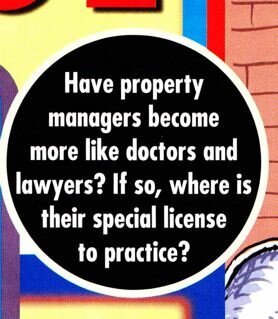
(3) ADVERSARY TRANSACTIONS. Some transactions are adversary transactions (such as buyer-seller and landlord-tenant) in which, Kleine states, “licensing is necessary to protect one of the parties, usually though disclosure to ensure fair play, and sometimes with cooling off periods as an enforcement mechanism.”
So what about managers? It is not completely accurate to say that agents are unregulated. Legally, a management firm must have a license. But it is not one that has much to do with the skills needed as a property manager. Under state law, a firm must have a broker’s license.
The reason goes back to the origins of modern management: when the licensing requirements were put in place, most New York City agents worked for owners of rental properties; they usually answered to one person – the landlord – and were primarily licensed because they had to handle financial transactions: collecting the rent and negotiating leases. The law clearly spells that function out. Article 12-A of the Real Property Law provides that anyone who, on behalf of another and for a fee, (1) negotiates a sale, exchange or rental of real property, (2) collects rent, or (3) negotiates a commercial loan secured by a mortgage must be licensed as a real estate broker, must be licensed as a real estate broker.
In order to qualify for licensure as a real estate broker, an applicant must have at least one year of experience as a licensed real estate salesperson or at least two years of experience in the general real estate field (e.g., buying and selling property or managing property owned by an employer), have satisfactorily completed both the qualifying salesperson course of 45 hours and an additional 45-hour real estate broker course as approved by the secretary of state, and have passed a qualifying examination administered by the state.
The courses, offered by a number of organizations including the Real Estate Board of New York (REBNY) and New York University, cover a range of topics, including management. The REBNY course is typical, including courses in estates, deeds, leases, contracts, titles and closing costs, land use regulations, construction, valuation, human rights and fair house, the environment, real estate mathematics, taxes and assessements, rent regulation and sign ordinances, and real estate property management.
“A substantial portion of the course requirements relate to property management,” says Marolyn Davenport, at REBNY. “We have tried to make ours very relevant to property management.”
Yet, out of 26 sections in the REBNY course, one is devoted to management for commercial, industrial, rental, and co-op/condo properties. Ronni Lynn Arougheti, a principal in Heron Management, teaches the management portion of the course: a five- to six-hour, one-day session, from 9 to 4. She admits that the session only touches on each subject but says: “Nothing can be a substitute for practical experience. When I teach the course, I try to give them lessons from practical experience in how to solve problems.”
Many argue that the courses do not adequately address the full-range of management duties – and that the skills needed by a good manager are vastly different from those needed by a good broker. “Management is a minute portion of the REBNY course,” says Michael Wolfe, president of Midboro Management. Adds NYARM’s Jones: “It doesn’t doesn’t teach you how to deal with the technical and practical side of property management. It’s really a broker’s course.”
Arougheti, also an officer with REBNY, says that the initial license is just a first step – managers can and should take more comprehensive, management-related courses under the continuing education portion of the law. But there is no absolute requirement that agents take rigorous management courses; they can opt for less-intense broker-related subjects.
 without one.Or, practically, they can do nothing at all. According to many in the industry, countless managers practice without even getting the broker’s license. For instance, the manager of a 22-unit Upper West Side co-op in Manhattan has operated as the agent for the property for almost a decade with impunity. Jones says that he is not alone. “A great many managers are functioning without brokers licenses. You can become a manager without a broker’s license. The law is not strictly enforced.”
There are a number of reasons why. Some operate under the premise that only the principal in the firm needs to have a license. Others interpret the broker law as not being applicable to them since it states that agents must have a license in order to collect rents. Because co-op managers collect maintenance and/or common charges, no diploma is necessary.
Even if both arguments are wrong, most managers have little to fear legally. To track down unlicensed brokers, the state relies on complaints from the general public. Any cases are turned over to state investigators and charges are made by the attorney general’s office. The fines are underwhelming to non-existent: operating without a broker’s license is a misdemeanor. Theresa Wright, a spokesperson for the Division of Licensing Services, could not report any case of a manager losing his broker’s license or being penalized for operating
STATUS QUO?
So what is the result of this? An industry in which managers can – and often do – operate without proper supervision, punishment, and education. Incompetence occurs more often than not, and the business leaves itself open for corruption.
After the last round of indictments, State Senator Karl Kruger (D-Brooklyn) drafted a bill to require management licensing. Among its features were annual registration of residential managers, judicial review, education and renewal requirements, and a provision for penalties.
Predictably, a democratic bill in a Republican-run body went nowhere. But there is more than partisan politics at stake. There is industry politics. Although many say they want licensing, a greater number seem to be against it. For instance, REBNY, the largest industry trade group, is opposed to Kruger’s bill, arguing that the current licensing requirements do not need a major overhaul – just tinkering.
“There are already requirements in place,” says REBNY’s Davenport. “The goal of the broker licensing law was to be as comprehensive as possible. Our position is that you can make it better. We are not advocating a new license. Over the years, we have made suggestions for ways to improve the law, but the legislature has not acted. We also feel we cannot support legislation geared towards specific certifications. No one in the industry wants to limit choices.”
There are possible financial reasons behind such opposition. “REBNY is against it because the organization is controlled by large real estate owners and they do not want to have to pay for education or higher salaries,” says the principal of a mid-sized management firm. “REBNY has a lot of power in Albany.”
“REBNY doesn’t want to see licensing go through,” observes Greg Carlson, principal in Carlson Realty and executive director of the Federation of New York Housing Cooperatives. “When you get down to it, it’s a fight over who’s going to control the educational piece of the pie. REBNY makes a lot of money on its membership and course fees – for its broker broker license program, salesman license program, continuing ed program.”
Carlson adds that the rental industry is also against licensing because “they fear will it will cost them more money for their property managers, who will demand more as licensed managers.”
Davenport says that such arguments are untrue. “If there were required management educational requirements, we would be in the forefront of that. There is no conflict of interest [in our opposition].” She adds that many agents do not want additional red tape or the costs of further licensing. “There are already requirements. We don’t want to put people in the position to meet multiple requirements.”
Then there is the honesty argument: you cannot legislate integrity. After all, licenses among lawyers and accountants do not stop corruption there. And if the threat of jail doesn’t hold them, what will threat of license revocation mean?
“The broker licensing has a code of conduct. If you’re convicted of a felony, you can lose your license; that’s adequate,” says Gerard J. Picaso, principal in Gerard J. Picaso, a management firm. “All those people were caught [in the Manhattan District Attorney’s kickback investigation], people still kept doing it, even though they knew an investigation was underway. Bad people do bad things no matter what the consequences.”
But can licensing mitigate some criminality? “The threat of eliminating someone’s ability to work is very powerful,” says J. Brian Peters, director of management at Rose Associates. “It may, in fact be easier to enforce that than to try and bring a legal case beyond a reasonable doubt that somebody was a crook. We have the lesson of these two rounds of indictments. The district attorney was successful in bringing the indictments, but the actual number of those convicted is relatively low because of the high standard needed for conviction. You would not need as high a standard to revoke a license.”
“This is not a panacea which will insure honesty and integrity,” admits Kuperberg. “I agree: you can’t legislate honesty. However, with mandatory certification, you can create several positive results. One would be a central registration system of all managers so that if someone is indicted or convicted of a crime, it would be on record.”
Currently, after paying a fine or doing jail time, a convicted manager can – and often does – go back to work as an agent and boards are none the wiser. “You have all those people who pled guilty to kickbacks and they’re still managing,” Kuperberg says. “That’s ridiculous. If you you lose a license of certification, you lose the ability to ply your trade. That makes it worth keeping, and they may think twice about jeopardizing it.”
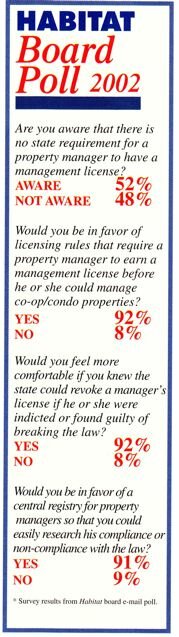 A management license could also improve the image of the manager as a professional, and could help recruit newcomers to the industry. “If you’re an accountant, or a CPA, or an attorney it means something to obtain a license,” Kuperberg says. “You work and study for it. I don’t know anyone who goes to college and says I want to be a property manager. Everyone has fallen into it. This would make it more of a profession.”
“My personal view is that co-op boards often view the manager as just another another vendor,” says PRC’s Khazzam. “They try and knock them down on fees, and as a result, you get the minimum level of fees. The work suffers because the agent is not viewed as a professional. Licensing and certification would help that.”
BUT WHAT STANDARDS?
Just as important – and perhaps the biggest road block – is deciding what kind of standards are needed. License requirements should start with the question, “What do managers do and who does this kind of work?” says NAHC’s Kleine, who adds that licensing discussions “need to address the ‘who.’ Should the firm be licensed or the individual? If the individual, which ones – principal, comptroller, property manager, site manager? If the firm is to be licensed, what are the licensing criteria? Firms don’t have education or experience, people do. Firms can’t be tested. Firms can’t be put in jail. Most licenses of firms simply require that they have adequate insurance. Remember, buildings do not have to hire a firm. They can self-manage and they can staff manage. And then defining the licensee and the bottom can be slippery. When I was president of a 90-unit townhouse association with a budget of $50,000, one proposal by the realtors in Virginia would have required our treasurer to get a license because we paid her $600 a year.”
There are are other areas to define. Is mandatory certification sufficient or should there be state-supervised licensing? Kuperberg is “strongly in favor of mandatory certification [because] licensing to me assumes a governmental-issued and overseen program along with whatever tests and procedures a governmental agency puts in place. That’s a lot of red tape. And every licensing regulation proposed [under state law] ends up being has been so watered down my 15-year-old son could pass. I don’t think the Department of State has the wherewithal or expertise to come up with something. There are several existing property manager certifications. One of those should be made mandatory.”
Any license should establish a baseline level of competence. “A continuing education requirement would help standardize the basic knowledge and qualifications of people within the field and help establish a threshold level of ability before somebody could be professionally involved in management,” Peters says.
“The benefits, especially for co-op or condo boards who come to their roles without real estate experience, is that they know they have a manager who has a minimal education,” Carlson says. “Licensing will not cut out fraud, or negligence, or stupidity, but it does tells the boards that they have someone running the property who has, at least, a minimum knowledge of the business.”
So, where does licensing stand? The industry says it is up to the legislature. The attorney general’s office, which regulates co-ops, also says it is waiting for the state lawmakers. But the legislature bows to lobbyists and the industry’s wishes. Until the trade associations get together and agree on a common goal, the politicians will not act. “As long as they’re split, nothing will happen,” NAHC’s Kleine says. “The turf wars in the industry and the money from lobbyists stop action in such situations.”
“There really isn’t a body that gets together on a non-competitive basis,” says Khazzam. “There is no body that speaks as one, providing unity and dialogue within the industry. Somebody has to stand up and unite; management companies have to get together and have a summit on the industry, but that’s nowhere near happening. We are so much at each other’s throats.”
“If all the trade groups would get together and set up a committee to work it out, something can happen,” Wolfe adds. “There should be a consensus. No one can convince me that a broker license is enough. All these organizations have different interests; if they could get together, legislation could more easily be accepted and passed.”
For change to occur, the bottom line is simple: co-op and condo owners need to get mad as hell and say they’re not going to take it anymore. “If boards push for it, more managers will get behind it,” argues Khazzam. “But you have a difficulty because of the nature of boards. They are volunteer, with a one-year term situation Once you educate him about why management licensing is needed, he’s gone and the process starts all over again. Ultimately, your client has to make that push.”
As long as boards accept the status quo, nothing will happen, except perhaps more incompetence, more indictments, and more trouble for an industry that, in general, insists on keeping its head in the sand. The issues are stark: the manager is often responsible for the financial life or death of a co-op or condo, and must guide a frequently unskilled and untrained, part-time volunteer board.
“In order to qualify to manage millions of dollars of money for clients all an agent has to show is a slip of paper that says he had 45 hours of schooling as a broker,” Kuperberg says. “Learning how to list exclusives is not a skill you need to have for management.”
Management 2012
[[wysiwyg_imageupload:796:]]
THE BUSINESS PARTNERSHIP
Experience coupled with volunteerism: a unique relationship that can last for decades or end in a flash. How to make it last, and make it good.
Eric Ackerman, president of a 192-unit co-op in Mamaroneck in Westchester County, recalls the incident clearly. A tenant-shareholder approached him in the elevator and asked: “Where was all that smoke coming from the day before yesterday?”
“Smoke?” Ackerman replied. It was the first he had heard about it.
Puzzled, he called the manager.
“Oh, yes,” said the longtime agent at the complex. “There was a minor incident with one of the boilers. It let off smoke – so we got the fire department in here – but it turned out to be nothing.” The agent was going to mention it at the monthly board meeting.
Ackerman was not pleased. “When anything – and I mean anything – goes on here, I should be notified,” he told the manager. “There should be nothing that I, as the president, do not know about. Even if no action is required, I should have been sent a note. And then a notice should have been posted in the lobby explaining what went on. I shouldn’t be out of the loop – and the owners have a right to be informed.”
Andrea Bunis, president of Andrea Bunis Management, recalls a conversation she had at another co-op. The board president was complaining about tardiness in her response to the board’s e-mails. She felt the complaint, though common, was based on a misunderstanding of how the communication process should work. “We get close to 300 e-mails a week,” she explained to him. “Most boards will copy us on their internal discussions, so we may get 10 e-mails on one day from one board. We try and respond quickly, but some of these e-mails need research – so we can’t give you a quick answer on those.” What she usually does in such cases, is send an e-mail saying, “We’re working on it.” But, she adds ruefully, “although they want an instant answer from us, sometimes they don’t get back to us with a decision for weeks.”
Two views from different sides of the fence, highlighting a key part of the management-board relationship: frustration. Indeed, although the bond between a co-op/condo board and its managing agent has been compared to a marriage, the two relationships are ultimately profoundly different because the management-board connection is a business partnership – but one that can go on for many years, often with the same account executive, and one that frequently becomes very personal. Despite this longevity, or perhaps because of it, the management relationship is one of the most talked about, complaint-prone, and personality-challenged one in New York today.
In an exclusive co-op/condo board survey, Habitat has identified four key areas that make a difference in the success or failure of the board-management partnership: expectations, initiative, communication, and board involvement. And, even though complaints are often heard about and from manager and board member alike, the survey (and follow-up interviews with board members and management executives) shows that most of those partnerships actually seem to be working fairly well, and that their successes (and failures) offer lessons for all.
Expectations
To begin with, the surveyed boards seem to stick with their management firms. Slightly over 60 percent have been with their current firm six years or more; some 16.5 percent have been with the same firm for 11 to 15 years; and some 12.6 percent have had a more than a 21 year relationship. Despite this longevity, 40.6 percent say the performance of their current agent is “sub-par” or “needs improving.”
In a follow-up interview with one participant, a board member at a 77-unit Manhattan co-op said the directors wanted a non-sponsor-affiliated manager who would take initiative. The early impression of the agent was “terrific,” but a little over a year into the partnership, expectations were not being met. “We were hoping that the new manager could train and guide the super, because he has some good qualities but he needs supervision,” notes Rhona Magelowitz, the treasurer, about the firm. “We’re just not seeing that yet."
Many managers feel that boards frequently have skewed, unrealistic expectations of what a manager can do. As Neil Davidowitz, president of Orsid Realty, notes: “Expectations of service and reporting are often tied to an economic model that doesn’t work for us. In short, for the fees we’re paid, it’s hard to live up to certain expectations for clients that are in a different business model. They’re in a corporate world where there’s an expectation of a different kind of reporting – financial models, long-term capital planning – that’s hard to [achieve] for the compensation we receive.”
[[wysiwyg_imageupload:797:]]
How do the successful boards get their expectations met? The key is to meet, to discuss, and to monitor. “You need to have face-to-face meetings with your board members especially at the beginning to come up with a fair and balanced plan for what you’re looking to do for your property short-term and long-term,” says Robert Friedman, a principal in Maxwell Kates, a management firm.
What this means is that you must clearly lay out what needs to be done and check in periodically to see that everything is on track – and then make course corrections as needed. “At the beginning of each year,” notes Michael Berenson, president of AKAM Associates, “we’ll go into each building and go into all goals and objectives for that year; we’ll see what we want to accomplish, whether it’s a five-year capital plan, or a new preventative maintenance study, or setting up a website. We’ll address that at that meeting and throughout the year there will be points where we meet to discuss the status of the items, and what they expect from us.”
Initiatives
The survey also revealed that a strong majority of the managers – some 68 percent – offered new initiatives. These ranged from a conversion to a gas heating system and the replacement of all common area fixtures with energy efficient bulbs to security cameras and boiler controls.
Managers say that offering new ideas is a no-brainer – and also a necessity if they want to be competitive with their colleagues.“The trick is to stay ahead of the board and be presenting them with the ideas, the initiatives, and putting it before them before you’re asked about them,” says Don Wilson, president of Blue Woods Management. “Tell them what the issue is and what some possible options are. If you present that all up front it makes them more comfortable and puts them at ease.” He says he draws ideas from his observation of all the properties he manages, often bringing an idea that worked at one building to another.
“You should have a strategy session,” says Dan Wurtzel, president of Cooper Square Realty, “where you look at goals and objectives and see how [your approach to them] can be improved. Otherwise, if you continue to maintain the status quo and the status quo isn’t working for either side, what you have eventually is a very unhappy client and a manager who isn’t doing the right job.”
“The key to being successful in a service business is to be proactive,” adds Berenson. “Just to sit back and wait for the client to ask is a reactive way to manage. At AKAM, we meet with our managers on a weekly basis and do a lot of proactive thinking. The managers go through items on a regular basis to discuss what they can enact in their buildings. We do a monthly walk-through of each building and give the client a written report – a checklist of all the items in the building [highlighting areas that need attention].”
[[wysiwyg_imageupload:798:]]
Such attention to detail leads to satisfied customers. “Our manager negotiated payment plans with our vendors because we were financially strapped,” says Alma Frank, board president of a 12-unit co-op in Chelsea, a survey respondent. “He suggested things to do, like prepayments on maintenance. He took the initiative. He had to communicate with people [the residents] who were never satisfied, who were never happy, who were belligerent. Our annual meetings were atrocious. There was board bashing, but he stayed on track, discussing what the city regulations are, how the elevator laws have changed, what new costs were, and so on.”
Nonetheless, over a third of those surveyed – 34 percent – said the manager proposed no new initiatives, and some even said they didn’t expect them to, either. “We usually come up with initiatives, and then work with the manager,” explains survey respondent Eugene Broughman, vice president at a 528-unit garden-style co-op apartment complex in the Bronx. “The last one we did was a boiler conversion and now we’re doing meter room upgrades. We’re a very proactive board. We say to [the manager], ‘This is what we’d like to achieve, is there anything out there that fits that model?’ And they’ll come up with their own suggestions.”
“Generally, the managing agent is responding to what we want,” adds another respondent, Charles Anderson, president of a 160-unit Manhattan co-op. “They offer a wide range of suggestions, but it is the board that makes the final decision.”
What can a board do to get more initiatives from the manager? “We measure initiative by productivity,” says Steve Greenbaum, director of management at Mark Greenberg Real Estate. “If there’s an item that needs to get done, the amount of time it takes to be done and the amount of professionalism involved proves how much initiative the agent has. It’s our role to take initiative and move things across the board.” If you feel the manager is not taking initiative, Greenbaum says you should talk to him about what you expect and if that doesn’t work, report it to his supervisor.
Communication[[wysiwyg_imageupload:799:]] The way boards deal with the managers on expectations and initiative illustrates another important area in the management-board relationship that came out in the survey: communication. Not surprisingly, the main method of communication these days is e-mail. Some 94.9 percent use e-mail as the primary means of communicating, as opposed to 38.8 percent who primarily use the telephone. “E-mail is great,” says Jay Silverberg, president of Zenith Properties. “It’s way easier to coordinate projects, getting in touch with vendors and board members in one communication instead of trying to coordinate conference calls. It’s concise and to the point.”
There is a great potential for abuse here, however. Nearly a third (31.3 percent) communicate with their manager every day, which seems like a lot (unless they’re involved in a project), while a slightly smaller number, 28.1 percent, communicate (perhaps more reasonably) once a week; a solid 50 percent do so only as needed.
Managers have mostly positive things to say about e-mails, but offer caveats. “Because of technology, the expectations are for immediate replies, immediate answers,” says Friedman, of Maxwell Kates. Adds Davidowitz of Orsid: “You have an obligation to get back to them [within 24 hours] and say, ‘We received it. This is what I can answer right now; these additional questions are requiring further analysis, further review. We need more time.’”
What can boards do to smooth out the lines of communication? “Boards don’t often speak with one voice,” complains Davidowitz. “They’re split on decisions. We need one voice and one decision.” The solution is to set up a single person as the liaison – usually the president – with the manager, which should cut down on confusion and save time. But even while you’re doing that, adds David Goodman, director of business development at Tudor Realty, “you should copy all the other members of the board so no one says they weren’t informed.”
Board Involvement
Board members who complained about their managers in Habitat’s survey were also among the ones who described themselves as “proactive.” In fact, even boards that expressed satisfaction with their agents – and had stayed with them for years – said they tended to be involved or very involved with their building’s activity, describing themselves in subsequent interviews as “proactive” or “hands-on.”
The survey found that nearly half – 47.9 percent – were involved in the day-to-day running of the property, while 45.8 percent were “very involved” but not on a daily basis.
“Tougher economic times require the boards to pay even closer attention to where their money’s being spent,” says Silverberg of Zenith, “so there’s a lot more activity by boards.”
A few board members in the survey follow-ups, point to the management kickback scandals of the 1990s as a turning point in the management-board relationship. Until then, many boards were content to turn over the reigns of power – the day-to-day decision-making, if not the basic running of the building – to the manager. But after two rounds of indictments in 1994 and 1997, most boards realized that oversight was necessary and an ever-increasing number got more involved, attending educational seminars and taking more of an interest in what had been considered a mundane job.
In follow-up interviews, most managers said this was a good thing, since savvy boards make their jobs easier. “Co-ops are not as mysterious as they were in the past,” says Greenbaum. “People understand them more. There’s been a lot more information and people have been educated about co-ops. I’m like Sy Syms, I believe ‘an educated consumer is my best customer.’ The more they know about what we do, the better they are, and my most educated boards are the ones that are most responsive. The more educated they are the better.”
Habitat, July/August 2012 (written June 12, 2012)
Management Issues
PARTNERING WITH THE BOARD
[[wysiwyg_imageupload:947:]]Call it a different face of management. Or call it a change of approach. But whatever you call it, don’t call it mundane.
Judy Mann didn’t. The board president at the 173-unit Newswalk condominium, Mann was frustrated by her condominium’s most recent management firm, which promised the moon and delivered only scars. In fact, Mann was getting skeptical about the very idea of a management firm.
“I think the managing agent business is a very complicated one. Having a cost-effective system that works is very tough – at least, it has been in our experience here.”
She recalls the previous firm that had managed her property. The Newswalk is a luxury gut renovation of a Daily News printing plant in Prospect Heights, Brooklyn. “We had a managing agent who was very good at tracking arrears and staying on top of payment plans. She wasn’t so good at staff supervision and some of the building’s technical stuff.
“So we went to the management firm and said, ‘This is only semi-working,’ and we were told we would be getting a replacement: a star managing agent. Then he was piled high with buildings, and we never saw him.”
Soon after, Mann’s condo found a new management firm that was “very, very customer-focused, dealing with our unit-owners on a very personal level.” When KW Property Management & Consulting, which manages 45,000 residential units from six regional offices in three states, started working at the Newswalk on November 1, the company sent out a packet to all the unit-owners. That not only introduced KW, but it also offered a questionnaire asking people what kind of service they expected to get from their managing agent.
“It never even crossed my mind that you could have a questionnaire like that,” says Mann. “All I ever wanted was that a managing agent would get back to me someday without my having to work too hard at it.”
KW immediately began training the staff. KW told the board that there was no staff room, no lockers, and no refrigerators in which the staff could put their food. “Then we found out these guys were working with their own tools,” recalls Mann. “There was no one paying attention.”
Every week, the board received a management report. “It has all of this information that we have never known,” Mann notes. “What are the move-ins on rentals, what are the purchases? The things he’s taken care of, staff supervision. We have a terrific super who has needed backup. He’s getting it. All the pieces of the puzzle are falling into line. It’s a real partnership.”
Partner or consultant? Most management firms say they are not just employees of a co-op or condo but partners. “‘You’re as good as we are and we’re as good as you are’ is what I tell my boards,” says Peter Lehr, director of management at Kaled. “We have to be on the same page. I would say it’s more of a partnership now.”
But partnership takes on different meanings depending on who’s talking. Many managers see partnership as a way to guide their boards through the maze of real estate issues. “When you look at the things we do – today, I’m dealing with installing new booster pumps in the building. I have a temporary boiler in one building, we have an environmental issue in one building, there’s a legal issue in one building,” says Michael Wolfe, president of Midboro Management. “In what other field do you have to have a very good working knowledge of all those categories?”
There’s a new kind of partnership emerging, however. It is a partnership based on economic need – the co-op saving money, the management company earning it – and that may be pointing to a change in the management landscape. As David Kuperberg, the CEO of Cooper Square Realty, puts it: “Can management services do more than day-to-day management and help the building improve and succeed? To be a caretaker manager is not what boards want now and is not what’s effective.”
Is this the Future
“Just collecting the maintenance, doing a budget, paying the bills, and making sure the staff shows up is not enough anymore,” says Kuperberg. “The good managers are the ones that help their buildings do better than what everybody else is doing.”
Indeed, Cooper Square has broadened the range of services it offers while under the ownership wings of the larger First Service Corporation. Among the areas it now covers: project management; energy services; on-line sales and lease applications; insurance pools; free move-in services for new residents; and energy financing.
“It really is partnering with our boards to reduce costs,” says Kuperberg. “By reducing costs, we are increasing property values. There’s a correlation between maintenance/common charges and purchasing prices. The lower the carrying charge, the higher the purchasing price.”
While such programs may be a trend for the future, most New York management firms don’t have the size needed to offer them. For instance, Cooper Square, which is owned by the larger First Services Corporation, can take advantage of First Service’s size to become part of a 24-hour “customer care center.” Kuperberg says that “this is a service business, and it is our job to service all the residents of our buildings.” One of the greatest complaints, he notes is that managers do not return phone calls – promptly or at all. The manager, he notes, is frequently in the field, and ends up playing frustrating games of phone tag with residents calling with questions. In response, Cooper Square offers its customer care center, with a 24-hour-a-day bank of phone operators who do nothing but answer questions. “We have 600 pre-answered questions for each building with a Google-type search engine,” says Kuperberg. Each building might have similar questions – what is required under the alteration agreement, for example – but the answers may vary depending on the circumstances of the particular property. The operators have access to the records of every Cooper Square client. If it’s an emergency, it’s transferred to an agent’s cell number.
But, Kuperberg freely admits that such a center would not be feasible in New York. “There isn’t the volume needed,” he says, adding that it pays for itself because it is a regional center dealing with First Services clients as well.
Some managers think there are drawbacks to these large-scale “partnering” relationships. “You set up these outside service companies and they can take away from your core business, which should be management,” says Wolfe. “I think there are conflicts of interest in setting up a separate company.” He believes that it can hurt the management firm’s credibility when it is recommending work. Some may ask, ”Is it really necessary? Or is the manager trying to create work for his subsidiary?”
[[wysiwyg_imageupload:948:]]
Although the Florida-based company KW currently only manages three properties in New York City, Andy Ashwal, the executive director at KW who is managing the Newswalk condominium, has high hopes for the firm’s future in the Big Apple. But he says it is not planning to set up any subsidiary companies to do construction management, among other things. Ashwal says he feels that such operations dilute the mix, and that management is about running the buildings in a proactive way.
There is also the question of what happens if your board doesn’t like the core management services, but is locked in to all the extras? Does it live with poor management in order to get the carrots dangled from the partnering stick?
For, as many managers argue, the business of management should be management. Neil Davidowitz, president of Orsid Realty, says that, “basically, our role is to ensure the stability of this corporate entity. It’s almost like a guardian. You’re in charge of all elements but you answer to someone else: your board.”
Being in charge means more than dealing in a reactive way, and many management companies already practice long-term planning for their buildings. KW, for instance, typically projects five years into the future.
“That’s centered on maintaining the central plant,” notes Ashwal. “It revolves around Local Law 11 and other regulations. It’s looking at staffing – how you might need to be moving your staffing around, as well as other cosmetic capital things, like changing carpets every five years. Have you done an engineering study so you can set aside reserves?”
Ashwal says that such planning is attractive to boards. He notes that his company’s size – and the purchasing and manpower efficiencies that come with that – come may be one reason that the new-to-New York company may make inroads. But another calling card is the firm’s philosophy, which may sound familiar to long-time New York City managers.
“As apartment prices go up, as purchasers become increasingly more sophisticated, as we expect the flow of information to be more open, management companies will increasingly have to provide more information, more vision to their clients,” concludes Ashwal. “It’s definitely become a partnership. We work for the building, so they are definitely the boss in the scenario, but I believe that we are the ones that are helping them make their decisions and steer their ship. If you’re not initiating things then you’re not adding value.”
Habitat, January 2013
Micromanagers
DON’T CALL HIM A MICROMANAGER
By Tom Soter
Call him a “take charge” kind of guy, but don’t call Michael Herzog a micromanager. Although he admits to being a “detail-oriented” person, he says that, unlike an actual micromanager, he knows when to pull back and when to engage. As the president of the 68-unit co-op at 257-291 Cedarhurst Avenue in Cedarhurst, Herzog has been actively involved in the affairs of the garden apartment house for over three decades. An accountant for many years, he arrived there in 1961, raised his family at the property, and represented the tenants in negotiations with the sponsor during the property’s conversion to a cooperative in the 1980s. He has served as the board president from 1988 to the present, admitting he has even more time for the co-op since he retired. Herzog, at 77, hasn’t slowed down, spending at least 28 hours a week on co-op business. He sat down with us recently to discuss the benefits (and perils) of “take charge-ism.” (Is he a micromanager? Well, he did call Habitat three times after the initial interview to clarify and add to what he had said. But that just could be an attention to detail...yes?)
How would you describe your role on the board?
I see both the big picture and the small picture. It's not only a co-op, which is a business, but it's my home, and I want to make sure it is the best place for my family and everybody else to live.
How often do you touch base with your managing agent, Steve Greenbaum, the director of management at Mark Greenberg Real Estate?
I e-mail our manager every day. We are in touch all the time. Any course of action I want to take that is other than routine, we check with each other before we do it. I am probably a pain in the ass to him because I am e-mailing him or calling him and his staff all the time.
How much time do you spend every week on board matters?
Maybe the average is four hours a day. But you’re on the job all the time. I was walking the grounds the other night, and I noticed that one of the lights was out, which the porter wouldn’t have seen because he isn’t here at night. So I called the porter at home at 9 o’clock that night and told him to replace it.
And that’s easier than calling the manager?
Well, first of all, I wouldn’t call the manager for something like that because if I call him and he calls them it's going to take an extra two days. I live here; it's not a burden to me. That’s my nature, yeah. I am not walking around the property all the time. I just happened to be there; I saw the light was out. We don’t want to bother the management company with little stuff like that because when the big thing happens, they are not going to jump to it as much if I have wasted their time with a lot of small stuff. Four or five years ago, our boiler went out in the middle of the winter. I needed Steve – who knows how to deal with it – to deal with it immediately, which he did. So he and the management company can really concentrate on the important big issues, and I am not going to waste their time with light bulb has to be changed.
But should you get so involved in everything?
Accountants tend to be detail-oriented, and as an accountant, I am a detail person. I’ll give you another example. I happen to like landscaping. We have a beautifully landscaped building. Every year, in the spring, I go around with the gardener and we spend let’s say $4,000 a year on landscaping. That’s not the gardening because the gardening itself runs us about $13,500. So I go around with the gardener, and I say, ‘I want trees here,’ and I tell him what kind of shrubbery I want planted, what kind of trees I want planted and everybody is satisfied with the results. I enjoy doing it. Now the manager is not going to go around deciding the landscape, and I don’t want to necessarily leave it up to the gardener himself; I want to be involved.
So you think that someone in your position should have such attention to detail? Is it that important to get down into the nitty-gritty?
I believe in attention to detail, yes, okay, but the attention to detail can be different. Such attention to detail works in a small building like ours wouldn’t work as well in a larger property. In a large building like North Shore Towers where, first of all, it would be mentally and physically impossible for one person to do there what I am doing here, you have to obviously delegate everything, and there you are strictly going to be a macro-manager; you couldn’t do anything else.
I get involved in everything here, whether it is making sure that when I get the monthly report on expenditures and maintenance, if somebody is in arrears, I immediately discuss that with the bookkeeper about what action we should take. Because I have been involved so long, and thereby having had a lot of experience, mistakes that I might have had made in 1988 I won’t duplicate now.
So what drives you?
I just want to see the building run well. It's my home. It's the investment for a lot of people. I want to see it done right. I think if somebody is not respectful of other people, it's not going to work. I think if you are not open to hearing people’s complaints. I will give you an example. A resident called me, said she had some surgery and there was no hand-railing on the two steps going up to the entrance door. She said that, because of the surgery, she needed a hand-railing to get in and out. That same day, I called Steve. I said, “Steve, we need about a ten-foot wrought-iron railing. Do you have somebody who could do it?” He called somebody; in two days we had somebody here and we put in a wrought-iron railing, okay. So if you are not going to be responsive to individuals’ needs that are legitimate, you get a lot of complaints that you can't deal with.
Do you ever feel you take on too much?
For me? No. I mean, again, that’s my nature; I always take on a lot.
Do you know your limitations?
It's very important to know your limitations. I always start with an idea. I will kick it around with the board members, but we always go to Steve, our manager, because he is the professional; obviously I want professional advice on things I know nothing about. You have to know your limitations, otherwise you are going to get into difficulty.
One of our board members is a New York City police officer, and he took the lead – this probably goes back six years ago or so – with [getting security cameras for the property]. He had knowledge about that, he was good, and he and I went together to look at other buildings that had security cameras. But I certainly let him be the lead on that because he knew more about it than I did.
I am very interested in things about co-ops, and I read a lot about it particularly in your magazine, the Cooperator and the New York Times. I always look at things that other buildings are doing that I am not aware of, and ask myself, “Do they apply? Would this be good for this building? Not good for this building?” And a year or two ago, there was an article in your magazine about what is the responsibility of boards and management companies for people having guns in the building?
So I read that, and I said, “How does that apply here?” What I do all the time is get input from the rest of the board. First of all, I forwarded the article to all the board members and to Steve, even though they get the magazines, to make sure that we focus on this, and I asked for input: “Do you think this is a good idea to have it?” Now, it's very interesting because I was leaning towards it might be a good idea to know if people had guns or not. But the board member who is a New York City police officer was very much against it. He said, “Look, we know there are two people in the building that have guns.” One was the police officer, and other is a court officer.” He said he doesn’t want people to particularly be aware that he is a police officer and he said he doesn’t want people knowing that he has a gun in the apartment because it becomes a target; people are going to want to break in and steal that gun. So that gave me a totally different perspective, and we didn’t pursue it. You have to get input from other people.
If you had to sum up what the role of the board president, would you say it is someone who takes on extra duties because he has to or because he wants to?
I would certainly not say it's because he has to. Circumstances to a certain extent determine the role that the president and the board are going to take. So in this case – because of what I have described, because of what the management company’s role is, because of what the other board members’ role is – I work within that environment to do my own personal style. In the end, it depends on the shareholders and how much involvement other shareholders want. I would certainly think that if there were a lot of shareholders who wanted an active role, okay, I would do less.
Let me put it like this, I could be a good Indian or I can be a good chief. If there was somebody that had a lot of expertise in something and wanted to do it, that’s fine. As long as it's being done well.
SIDEBAR
BECOMING A “HANDS-ON” PRESIDENT
A FIVE-STEP PROCESS
Board president Michael Herzog offers advice for small- to mid-sized buildings on steps a president can take to be “hands-on,”
(1) Respond quickly and communicate regularly with the residents.
(2) Know your limitations. Don’t feel you have to know everything.
(3) Don’t keep re-inventing the wheel. Keep abreast of developments at other properties. Read real estate publications to find out what others are doing.
(4) Discuss matters with the board.
(5) Be sure the board is comfortable with the number of tasks you are taking on; don’t hesitate to delegate.
January 14, 2015
No More Leaks
[[wysiwyg_imageupload:1075:]]
Spotlight on
70-25 Yellowstone Boulevard
Plagued by leaks in its large underground garage, the board at 70-25 Yellowstone Boulevard, a 563-unit Forest Hills cooperative, was seeking solutions. The situation was simple but frustrating: an Olympic-size pool on the building’s ground floor was leaking into the garage below it. Not only was spalling occurring on the walls, but the water was harming the structural integrity of those walls – and damaging the cars as well. The situation had gone on for nearly a decade, with various stopgap remedies being employed to stem the tide, but a permanent solution eluded the co-op.
Then, Yvonne Marscheider, assistant treasurer of the board, came across CGI Northeast at a trade show. That isn’t a special effects film company – as in Computer Generated Imagery – but it does offer some special effects of a more practical nature. CGI in this case stands for Concrete Gel Injection, a relatively low-cost and low-impact waterproofing solution.
“I thought it was something we should look into,” Marscheider notes. “When you saw the sample it was so common-sense smart that you immediately took an interest in it,” remarks Tony Pelloise, the property’s executive manager, who works for Gerard J. Picaso Inc. Since 2004, CGI Northeast has successfully completed over 300 projects (both commercial and residential condominum/cooperative buildings) within the tri-state metro area.
This is how it works: CGI contractors come in, drill a hole on the interior side of the building where a crack has appeared. Then Aqua Loc Resin LV goes to work. That is a “two-component hydrophonic resin system,” explains George Doukas, executive vice president at CGI. The resin is injected and when water is added, a flexible, “rubber-like” water-sealing gel is formed. “Upon the calculated setting time (as fast as five seconds for active leaks), the two components will become a gel, occupying volume within the depth of the structure and forming a gel on the positive (exterior) side at the crack points of entry (between the wall and the soil),” he notes.
The gel is non-toxic, odor-free, and environmentally friendly. Because the Aqua Loc Resin LV and the additives are close to the viscosity of water, these fluids can migrate into the smallest of cracks, fissures, and water pockets within the depth of the concrete. The fluids will also travel full-depth to the membrane above to form a gel, if the membrane has been compromised.
Alternative methods (by other companies) would have been to work from the exterior, which would have meant tearing up the grounds outside to get at the leak. In Manhattan, you usually don’t even have that option, notes Doukas, who adds: “Unlike Grout injection (urethane expanding foam injection), our system does not require ports (i.e., hydrocarbon steel) that often times remain embedded within the points of injection and will eventually corrode and allow water to intrude again. Rather, after our injection procedure is completed, our twist-in tools are taken out and the bored holes are closed with hydraulic cement.” Doukas says a big plus of CGI is that it works from the inside.
The process was completed more quickly than a major construction job – it took about a month – and was cheaper ($25,000) and less intrusive. The co-op subsequently hired CGI Northeast for a $45,000 project to Aqua-loc all the other areas of the garage, a process that is currently under way.
Pelloise is pleased. “This repair prevents a million claims from happening where people get damages to the finish of their car, caused by leaks,” he notes. “We were able to address the worst of our leaks coming from the pool deck. It’s a tremendous alternative.”
The new job will take about three weeks, estimates the manager. “To replace the entire roof membrane of the garage would cost us about half-a-million dollars,” explains Pelloise. “The membrane project will have to be done down the road, but this [new product] allows us to put more money in the reserve to help us prepare for the membrane project. And, in the meantime, we’ve solved the more pressing problem.”
Habitat, June 2013
No Smoking
Margaret Enloe doesn’t remember whose idea it was, but it sure made a lot of sense. “Air purifiers,” she says now. “You have a problem with the air and that certainly helps.” Enloe, who has served on her seven-member co-op board for at least half a dozen years, also doesn’t remember when the complaints about secondhand smoke started – “Before I was on the board,” she observes – but she knows when they stopped: after the board successfully banned smoking inside apartments at the 76-unit, prewar cooperative at 15 West 84th Street. How they did it is an object lesson in implementing a potentially controversial measure.
To begin with, the board at 15 West 84th started with an advantage: it had always had a good relationship with its shareholders and had been transparent in its decision-making, even going so far as to distribute copies of the minutes for everyone to see.
When the secondhand smoke complaints increased, Enloe says, the board examined options. Someone – possibly an agent from the building’s management firm – suggested that they try installing air purifiers. Fred Rudd, the president of Rudd Realty, recalls utilizing purifiers at the 200-unit 215 East 80th Street in Manhattan, a building his firm manages.
“People were complaining about secondhand smoke [at 215],” he notes, “so we asked the tenant [who was smoking] to install two air purifiers with charcoal filters in his [two-bedroom] apartment. The building bought them and will pay to change the filters as necessary. The building is also paying for the electricity.”
He reports that each device costs about $400, while the electric usage, if running constantly, comes to $75 per device annually. Rudd adds that the expense in such cases is minimal – and the results could be major. “You’re not talking about a great deal of money – and you’re dealing with someone else’s health,” he says, adding another plus: “Many, many people prefer to be in a building without smoke. Taking these actions help sales.”
Back at 15 West 84th Street, Enloe felt the air purifiers – which in her building were paid for by the smoking shareholders – were not enough. The devices kept the air cleaner, but the smell and the smoke often lingered. The board members discussed the possibility of banning cigarette smoking altogether, which led them to attorney Richard Klein, a sole practitioner who gave them the practical steps for doing it. They were told that, while they could pass the ban by a resolution in the house rules, in order to protect the ban from legal challenge, they needed to make a change in the proprietary lease. That meant they had to achieve a super-majority vote from the shareholders.
The board members approached the upcoming vote methodically. The co-op’s attorney drafted the amendment, suggesting that they grandfather in the four existing smokers, exempting them from the ban for three years. At the end of that time period, the smokers would have to give up cigarettes – or their apartments.
Enloe says the limited grandfathering clause was inserted partly to make the smoking ban “more palatable” to (and thus gain votes from) a number of shareholders who had expressed concerns about banning an activity that was occurring in the privacy of someone’s apartment (smoking has long been banned in the building’s public areas – which include the area directly in front of the property).
Klein adds that the board thought that putting a ban in place – and still allowing a handful of people to smoke for an unlimited time – defeated the point of a smoke-free building. Three years, he notes, is a reasonable amount of time to give someone to quit the habit.
The board distributed the amendment to the owners and then held a pair of informational meetings with the shareholders, explaining what was happening and addressing any questions and/or concerns. The ban meant that new buyers or even guests of current owners could not smoke anywhere on the premises. Buyers had to sign a statement acknowledging that they knew it was a smoke-free property.
“They listened,” recalls Faith Brenner, a manager from Rudd Realty who has handled the building for the last two years. “There were non-smokers who stood up for the rights of smokers... It is a family building and people would say, ‘There’s smoke going into my child’s bedroom.’ It was a concern.”
Then, at a third meeting, the shareholders voted in favor of the ban. “The vote was quite a bit beyond what we needed to pass [the measure],” Enloe recalls, about 17,000 shares for and 3,000 against.
That was in February 2010. In the ensuing three years, two of the smokers have quit and a third has turned to mechanical, smokeless cigarettes. A fourth, however, is hanging in there. The board will not comment, but the question remains: what happens if that last smoker would rather fight than switch?
There may be grounds for a battle, too, argues attorney Stuart Saft, a partner at Dewey & LeBoeuf, who was not involved with this building but has successfully implemented bans in other co-ops. His particular area of concern is the limited grandfathering measure.
“I’m not sure, legally, if you can retroactively tell someone that they cannot smoke in their apartment. You can tell them that smoke can’t leave their apartment, but – as much of an anti-smoking advocate as I am – if somebody already owns the shares and has a lease and is living in the apartment, I don’t think you can take away their right to smoke if they’re not affecting anybody else. [Even] if they amended their proprietary lease, there’s a fair likelihood that it wouldn’t survive a challenge [from the grandfathered people]. I don’t know anything in the corporate documents that gives the board that kind of authority. They could bring an objectionable conduct action [to evict him], but the smoke would have to emanate out of the apartment.”
Klein, the attorney who drafted the change, disagrees. “I’d be worried about [losing] a court challenge if we had simply done it by board resolution,” he says. “But we did it all by the book. We got a super-majority of the shareholders to agree, and we amended the proprietary lease. Under the Business Judgment Rule, I believe the board acted within its rights, and I think the courts would concur.”
Enloe, for her part, feels the board did what it had to do. “You need to do it thoughtfully, without rushing it. To be effective, you need to do it as a change to the proprietary lease. You need to let people air their views, both the pros and the cons. It’s not something you can jam down people’s throats because it touches everyone in a very visceral way, close to their homes, so they have very strong views about it. Nobody came to the [final] meeting unaware. Part of our thinking was you have people smoking, which is not a protected activity, and it is incumbent on you as a board – if you have people affected by that – to take care of the complaints. We felt we had a responsibility to do something about it.”
Habitat, January 2012
Paying for Performance
SHOULD CO-OP BOARD MEMBERS BE PAID?
[[wysiwyg_imageupload:90:]]I never thought much about it, but some cooperative housing association board members think they should get paid for what they do. My small, 22-unit Manhattan co-op, like others of its type, flirted with this idea some years ago when a board member took over as the manager. Our smallish management company had been falling down on the job, and one director – who worked at home anyway – found himself taking on more and more of the manager’s duties: dealing with contractors, keeping watch on the building systems, responding to shareholders’ requests, even going to the Department of Buildings to appeal rulings. When we had finally had as much as we could take from our manager (at one meeting, I asked why some long-standing task had not been completed, and her response was: “Well, you can pick up the phone and make a call to the contractor, too, you know”), we decided to hire our director as manager. We had to pay him, of course, but we were traditional enough to have him step down from the board.
And that brings us to the question of the hour. Why are professionals and most board members so dead set against the notion of paying for board service? To hear them talk, you’d think the discussion was about bribery and corruption not compensation for time spent. “I don’t think it’s appropriate. Most bylaws prohibit it,” says Arthur Weinstein, a veteran co-op and condo attorney. “It might create the wrong incentive for a person to serve on the board. They’d be serving for the money rather than for the good of the building. And I don’t think you could ever compensate people fairly for the amount of time they put in. It would be inadequate.”
“It doesn’t seem that ethical from the outside,” notes CPA Jay Menachem. “The board isn’t supposed to make money off the building operation – to take compensation for what is supposed to be a voluntary job.” ”
“If they are running for the board to make a financial windfall, then that’s the wrong motivation,” argues attorney Steve Sladkus, a partner at Wolf Haldenstein Freeman Adler & Herz. “Board members should not be paid,” agrees attorney Matthew Leeds, a partner at Ganfer & Shore, adding unequivocally: “They would be looking at the job for the money.
So what, you might ask, is wrong with doing a job for money? Does a corporate board expect its directors to serve without compensation? Of course not. And with the compensation, say some, those corporations get top-notch people, picked for their expertise not their personality or popularity with the shareholders. After all, would you rather invest your life savings in a corporation with a “professional” board that is trained in the matters with which the corporation must deal, or would you prefer to put your money down on the corporation with the “amateur” board that was learning as it went along?
What’s stopping more boards from getting paid begins with tradition. The reluctance to offer a salary goes back at least to the 1940s, when the “Model By-Laws,” issued by the Federal Housing Association, required that the unanimous consent of the shareholders be sought in order to compensate board members. But that hurdle can be overcome: although the bylaws generally prevent compensation for boards (other than reimbursement for money spent), there does not appear to be a city, state, or federal statute or regulation prohibiting it.
So, should you try compensating your board members? What are the pros and cons of paying board members for their services? What might be the consequences? The issues raised by professionals include:[[wysiwyg_imageupload:91:]]
The Expectations Game. “You would just be raising expectations among shareholders,” Sladkus notes. “We’re paying you all this money and you’re running the building into the ground.”
Do They Care? If you recruited from outside the property to hire board members for their qualifications, you get people, “less interested in the building because they don’t live in it,” claims one veteran attorney.
The Discipline Conundrum. If you are paying resident-shareholders for their service, it is harder to discipline them. I know that in my building, the ex-board member/manager we paid, would often do what he wanted, regardless of board instruction. He was our neighbor, so it was difficult to come down on him. Similarly, one co-op that CPA Menachem once represented had a problem because the board president was a three-man band. “We found some financial irregularities,” he notes. But to whom was he to report them? The president was also the salaried bookkeeper and manager. He finally wrote a carefully worded letter to the board. “Normally, it’s much easier to rectify a problem when there’s a segregation of duties,” he explains. “There may be nothing wrong with it, but when you’re paying someone who is also in charge, there can be the appearance of impropriety.”
Nonetheless, there are boards that pay members for doing work. “These particular boards are not using a management company and are paying for less than they would for a management company,” says Menachem. “They’re doing a lot of extra work and paying a little money.”
He cites a 51-unit condominium in Queens where the board president and the treasurer, two long-time residents and retirees, were “paid” by not having to pay common charges, about $500 a month. “The president and the treasurer would split the tasks, getting together the revenues, paying all the bills, keeping the books. You have to keep track of common charges. Possibly sending fines. And so on. It was a great deal of work.” The treasurer has since given up the job and it is now handled by an outside, salaried bookkeeper. The president still gets paid, and says Menachem, “does a lot; he walks the grounds every day. You could go out and get an outside management company, and they’d pay more.”
There is also a nine-unit Manhattan co-op in the East 50s that pays a shareholder/board member about $515 month to handle the property. That’s no surprise, says the cooperative’s CPA Menachem, because the co-op, with five people owning the property’s eight units, doesn’t have the cash for outside management. And, anyway, the manager has building maintenance experience in his day job as an outside project manager; for his building, he pays all the bills and handles all the problems. He has been on the job for over 20 years.
That said, how then do we answer the question, “To pay or not to pay?” If you can cope with – or are at least aware of – all the issues raised by professionals, then you can at least make an informed decision. But, perhaps the best answer is to sidestep the question altogether. If it’s a question of no-nothing boards vs. savvy ones, then we might agree with the position of managers and attorneys who say that the answer to the “amateur board” problem is not compensation but education. A number of managers and law firms told me that they do this by staging regular educational seminars for their boards, and also encourage the members to attend seminars at the [[wysiwyg_imageupload:92:]]Council of New York Cooperatives & Condominiums – and to read Habitat and other real estate journals.
“I think a training program is a great thing,” says Sladkus. “I’m surprised that more businesses haven’t been started to train board members. If someone were to organize that I’m sure boards would pay for that.”
“We often have sessions with board members explaining their roles to them,” adds attorney Steve Wagner, a partner in Wagner Davis. “We explain what a fiduciary is, why they are fiduciaries, what that entails in terms of their conduct and the liker. I think it’s very valuable because a lot of times people haven’t served on the board and don’t know what’s involved, and rather than ad-libbing it, that puts a frame on what they should and shouldn’t be doing. The training process isn’t that you get a two-hour training session and then you’re qualified to be a fiduciary. Education is an ongoing process.”
August 24, 2010
Resources for the Elderly
[[wysiwyg_imageupload:819:]]
For many at the Fort Lee, N.J., cooperative, “the problem” was getting out of hand. In a nutshell, some owners were upset about a group of residents, all aged over 70, who kept sitting in the lobby day after day. They would talk to each other, talk to the staff on duty, and, in the words of one owner, “make a nuisance of themselves.”
The board was at a loss. The directors knew that the lobby was not a place for congregations. They politely asked the group to leave. Many times. But the so-called “Lobby Gang” continued to sit and chat. The board discussed it at innumerable board meetings. The members grew frustrated. And the gang remained in place.
A tempest in a teapot? Perhaps. But on a practical level, the board had a point. “The lobby is a place of egress and ingress,” explains Jeffrey Levy, a manager at the Argo Corporation. “It shouldn’t be a meeting room. And it’s not just a question of letting seniors sit there: it is people – it could be teenagers, it could be anyone – congregating in that space. For one thing, it’s a potential fire hazard. And there’s another problem. Some may think it doesn’t look that good to potential buyers to see people hanging around in the lobby.”
Yet there is a bigger concern at stake, and it has to do with why the seniors were sitting in the lobby to begin with. Simply put, the issue is the elderly. It is an issue that affects everyone, since the over-60 class is one that each owner will eventually join. And in a housing association, where the residents run the show, care of and concern for seniors becomes a particularly important issue. How does a cooperative, condominium, or homeowner association treat its more senior members? As a nuisance? Like everyone else? Or does it simply ignore their needs until a crisis occurs?
“The Bible says that society is judged by the way it treats its elderly,” notes Alvin Wasserman, director of Fairfield Property Services, a Commack, N.Y.-based management firm. “I think that applies to homeowner communities, as well.”
Boredom and NORCs
If your property is made up of young urban professionals, some may think that, when compared with lobby renovation or boiler repair, dealing with the elderly isn’t a pressing issue. But it could be.
“Naturally occurring retirement communities – or NORCs – find themselves in all parts of our country and throughout the world,” observes Nat Yalowitz, a board member at Penn South, a 2,820-unit Manhattan cooperative and the CEO of the NORC Supportive Services Center (N-SSC). “Extensive research indicates that most people prefer to continue living where they have been living even after retirement. When there are large numbers of retirees who accumulate in one community, they form a NORC.”
On a basic level, boards should take an interest in every member of the community, looking on the residents as a resource rather than a burden. “I do not think that any one subculture should live by itself due to age, religious belief, or race,” says Levy. “My thinking is that the more the mix the better it is. With senior citizens, you can learn from them in their life experience.”
Indeed, many say that seniors have much to offer. They usually have more time to devote to the property because they are frequently retired, and they often bring previous a wide-range of experience to the plate. “Even if they’re not on the board that doesn’t mean they can’t participate,” says Howard Kupferberg, principal in LCC Realty in Cedarhurst, N.Y. “If you’re looking for new hallway lights, or redecorating ideas, it is worthwhile for the powers that be to get people involved in some fashion.”
“Many retirees have time to serve on committees,” notes Elaine Warga-Murray, president of E.W. Murray Associates in Howell, N.J. “They can bring very useful knowledge because they have the experience of being in business.”
Managers suggest getting seniors involved in a variety of ways. They can write newsletters, serve on committees, or keep an eye out for problems in the property. Jay Cohen, executive vice president of A. Michael Tyler Realty in Manhattan, suggests using seniors as an extra set of eyes and ears. “They see all, hear all. They can help keep an eye for things. If they see strange people or someone moving into the building, they can report it.”
“You have an empty building from 9 to 5,” Levy adds. “That’s not a good thing. You have them moving around the building. They notice things. They may stop the super and tell him that there’s a seam in the carpet coming out. They could call attention to it before some trips on it, falls, and gets hurt.”
If people are congregating in the lobby, it could be from boredom. The solution could be as simple as finding an alternative area in which they can gather. “The building should set up a card room, or an exercise room,” Kupferberg says. “The board should try and find out what interests the seniors, and then go from there.”
“We made one of our rooms a senior citizen library,” Levy notes. “That moved all the people who hang out from the lobby to couches and bookcases. They could play cards, and hang out with one another in a constructive environment.
Health and Well-Being Concerns
More serious, managers note, are concerns about the health and welfare of residents. “You have to really pay attention,” Warga-Murray says. “Some don’t have a family or friend support system to look out for them. That can be dangerous. We have gone into people’s houses and shut the stove off. Or we have made arrangements for a social worker.”
There are government and private senior outreach programs that can help. Warga-Murray observes that her agents make sure that boards are aware and have an opportunity to take advantage of any senior program. “In many areas, for instance, hospitals will come into senior citizen buildings to give free flu shots. And in communities where they don’t have visits, we make sure they know about a program that is available so we can bus them to it if needed.”
Boards can set up simple, inexpensive programs on their own, as well. After a major snow storm a few years ago, for instance, the residents at one of the properties managed by Argo was concerned that the elderly could not get out of the house for basic supplies.
“We started a ‘Good Neighbor’ program,” recalls Levy. “People would complete forms saying they needed help, and then we created a list of those who were willing to assist. In Manhattan, you can call the corner store and have anything delivered. But elsewhere, people can become more homebound. In this case, we had a half-dozen people sign up to assist. That’s what cooperatives are all about.”
Boards can design even more elaborate programs. Waterside Plaza, a 1,470-unit rental on East 25th Street in Manhattan with 400 seniors, has a “Stay Well” program for its seniors. According to on-site manager Ruth Lerner, the property has a social services employee come by part-time, two mornings a week to check on the health and welfare of seniors who have signed up. “It helps us keep track of the people,” says Lerner. “ The Stay Well people will help at hearings on social security. They will arrange or help to arrange home attendance. There are a multitude of areas. And the thing is, this program can operate an place in a co-op or a rental.
According to Annie Levy, who runs the Stay Well Center at Manhattan Plaza, another rental, “this is not an expensive program. You don’t need a large staff or a huge space. You just need phones. We work with health, social work, and medical people to do assessments, to do educational activities.” Although she refuses to discuss actual prices, Levy says, “It’s cheap when you consider that one flood [caused by a senior citizen leaving the water running] or a fire because of a stove left on can cause 70 grand in damages or more. You want to hook up with people when they need it, not after the fact. This is about prevention.”
Amalgamated Warbass Houses, a 2,585-unit co-op in Brooklyn, which has a senior services program in place, spends $90,000 annually, and also obtains money from state grants. Rochelle Captan, the property’s resident manager, thinks it’s worthwhile. “Today, we have 1,500 seniors going on trips to museums, we have vans that takes people to doctors, and we have nurses on staff. We have exercise classes, and a lecture series. It’s a great improvement. Before this, seniors used to sit in the lobby. They had nothing to do.”
Penn South Breaks Ground
The work done at the Penn South cooperative is a good example of what can be done to help seniors at all levels. The Penn South Program for Seniors (PSPS) was founded in 1996 by the residents of the Mutual Redevelopment Houses-Penn South Co-op and members of the National Association of Housing Cooperatives and the Coordinating Council of Cooperatives. Its board consists of presidents of major housing co-ops, as well as leaders in the fields of health, social services, medicine, mental health, law, and gerontology.
The program began because the owners recognized the potential problem early on. Nat Yalowitz and his family moved into the co-op when it began in 1962. “In the early 1980s,” he explains, “my neighbors and I recognized that we had lot of older folks living here who were in their 70s, 80s, and even 90s who had simply aged in place. With that acknowledgment, we also recognized that many of these older folks were showing some distress in terms of their social, physical, and emotional needs as people. Some people were not getting out for days at a time. There were calls to the management office which had a personal nature to them.” Penn South was built as non-profit, limited equity co-op. Out of the 6,000 people who lived there, 4,200, or about 70 percent, were senior citizens. in 1983-84, with the board of directors’ support, Yalowitz conducted a survey of the entire co-op delving into health and social needs, and asking about specific requests for services.
There was a heavy return rate on the survey responses, and the answers revealed, in Yalowitz’s words, “the extent of need, as well as the intensity of need among a large percentage of seniors who responded.”
Those responses led the development of a pilot program, which the board supported and funded, to see if having a social worker on the site would meet some of the people’s needs. The success of that program – a great number of seniors used the social worker – resulted in the development of a comprehensive health and social services program on site.
After that, Yalowitz managed to get grant money – half-a-million dollars over two years from the United Jewish Appeal and other professional agencies – with the understanding that the board would support and later fund the project on its own. According to Yalowitz, after four years of operation, the board began to vote expenditures toward the program: $50,000 the first year, which in subsequent years increased to $125,000 a year. “This is simply a line item on the budget,” he notes, “and comes out of the monthly maintenance. When you figure it, that comes to about $45 a year, which is maybe $4 a month.”
A comprehensive on-site health service program was developed to help its seniors live independently at home. It has been active in promoting supportive services programs. Beth Israel and St. Vincent’s Medical Centers have opened medical practices at Penn South that coordinate with PSPS.
Besides health care, the co-op developed a variety of educational, recreational, cultural and physical education programs. Long-time resident Paula Vogel, for instance, is part of a video group that creates biographical video programs of older people. She is also part of the art classes that not only paint and sketch but stage exhibits.
“We have a permanent show on the walls of the center,” she notes. Once a year, they have an outdoor show, at which 30 to 40 seniors, ranging from 60 to 90, display their work. “It is quite a spectacular thing,” says Vogel. There is also intergenerational work, including a 150-foot-long mural painted by seniors and children.
Harold Vander Malle, who has lived at Penn South for three decades, says the program has made a great difference in his life. “I started out in it kind of slow,” he recalls. “You have stereotypes to deal with. I didn’t know how a senior citizen is supposed to act. So I stuck my toe in very slowly, but by bit got involved. Now I have a very full plate.”
On a typical day in November, for instance, Malle spends the morning at the Penn South adult day care center for memory retention people, listening to older people in the community who suffer from Alzheimer’s disease. “We sit around and have a cup of coffee and cookies. Their short-term memory is basically gone but they have great long-term memories. Then we went outside, selected leaves, dried them off and glued them to big sheets of paper. It sounds corny, but the folks loved it. They pasted leaves on and designed it’ some signed their names if they could; but they all responded to the project.”
Later, he went to an intergenerational project: a puppet show. “It’s set up among youngsters and oldsters and in-betweeners. There are two dozen of us making a storyline and constructing hand puppets. Then we’re going to give a show.”
Malle and other seniors are also in a drama group that is rehearsing for a performance of Clifford Odets’ Waiting for Lefty. “It’s so appropriate for our co-op,” he observes about the left-wing play from the ‘30s. “Lots of people here were activists, so this is right up our alley. It’s a lot of fun.”
“The major and simple objective of all the services and programs is to assist seniors to remain in their homes among family, friends, and neighbors,” Yalowitz notes. “I feel it is better than going into nursing homes or ‘adult’ facilities.”
Other Programs
Penn South’s program became a model for New York State’s 1994 National Occurring Retirement Communities legislation, which assistants in funding programs. There is about $1 million in grant money.
The state requirements include:
(1) A minimum of 50 percent of the housing units in the building must be occupied by residents who are 60 or over, or 2,500 units);
(2) The majority of the affected residents must be low- to moderate-income, as defined by federal guidelines;
(3) The property must have been constructed with government funds;
(4) The property cannot be designed specifically for the elderly (i.e., a senior residence or retirement community).
Although most co-ops and condos in New York do not fit these requirements, Yalowitz says there are alternatives. Penn South set up the NORC Supportive Services Center in 1996. This a non-profit organization offers consulting services to housing companies both public and private throughout the U.S. It has helped co-ops in New York, Michigan, Maryland, and New Jersey.
N-SSC provides educational seminars and information materials and training programs to housing companies and others. The center will develop and administer an assessment survey to determine physical, social and community health needs to those living in the housing units. It will also help develop a professional services program and funding plans to support it.
The center will also assist the board of directors or owners in selecting a community agency as a provider services for on-site social and health services. It will also help in developing and monitoring a budget, and in setting it up as a 501(c)3 organization, which helps with tax deductibility.The center will also assist the organization in program evaluation, and provide ongoing consultation and project management.
Yalowitz says there are currently 14 NORC programs in New York state organized by N-SSC. They are subsidized with state funds and serve thousands of seniors and their families. The programs coordinate with other organizations which provide services to seniors, including hospitals, government organizations, physicians, and other community service organizations. N-SSC fees range from $1,000 to $5,000 per service. If the co-op is non-profit, that can be less
“We realize that most of these programs exist in large housing developments like Penn South,” notes Yalowitz. “Last year, I began to bring together smaller housing developments in the same geographical areas. I’ve been talking to five smaller housing cooperatives on the Upper West Side [of Manhattan] about coming together to do this. You get five co-ops of 150 or 200 units each and you have the critical mass to do it.”
A Problem Not a Solution
Many think there is strength in creating such programs because they bring people together. Having a senior program is, says Penn South’s Vogel, “very useful and absolutely essential. It takes the burden off everyone, including the younger people who might be concerned about aging neighbors on the floors. And it does improve the atmosphere for all of us.”
“You are going to have hurdles,” says Yalowitz. “You have to overcome the inertia present in any large group. But if people understand the need, you can do it. If you don’t deal with it, problems will fester, people will get frustrated, and you enter into an era where there’s a destabilizing of the community. And you’ll have lives prematurely deteriorating. If you get involved, it benefits everyone.”
In fact, Argo’s Levy doesn’t see senior citizens as a problem but as part of the solution. “If you make them a resource, you’ll find they’ll not have as many complaints. When someone is ignored, they only complain louder. If someone calls to make a complaint and you call them back immediately, you will get a more positive communication. Ignoring them is not the answer. Finding a solution is. Not everybody can afford to retire and go to Florida and not everybody wants to.”
HABITAT, January 1999
STOP WORK
When is a stop-work order not a stop-worker order? When it’s resolved, right? For most people, that would be the answer. But not for the Department of Buildings (DOB). Apparently, in the bizarre world of that bureaucracy a phantom stop-work-order can continue to exist…even after it has been resolved. And woe to the person who tries to resolve it.
The story starts six years ago, when my co-op was having façade repairs performed on the building. The contractor neglected to get a weekend work permit, someone reported it, and the DOB “Emergency Response Team” (impressive name, isn’t it?) showed up and issued a stop-work order. Almost immediately, a red banner went up on our building’s DOB page, saying: “STOP WORK ORDER EXISTS ON THIS PROPERTY.”
Sounds pretty damning, right? We thought so. With this mark of Cain on our property, no other construction work could apparently be done, residents couldn’t refinance their mortgages, possible buyers would see this as a stain on our collective character, and the building’s own underlying mortgage might very well be in jeopardy.
Yikes!
We immediately had the contractor clear it up. He pled guilty, paid his fine, and told us it was all cool again. We sighed a sigh of relief – only to become agitated again when we turned to the DOB website.
That damned red banner was still there: “STOP WORK ORDER EXISTS ON THIS PROPERTY.”
We talked to the contractor. He said it was resolved and showed us the paperwork to prove it. We called the DOB and its rep said someone would have to come down and personally deal with it. As board president, I went to the DOB offices – a crazy place that looked like an off-track betting office, with shirt-sleeved men in an office separated from the rest of the world by glass windows through which you spoke (or tried to speak) to the agents. Either the glass was too thick or the men behind the partition were hard of hearing and/or angry, but there seemed to be a lot of yelling going on. When I finally got to talk to one man, he wouldn’t even look at the paperwork, simply shouting at me, “If you want to get this resolved, it’ll cost you $5,000!”
“But it is resolved,” I said, in vain, for he had already started chatting with someone else, ignoring me.
Others on the board tried to resolve the issue through phone calls, only to get similar results. But then we made a curious discovery: the red banner was still there, but if you clicked to other DOB pages regarding our situation, they all uniformly said, “resolved.” Every one of them. Except for the one on the first DOB page that you visit if you are checking out our building.
It was our phantom violation and no one we talked with, from managing agents to engineers, knew why it remained there. But it didn’t seem to affect further capital work – or anything else for that matter. The situation was normal – except for that freaking red banner.
We let it be – until this past January when someone on the board made a joking reference to it. That got me thinking, “Maybe, with a new year and a new approach…” Ah! The happy dreams of hollow men…
I called an engineer to get his opinion. He assured me the records all indicated that the issue was long moot – and he didn’t know why the banner had not been taken down. He suggested I call “311.”
At 311 – the city’s help line – they couldn’t have been more unhelpful. After I explained the problem, I was told I had to speak to someone at DOB, to which they quickly connected me. The phone rang about 20 times – I guess everyone was too busy helping others to answer – and then I hung up and called 311 again. This time, the rep said I’d have to go down in person to DOB because “that kind of thing can’t be resolved on the telephone.”
Finally, giving in to exasperation, I said: “Let me see if I have this right. I have to go down to the DOB office, at great personal inconvenience, to resolve an issue that, according to every page on the matter on your website except one, has been resolved. Does that make sense? Why can’t someone just read the DOB website, see that it’s been resolved, and remove the red banner?”
“That kind of thing can’t be resolved on the telephone.”
The sound she may have heard was me banging my head on the wall.
“Is there anything else I can help you with, sir?” she asked.
I don’t think she was being ironical.
February 13, 2012
Taking Charge 1
Pat Whaley was a schoolteacher for 35 years but she learned a few lessons in her position as board president at Villas on the Bay, a 42-unit condominium in East Moriches, New York. Built in the early 1980s on Long Island’s south shore, not far from the tony hamlet of Southampton, the four-building condo was, she says, “falling apart. We are on a beautiful piece of property overlooking a beautiful coast, and our buildings were awful. They were really in deplorable shape. I was a teacher, but the situation we were in really taught me a lot.” The board, she notes, had been having difficulty moving ahead with projects and had its priorities wrong.
It’s a lesson that served her in good stead as she has dealt with an aging set of buildings and increasing complaints from the unit-owners about whether the board was going to take action. She knew how they felt; fixing the problems was the main reason she had run for the board. “This is a project that’s been discussed back and forth by this board and other boards probably for the last seven years or so,” she notes. “The buildings were starting to fall down,” she adds. “We are right on the water with full frontal exposure, so it had been at least 30 years, and it was a continual maintenance and repair project; we needed lots and lots of work.”
Once on the board, she was frustrated by the inaction. One problem was that the Villas on the Bay manager – a solo practitioner – “had limited knowledge and resources to handle any kind of project of this magnitude,” Whaley says.
With dissident voices increasing among the residents, she assumed the president’s seat, and one of her first actions was to hire Fairfield Property Services in January of 2012. “We needed a large management company that had experience doing a project of this size,” she recalls.
Soon the work kicked into high gear. “What made it work well was that I have been doing this for 48 years, and I have done many, many projects very similar to this,” explains Harry Seid, the manager assigned to the condo. “So it was basically just second nature to us.”
The board obtained a $1.75 million line of credit from its lender and hired an engineer, Jordan P. Ruzz & Associates, and a contractor, Brightwaters Building Company. (“We had a little bit of savings, and that will be earmarked for some additional projects that the community is contemplating doing in the spring also,” says Seid. “But as far as the scope of the work and the original amount that the loan was structured for, that came in within or a little bit below budget.”)
That work included replacing all of the existing cedar siding on the property and around the buildings, and dealing with the extensive water damage underneath. It also included replacing the stairs, the lighting fixtures, all of the indicating signs, and the swimming pool; repairing the decking area around the pool, as well as adding a heating system to it; and replacing all of the residents’ garage doors. Fencing is being done now, and the last piece of the project will be additional landscaping, which will be addressed in the spring.
Communication with the unit-owners was crucial. “We had some dissension,” says Whaley, “but in the end I have not heard from those people. I have lived here 14 years. I know everybody by name. I have a fairly good relationship with most of them, so once we had the plan in place and we knew the roadmap that we were going to follow, we let the homeowners know. In the end, people have been very, very happy. Things have settled down.”
Rita Cody is not very descriptive when she is asked to explain what convinced her to buy a unit at Crest Manor, a seven-story, 160-unit co-op at 377 North Broadway, in 1990, but she knows why she joined the board. “I got on 10 years ago. They were begging for people. There was nobody going on it, so another person and I volunteered. I don’t know what I expected. They needed to make some decisions, and they needed a quorum; we had a managing agent who needed to be told everything to do; now we have a managing agent who knows what to do.”
Since joining the board 10 years ago, Cody, a vice president on the seven-person board (and serving as acting president while the president is away), has been involved in improving communication among the residents, a major part of the building’s focus. “We like to make sure that everybody in the building is aware. We put [information] under their doors. We don’t want any surprises.”
Such communication is crucial these days at Crest Manor. The building is just beginning the turmoil and disruption of major garage renovation. But it is also undertaking the replacement of all the balconies and a complete refurbishment of the swimming pool.
The 35-year-old property has been dealing with crumbling infrastructure for years, according to longtime managing agent Darek Chrzanowski of Stillman Management, who says that the time for stopgap repairs had passed. The building had to get serious about the conditions.
“We knew the cars on the bottom level [of the two-level garage] were getting messed up every time it rained,” observes Cody. “The top level is metal underneath it, and it was rusting, so when it rained, the rust would get on the cars. We did repairs before that, but nothing this expensive, and it just wasn’t holding. They’re going to put a new coating on the garage that will last 10 years. It’s something you have to keep up. It’s like a roof warranty.”
Management was firm in this situation. “It’s been 20 years since the last time they’ve done anything,” Chrzanowski notes. “The garage was just very unsafe at this point, and it needed to be done.”
“The management company got an engineer, and they came in and started looking at the terraces, too; some of the cement was falling off,” admits Cody. As it turned out, “the terraces [were] in worse shape than the garage, so we said, ‘Oh boy, this is stuff you can’t put off.’ We [had] already [done] our roof, and now we had to clean up the fire escapes, get the rust off of them, and paint them up again.”
The board considered more spot repairs, but Chrzanowski says, “You’re still talking about a full replacement down the road anyway. I said, ‘Do it now. Get it over with. It’s a big project.’”
Actually, it’s three projects in one: the terraces, the garage, and the pool. Budgeted for $2.5 million, the work is being funded by a refinancing of the co-op’s underlying mortgage.
“We pushed them to do all three projects at the same time,” adds Chrzanowski, “We set up a very high goal for ourselves, so we want to be done with the project sometime in October or November 2015. It’s going to be a lot of disruption, a lot of coordination, a lot of moving people in and out of the parking lot.”
One major change: the building’s residents will be using the parking lots of nearby churches to house their cars. Two other headaches: to prep for the upcoming work, the pool was closed this past summer (a move that no one wants to repeat), and most of the residents, says the managing agent, lost their terraces as the structures were taken down this fall. They will be replaced by new ones in the spring.
One factor that made tackling all three projects at once palatable to the board was that one contractor, Xinos Construction, would handle them all. “This made it much less complex,” says Chrzanowski. Nonetheless, it will still be a juggling act of sorts, with 15 to 20 workers swarming over the property, working in three areas at once.
Helping to coordinate the projects, which began in mid-November, is veteran superintendent Miguel Mercado (20 years on the job), his staff (up to 15 years), and Chrzanowski himself. The agent has been coordinating “multiple jobs like this” since 1978. (Stillman will probably also provide a construction manager to help out.) “Regardless, it is going to be a headache,” he admits. “It’s going to be a real challenge.”
Cody admits that it’s a lot of work – there have been delays from the planned start date, sometime in September, as final details have been worked out and contracts are signed – but she’s happy to be involved in her property. “I like knowing what’s going on in the building,” she explains, adding that the board has not had much difficulty with the residents. “The people here are pretty good. It’s a nice building; we don’t have too many problems.”
Not that she wouldn’t be happy to step down if someone wanted to serve in her place. “They’re always looking for new blood. I have a year to go. If someone wants to step up, that’s OK with me.”
Additional reporting by Jason Carpenter.
January 2015
Taking Charge
[[wysiwyg_imageupload:1515:]]
Northbridge Park Cooperative, Fort Lee, N.J.
Allan Heussinger is bullish about his building, a 14-story co-op that towers over Fort Lee, New Jersey. He’s lived at the Northbridge cooperative, a 270-unit property for nearly three decades, and has the know-how that comes with experience. It doesn’t hurt that he has been involved with real estate for many years and has an MBA in finance.
He’s not too concerned about the past, though. He’s on about the future. “We are doing projects over the next 10 years,” he notes with a tinge of pride. It happens to be something that he knows a bit about since he serves as chairman of the building’s engineering committee. In the last few years, he has been busy, too, overseeing the replacement of the cooling tower and the repair of the windows, elevators, hallways, and roof. The future promises more change: there are plans afoot to replace the chiller; install new exhaust fans (with variable, energy-saving speeds); and restore the garage deck.
“I have been doing this for 30 years. My background is as an attorney previously practicing real estate law. I am also a court-appointed 7A-Administrator for problem/distressed buildings mostly in Upper Manhattan. My academic and actual experiences are most valuable to serving on the board.”
As the owner of a real estate development and management firm in New York City specializing in the renovation of residential buildings for affordable housing, Heussinger knows what he’s talking about. His expertise was handy in the aftermath of Hurricane Irene. Following the water infiltration caused by the storm, the board of directors commissioned an engineering study from Rand Engineering & Architecture at a cost of $10,000. “We had a study done as to what the useful lives would be; what the estimated cost would be,” Heussinger explains. “What are the priorities? That way, we knew where we have to go. We wanted to do that methodically.”
The Plan
The long-term plan began with the roof, and the most recent job the co-op had was to deal with a severe leak problem. “We had leaks coming out of every corner of the building,” recalls Heussinger. “The building is about 60 years old. We discovered that there were certain defects in the original construction, weep holes were blocked up, and the inner wall was cracking. We were getting tremendous amounts of complaints from shareholders and residents.”
In addition to the leaks, “the concrete itself was so deteriorated it was falling off because the water was getting inside the walls,” reports Esin Pektas, senior architect at Rand Engineering & Architecture. Pektas oversaw the project, which began on September 11, 2013.
The work itself went relatively smoothly, with the board plugged in as needed. “We met with the board whenever necessary,” the architect recalls, noting that the directors received weekly, detailed reports on the job. With the board, the manager, the super, and the committee members, she notes: “We were dealing with almost 15 people, and it was just in perfect harmony. They asked for explanations and presentations, and asked how much things would cost, the schedules. They were very involved. The job ended on August 25, 2014 and cost $1,731,200. To pay for it, the board refinanced its underlying mortgage on February 1, 2013 for $21,000,000, taking out extra money as part of a long-term strategy to repair and upgrade the property.
“This board is very proactive,” observes Christopher J. West, the general manager at Northbridge Park Cooperative. “They are a great board to work with, and this is a great place to live.”
Heussinger, an involved owner paired with an involved board, agrees – otherwise he wouldn’t spend at least six to seven hours a week on board business, excluding regular meetings and special meetings. “I do it because I am a long-time resident of Northbridge Park Co-op and want to be assured that the building is on solid footing and going in the right direction in the future. Many shareholders rely on my skills and experience and I am committed to make certain that this reliance is well-deserved.”
Taking Charge 2
Robert Dobruskin, board president at the Kensington, the 195-unit co-op at 200 West 20th Street, was entranced by the building as soon as he laid eyes on it. “I loved its mosaic entryway and the Art Deco design,” he recalls. He had lived as a renter in Chelsea since 1995, and he knew that if he ever bought an apartment, it would be there.
By 2003, Dobruskin had bought his dream home, and within three years, he was serving on the board. “I wanted to be part of the co-op experience. I wanted to help shape the destiny of the building,” he explains. In 2010, after a number of years as vice president, he moved into the best spot to be a mover and shaker: president of the seven-member board.
One of his goals was to stop the leaks in the aging property. Built in 1937, the elegant building, now populated mostly by young professionals, had seen better days. The main problem, admits John Devall, the property’s veteran managing agent from Orsid Realty, was a continuous string of incidents involving leaks over the years that baffled everyone. “We had performed some inspections, and we couldn’t quite figure out where the problem was,” Devall recalls. “We had been doing interior repairs the entire time.”
The board hired Rand Engineering & Architecture. Initially the thinking was that the leaks were coming from breaches in the façade, says Michael Larkin, the senior structural engineer from Rand who supervised the work. “Then we did a whole series of water tests, and we realized [it was] not just the outside wall [but] the full parapet wall that [was] defective. That meant that the whole scope of the job increased.”
The parapets were compromised: the brick was worn in places, counterflashing had been improperly installed, and waterproofing was needed in some areas.
“There was a lot of discussion – a lot of discussion,” Devall recalls. Rand’s Larkin attended one meeting, presenting all the pros and cons, “and we talked about the numbers. Then at that meeting, the board still hadn’t decided. It was a tough decision.”
At issue: whether the board should authorize a full replacement or continue with the patchwork repairs when new leaks appeared. “As president, I helped lead the board over this multi-month period where we needed to decide the type of work we were going to do, and who was going to do it,” recalls Dobruskin. “There are seven members, and each brings to the group [his or her] own experience and perspective, and getting all of those perspectives to align and make a decision is a challenging process. In our building in particular, three of the seven members are sponsor representatives. The sponsor still holds 25 percent of the co-op corporation, and they also own the commercial spaces in the building.”
Dobruskin says he was prepared for his role because of his day job as a city planner. “I am accustomed to working in groups that make decisions. My city planning work is related to many of the decisions we need to make for the building, dealing with city rules and decisions, and changing regulations. I know how to work with people to make decisions.”
After multiple meetings and long discussions, during which the board debated its two options, it ultimately decided to go with the full parapet replacement.
Were there difficulties with the sponsor over the parapet replacement? All Dobruskin will say is: “The sponsor has his own interests.”
“We were convinced that this would solve all the water penetration problems permanently,” recalls Devall. “We didn’t want to put a Band-Aid [on the problem only to have to] come back to this three or five years from now and have the same sort of situation. Some of those bricks are still there from 1937. It’s high time that they get swapped out. They made a decision to put no more money into stopgap repairs.”
Another factor in the decision was that, in 2013, in preparation for upcoming Local Law 11 inspections, the co-op had refinanced its underlying mortgage for about $2 million. “The local law cycle is coming up here, and we thought we were going to address this condition during that project,” explains Devall, “so the building is now in a much better cash position to undertake this type of work.”
After the board decided to go ahead – putting off a window replacement job until the leaks were eliminated – it announced the project at its annual meeting. There was hardly a murmur, recalls Devall, with some surprise. “At most buildings that I manage, when someone hears that a whole parapet wall is being replaced, and that we are going to spend an extra $200,000, some people do blink or blush, and they give me a call.”
Skyline Restoration is doing the work, which began in mid-November and shut down when the cold weather arrived. Devall is doing most of the liaison work with the contractor and Rand, while Dobruskin – recalling his early love for the Art Deco property years ago – will focus on the new decorative brick, which must match the existing design of the building.
“The majority of the brickwork in the building is the original brickwork, and it’s been quite some time since the building was cleaned,” observes Dobruskin, who seems enthusiastic about giving an improved face to his home. “One of the challenges in this area has been getting the right brick. The existing bricks are dirty. So I have to eyeball it and imagine what the brick would look like clean, because, ultimately, you want the new brick to match the clean brick, not the dirty brick. It’s just common sense.”
Keeping the Condo on the Same Page
Mike McClorey has the no-nonsense manner that went with his longtime job as sanitation worker when he explains what led him to buy an apartment in the Quail Run at Deer Park condominium a decade ago: “I was attracted to this building because it’s quiet, the community is great, the taxes are ridiculously low, and the maintenance is absolutely amazing. It is the best kept secret in New York.”
McClorey began his first term as president of the nine-member board a little more than a year after he had moved in. “I wanted to get involved with the community, and I wanted to see if I could make it a better place to live for everybody,” he says.
The 160-unit condominium association, located in Deer Park on Long Island, was built more than 40 years ago as a collection of one- and two-story buildings and is now an enclave for the middle class. In 2004, leaks began appearing. They were minor, and the board felt it had them under control.
After Hurricane Sandy, however, the leaks became more severe. The board hired R&W Engineering to evaluate the roofs and determine what was needed to fix them. Apparently, the flashing hadn’t been installed properly in some areas, and this had become a problem, especially in a collection of two-story ranch-style units. “Any time there was an elevation change in the structure – wherever it went from a single-story to a double-story roof – they had a lot of leaks,” notes the property’s managing agent, David Niederman, of Fairfield Properties.
The board members agreed that – in Niederman’s words – “it was basically time for [full repairs] to be done.” The unit-owners were another matter. Since they were looking at an $850,000 job, most of them had questions, which the board addressed in a pair of meetings.
“We explained some of the options they had for raising funds and what had to be done,” says the manager. “Some of them wanted to know if they really needed to [do all the repairs] to the whole community, whether they could just do some of them for now, or asked, ‘Can you patch some of them as opposed to replace them?’ or ‘Can the project be spread out over time instead of being done all at once?’ We told them that it was less expensive to do them all at the same time.”
It was also more practical. “We were putting in bigger gutters when we redid them,” Niederman says. “You could not partially replace some of the gutters. You couldn’t really do that on half the roofs.” They also were using a different shingle style, which would mean it wouldn’t match if they only did some of the buildings.
“We told them that we really had to do this now, and we had voted for it, and that’s why [they had] elected us,” observes McClorey, who used the people skills he has honed as a supervisor at Home Depot to help everyone understand the issues. “We look at it like this: these people own these properties; it’s their home. So we want to get their input as well. We all want to be on the same page.”
The emphasis on communication is paramount to McClorey. The board alternates closed and open meetings every month so residents can attend and offer comments if they like. “We set up the open meeting to let the community know exactly what the board’s intentions are,” he explains.
Perhaps that’s why there was very little grumbling when the condo ultimately borrowed $900,000 – the extra $50,000 would go to some paving work that would be done in the near future.
Speed was the watchword. The job started October 13, 2014 and finished roughly 30 days later on November 17. The contractor that handled the roof work was JEM Consolidated.
“We were kind of surprised [at their speed],” says Niederman. “The contractor told us it would be done fast, but we didn’t believe it. He actually got it done in that time frame, however. It was impressive.”
McClorey agrees: “Our attorney drew up the contracts and sent them over to the contractor. He signed them, they started, and the guys finished 36 buildings in five weeks. They did a phenomenal job.”
February 2015
Talking With a Board President
In his real world job, Barry Klitsberg is called an Aging Services Program Specialist, which means he deals with the problems of aging Americans as a bureaucrat for the U.S. Department of Health and Human Services. In his other – perhaps more taxing – volunteer job, he has served as the president of the 12-building Quality and Ruskin Apartments Corp. in Forest Hills for over a decade. It is a role he jokingly describes as “a kind of purgatory.” The TK-unit complex he supervises – consisting of, in Klitsberg’s words, “working folks” – was constructed between 1948 and 1950; it went co-op in TK. Klitsberg joined the seven-member board in 2000 and became president in 2001. Habitat’s Tom Soter sat down with him recently to discuss life in the co-op lane.
Have you always had an interest in serving on the board?
K: After the first couple of years of living here, I thought that it might be a smart idea, and I had some suggestions, and the existing board at the time had a vacancy. So, they asked me to sit on the board.
What were the ideas you had?
K: Storage lockers in the buildings, for one thing. There are a lot of people living here and we found they didn’t have space in the building. So I came up with the suggestion that would alleviate that, and in addition, raise some money.
That seems like a very practical idea; did anything in your professional experience prepare you for your work on the board?
K: My professional experience is with the federal government at the Department of Health and Human Services. We deal with programs for seniors. We fund them so the states of local governments can provide services. We pay for a lot of the services. We make sure that the states and local governments are in compliance with the Older Americans Act. We provide assistance to states with their policy issues. We monitor their performance. The positive side of that, as far as the co-op is concerned, is that I am familiar with “people work” and how to negotiate my way through the mounds of paper and we have to deal with.
What are your strengths as a board member as you see it?
K: I am very persistent. I pay attention to detail.
Give me an example of that.
K: A number of years ago, we needed to purchase new boilers. We have 12 buildings; we needed 12 boilers. Our building is managed by Argo, and they also sit on the board as the sponsor. There is another Argo co-op in the neighborhood that had eight buildings, and they also were in a similar situation. So we combined our purchase with theirs, and we did a purchase for 20 boilers. We were able to save a bit of money by doing a larger purchase.
What do regard as highly desirable qualities in a board member?
K: There should be a certain amount of commitment, meaning they come to board meetings; that they look at the materials we are discussing in advance, so they are familiar with any issues that we have to deal with.
Do they do that?
K: Most of the time.
What are some of the least desirable traits in a board member?
K: They don’t show up at board meetings, or they come and they are very late. They are not prepared at all, or they might have their own agenda. They might be focused on one particular item or one particular building in the development, and we have got 12. So I have to make sure that we all focus on not just the individual building we live in but the entire property.
Empathy is a tricky business for board member. You have to care about the people at the same time making very hard choices for the corporation. How do you handle it?
K: I talk to people. I explain that whenever I do something, it’s not because of a whim; it’s because I always have a reason for what I do, and it’s usually the safety or the infrastructure of the buildings or the grounds to make them more appealing, but certainly never for whimsical reasons. Even if they don’t agree, they at least understand where you’re coming from. So once I do that, they tend to buy into your project.
Were you in any sort of leadership role as a child?
K: No. I was an average kid. I just wanted to play ball and look at girls.
Where did you grow up?
K: In Queens, in Long Island City in a housing project for a while and then other areas of Queens.
What you do in your spare time?
K: I like to read a lot, Mostly nonfiction, historical books, biographies. Right now, I am reading a book about Jesus Christ called The Zealot. It talks about Jesus not as the religious icon, but as the actual person behind the religious aspect that him being – they called “a bandit” back then, but that was the term they used for a revolutionary. Before that, I read a book about Roosevelt and Churchill which was just a fascinating study of the two characters and how they worked with each other for their own needs which became mutual ends, which was obviously the war.
What drives you?
K: I want to provide a good life for my family – my wife and daughter – and make sure they have a comfortable lifestyle, meaning that the building and our residents are kept in good shape. Their happiness and health is paramount to me.
What are some of the major challenges you have had as a board leader in the building?
K: Sometimes getting things done is, I wouldn’t say tedious but time-consuming, and it takes a long time to finish projects, or even to get them started – to go through all the bids from the vendors and the specifications. Sometimes I don’t have the patience for all that. So that’s one of the things that drives me because I want these things done yesterday. And sometimes getting contract signed and getting the lowest bid takes a while because you have to go through the procurement process and the paperwork, and that could be frustrating.
How do you keep going when it gets so frustrating?
K (laughing): I yell at people on the board or mostly the property manager. I don’t yell at the board really; I yell at the property manager. He knows when I am calling that something is up or something is not being done the way I expected.
When would you be ready to call a quit and say, “I can step down”?
K: I don’t know when I will quit. I think I might when other people who are on the board show an interest in being president. Most of them are very happy with me – they don’t want to have people coming up to them in the street complaining about a particular thing in their building. So they are very happy to let me do that. And I am willing to keep doing it as long as I think that I am helping to keep the buildings in good shape.
Do you have a favorite saying or expression?
K: I have quite a few. They are not original. Kennedy’s “Don’t get mad, get even,” and Lincoln’s “Keep your friends close and your enemies closer.” I like those.
Finally, how would you describe yourself in one or two words?
K: Overweight.
Habitat, January 4, 2014
Tax Abatement
CO-OP/CONDO TAX ABATEMENT DIES IN LEGISLATURE
The latest from Albany: mixed signals, missed opportunities, and a hope for future change.
Those are all the ingredients that go into the tax abatement stew that has been simmering for so long it’s all but evaporated. The short story is that, for the moment, the tax abatement that 360,000 city taxpayers count on each year, is dead. The price of burying it? Some $430 million in additional taxes.
The long version of this sad tale goes back 16 years to when the tax abatement was passed as a “temporary” measure, designed to give some relief to co-op and condo owners, who didn’t get the same tax breaks that others received. “It was meant to be a first step,” explained Mary Ann Rothman, executive director of the Council of New York Cooperatives & Condominiums. Co-op and condo owners “were recognized to be paying three to five times as much in property taxes as other homeowners in Class 1, which is for one-, two-, and three-family homes.”
The problem is, it turned out to be the only step. Until now. The state law authorizing the amendment had to be renewed by June 21, the last day the legislature was in session. On that date, the city proposed a wide-ranging bill that called for changes not only in the tax abatement but also in the J-51 (tax benefits for renovation) and 421a (residential building incentives) programs, as well. Since state law requires a three-day waiting period before a bill can be considered – and since Governor Andrew Cuomo would not intervene to waive the requirement – the bill was DOA.
According to Eric Weiss, a tax attorney and partner in Tuchman Korngold Weiss Lippman & Gelles, the city seemed surprised by the outcome, having already prepared and mailed out tax abatement forms for fiscal 2013. Can the city continue the tax abatement on its own? “No,” said Weiss, “it has to come from the state.”
While most insiders were shocked by the outcome – although one professional wasn’t too shocked, saying, “That’s Albany” – many predict that after the November elections, a special session will be called to pass some form of an extension. “We have been advised that the legislature is expected to take up these issues during a special session later this year,” Steven Spinola, president of the Real Estate Board of New York, said in a prepared statement. “We expect that after the special session, a co-op/condo abatement, with very few changes for primary residents, will continue and the J-51 program will be extended.”
HABITAT Website, June 27, 2012
The Admissions Game
[[wysiwyg_imageupload:955:]]
Tom Sinclair and Liz Roberts, a married couple who owned a co-op on the Upper West Side of Manhattan, felt like they’ve been sandbagged. They brought a buyer for their apartment to the board and expected an easy approval. “She had submitted what seemed like pounds of paperwork, showing how strong her financial picture was, along with sterling character references,” Sinclair recalls. “I had heard how tough some co-op boards were, but neither Liz nor I expected any trouble. After all, my wife had been a long-time model resident [in the years before our marriage] and our potential buyer seemed perfect.”
They waited … and waited … and waited for the board’s decision. Finally, some four months later, they were told that their buyer had been rejected. “No further explanation was forthcoming, and neither the head of the co-op board nor the managing agent had the courtesy to return our calls. My wife tried everything to get in touch with the board president – calling, writing, putting a message in the co-op board complaint box, even going to her door. But she received no answer or communication from her whatsoever.”
Sinclair’s story is not uncommon, and what that board may have needed was a schedule, or a timeline, to keep them on track.
The Buyer Gets the Package
The admissions process seems like it should be a straightforward affair. The seller gives the admission package to the buyer, the buyer completes it, management vets it, the board reviews it, and then says “yea” or “nay.” Yet even the simplest procedure can become complicated where co-op boards are concerned. (Condo admissions are another story, since condo boards have little power to reject new buyers, short of buying the unit for the association.) That’s why boards may want to follow a schedule.
The first point on any admissions timeline is, in fact, the least important to the board – and in which it has very little involvement. That is getting the package out to the buyer. The seller or broker will present the building’s admissions package to the would-be buyer. Depending on the contract between the buyer and the seller, the buyer can have anywhere from three weeks to three months to complete it. The applicant fills out the forms, provides financial statements and reference letters, and offers financing documents from a lender, including the essential commitment letter.
Vanda Jamison, president of a two-building, 44-unit cooperative in Harlem, says that her board won’t even review a package without a commitment letter. “We’ve learned not to act prematurely,” she says. “When we did in the past, we wasted a lot of time [because the loan fell through].”
According to Annaise Valerio, a transfer agent in the closing department of Rudd Realty, a management firm, this material is then reviewed by the manager. That should take a week, she says. If that review finds that the package needs more – tax returns are missing, financial statements have gaps in them, references are obviously form letters – add more time. The manager returns the package and requests it be returned within another week to ten days.
Until this point, the board has very little involvement in the timeline, although if you hope to encourage sales within your building, you may want to review the status of sales applications with your manager.
One broker says that such a review might reveal that some processing delays are being caused by your agent. If your co-op has a great number of shareholders who are refinancing, then your manager – who usually acts as the transfer agent in refinancings as well as sales – could get backed up, warns broker Bruce Robertson, a senior associate with the Corcoran Group who has also been a board member at his co-op. “Those refinancings are clogging up the system,” Robertson observes. “A broker can put together the loan package and get it to the manager. But then they wait. As a broker, I may send an e-mail to the manager, reminding him of the deadline. But he usually says, ‘I’ll get to it later. I’ll get it back to you next week.’ That’s where the bottleneck is. You rush it to the board and it’s really ‘hurry up and wait.’”
[[wysiwyg_imageupload:956:]] Delays are where boards get bad reputations in the broker community, says broker Jerry Minsky, a senior vice president at Douglas Elliman Real Estate. Ideally, the manager should turn the package around – from buyer to manager to the board within two weeks (nonetheless, many managers include a disclaimer with their package, saying that the review may take up to 30 days).
Board Delays
Once the package has been greenlighted by the manager’s transfer department, it is delivered to the co-op admissions committee and, absent that, the board itself. (In self-managed buildings, it is up to the seller to manage all the logistics, including hiring a lawyer as transfer agent.) A copy of each package is distributed to every board member, with confidential information, such as the social security number, redacted. Some distribute this data electronically. The admissions committee should spend a week to ten days before giving their recommendation to the board.
The board review, says broker Miriam Sirota, a senior vice president with Brown Harris Stevens, should take about two weeks; however, some take up to three-and-a-half weeks. “I don’t think boards are being malicious [in delaying],” she notes. “They are, after all, volunteers and very busy. But board members need to understand that these are people’s lives they are dealing with, and some of the sellers are selling because of financial need, or buyers have to be out of their apartment by a certain day, or a loan commitment will expire. Boards don’t always think about these things, but they’ve got to make the review of the package a priority.”
“We try to make it clear to boards that delays can be fatal to a deal,” explains Fred Rudd, president of Rudd Realty. Boards should understand this and try to be reasonably accommodating to the buyer.
Such accommodation can lead to challenge, however. Robertson cites an example. “We had a closing yesterday in my building,” Robertson recalls. “We had a buyer who had to be out of his rental by December 31. It was rough, and we really had a lot of obstacles to overcome. We lost two weeks because of [Hurricane] Sandy – the managing agent had lost power for two weeks, so they were out of commission. Then there was Christmas and the holidays, which caused more delays. But we got some board members together and managed to pull it off. We approved them and they could move in on time and not have to pay two months extra rent on the apartment they were leaving.”
For all that, however, some boards don’t like to be rushed, saying that it is their duty to move with deliberate speed, insisting that would-be buyers get their applications in within a week of the regularly scheduled board meeting, so that the directors have time to review it and then discuss it. If the buyer misses that deadline, he or she has to wait – possibly a full month (or two, if it is the summer when meetings are less frequent) for the next meeting.
Whatever procedure they follow, boards can keep on track by creating a schedule and remembering what the whole process is about. At the end of the day, says broker Minsky, the savvy board understands that it should be conscientious but accommodating, and remember that this is, after all, about finding the right neighbor – and making a sale.
“Boards have to follow the rules,” he concludes. “They should be considerate of their buyers and remember that, through their actions, a real estate deal can fall apart at any time.”
The Gadfly
[[wysiwyg_imageupload:676:]]
Every crusade begins with a cause, and every crusader seeks out his or her own brand of justice. In the case of a man we’ll call Howard, it was a problem with his bathroom vent that occurred when he was only a shareholder. He contacted the board and said that the gas dryer from a laundry room below was venting directly into his bathroom. Within five minutes of someone using the downstairs dryer, the bathroom was a sauna.
It seemed like a serious problem – yet Howard received just one call from the board. The president phoned him to say, “You are the only one complaining about this,” and then let the problem fester.
Days turned into weeks and, finally, Howard felt compelled to report the co-op to the Department of Buildings (DOB). That call ultimately solved the problem, but the visit by the DOB inspector also earned the property a violation.
Did it have to come to that?
The short answer is “no” – but the longer answer is more complex.
Howard’s initial experience with the board created a crusader. “After the dryer incident, I began paying more attention to the board’s activities,” he says. “I came to believe that ours was an entrenched board that was voted in year after year by apathetic shareholders. Our board liked to refer to the co-op members as a ‘family.’ I came to see that this feel-good metaphor was manipulative and had a dark side: the shareholders were clearly considered the children of the family who were to be seen and not heard.”
Howard ran for the board and was elected. Serving for a little over a year now, Howard has been a constant gadfly, poking and prodding, asking questions and demanding answers until everyone is probably sick of him. Yet figures such as Howard play important roles in the running of co-ops and condos. They keep boards on their toes – and, if dealt with properly, they can be a big help to community life.
Out of the Past
When Howard got on the board, he came with an agenda -– and a chip on his shoulder. He felt that the board was lazy, inept, even corrupt, ruled by an iron-fisted president. “In my opinion, the board president ran the board like it was a personal fiefdom and had a great deal of ego invested in it,” says Howard. “The president alone decided what would and what would not get onto a board meeting agenda. Board records were sloppy and incomplete. In my opinion, the board had forgotten, if they ever knew, that their primary purpose was to protect the interests of the shareholders.”
Such thoughts were natural, but, say experts, Howard would have been a more effective member if he had been a little less direct in expressing his opinions. Who wants to have a Moses on the board, constantly hectoring them about what they’re doing wrong? No wonder Howard felt that “from my first day as a board member, I encountered open hostility from management and several board members. The board, following the advice of the managing agent and attorney, made numerous attempts to obstruct any efforts I made on behalf of the shareholders.”
That obstruction was first seen when the newly elected Howard requested past records. “The building was in the midst of an expensive construction project,” says Howard, “and I asked to see the contracts pertinent to the construction. I was informed by the managing agent that, according to the attorney, I, as a board member, had no more rights to review these documents than a shareholder.” The refusal created unnecessary controversy. “To gain access to the board records, I threatened to sue, and I meant it,” recalls Howard. The board backed down.
Once he examined the records, Howard uncovered what he thought was a major scandal: poor work by a contractor and a lack of response by the board. “I discovered that some years earlier a report had been received by the board regarding the $450,000 balcony waterproofing project currently under way. The report stated that the previous $200,000 project to waterproof the balconies five years earlier had been done with improper materials that exacerbated rather than eliminated further leaking.
“When I raised the point at a board meeting, it became clear to me that no board member had ever read the report and that the possibility of a breach of contract claim against the company that used the improper materials had never been considered by the board, the managing agent, or the attorney. I have since learned that a breach of contract claim has a six-year statute of limitation; the original work was performed in 2004 and the report was received in 2009. In other words, had the board bothered to read the report when it was received in 2009, they would have been within the six-year statute of limitation.”
Life Lessons
There were more incidents – apparent ignorance kept the co-op from taking part in an energy- and cost-savings program offered by the New York State Energy and Research Development Agency (NYSERDA); possible election irregularities in the counting of votes; anger over a newsletter published by Howard that discussed the NYSERDA program – but it all comes down to the main issue facing the board and its gadfly: do you want to be right, or do you want to get things done?
“It’s all about being able to work together effectively and making informed decisions,” notes attorney Steve Wagner, a partner in Wagner Davis who is not connected to the building. “If you can’t, nothing gets done. You have to find consensus and common ground. Everyone agrees the building should be maintained; how you do it determines what kind of community you’re going to be.”
To do that, Wagner notes, a board critic may want to focus on what’s coming up, not dwell on what came before. Granted, he who forgets the past is destined to repeat it, but he who constantly looks back may end up in a crash. Says Wagner: “If he keeps looking back, he’s going to miss the headlights of the truck that is about to run him over – i.e., he may miss the next major issue the building will have.”
That said, what lessons could a board and an internal critic like Howard take away from these experiences?
Be diplomatic. Being blunt is satisfying but ultimately not rewarding. Here’s the first lesson for new board members with bees in their bonnets: don’t take a holier-than-thou position. You’ll alienate members who may be better employed as your allies.
“When the board is under attack, they take on a siege mentality,” observes attorney Stuart Saft, a partner at Dewey & LeBoeuf. “I’ve been on boards where we’re doing our job for a long time, and then somebody new comes on who doesn’t have the institutional memory of the other members. The first thing they want to do is tell us everything they know about what we should be doing, notwithstanding the fact that we have done this for years.”
“They often get on the board and feel like they have a better way to run it,” agrees Carl Borenstein, an executive at Veritas Property Management, which is not affiliated with the building,
By the same token, board members should not be brusque and offhand with fellow directors and shareholders. When Howard was constantly calling about his dryer, the board president should have handled it differently, professionals note. He may have been irritated by the caller’s complaints, but he should have been more diplomatic – and certainly should have seen that the problem was fixed. It should never have gotten to the point where the DOB was brought in.
Listen, learn, and use psychology. Howard was not humble, and his pronouncements could not have endeared him to his fellow board members. Indeed, experts say that new board members should temper their remarks. The art of politics is seeking consensus and compromise, subtly leading in the desired direction rather than pushing.
“Whenever I go on a new board, I try to listen and learn,” Saft says. “I look to see what’s happening and who’s in charge. I make suggestions as I go along. I pick my fights. Even if you know what you want to achieve, you move the other board members slowly in the direction you want them to go. It’s about group psychology.”
Co-opt your critics. The board, for its part, should have embraced the newcomer’s enthusiasm, rather than fighting it every step of the way. For instance, when the newly elected Howard requested to see past records of the corporation, the board should not have refused. “That makes him think there’s something they don’t want him to see,” says Borenstein. A lawsuit would serve no one’s purposes – both Howard and the co-op would be paying out of pocket – and Howard would have won a right he already had: to examine the co-op’s history.
Borenstein says that one way to silence critics is to assign them to committees that channel their enthusiasm into constructive areas. “Shutting him down is not the right approach. The quickest way to shut someone up is to volunteer them for a job [involving the criticized area]. I would say, you serve on a committee and see what you find. If you try to shut them down totally, that creates more animosity.”
Look at the facts as objectively as you can. Was the board president as powerful as Howard imagined? Saft says probably not and that board gadflies should not ignore facts that may indicate that the board president is not as all-powerful – and the residents not as apathetic – as you may think. After all, in Howard’s case, the critic was elected to the board, reportedly getting almost as many votes as the president. And the system was transparent enough to let him see the vote tallies. “I was impressed by the fact that he was able to get elected to the board,” observes Saft, “because if the president was running it as his personal fiefdom, he would have had the ballots counted so this guy would have lost.”
In the case of the statute of limitations and the contractor, there can be other reasons that a board might not sue a contractor in such a situation besides ignorance of the law, reasons that a competent attorney or managing agent might have explained to the board.
“The problem with bringing a claim on a $200,000 project is, what’s it going to cost to bring the claim?” observes Saft. “How certain is the reviewing engineer that the job was done improperly? Is the contractor judgment-proof at this point? If the contractor has gone out of business, or filed for bankruptcy, or has loads of claims against him, you could wind up spending $75,000 and at the end of the day getting nothing.”
Experts agree that boards and newcomers should remember that a little knowledge could almost be as dangerous as no knowledge. Howard sought out information but brought with it preconceptions that colored his interpretation of the facts. “He’s right in saying that board members have to pay attention, but he’s painting this board really badly, and I’m not sure if the problem was the board or the managing agent,” says Saft. “You need to get good advice. That’s why you hire professionals. Obviously, they had the wrong professionals.”
In the end, experts say that boards should embrace those who seek out knowledge – and follow suit. Most experts agree that if boards rely too heavily on professional advice without having the wisdom to give them perspective, the building could be heading for trouble.
“He is trying to do the right thing,” says Wagner. “He is educating himself. He is doing his homework and asking a lot of good questions.” In fact, board members, new and old, need to remember the adage, often quoted by the late co-op advocate Charles Rappaport: “An informed board is an effective board.”
Habitat, March 2012
The Image Game
It was certainly an odd situation, to say the least. The board at 127 West 96th Street had accomplished a great deal during its time in office. The budget at the 128-unit co-op was balanced, a new roof had been installed, maintenance was reasonable, and the building itself was in good physical shape.
Yet the board was not very popular.
In fact, the annual shareholder meetings were, as one participant recalls, “tense” affairs at which residents seemed unhappy even though they had little about which to complain. One owner recalls that she was actually “a little scared of the board,” acknowledging that the directors appeared to be “shadowy figures” to her.
Those feelings and others all came to the surface when the board decided to redo the lobby and hallways in 2005.
The cold atmosphere suddenly got hot.
One group of shareholders vociferously opposed the design choices and started a campaign that accused the board of ruling imperiously without concern for the residents’ feelings. “There was this small faction that didn’t like the lobby, and they were able to make it into this whole ‘imperious board’ thing,” recalls Kate Chamberlain, the current board president. “There was a lot of animosity and finger-pointing,” adds Rob Mecarini, who joined the board about three years ago.
But it wasn’t just outside agitators. The board itself was split. So split, in fact, that four of the seven directors stepped down rather than carry on. “There were a lot of hurt feelings from the members of the design committee,” says Chamberlain, adding that they felt the time and energy they had devoted to the redesign were unappreciated. A few months later, a fifth, longtime member stepped down for unrelated reasons.
So, enter the newbies. “You’re looking at five new people on the board,” Chamberlain notes. “By November of 2005 we only had two people who had any experience. We were trying to re-invent the wheel.”
The newcomers had a lot more than the lobby to consider. They had to hit the ground running, not only re-inventing the wheel but changing the entire image of the board itself. That was no small task.
Spinning Real
So what did the new, novice board do? If, as Tolstoy once wrote, “Happy families are all alike; every unhappy family is unhappy in its own way,” the board directors had to search for their own route to building happiness – and “communication” and “transparency” were the watchwords they used. The new board decided that the problems with the old board did not stem from anyone’s ineptitude or greed but from a general approach. It was a question of “spinning the information,” says Chamberlain. “They didn’t promote themselves to the shareholders,” and that made them seem out of touch and, perhaps, even a tad arrogant.
The new board started with the idea of connecting with the owners, of dispersing the sense of hostility that had grown up like moss on a garden wall. The first step was to put in place a shareholder liaison: a board member who could connect one-on-one with shareholders who had complaints. There was one person on the board “who was really good with people,” says Chamberlain. His name was Steve Brown.
“We realized that there were some people on the board who were more financially oriented but not necessarily good at handling communication, and I’m probably one of the more tactful board members,” Brown observes. “Initially, it was tough. I was the recipient of all the negative stuff. But I felt that if I could convince the shareholders that there was an outlet by which their voices would be heard that would change the feeling of what was going on in the building.”
Wasn’t that the manager’s job? Well, yes and no. The manager can be very busy, says Ruth Shoenthal, a current board member who worked for years as a managing agent (but not at 127 West 96th). When she worked as an agent at other properties, Shoenthal recalls, “there were always people who, if they didn’t like the answer they were getting, would call you and call you, and try to change it. So, what happens then is that a managing agent cannot deal with it beyond that point; it really falls to the board to deal with that person who has issues like that.”
Having a shareholder liaison meant that someone who was both tactful and present (i.e., he lived there) could interact immediately with residents. Because he was an owner in the property, he had more of a stake in the building than the manager -– and he could relate to the residents’ concerns more readily.
In addition, he would actually visit them. That both gave them a chance to vent and also made them feel that someone was listening. Brown adds that, psychologically, just the idea that he was paying attention made a big difference. Even if he didn’t have an answer, the fact that the board was listening was critical. Supplementing that was the “Board Box,” a drop box – and later an e-mail address – where residents could write notes to the board about something that bothered them.
News You Can Use
At the same time, the board was launching the four-color, printed 127 West 96th Street Newsletter, a four-page collection of news, both soft and hard, about events in the building and the surrounding community. It was all done with a light touch and a spirit of fun by Carolyn Hahn and Kate Chamberlain. Hahn has written and edited it from the beginning, while Chamberlain, who has lived at the property since 1998 and joined the board in 2005, designs it. The glossy document has everything from news items like “The Board Update,” about current decisions and initiatives, to lighter pieces like “The Whole Story on Whole Foods” (about the supermarket chain opening a branch nearby) and “Trashed: Top Ten Recycling Persons Not to Be.”
With its breezy, informative style, the quarterly newsletter did a lot to make the community feel like, well, a community. Shareholders felt as though they were part of something, and both women feel pride in their accomplishment, with Hahn reporting that many residents have asked her why she can’t produce the newsletter more frequently.
“Last year,” says Chamberlain, “there was a potential strike by all the porters and doormen. That’s where something like the newsletter can come in very handy. We used it to explain the potential of the strike, how this would affect our building, and some of the things you could do. Then we would also follow up with official memos. And we did very well getting people to sign up for volunteer duty [in the event of a strike]. It brought a [cohesion] and a sense of being neighbors. It’s a great way of building a more neighborly feeling. With the old board, there wasn’t a feeling – rather than just sending out a memo, which might sound patronizing. In the newsletter it’s just a reminder and might be done in a funny or nice way.”
Once More With Feeling
Besides the liaison and the newsletter, the board established a second, unofficial shareholder meeting, where the directors could update the residents on ongoing projects and also take the pulse of the building. The gathering came about by accident: one year, the annual meeting was called but did not achieve a quorum. Instead of canceling the session, the board members held an unofficial get-together and found the give-and-take – the plain speaking without the necessity of conducting any official business – was useful and helped them plan for the future. “We could say, ‘We’re thinking of a maintenance increase,’ rather than hitting them with it, and they would have a chance to express their concerns and prepare for it financially,” says Brown, the shareholder liaison. “Again, more communication.”
So, six months after that, the fluke became official policy, as the board convened the first of its mid-year informational gatherings. That first meeting is now held in the spring and the official, annual shareholders meeting is in September. “By moving it to the fall,” says Chamberlain, “we have a better feel for whether we have to raise it. In spring, we can’t say for certain what the price of oil will be in the fall.”
Finally, the board sends out detailed memos and letters on ongoing projects to keep the shareholders in the loop. For instance, when the board was upgrading the building laundry rooms to make the water use more efficient, bigger machines and higher fees were predicted. The board sent out memos explaining that eventuality, and it also set up an area in the lobby where residents could contribute ideas to the design. “We learned from the interior renovation [we had done] that people like to have decision-making [input] in terms of what their building looks like,” Brown says. “So, when we re-did the laundry room – painted it and tiled it – we left out samples in a box, told people to let us know what they liked. So no one could say that we acted unilaterally.”
The result? “There’s very little animosity these days at the shareholder meetings,” Mecarini, the board member, notes. “There are one or two people who raise concerns, they are addressed, and we move on. As opposed to what happened in the past: there would be a lot of tension and a confrontational approach between the board and the shareholders. Our approach now is that we are here to serve the shareholders, and they should know what and why we’re doing what we’re doing. I think that makes tough decisions easier to take.”
Keeping everyone in the loop is the lesson of the remarkable turnaround at 127 West 96th Street. For, as Chamberlain puts it: “The former board didn’t do anything evil or bad; they just came across as obnoxious. The imperious board actually did a good job. They just didn’t know how to sell themselves.”
And in America – land of the commercial and home of the spin – selling yourself is the name of the game. In fact, selling, like a diamond, is forever.
Habitat, July/August 2011
The Never-Ending Story
[[wysiwyg_imageupload:800:]]
Alina Nikolaou speaks softly, with a Greek accent: “It's distressing. It's depressing.” She is 25, with long, silky brown hair, an oval, olive face, and piercing green eyes, "An average couple with our income, if they don't have a fairly large income. I don't see how they can afford a house, there is no way."
Alina is a young professional, who with her husband, Christos, has been looking for an apartment to buy on and off for over a year now. “It is a full-time job,” she says. The ups, the downs, the victories, the defeats have all been symptomatic of what many upper middle class couples have been experiencing in their own quests for the American Dream: a home of their own.
Alina and Christos have been married for a year. He works for IBM in Hawthorne, New York; she is employed by Greek Video, Records, and Tapes in Brooklyn. They are now living in a two-room apartment in the West 70s that Christos sublet before he married. It is cozy, but compact, sort of unit where the kitchen doubles as the dining room, the living room, the guest room, and the den. Both agree they need more space.
Their search has been complicated because they insist on finding a place on the Upper West Side – which they like – and for less than $200,000, which is what they feel they can afford.
"It appears there's a very limited set of apartments," notes Christos matter-of-factly. He is 30, with straight dark hair, gold wire-rim glasses, a prominent nose, and a thick Greek accent.
He knows a great deal about his field, computer research, but that has not been of much help in dealing with the search. He and Alina have had to start from scratch. "We perhaps could have been more systematic," he says. Yet it is hard to see how.
They began their quest reading an advertisement in the New York Times Magazine. It was for a one-bedroom in Chelsea and they strolled down to take a look. "We were not very serious then," she notes. "We didn't realize how aggressive the market is, that you should portray a certain image to a real estate broker. "
One broker took them to a "perfect" place on 114th Street – a two-bedroom on the seventh floor with views of the Hudson River. The asking price was $195,000; the Nikolaous offered $185,000. After four days, they called the broker-she breezily told them: "It's been sold for $205,000."
That made them both angry – and frustrated. They would have bid more, but didn't know they had to. Christos, however, has the calm of hindsight: “It was a funny situation. The owners of the building were a very well-known family who lived in the building. And they wanted really well-connected people to get in. The broker was very reluctant to show us the place. She said, ‘Even if you make an offer, you have to be very high to be considered.’ It was like she was saying, ‘I'm showing the apartment to you, but don't really bother; It’s not going to be for you.’”
That was among their first lessons: it's not how much you make, or even who you are, but how you appear. “I wouldn't go see a woman broker now in blue jeans,” remarks Alina. “I wear skirts now. It’s a whole image. They pay more attention to you if you look more professional and act more businesslike.”
“Yes,” adds Christos. “If you’re specific and to the point, you give the impression that you really mean it. Because if you just say, ‘Well, we're looking to buy an apartment,’ with no details and no knowledge, they get the idea that you're naive, or that you just don’t know what you're talking about.
Such wisdom came with more searching. One broker showed them an apartment in the West 60s that was too expensive and then advised them not to go much further uptown because it “became dangerous.” Another made an appointment to show the Nikolaous four apartments that she said would be ideal; it turned out that the couple had seen three of them already with a different broker and that the fourth was akin to a cave.
The Nikolaous are both amused and frustrated by the brokers. “They put you into their own stream of thinking,” notes Alina, who recalls one who thought he could get a $175,000 apartment down to $168,000. “I said, ‘My husband and I will have to talk about it. So I said, ‘Call me up tomorrow in the office.’”
“And we thought about it. And, except for a terrace, we didn’t get much more space and would have to move out as soon as we had a baby.” Then the broker called her. She explained their thinking and why they thought it wasn't for them. “He said, ‘What if I get the price down to $165,0007,’ I said, ‘We’re still not getting enough space.’ But he was insistent. He wanted me to call my husband and discuss it further. They insist. They want you to go along with them.”
But not all of the broker stories were nightmares. Esther Kaplan, director of sales for the Corcoran Group, was, in Christos's words, “more intelligent in her aggressivity. She is motherly. I think she thinks, ‘These nice little kids over here, we have to find a house for them.’”
They found her the way they have found most brokers: they responded to an advertisement for an apartment that was gone. “Usually what you find is that these listings are bait,” says Christos. “You will call, and the broker will start talking to you and says, ‘Well, maybe we can find something else.”
It was Kaplan who gave them some serious advice about how to negotiate, and Kaplan who recommended they learn how bank financing works. "She said we should get a more concrete idea about mortgages. We will know what we are up against," notes Christos. Talking about variable rates, caps, and quarterly payments, he begins to sound like a professional mortgage broker himself.
"Alina is less technical. "Usually we calculate that the bank will give us a mortgage that is double our income." Then they have to figure maintenance costs and gauge how much they can afford after taxes. "We will have to come up with a very big down payment," she says. "About $100,000. That would come from my grandmother because we don't have that much in the bank."
The frustrations are many: the lending restrictions of banks, the demands of the brokers for quick down payments , and the uncertainty of whether they can afford to move at all. "It can be distressing," sighs Christos. "I like to see apartments. But making the decisions – whether you should go up, how much you can really afford and making computations every time to see what that would mean for monthly expenses, how we can cover them, what the tax deduction is going to be – that's very tiresome. We've had very lively arguments about it."
That they can argue about such things, however, indicates how much they have learned in their 14-month odyssey. And the lessons continue. In one apartment, for instance, the owner offered: "The thing about our co-op is that there is no flip tax."
The Nikolaous were silent. "What'?" said Christos finally.
"No flip tax."
"Ah ... what's a flip tax?" he asked. He is amused by the story and remembers how the seller good-naturedly explained, adding that because of J-5l, "the real estate taxes will faze in after ten years. So that's a consideration that we didn't have in mind before. And then they told us that they had a very good money reserve and that the maintenance would not be increased for the next five years."
Questions in that building led to more questions in other buildingsabout installing laundry machines, about subletting when they visited Greece, about security, "about," says Alina, "rewiring, plumbing. About the tax deductions. What kind of people live in the building'? What's the feeling of the board? What kind of people do they want? And questions like that. If you don't ask them, they won't bother to tell you. They just let it go."
Sometimes, the Nikolaous found they knew more about a subject than the seller did or the broker. One couple had been in their apartment for two years and had been trying to sell it for four months when the Nikolaous came by. "We asked them what the maintenance was, and what the tax deductions were, and they didn't know. And they even got the papers out," remarks Alina, "and they were the wrong papers. They didn't know what they were looking for. Then I asked the broker. I have asked her five or six times, 'What is the tax deduction'?' and she never gave me a firm answer. "
In other areas, however, the broker's insight has proved helpful. Observes Christos: "Now we usually ask the broker, 'Do you think the seller is negotiable?' If they say, 'No,' and we can't afford the price, we forget it. If they say, 'Yes,' we ask, 'What do you think is a reasonable offer? An offer that won't offend them and yet will start them thinking and negotiating'?'"
As a case in point, the Nikolaous cite an apartment they are interested in on 103rd Street. The asking price was $245,000. The couple offered $210,000. "The owners went down to 230. and we said, 'No, 210.' They went down to 220, we said '212.' They said, 'No, 220.' So we're in a deadlock."
In more ways than one, however. Like most young couples, they do not always agree. "It's an apartment that is feasible for us," notes Christos with energy. "The size is right. The building is right. The view is right. I would be willing to go higher. "
But, says Alina, "it's been on the market since November and everybody told us that. And everybody at the broker's told the owner that our offer was the best offer they got. I'm suspicious. Why hasn't it been sold?"
They asked the broker, who didn't know. She even wrote a letter to the owners, making an offer. There was no reply. The Nikolaous became frustrated and began to feel the broker wasn't doing enough in other areas-that she was spending too much time on this one apartment.
Meanwhile, the search continues: they rushed to an apartment on ll0th Street with an aggressive sales lady who wanted a downpayment "right away, this second or the place is gone"; they saw a unit with nice space but a ghastly paint scheme and layout that would have cost thousands of dollars to refurbish; and then they found a good apartment on ll0th Street.
"We made an offer for that one and it was accepted," recalls Alina. "But then the owner died suddenly, so it had to be taken off the market because whoever inherited it had to decide what they wanted to do with it. "
It has become part of their routine – almost like having a relationship, with good memories, bad memories, and a treasure chest of experiences that has taught them more than any book ever could.
They remember another unit. "It was nice," she says, "but it was still at the beginning. It was a walkup. There was no security. We couldn't decide."
"And then things came up, and we said, 'Forget it, we are going to Greece.' So we stopped looking."
"And then we resumed looking."
"So. And we are still looking. I don't know how typical a young couple we are. "
Really, very.
Habitat, July/August 1985
The Schwab House
On an Upper West Side Garage Roof,
a New Garden Welcomes the Seasons
HABITAT ONLINE
July 31, 2013 — By all accounts, the original Schwab House was a beauty to behold. An extravagant, 75-room mansion located on Riverside Drive between West 73rd and West 74th Streets, it was constructed for steel magnate Charles M. Schwab and has been called “the grandest and most ambitious house ever built on the island of Manhattan.” It combined details from three French Renaissance châteaux and took four years to build at a cost of $6 million. After Schwab’s death, however, the building fell on hard times. It was demolished and replaced in 1951 by a 17-story, 633-unit building that was also called the Schwab House. It went co-op in 1984.
Now, in a small way, some of its predecessor’s grandeur may be returning to the property.
'Edge of the Woods'
When it was built, the new Schwab House had a street-level, 8,500-square-foot garden that sat on the roof of the underground garage. That garden had seen better days: when garden designers examined it in 2011, it was overgrown with weeds and debris and had a number of 30- and 40-foot tall trees sitting in barely any soil.
Then leaks began appearing in the garage, according to Mitch Levine, a longtime board member. Since everything had to be removed to replace the leaking roof, the board decided that this was an “advantageous time to change the structure of the garden.”
The board members had specific ideas. “They wanted things that were colorful throughout the year, things that changed through every month of the year,” says Patricia Olmstead, the principal of Urban Explorations, who was chosen from a field of five contractors to remodel the garden.
Olmstead came up with a concept that matched those ideas. Dubbed “An Edge of the Woods Garden,” the design included low-light plants that grow at the perimeter of a forest under dappled shade (perfect light requirements for a building that faces north); magnolias, a redbud grove, and Heritage birch (in sunny areas) to frame both sides of the garden; and a pondless waterfall with a dry stream. Heritage birches planted on raised areas enhance each corner. Olmstead color-coded the design for every season: evergreens, hellebore, and rock gardens for winter; early blooming plants for spring; perennials and annuals for summer; and trees with colorful foliage for autumn.
Heaps of Ideas
The board may have liked her ideas, but what cinched matters was her plan to save money on the $250,000 project. “The first problem was how to get 740 cubic yards of lightweight soil onto [the garage roof],” she says. “Manual delivery of bagged soil would have exhausted my crew before we started planting. We solved this by hiring a company that blows the soil into the space. It saved the co-op about $25,000 and got us the job. Another problem was that we only had about 2 to 2.5 feet of soil to plant trees and shrubs. We created mounds, so that we could plant larger trees and allow for better viewing from the lobby windows.”
Before the project was approved, Olmstead appeared before the gardening committee (some of whom had done extensive gardening at some large projects, reports Levine), and also conferred with the board of directors. Finally, her approved designs were presented to the residents at a public meeting. “We had a list of all the flowers and everything else,” Levine recalls, “and then we put the information out in the lobby for the entire scope of the project, so people could see the garden itself evolving. This was a long project, and we wanted them to see what progress was being made.”
Levine, who has nothing but praise for Olmstead, met with her regularly to answer questions and monitor progress on the project, which was funded from the reserves. It began in October 2012 and ended in July 2013. The finished garden, which is meant to be seen but not visited, has drawn praise from shareholders, ranging from longtime residents who started renting there in the 1950s to young professionals with growing families who bought in the 1990s and later.
Everyone is pleased, Levine reports. “We have gotten a lot of thank-yous from people who live or walk on 74th Street. This is a flowering garden with trees that are still in their infancy, but it is a much more colorful, much more open-designed garden than its predecessor. A lot of people walk by, and a lot of people stop. People are happy with what they see.”
The Year in RE Review, 2015
The year is ending, and with that, we present a review of what was good, bad, and inane in the New York Real Estate world.
The “I’m Not Going to Mince Words” Award: to board president Joe Camastra, who commented on a previous board’s inability to build a park in the public space at his co-op: “They listened to so many people that did not know what they were talking about. They just wanted to put a flower pot here, put a flower pot there, put some flowers in it, and think they were doing good. They had no idea what the hell they were doing.”
Most unusual communication a lawyer had to undertake: by attorney James W. Glatthaar, who was forced to write a letter to a shareholder about the proper disposal of a discarded box that had contained an inflatable “love doll” and was seen by many unwary residents in a public space before it was trashed
Least pressing new legislation passed this year: Local Law 39 of 2015, which mandates that electrical sockets in common areas have covers added to them to avoid shocking the unwary who may stick (apparently very thin) fingers into them.
Best place to hold an annual meeting: to Le Havre, a 1,024-unit cooperative in Queens that stages a summer session by the co-op’s swimming pool, which gives firebrands and hotheads an opportunity to cool off – quite literally – if the discussion gets heated.
Most appropriate response to the sound of a gas leak: by the contractor who punctured a gas line and ran screaming out of the apartment.
The Humphrey Bogart Don’t Mess with Me Award: to two-time winner Joe Camastra, the board president who told disgruntled ex-board members that he had forced off the board: “I’m not running away. You can sue me. But be careful about what you say because I’ll come after you, and I’ll take everything you’ve got.”
The “Who Says Soap Operas Are Dead?” Award: to the shareholders involved in these attempts to lie, cheat, and steal to get or profit from a co-op apartment, including Amy, who produced a power of attorney allowing her to transfer an apartment from boyfriend Bob to Amy, without disclosing that Bob was dead and had living relatives/beneficiaries; to Cindy, the executor of her mother’s estate, who sought to transfer the lease and shares to a trust to permit Cindy to live in the apartment without disclosing that her sister, Daisy, had equal rights to inherit the apartment but would receive no benefit from the apartment while Cindy lived there; and to Ed, the beneficiary of decedent Fred, who sought to sell an apartment without revealing that the federal government had filed tax liens against Fred in Florida where Fred had lived in the last years of his life.
Simplest Way to Resolve Tension Prize: to high-powered board president Francisco di Blasi, who has spent the last five years caring for his co-op’s impressive roof garden, and admits: “I work one hour here, and the problems of the day seem unimportant.”
“But why would you want to?” Award: to the shareholder who was excited about the installation of a new remote-controlled door intercom that could be opened by someone on a cell phone: “This system can go to any telephone number so the door can even be answered from overseas. I love that I can let UPS in the building when I'm not there.”
Best Training for Being a Board President Prize: to Amy Markovitz, who before serving on her board worked in a halfway house for the mentally ill. “I had one guy climb out on the roof at two o’clock in the morning. I thought, ‘Holy cow, what do I do?’ I talked him off the roof.”
Best Media Conglomerate about running a co-op or condo in New York City: Habitat.
WAS HE A RACIST?
Was co-op board president Nick Biondi a liar? Biondi was widely branded as a racist – in fact, as a symbol of racism – after the co-op board of which he was president rejected an African-American man for an apartment in Biondi’s posh building. I talked to Biondi years after he had lost a lawsuit (and thousands of dollars in punitive damages) over the matter, and he insisted he was innocent.
Was he lying? Hard to say. Even though my first boss once said to me, “The best lies are those which you yourself believe,” I don’t think Biondi was lying to me or to himself. For proof, you have to follow Joe Friday’s dictum on Dragnet: “Just the facts.” And the facts in the case – the logic of the story – seem to indicate that Biondi and his board got a bum rap.
As I said in a story I wrote on the subject in March 2001: “If it was racism...this board seems an odd candidate for the charge: [board director Michael] Silverman, who had lived in South Africa and had known Nelson Mandela in the 1960s, notes that he left that country many years ago because of its apartheid policies. Biondi says that he rented one of the two apartments he owned [in the co-op] to a black woman, while Lawrence Wiener, the sponsor and [a] board member...has a stepbrother and stepsister who are black...”
Racist? I don't think so. But who knows for sure?
May 9, 2011
Winner at Work: Porter
WINNER AT WORK
Where the Buck Stops
Richard Porter believes in taking responsibility. “The worst mistake you can make is to hire somebody and then go away,” he notes. “You have to watch everything. Management companies are not going to be as responsible as you are to see that the work is done properly. The buck stops with the board.”
Porter learned that lesson the hard way: at the school of personal experience. In the 1980s, when he moved in as a renter at the 212-unit building at 60 East 9th Street in Manhattan, he was a novice to the co-op experience. “I had always lived in a rental,” he recalls. But, on the face of it, the property seemed attractive. Built in the 1950s, it had a 24-hour doorman, a common garden, and laundry facilities, and was in the heart of the bustling New York University-Greenwich Village community.
Nonetheless, Porter soon realized that he would have to take more than a passing interest in the affairs of the building. By the time the rental converted to a cooperative in 1988, he had discovered that the boiler was dying, the roof leaked, the elevator broke down constantly, and the sidewalks were badly cracked. To top it off, the budget was in disarray.
Porter ran for office and was elected board president in 1989. He was one of seven directors who knew nothing about running real estate. “We had a situation where we were new and inexperienced and thrust into this daunting situation,” he recalls. “We had to learn through on-the-job training. It was a very difficult, very demanding job. There are so many things to do. Because we were the first board, we were left with all the headaches.”
Yet Porter did not panic. Instead, he used skills he had learned working as a senior administrator in various non-profit organizations and as a vice president at a college. “In that capacity, I was familiar with budgets and management procedures,” he explains. “In terms of how it applied to co-ops, I looked at magazines like Habitat and went to seminars.” It helped that he was semi-retired and had time to spare.
The board systematically examined the various problems and then set about prioritizing what needed to be done. “You know, everybody wants everything done but they do not want to pay for it,” he sighs. “They want us to keep maintenance down, but then where does the money come from? Eighty percent of the budget is out of the board’s control: you have real estate taxes to pay, debt service on the mortgage, the payroll. Those are fixed costs.”
Luckily, the property had a healthy reserve fund, savings from a J-51 tax abatement, and a ten-year balloon mortgage at a good rate. “So we were able to go through a number of projects before we got low on funds,” he observes. “The board could tap into that for the initial capital projects that were envisioned. For future income, Porter established a finance committee to seek out financing through a new mortgage. In 1997, the property refinanced and replenished the reserves with $500,000.
With funding available, the board implemented a capital improvement program to replace the roof, install a new boiler, repair the elevators, and put down a new sidewalk. After that, the lobby and mailroom were upgraded.
During the ten years of capital work, the board turned over and the management changed three times. Through it all, Porter has been a constant source of stability. “He’s done a fabulous job,” observes Stuart Saft, a partner at Wolf, Haldenstein, Freeman & Herz, the building’s attorney. “He is very typical of a good board president. Without becoming the building’s manager, he still remains very involved, keeping control of what’s going on. He deals with shareholders and their issues without getting into individual agendas. He treats it like a business. It’s not personal.”
Porter, who just won a 1999 Habitat Management Achievement Award for his efforts, takes it all in stride. He believes that getting involved is about doing the job he was elected to do. “You can’t expect the management to have the same concerns you have,” he explains. “They have several other buildings running simultaneously. And if you’re on the board, you must be able to take the time to devote to board membership. You shouldn’t look at it is token membership. You have to give time and energy to it. You’re running a business.
“I think some board members – not my own – only think in terms of things that are self-serving. Or they may approach issues more emotionally than they should. You have to be objective. Lots of problems come up and you have to solve them rationally.”
HABITAT, December 1999
Discrimination
DANGEROUS WATERS
By TOM SOTER
Additional reporting by Alan Saly
from MARCH 2001

Nick Biondi.
You’re sitting on the board. You have to meet with a proposed sublessee of one of the apartments in your building. He arrives and you think he’s a bit arrogant. He also doesn’t show up with his wife, who plans to live there with him. You have your doubts about him because he seems overly aggressive, and you ultimately turn him down.
Oh yes, and he just happens to be black.
Guess what? You may have problems. Big time. In fact, you may face a discrimination lawsuit like the one that hit Manhattan’s Beekman Hill House cooperative. In that 1997 case, a federal jury found that the board had illegally discriminated against an interracial couple who were awarded $640,000 in damages, $410,000 of which was paid by the individual board members themselves.
Most everyone in the cooperative housing world has heard of the “Biondi case,” so named for Nick Biondi, the board president at the Beekman Hill House at the time of the suit. What most know about the story is that someone named Biondi was a board member who turned down an African-American who wanted to live in his building. That, after the rejection, the African-American sued for discrimination, and that Biondi – or someone in the interview process – had written “black man” on a piece of paper. That Biondi and his fellow board members subsequently lost the case and had to pay damages out of their own pockets. Many who heard the story think of it in – if you’ll pardon the expression – black-and-white terms: Biondi was a racist who got what he deserved.
The story is more complex than that, however, and boards need to learn a different lesson from the story: a tale of bad advice, of clashing egos, and of a lawsuit which never should have happened.
TAKE-CHARGE GUY The saga begins with the Beekman Hill House, a 66-unit cooperative at 425 East 51st Street. Built in 1929, the property is a ten-story, red-brick building which went co-op in 1986. A driving force in the conversion was Nick Biondi, who had been a renter since 1981. An aggressive, take-charge individual, Biondi fought with the sponsor, Lawrence Wiener, to get the best deal for those tenants who bought. After the conversion, Biondi served in various positions on the board before being elected president in 1990.
By all accounts, Biondi was the man who ran the place and got things done. “He was an excellent board president,” recalls Simone Demou, a former renter who bought her apartment and had worked closely with Biondi during the conversion. “He dealt with the sponsor, the manager, and the super constantly.” Adds another former owner and board member: “Nick had a lot of say. He was pretty strong. He has a bulldog tendency about things.”
Biondi himself admits he did the job because few others wanted it. Of the five active board members (an additional two were sponsor seats), only Biondi and Michael Silverman actually lived in the building. “People were apathetic,” he says. “You know how it is: I did the work because I had to. No one else wanted the job.”
In many ways, Biondi was a typical president: assertive, knowledgeable, and self-sufficient, who got things done because no one else cared as much. “I was the one,” he says. “I did all the work. I was no more hands-on than anyone else [in my position]. It was because of the peculiarities of our building. We had five board members, one was an absentee-sponsor, [Katherine] Cundey – you never knew where she was; [Richard] Appleby didn’t live in the building. Who’s left? The super, me, and Silverman… There were no [other] directors around.”
THE WRONG AD The problems for Biondi and Beekman Hill House began in June 1995, and everyone agrees that it all started with a misunderstanding. Wiener, the sponsor, was still renting a number of apartments that he owned. He took out an advertisement pushing his units, promising applicants, “No board approval needed.” The ad caught the attention of Gregory and Shannon Broome, a young interracial couple – he is black, she is white – who had recently moved from Maryland and were looking for a place near Gregory Broome’s office. He worked a few blocks away as an associate at Skadden, Arps, Meagher & Flom (she drove to work at General Electric in Fairfield, Conn.). They came to the building and looked over Wiener’s apartments; when they didn’t like those, the super also showed them a unit owned by Simone Demou. It needed board approval, although the super didn’t tell them that.
The Broomes were eager to move in and immediately met Demou. The parties quickly agreed on a two-year sublet, beginning with a rent of $2,400 a month. It was then that Demou told them that board approval would be necessary. Gregory Broome, feeling a bit sandbagged, was slightly annoyed and said so. “We didn’t realize until some point later on that there had actually been two ads in the paper,” he explains. “We thought Demou had placed an ad saying, ‘No board approval.’ We didn’t see the other ad. Not being from New York, I did not know that sponsor apartments often don’t require board approval.”
Demou, however, told them that approval for sublets was perfunctory and that the couple should have no problem. She told Broome to call Nick Biondi to set up a meeting.
In many buildings, such interviews are generally arranged by the managing agent and usually take some time, often as long as 30 days. But at Beekman Hill House, Biondi handled such matters. According to Demou, the president had frequently approved her past sublessees – she had had four or more already – after a single interview in which he alone vetted the prospective renter. Biondi, however, says that he always had a second board member at the interviews.
Broome called Biondi to introduce himself – accounts differ as to when, but it was either on Friday morning or Friday evening – and Biondi says he tried to be as accommodating as possible. Broome told Biondi that he needed to move in on the coming Wednesday; could they meet before then? Biondi told him that he and Michael Silverman, another board member, could meet the Broomes on Monday evening. Broome says he told Biondi that his wife might have trouble making that date.
“I talked to Biondi, and he said that he normally gets one board member, usually Silverman, to interview people who wanted to sublet, and that I should walk over after work, and we scheduled a meeting for a Monday,” says Broome. “...He knew that we had signed a lease, which would have commenced in early June, and I forget the date on which the lease was effective, but it was some time in the early part of June. Based on that call [to Biondi]…we had arranged for movers. I was convinced that the board approval was not a big deal.”
THE FIRST MEETING On Monday, Broome met Biondi and Silverman. “We met at 6:30. I quickly looked through the [application] package,” recalls Biondi. “It was a little light, there was a couple of things missing, nothing of any import… [We told him] we had to meet the wife.”
According to Broome, however, the two board members were not very communicative or inquisitive. “They asked what I did at [Skadden, Arps, Meagher & Flom], whether we had any pets; perfunctory questions. Nothing that sticks. It was a short meeting, less than a half-hour,” remembers Broome. “Biondi wasn’t as nice as he was on the phone. Over the phone he said, ‘I know Skadden, and I know the firm you worked at before’…. He was pretty chatty on the phone, and it gave me the impression that I would say, ‘Hi,’ and that would be it. When I got there, it wasn’t like that. I didn’t think a whole lot of it at the time.”
Biondi says he was concerned because Broome had not come with his wife. They told the applicant they would have to meet Mrs. Broome on Tuesday before they could give an okay for a Wednesday move-in. Silverman recalls that after this first meeting, Biondi told his fellow director, “We may have trouble with this guy.” Silverman said, “If this is because he’s black, don’t go there. We could get sued.” Biondi said it wasn’t about that; it was about Broome’s personality, that he found him overly aggressive. Biondi denies saying this. He admits that he did warn Silverman of problems with Broome, saying it was the absence of the wife and that he got a “strange feeling” from Broome.
Demou says she was surprised that the board had requested another interview since, in her experience, past sublet applications had been approved after one meeting. (Biondi, however, says he viewed the second meeting simply as an extension of the initial interview.) Concerned, she made calls to other board members and even visited the subleasing agent at American Landmark Management, Maria Capraro.
The board, the superintendent, and the agent, in later court testimony, claimed that Demou made heated charges of racism against Biondi and the board and was threatening to sue for discrimination if the board didn’t approve the sublease. “I felt angry when she threatened me personally with getting my vote,” board member Richard Appleby recalled in trial testimony. Demou says she simply spoke of the virtues of the Broomes and made no threats, implied or otherwise. “I didn’t threaten the co-op,” she says. “Why would I? I’m an owner.”
THE FULL BOARD MEETS The Tuesday meeting was canceled. Biondi says it was because he couldn’t find a second board member to come to the interview; he also recalls that another director, Katherine Cundey, wanted to meet the Broomes but was unavailable on Tuesday. Biondi also notes that everyone on the board was becoming angry at the calls being placed by Demou, feeling that she was trying to unduly influence them, and that many members were requesting a full meeting both with the Broomes and Demou.
The Broomes, who had impeccable financial and personal credentials, were surprised by the brouhaha, and only now began thinking that discrimination might be involved. “I thought it was strange,” says Broome. “I started to think that there might be something going on when I called Mr. Biondi to find out what was going on and he said they needed a full board meeting. It didn’t seem entirely consistent with what what Ms. Demou had told me.” He adds: “I had not faced any sort of discrimination before. I mean, I’ve had empty cabs pass me by, but [there had never been] discrimination when someone had information about me; never in an employment case.”
If it was racism, however, this board does seem an odd candidate for the charge: Silverman, who had lived in South Africa and had known Nelson Mandela in the 1960s, notes that he left that country many years ago because of its apartheid policies. Biondi says that he rented one of the two apartments he owned in Beekman Hill House to a black woman, while Lawrence Wiener, the sponsor and the board member who actually wrote “black man” on a note pad at the second interview with the Broomes, has a stepbrother and stepsister who are black.
Nonetheless, the steps the board had taken so far were dangerous not because the board members were racist but because it could give the appearance of racism to anyone who was paying attention. In this case, the board had seemed to stray from its own procedures: a single interview and then approval. And in discrimination cases, where appearance and reality can become indistinguishable, that meant the board was stepping onto thin ice. In fact, what is remarkable is not that the board began getting angry at Demou’s actions, but that its professionals seemed to be AWOL or unaware of the dangerous waters that the Beekman Hill House was entering. Biondi had the presence of mind to call the corporation counsel, Herbert L. Cohen, of Manhattan-based Stiefel & Cohen, to get his advice on how the board should proceed. Cohen said he thought he should attend the upcoming board meeting. (Cohen, who is currently being sued by Biondi, refused to comment on the facts of this case.)
On June 13, the full board met, first with Demou and then with the Broomes (Cohen was only present at the talk with Demou). The directors angrily charged the Broomes with stirring up a legal hornet’s nest by saying they would sue if rejected. Gregory Broome says that was the first time he had even heard of the threatened discrimination suit. “That [meeting] was tense,” he recalls. “The first thing they asked was if we had threatened to sue, accusing them of discrimination. We had not made any threats to sue; absolutely not.” The meeting became one of charges and counter-charges, and then the Broomes and Demou left.
REJECTION After the meeting, the board discussed the issues with its attorney, Cohen. According to Biondi – and confirmed by the minutes penned by Cohen himself – Cohen said, “They’re obviously litigious. If Broome were white and was making these threats, would you approve them?” The directors said no. “Well,” Cohen said, “then you must turn him down.” In Cohen’s view, the board could not give in to blackmail, that accepting a subtenant after the owner had threatened the co-op with litigation, would be setting a dangerous precedent. Board members present recall that he also argued that the Broomes were potentially litigious and could start lawsuits even if they were approved. Based on this advice, the board voted unanimously to reject.
That Cohen would give such advice is amazing, considering the fact that the Broomes were both lawyers and that Gregory Broome was a member of a legally protected class who would have strong grounds to sue if rejected. But the board members had no way of knowing that: they trusted their lawyer, did not think they were racists, and were buoyed by the feeling that they were in the right. Rather than try to get them to avoid trouble, however, Cohen was steering the directors right into it.
Another remarkable fact is that the managing agent was nowhere to be seen. The manager was the one who, supposedly, could bring to bear his wealth of experience, counter-balancing the attorney with street-smart common sense and advising the directors on how to avoid more trouble. But, Biondi says, “We never heard from him once during the whole thing. He just took a powder.” (American Landmark no longer exists; Maria Capraro, the leasing agent for the building who now works for Brown Harris Stevens, says she has no comment on any aspect of this case.)
The Broomes were stunned when they heard the news of their rejection. Gregory Broome says he had now come to believe that racism was involved and the two decided to sue as a matter of principle. “Part of our disappointment was that you felt you got hosed. That could be the only explanation. We couldn’t think of any other reason that we would be turned down for a two-year rental. It seemed odd. You want to believe that racism was not the reason. But it became harder to dismiss that possibility.”
When the Broomes sued, Biondi says that Cohen and the insurance company’s lawyers, Epstein Becker & Green, argued that the board needed to go to trial. (Through spokesmen, Chubb Insurance, the firm that handled Beekman Hill House’s insurance and defense, declined to comment on the case, as did Epstein Becker & Green, which is being sued by Biondi.) Biondi admits to feeling helpless, that the board thought of settling before trial but was dissuaded by its professionals. “The attorney would say… ‘These people [the board] did nothing wrong, and we’re going to fight it to the end.’ [After that,] you have no say. You’re the board member. It’s out of your hands. You’re gone. It’s in the hands of the lawyers.”
The federal trial, in May 1997, took about one week. Demou testified that Biondi had made racist remarks in the past and denied threatening to bring a discrimination lawsuit; Biondi, the other board members, Capraro (through a deposition), and the superintendent all testified that Demou had threatened them with a discrimination suit if things didn’t go her way. In the end, the jury found for the Broomes, awarding them $640,000 in damages, including $410,000 in punitive damages against the Beekman Hill House and its board members. Of that, Biondi was personally liable for $125,000. The jury also awarded Demou $107,000 in compensatory damages and $57,000 in punitive damages.
The corporation’s Directors & Officers’ liability insurance paid $230,000 in compensatory damages against the corporation and its directors but did not cover the punitive damages. Since, in New York, it is illegal to insure for punitive damages, the court of appeals ultimately rejected Biondi’s insistence that the co-op pay the judgment. Biondi argued that he was acting on behalf of the building; but the co-op and its carrier refused to pay. He sued and lost.
IT CAN’T HAPPEN HERE So what went wrong? Legally, say attorneys who were not involved in the saga, the directors made almost every mistake they could. “It sounds like it was a series of bad mistakes from day one,” observes James Samson, a partner in Manhattan’s Bangser Klein Rocca & Blum. “If the defense was ‘My personality and his personality didn’t mesh,’ that’s a tough defense in a civil rights case.”
More to the point, however, the directors made mistakes that were based on advice given to them by their attorney, a trusted professional who was supposed to keep them out of trouble. Unpardonably, too, the managing agent – who presumably was more knowledgeable than the volunteer board members – was nowhere to be seen during the whole affair.
“It’s only reasonable for the board to take their professional’s advice,” notes Arthur Davis, a management consultant based in Manhattan. “These are volunteers who are not trained in running a corporation. This case is an indication of an inherent problem. If the board members have a legitimate attorney steeped in real estate who gives them advice on some matter, then they’ve done all they can. How can these people second-guess their professional? There is no way to know if he is giving good advice or bad advice. If you have an engineer who tells you your facade is fine and then it falls down, you sue the engineer. But, before the fact, you don’t say, ‘I’ll get another engineer’s opinion.’ You have to trust them. You don’t have the experience to do otherwise.”
Cohen and the manager should have both warned the board not only of the bad precedents that existed in turning down the Broomes, but also of the difficulty in fighting a discrimination suit. “The general consensus is that it should have been settled,” observes Stuart Saft, a partner in Wolf Haldenstein Adler Freeman & Herz. “It should definitely not have gone to trial. The fact pattern as such was problematical. In discrimination suits, you have to prove the negative – that you did not discriminate – which is next to impossible.” And, he adds, there was evidence against the board: “Writing [‘black man’] on a piece of paper demonstrates that they were paying attention to [race],” says Saft. “They saved [the paper], too, and that became evidence that race was a factor.”
The attorney notes that a professional should have told the directors that the intensity of their emotions was disproportionate to the situation: the Broomes were not attempting to buy the unit – when greater financial scrutiny is required – but merely rent it. Demou was still the owner and still financially responsible for the apartment’s maintenance. “You know, this was just a sublease,” says Saft. “It should not have been a big deal. Someone should have guessed that, based on their finances and that they are professionals and lawyers, that this would escalate if the board took the wrong steps. It had trouble written all over it.”
A professional advisor should have cooled down the hot rhetoric, not stoked it with calls of doing what was right. “[You have to] step back,” Samson advises. “This is a touchy judgment call. Was it simply a case of two aggressive guys going at it? There could have been resentment by the applicant about going through the [interview] process. Going before the board is a demeaning process no matter what you do and no matter who you are.”
Better advice would have been to try and avoid a lawsuit and, then, if it came to a suit, try and settle before going to court. “In most situations like this, a lawyer should be helping the board find how to get to ‘yes’ rather than ‘no,’” observes Steve Wagner, a partner at Wagner Davis. “Don’t try to figure out how to say ‘no,’ try to figure out how to say, ‘yes.’ When boards want to sue or fight a suit in situations like this, I take an active role in convincing them it’s not a good idea.”
Indeed, Wagner, Samson, and Saft all agree that the board was poorly served in the advice it got, since the case had all the earmarks of a disaster waiting to happen. In discrimination cases, plaintiffs look for deviations from the normal procedures that might indicate illegal biases. Although the board members felt they had good reasons for what they did – the second interview was scheduled to meet Mrs. Broome, the full board meeting was set up to deal, primarily, with Demou’s phone calls – to an outside observer looking for discrimination, Beekman Hill House was varying its normal interview process after having met once with an African-American applicant.
“Co-ops should run themselves in a business-like fashion,” explains Wagner. “There should be procedures. They apparently varied from their own procedures here. Had there been standards, or policies, or written house rules, they might have pointed to that. You want to eliminate the possibility of someone saying, ‘Why do you do it for them and not do it anywhere else?’ If you make up procedures on an ad hoc basis, you’re making a terrible mistake.”
Cohen, or the absent managing agent, should have pointed out that rejecting an applicant – who was a member of a legally protected class – for anything but a solid (i.e., financial) reason was extremely dangerous. Says Saft: “You have to have an objective standard [concerning how you] made the decision. If it’s finances, you have to see financial statements.”
In that regard, Beekman Hill House was on the shakiest of grounds since Skadden Arps is one of the city’s top law firms, offering handsome salaries to its employees. “Skadden Arps attorneys are very – you could say grossly – overcompensated,” observes Samson. “So if you’re going to reject, that’s not a good reason in this case. A rejection can’t be because of personalities; it should be because of what you saw on the [financial] papers. To say someone is ‘being aggressive’ is so subjective.”
The other main argument – that the Broomes were potentially litigious – was also weak. “The board or the attorney should have looked at whether the applicants had been litigious in the past,” Saft argues. “Just because they’re lawyers and litigate for a living doesn’t mean they are personally litigious. So that wasn’t a good reason to turn them down.”
Finally, the attorney should have warned the board about the nuances involved, about how boards are perceived by the general public (i.e., the jury): as arrogant, domineering, and capricious. “There is this perception of boards of co-ops and condos as somehow being arbitrary and mean-spirited,” notes Wagner. “People see boards – sometimes rightly, sometimes wrongly – as fruitful fields for small-minded people with Napoleonic complexes. In certain respects, that perception is a result of cases like Biondi in which boards continue to act, apparently, without regard to their constituents.” Such views could weigh heavily against the directors at trial, as most attorneys would know.
AFTERMATH In 2001, Biondi, Broome, and Demou all seem like sensible, reasonable people. Although Biondi says he has tried to move on with his life, he sounds bitter, feeling he was wrongly convicted of racism. Broome, soft-spoken and currently living in San Francisco, admits that the board may not have been or seen itself as racist but nonetheless acted in a discriminatory way. “I’m absolutely convinced my race had something to do with it. Maybe [Biondi] thought I should have been more deferential to him... Maybe he convinced himself [that race had nothing to do with it]. But it was partly because I am black.” Demou, who still owns a unit in the building, insists that Biondi got what he deserved.
But did he? No one can judge the complete truth of any situation; however, it is safe to say that Nick Biondi is a forceful individual who took charge of matters when others wouldn’t and that he was used to having things his own way. Perhaps Gregory Broome, who admits he was peeved by what he saw as a demeaning process, came across to Biondi as unnecessarily aggressive in wanting to move in so quickly.
Whatever the reason, the issue became personal when it should have stayed professional. Demou’s calls – whatever she said – put everyone involved on edge, and rather than cool off, the board got more heated. In his court testimony, Biondi claimed that charges of racism “devastated” him. “This was, in my view, so unfair. Here, ten years on the board, impartial, reasonable, always did the right thing, and here, some shareholder wants to rent her apartment and would turn on me with these lies, it was just – I was completely disgusted with the whole thing.” And by their actions – the lawyer offering incomplete advice and the manager offering nothing – the professionals let the board walk right into a roaring fire.
Biondi, an ex-boxer, saw a fight and, egged on by the lawyers, he and his fellow board members took on the battle with all the determination of a Rocky Balboa. But that fighting spirit was wrongly placed, as a good professional should have noted. “When two people get into a fender-bender type fight, the two start screaming at each other and it becomes traumatic,” observes Samson. “The rejection of a subtenant is a traumatic experience. You have to be sure racial [issues] don’t come into play when both sides are under stress.”
In the end, boards involved in such situations should search for ways out of trouble, not ways to win an expensive lawsuit. The Beekman Hill House case was extraordinary not because the board made every wrong step it possibly could, but because the professionals let them.
“You have a mixed racial couple, with excellent finances, who are members of a prestigious firm, one of whom is a member of a protected class,” Saft says. “The board turns them down. How is it not discriminatory? It’s unfortunate for Mr. Biondi, but the way the board made its decision gave every impression that it was racially motivated. And in cases like this, perception is just as bad as reality.”
The Beekman Hill House story is, in fact, the scariest of scenarios – the board as the Titanic, with the professionals as the captains of the ship, guiding them directly into a legal iceberg.
Now and Then


 [[wysiwyg_imageupload:124:]][[wysiwyg_imageupload:123:]]
Blowing the Whistle
By TOM SOTER
NOVEMBER 2005
 Larry Simms just thought that he was doing his job. As board president at the 165-unit Future Condominium in Manhattan at East 32nd Street, he was given a standard accounting form to sign: the so-called “rep letter,” which essentially said that, to the best of his knowledge, the financial reporting for the building was accurate. But he refused to sign it. The reason: he had found four areas that he could not verify as proper and that might actually have involved fraud (those included an unauthorized $15,000 bonus to the super and $61,000 of unauthorized overtime).
“I’ve always insisted – whatever my position on the board – in reviewing the actual invoices,” explains Simms, who is no longer on the board. “Because I know that if the agent understands that somebody’s looking at these things, they’re going to behave differently. I said, ‘Here are four instances of what looks like potential fraud. And none of these things should’ve happened. Now that they have happened and been identified, somebody has to rectify them.’”
That’s when it started: the charges of corruption against Simms, the attempts to get him to step down, the claims of theft of board property, the lawsuits, the verbal – even physical – attacks by neighbors who saw him as the enemy. It had become an uncivil war. Intentionally or not, Simms had inadvertently become a whistleblower.
The dictionary defines a whistleblower as “an employee, former employee, or member of an organization who reports misconduct to people or entities that have the power to take corrective action. Generally, the misconduct is a violation of law, rule, regulation, and/or a direct threat to the public interest.” If you’re on the board and you note something that seems unusual – either ethically or financially – should you “blow the whistle”? What does that involve? And what should you expect from your fellow board members?
Very few actions you initiate on the board are as consequential or as dangerous – and yet so necessary – as knowing when and how to inform on your neighbors. But like Terry Malloy, the tortured protagonist in the film On the Waterfront who testified against his friends, whistleblowing usually comes with a steep price. Although some may applaud you, a good number will probably end up hating your guts.
Signs of Trouble
Many get on the board for the wrong reasons – following a personal, not building-wide, agenda, for instance – while others find the power positively heady. “There are a lot of people that get to be in a position of power on a board that don’t have real estate experience or don’t have business experience, and can’t [differentiate between their interests and the corporation’s interests] and realize that you do have a fiduciary obligation when you’re on the board of a major corporation,” observes Morrell Berkowitz, a partner in the law firm of Gallet Dreyer & Berkey, who represents Larry Simms in two lawsuits against the Future Condominium “Usually, when there are problems, they are caused by people who say, ‘What can I get out of it?’”
Still, even if you suspect someone of self-dealing, you need to be sure of your facts. If something seems odd, experts say you should check it out quietly before acting publicly. It is crucial that you talk to other board members and – without making any accusations or charges – find out what you can. Being confrontational right off the bat is usually counterproductive: people will shut down and get defensive and you will find out little. “You start by asking questions,” Simms notes. “If you don’t get reasonably responsive answers, then you should begin to suspect a problem.”
To Robert Grant, director of management at Midboro, there were warning signs as soon as he took over management of a posh East Side co-op. “My take was that there were some real conflicts of interest. It was obvious from the day I started. A lot of the board members were art dealers, and ran galleries in their apartments in the upper floors, and the building’s not zoned for that. So right off the top, I started sensing something was wrong. I just noticed that the way they would decline or approve applications for apartment sales – sometimes it was tied into their own desire to buy those same apartments.” Grant eventually resigned the account.
If you suspect something and the board members are of little help, talk to your professionals (unless they’re the ones who are arousing your suspicions). See if there’s a simple explanation for the questionable action, since you may just be missing a key fact or misunderstanding an essential point. “The first place usually to go is to the professionals. Speak with the accountant or the attorney,” advises Mindy Eisenberg Stark, a forensic accountant, “because one of them generally is going to know what path you should take.”
“If you think the board has acted inappropriately, as a board member, you do have the right to contact the outside attorney, the outside auditor, the insurance carrier, and a managing agent on your own,” adds Aaron Shmulewitz, a partner in the law firm of Belkin Burden Wenig & Goldman.
What you don’t want to do is go public. At least not yet. “One of the worst things to do is to start a letter-writing campaign to the shareholders [before you have the facts..],” says Stark. “Because what you’re doing then is alarming people, and you cause the entire building to start choosing sides. You will start a ‘he-said-she-said’ kind of war.”
There are also liability questions that should concern you. If you’re wrong and you make an accusation to the shareholders, you could be held liable for defamation and other claims. The only legal reason to go public to the shareholders is if you are demanding that they use the information you are providing to remove one or more of the guilty directors from office. And if you do that, you’re crossing a point of no return. Things will get incredibly ugly very, very quickly.
“There’s a dual problem here,” explains James Samson, a partner in Samson, Fink & Dubow. “On the one hand, discussions by the board should stay within the board. You don’t get an open and frank discussion of the issues if the parties can’t feel like whatever they’re talking about is going to stay within the board. On the other hand, when you see wrongdoing, the board members have a duty to report it to the shareholders or to deal with it.”
The catch-22 is that after you offer your criticisms to the full board and/or the rest of the building, you will possibly be ostracized and forbidden access to useful information. For instance, Simms, the Future condo president, found that, once he was considered a whistleblower, the manager no longer allowed him to review the financial records. “I begged these guys,” he recalls, referring to the management firm. “I said, ‘You have a responsibility to seven equally elected members of the board who are fiduciaries. And you have to give financial information to each of them. I’m not telling you to favor me over anybody else. But you cannot under any circumstances cut off the flow of financial information to a board member.’” But that’s exactly what the manager did, reportedly under the board’s direction.
One step you can take is to wait for the next election and quietly campaign for change. Says Grant: “If it’s a member in the minority uncovering something, they should prepare really carefully and do a very intense campaign to get people’s proxies. They should have very private, discreet conversations with the shareholders explaining why they should give them their proxies to clean things up. And then they become the majority.”
 Common Mistakes
Whistleblowers make mistakes. Typically, they trust too much and pay a price for it in the end. Most whistleblowers are “straight arrows” and believe in the system; so, when they find an oddity, their instinct is to turn to the president or the manager. They often don’t imagine that the president or the manager may actually be involved in the wrongdoing. A whistleblower is typically not cynical (but perhaps should be).
For instance, when a new board took over at an Upper East Side building – reformers had a narrow majority of four out of seven seats – they found a number of oddities. In one case, the board president had requested to be paid for contracting work that she had done. “And, of course, she was reminded that board members can’t get paid,” says a professional who had worked for the co-op. “Shortly after that, as the story goes, one of their contractors issued an invoice for the exact dollar amount that the president had been asking for. And the co-op promptly paid it, because this president was in control, and the property manager was under her spell and signed off on it. So this contractor got his money – coincidentally, the same amount that the president thought she should be given.”
To look into that issue and other matters, the reformers, in a closed executive session attended by six members (the former president was not present) hired a forensic accountant. He found a host of problems, including missing vendor invoices, a questionable payment of nearly $70,000 to the manager, and personal use of a lawyer by the ex-president for over $2,000 that was paid for by the co-op. But after the report was delivered, most of the board members lost their nerve – except for two directors, who then became defacto whistleblowers.
“I wanted to make sure that, when the time came, these people [on the board] would do the right thing – that they would not be afraid if the results found that [the former president] was involved in a lot of possible crimes,” recalls one of the two directors. “And I was wrong. What happened was, we got the report and we were talking amongst ourselves, and I realized that we needed to get the advice of somebody who is a criminal lawyer. There was a board member who said, ‘Well, how much, at most, does the forensic accountant think is missing?’ And I said, ‘It could be between $1 million and $2 million.’ And this woman said, ‘Well, $2 million, doesn’t seem like a lot of money.’ And then, this other board member said, ‘You know, maybe there’s another way, maybe we shouldn’t pursue this at all, maybe this could backfire.’ Something was weird.”
But the two determined directors met with a criminal lawyer anyway, who warned them: “Your board is in such deep trouble and you don’t realize it, because you have a fiduciary responsibility to report this. And if you don’t, five years from now, when somebody finds this report, they can come back and sue you in civil court about it, saying that you didn’t fulfill your fiduciary responsibility by not reporting it, and also that you didn’t take it to the authorities. This is a really huge issue. You’ve got to get a lawyer and you’ve got to protect yourself.”
So the two board members began calling their colleagues, saying, “Listen, we’ve got to meet. I’ve got to tell you what this lawyer said because there are some very serious implications.” Nobody wanted to meet. All of a sudden, everybody was busy. “And the next thing you know,” says one of the dissident directors, “we get this e-mail that the board had accepted our resignations. They were trying to force us off the board.”
So much for trust.
Other mistakes whistleblowers often make include not collecting enough evidence on the problem they’re trying to expose, not building support among colleagues and others, and not waiting for the right opportunity before they come forward.
Indeed, this last point is vitally important. Experts say that, when coming forward, timing is everything. “Once they blow the whistle, the stream’s going to dry up, so to speak,” observes Michael Kessler, president of Kessler International, a forensic accounting firm. “Nobody’s going to be cooperative anymore, especially when people know you’re going after them. I had a case where a prospective client started checking bills. She went to the Environmental Protection Agency (EPA) and pulled a contractor’s business records to see how much asbestos was removed from the building. What was reported to the EPA was considerably less than what she was being charged for. So, one of the documents had been falsified. And she’s got a number of incidents like that. My suggestion to her was to put it all together, and then we’ll make a request to see the books and records. If they deny her, then she has a perfect opportunity to go to law enforcement and say, ‘Not only have I found X, Y, and Z, but I also suspect there’s a lot more they’re not allowing me to see.’”
Some experts also suggest that you create a paper trail after you’ve gathered your facts. Explains Shmulewitz, the attorney: “You should certainly put your allegations in writing to the board, especially if you’re in the minority. If you believe that the other six people have done something inappropriate, one way to insulate yourself from liability down the road, should there be any shareholder lawsuits against the board and/or the individual directors, is to go on record having said that you were not involved in this and that you were demanding that they rectify the situation.”
Blow That Whistle?
Once you’re sure something that is possibly illegal is taking place, you need to consider your options very carefully. As a whistleblower, you can expect to be vilified, attacked, and isolated. Do you have the stamina for it? It is not just about speaking out; it is about fighting an ugly war of charges, countercharges, and (often) outright lies. You have to be tough. So does your family. So do your supporters.
“When you say that the board is a bunch of thieves, you’re going to be shunned,” warns Kessler. “You’re going to have your supporters behind you, no doubt about it; but the [accused] – if they are still in power – will see that you do not get what you used to be able to get.”
“It’s not pleasant,” admits Simms, the former board president, who adds: “It’s my home. My wife is here, my kids are here, and it’s very uncomfortable. There have been times when she would not go down to workout in the gym unless somebody went with her, because some of the people have said and done crazy things. So she did not feel safe. We raise our kids here, and we have to explain to them why people are saying bad things about their dad. I was physically assaulted in the lobby, in plain view of many witnesses.”
Adds another whistleblower currently involved in a dispute: “It’s horrible, because, on the one hand, what keeps me going is that I know that I’ve done the right thing and I know I’m on the right side. On the other hand, what price do I have to pay for it? I got accosted in the elevator the other day by a woman. She blocked the door – her hands were flailing all over the place – and I’m thinking, ‘Oh my God, is she going to strike me?’ It was ridiculous.”
Frightening as that is, such harassment can get even more serious. Berkowitz, the attorney, recalls a client he represented at an East Side co-op. When the board neglected to act on needed capital repairs that he had pointed out to them, this former board member called the Department of Buildings, which subsequently forced the co-op to perform the work. For the next year, however, the contractor used the whistleblower’s terrace as a dumping ground for supplies and debris – reportedly on the board’s orders. He saw it as retaliation and ended up suing the co-op.
With such incidents in mind, some say that it is important to consult with a lawyer before you blow the whistle. The consequences can be so severe – you can be falsely accused of the crimes yourself and your reputation ruined – that added protection is advisable. An East Side Manhattan co-op owner, who accused a board member of possible crimes, found herself named as the person who had misappropriated thousands of dollars in funds. Luckily, she had had a lawyer advising her from the start, and had protected herself with a paper trail, showing that all board expenses were authorized. She is now suing the board, and expects to win – and have the board pay her legal fees.
The Board’s Role
A whistleblower wouldn’t be necessary if the board did its job correctly. Many directors depend on the manager or the accountant to keep the building on course. That’s a dangerous mistake, since you are giving up control of your property to an outsider who doesn’t have the same stake in it that you do. Warns Mark Shernicoff, an accountant at Zucker & Shernicoff: “The board members can delegate, but it’s their [ultimate] responsibility. They have the obligation. They can’t rely on the professionals totally; we rely on the board. We’re not forensic accountants. We’re not cops, we’re not investigators. We can’t look at everything, so we rely on the existence of controls and on the integrity [of the board].”
When a board member raises serious questions, the board should probably turn to a forensic accountant, who will do a thorough review of all the paperwork backing up the numbers, interview the staff, the super, and, if necessary, contractors. “What we generally do is, we listen to what the problem is, what the suspicions are, and we go in and test the waters,” explains Stark, the forensic accountant. “Before we do a full-scale, expensive forensic audit, we go in and see what the issues are. We look at a limited test period, to at least see what’s going on in the building.”
“In most cases, the books and records are made readily available to us,” adds Kessler, the forensic accountant. “We conduct a forensic audit searching for irregularities. We do investigative work on some of the subjects that might be involved in the questionable transactions conducted. Then we issue a report and, upon the request of the board, either go to law enforcement and make a presentation or just issue the report. I’ve had situations where it’s frustrating, where you come up with clear-cut cases of fraud and nobody wants to do anything.”
Many boards ignore reported corruption, seeing it as the cost of doing business. They shouldn’t. “I constantly am amazed at how tolerant cooperatives are of corruption. It’s like they expect it,” Samson, the attorney, observes. “But the only way to root it out is to expose it immediately when the problem arises. As much as the rest of the board may want to put it under the rug and not embarrass somebody, the fact that it existed in the building is something every shareholder should know about, because that also prevents it from happening again.”
One East Side board director and whistleblower notes that the most important thing is to assemble the board and “get advice from a co-op lawyer and also a criminal lawyer. People think of co-op boards as their own little fiefdom or their own little kingdom, but actually they’re governed by the New York State corporation laws. This is a corporation and there are things that you have to abide by, and it’s really important that a board gets proper advice about the seriousness of what’s going on.”
The bottom line is accountability, or as some would put it, “the blame game.” Says Simms: “You’ve got people that have never done this before, who above all don’t read the bylaws. They have no clue as to what their fiduciary responsibilities entail. They don’t know what the board and what individual board members are allowed to do or required to do in any circumstance. They always wait for somebody to tell them. There’s no excuse for that in my book. They have to understand, first, their accountability to the owners, second, the accountability of professionals to the building through them. Most people that I’ve seen in board service do not understand that and are unwilling to do what’s necessary to hold outsiders, let alone each other, accountable. But, in the end, that’s your job.”
Charles Grodin
THE RIGHT KIND OF PEOPLE
BY TOM SOTER
July/August 2005
 Charles Grodin
To many co-op and condo owners, the following scene may be startling: a board meeting filled with petty (and not so petty) prejudices writ large.
“It’s not on the agenda, but I think we need to talk about the use of the elevators,” says Coles, a 70-something co-op board director, who is sitting with other board members and a managing agent in a posh Fifth Avenue apartment.
“What’s the question?” asks Doug, an intense 40-year-old director.
“Well, who rides on what elevators?”
“The tenants ride on the front elevators,” Doug says. “What’s the issue?”
“Well...what about the people who work for the tenants?”
“Our maid has always used the front elevator.”
“Oh, I don’t have any problem with your maid. She seems like a very nice young woman. She’s an Irish girl, isn’t she?”
“Yes.”
“Well, I’m the least prejudiced person in the world, but the other day I got on the elevator and there was a strange black man in there.”
“A strange black man?” asks Doug, amused.
“Yes. I’m not embarrassed to say I was somewhat uncomfortable... The minute he got off, I asked David, the [elevator] operator, and he said he’s the new houseman for the Willoughbys... Please don’t misunderstand me. I don’t have any problem with black people. It was just startling. He was a large man and it is a smallish elevator.”
The discussion continues (“We wouldn’t want a strange man, black or any color, riding the elevator with our wives,” argues one director). After voting to require hired help to ride in the freight elevator, the board soon turns to pets, and Bill, who works for the manager, talks about requiring height limits for dogs in the building. “You wouldn’t want to get on an elevator and have a Great Dane staring you in the eye,” he says.
“Or a strange black man,” deadpans Doug.
Can a board actually have been involved in such a discussion? Well, yes – and no. It is, in fact, only a reflection of real life in the days before the famous Nicholas Biondi case made such discriminatory talk less blatant and board members more circumspect (Biondi was a board president who was held personally liable for damages in a discrimination lawsuit brought by an interracial couple who were rejected for a sublet in Biondi’s building). The exchange cited above actually comes from actor/writer/radio-talk-show-host Charles Grodin’s new play, The Right Kind of People, which will open at New York’s Primary Stages, at 59 East 59th Street on February 7, 2006. (Three scenes from the play were read by Grodin and a group of actors at a gala benefit for the Lower East Side Tenement Museum at the Roosevelt Hotel in midtown Manhattan on May 19.)
A scathing satire of the absurdities – and often ignored responsibilities – of co-op board members, the play is drawn partly from Grodin’s own experiences from 1986 to 1992 when he served as a director at a luxury Fifth Avenue cooperative off Central Park. Grodin, much like his surrogate in the play, Doug Bernstein, was drafted by a fellow director to serve on the board. “They asked me on because they didn’t think I was a wild partygoer or a Hollywood type,” he says.
The idea for the drama came to him during his first meeting, following a discussion of a prospective purchaser for an apartment. “The board said something which I thought at first was a joke. They were going to turn someone down because he bought his suits off the rack. I said, ‘Well, I buy mine off the rack.’ And someone said, ‘We can tell.’ That was when I thought, ‘There’s a play here.’”
It all seemed absurd to him – but also a little frightening, since boards were allowed to practice what Grodin terms “legally sanctioned bigotry.” He began taking copious notes at meetings – “I was respected for my dedication to the job; no one imagined I was taking notes for a play” – and sought out real estate attorneys and brokers for more information. What he found was that his board was not an anomaly; abuses existed citywide. “I’m sure it’s a national problem,” he says.
Although he acknowledges that co-op boards fulfill a necessary function, he thinks that a great number of people get carried away by their power. He points to his own co-op. During his term of service, a dissident group, angry at the way things were being run, rose up and replaced the sitting board. Seeing Grodin as a kindred spirit, the rebels asked him to join them. He did, but says that the new board quickly became as bad as the old one; the only difference was that they were focused on different issues.
“There’s a lot that’s good about co-ops,” Grodin admits. “After all, they own the building and they’ve got to take care of the property. But a lot of it is about prejudice. Lawyers tell them not to give reasons for why they turned a purchaser down. They know what they’re doing.”
Grodin, who moved to Connecticut after leaving the co-op, spent 12 years writing and workshopping the play (which has seen four incarnations and had its premiere in San Francisco last November). With each version, he has tried to strengthen the characters and make them more complex. His intention, he says, is not to slam co-op boards but to shine a light on problems that currently exist in co-ops in particular and society in general.
“I don’t think it’s all black and white. People are not all good or all bad. This is a complicated situation,” he admits. “On my CBS radio commentary, whenever I talk about a controversial subject, I try to give a very balanced view, because the issues can be complicated. What I’m saying here is that with co-op boards, there is a possibility for abuse.” He adds: “My intention was to be provocative. To get people thinking about the issues. I think the situation reflects the world at large. Bigotry exists everywhere, in all 50 states. Some people feel more uncomfortable when they see a black man coming down the street than they would if it were a white man. It’s ingrained. People have a comfort level – they look for ‘our kind of people’ – the right kind of people.”
Air Rights

July/August 2008
It seemed like a slam-dunk. When a developer approached the seven-member board of 270 Fifth Street, a 35-unit Brooklyn cooperative, about buying the building’s air rights, it was a no-brainer. A million dollars for something the co-op never valued, never even thought about? Sure, why not? Images of capital improvements and new reserve funding danced in the directors’ heads.
But not for long.
Faster than you could say, “Sign here,” the holder of the four-story Park Slope co-op’s underlying mortgage, J.P. Morgan/Chase, put the kibosh on the agreement.
“We were stunned,” recalls Jason Wagenheim, the president at the time. “We thought it was a simple matter of getting them to sign a document.” The board didn’t realize that the air rights are considered an “asset of the corporation, so if we were going to sell an asset, we had to get the approval of Chase. This was totally new territory to us.”
In these belt-tightening times, when boards are looking for any number of ways to raise extra cash, be warned: if you don’t check with your lender, selling air rights, roof space, or other such building “collateral” can cause you to run afoul of the holder of your underlying mortgage.

The story of 270 Fifth Street is an extreme but not surprising example, as the board learned the hard way that the best offers in life are rarely free. In the spring of ’07, a developer offered a million dollars for 13,500 of the 37,500 square feet of unused rights.
“We approved the architecture and engineering plans, and were all set to pop a cork, when we learned that Chase needed to approve it,” says Wagenheim. Chase essentially said, if you go ahead with this deal, we’ll call your mortgage. The bank’s stance puzzled the board. The corporation’s original 20-year mortgage with Chase was for $1.1 million and expired in 2018, and “our building, as a co-op, is probably worth only five to eight million dollars,” Wagenheim notes. “We didn’t understand why Chase was putting up roadblocks. We had never considered the air rights as collateral and, in fact, felt they had a diminishing value because if we didn’t sell them to [the developer] now, we would have no other opportunity to sell them” (because the developer would put up some sort of building, even without 270’s air rights).
After further negotiation, Chase said the co-op could go ahead with the transaction – if it placed the million dollars in an escrow account until 2018. The board rejected that – “What would be the point?” says Wagenheim – and then Chase came back with another idea: it would let the cooperative out of the loan entirely for the price of the prepayment penalty: $250,000.
After a year of – sometimes tempestuous – negotiations, Chase finally allowed the co-op to make the deal, with a discounted prepayment penalty of $141,000. “They allowed us to pay a million dollars immediately,” says Wagenheim, “and the balance, which is $231,000, three months later.” The co-op took out a new underlying mortgage for $500,000 and paid off the Chase loan, minus $6,600 in closing costs. Their net gain on that deal was about $850,000. When you subtract $30,000 in closing costs on the new loan, their final profit on the transaction will be about $820,000. “But it shouldn’t have been so painful,” notes Wagenheim, who stepped down after spending over a year on the bruising negotiations (he was replaced as president by Cynthia Shaw Simonoff). “We paid a penalty because Chase acted in a manner that we thought was unreasonable,” adds Jeffrey Reich, a partner at Wolf Haldenstein Adler Freeman & Herz, the attorney who handled the 270 Fifth deal.
Some would disagree. Such steps – prepayment penalties and calling the loan – are not a question of greed or whimsy but simply a matter of business. “Prepayment penalties are almost always based on some form of yield maintenance,” explains Patrick Niland, principal in First Funding, a mortgage broker. “That is, the interest rate on the loan is the yield to the lender or investor. The lender is counting on six percent interest from now till ten years from now. If you prepay in year six, you give them the value of the remaining four years of interest. In essence, you’re maintaining the yield of the investor. You’re making them whole under the contract.”
Getting approval to sell air rights is a way for the lender to protect its investment. From the bank’s point of view, selling such commodities as air rights is getting rid of loan-securing collateral. “Most loan documents have a clause that says that if the borrower sells any significant portion of the collateral of the assets, then the loan becomes due,” explains Niland. “Selling development rights would be looked on as selling a significant portion of the assets. Most lenders charge a fee for changes made in the documents because there is some cost involved.”
“We have to know about air rights in advance,” adds Mindy Goldstein, a senior vice president at NCB, a major lender to cooperatives. “If they want to lease air rights to an antenna company or put up billboards or sign a new commercial lease, they need our consent. Anything that affects income needs our approval.”
Therefore, before signing agreements affecting your property’s value, you should check with the lender’s “investor consent department.”
“In the event the mortgage documents are silent or require release, you will need the consent of the lender,” observes Matthew Wehland, senior vice president at NCB’s investor compliance and credit review department. “When you have a partial release of the collateral, you need permission.”
But why would a lender, like Chase in the 270 Fifth Street deal, turn down a moneymaking opportunity or, at least, put up roadblocks? “Sometimes, a bank may not have as large a portfolio [in this area] as we do and may not be as flexible,” says Wehland. Other times, notes Reich, the lender may simply want to “get out of the business of making loans to cooperatives.”
More significantly, Niland notes, the overall market climate has changed in the last five years, making it more likely that lenders will not be as receptive to such speculative ventures as they once were. “The effect of the subprime mess rippled through the marketplace, like a stone in a pool,” he says. “The way the market has developed is that Wall Street takes every kind of debt – credit cards, home mortgages, and so on – and packages it; they buy these debts and put them all together in a big basket and then they issue a bond to the investing public, which is secured by the payments of the interest on the principal of whatever the assets are in that basket. If the assets are junky, then payments don’t come on a regular basis. Now, bond-holders don’t get paid and their bonds go into the toilet.
“What that has caused is an increase in the risk premium spread of the loan, and the ability of lenders to refinance their own debt at an affordable rate has lessened.” As a result, many lenders are more likely to turn down a deal or else call a loan, taking the short-term money over the long-term uncertainty.
Wehland suggests that a board considering any new money-making opportunities options consult its loan documents, talk to its professionals, and consider ways to simplify matters.
“If the co-op has an idea that they might sell air rights in the future, for example, they might have the air rights placed under a separate tax lot. That way, the building would be in one parcel and the air rights in another. Then the loan is only secured by the real estate portion and there is less difficulty in selling off the air rights.”